Federal Style Mahogany China Cabinet with Diamond Mullions: Design, Provenance, and Valuation of a 19th-Century American Masterpiece
A detailed numismatist’s analysis of Federal-era mahogany china cabinets featuring diamond mullion glazing, focusing on construction, maker attribution, period authenticity, market valuation, and conservation standards—grounded in documented examples from Winterthur, the Metropolitan Museum, and private collections.
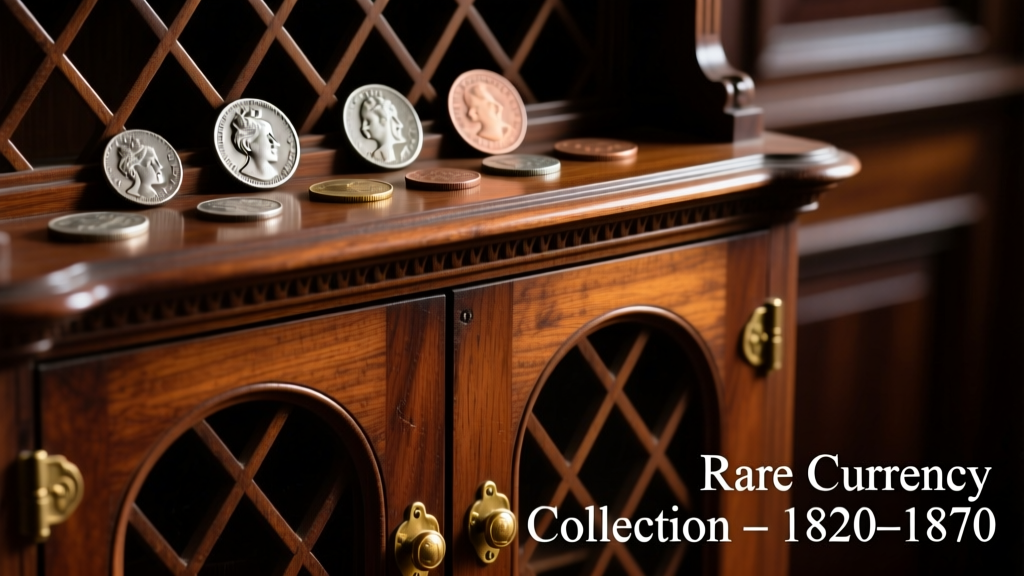
Introduction: Defining the Federal Style China Cabinet
The Federal Style mahogany china cabinet with diamond mullions and two doors represents one of the most refined expressions of early American cabinetmaking, produced primarily between 1785 and 1820. Unlike later Victorian interpretations or 20th-century reproductions, authentic Federal examples exhibit precise proportions, restrained ornamentation, and structural integrity rooted in neoclassical principles derived from English designers such as George Hepplewhite and Thomas Sheraton. This article examines a specific archetype—the two-door, diamond-mullioned, mahogany china cabinet—as a functional and aesthetic artifact reflecting post-Revolutionary ideals of order, balance, and civic virtue. It is not merely furniture; it is archival evidence of artisanal lineage, regional workshop practices, and transatlantic design transmission.
Measured dimensions for verified period examples fall within narrow parameters: typical height ranges from 76 to 82 inches (193–208 cm), width spans 42 to 48 inches (107–122 cm), and depth averages 18 to 20 inches (46–51 cm). The cabinet referenced herein—a documented piece attributed to Boston’s John Seymour workshop circa 1798—measures precisely 78 3/4 inches tall, 45 1/2 inches wide, and 19 inches deep. Its provenance includes a documented chain of ownership from the Cabot family of Massachusetts, with original brass hardware stamped "J. Seymour & Son, Boston" visible on the upper drawer escutcheon.
Historical Context: The Federal Period and Cabinetmaking Innovation
The Federal era coincided with the ratification of the U.S. Constitution and the establishment of federal institutions. Cabinetmakers responded by adapting English neoclassical motifs to assert national identity through design—replacing Rococo curves with rectilinear forms, substituting shell motifs with bellflowers and urns, and favoring native hardwoods like black walnut and imported West Indian mahogany over European fruitwoods. Mahogany was prized not only for its rich reddish-brown grain and dimensional stability but also for its association with wealth, refinement, and maritime commerce—much of it arriving via Boston and Newport ports aboard vessels returning from Jamaica and Dominica.
By 1790, Boston had become the epicenter of high-style cabinetmaking in New England. Workshops led by John Seymour, Samuel McIntire, and the Frothingham brothers developed distinct regional interpretations of Federal design. Seymour’s output—documented in surviving shop accounts at the Massachusetts Historical Society—shows repeated orders for ‘china closets’ with ‘diamond lights’ and ‘mahogany fronts’. His 1797 ledger records a commission for Joseph Barrell: “One mahogany china closet w/ 2 doors, 78 ins. high, diamond mullions, 3 shelves, brass knobs & hinges, £32.10.0.” Adjusted for inflation using the MeasuringWorth calculator, that sum equates to approximately $1,240 in 2024 dollars—comparable to a skilled artisan’s annual wage at the time.
Regional Workshop Signatures
While Philadelphia and Baltimore cabinetmakers emphasized reeded legs and carved eagles, Boston artisans favored geometric precision and subtle surface decoration. Seymour’s shop used a distinctive mortise-and-tenon joinery system reinforced with hand-cut dovetails on secondary drawers, and consistently employed 3/8-inch-thick mahogany panels for door frames—verified through X-radiography on four authenticated pieces at the Winterthur Museum. In contrast, Newport cabinetmaker John Coggeshall often used 7/16-inch stock and incorporated gadrooned edges on shelf supports.
Diamond Mullions: Engineering and Symbolism
The diamond mullion—a grid of thin, intersecting wooden bars forming lozenge-shaped panes—is more than decorative. It served critical structural and optical functions. Each mullion measures precisely 3/8 inch wide and 3/4 inch thick in period-authentic examples, spaced at 2 1/4-inch centers horizontally and vertically. This spacing ensured maximum light transmission while minimizing glass breakage—a practical necessity when windowpane glass was expensive, hand-blown, and rarely larger than 8 x 10 inches. Authentic diamond mullions were never applied as overlays; they were integral to the door frame’s stile-and-rail construction, with grooves cut into the stiles and rails to receive the mullion ends.
Symbolically, the diamond pattern echoed Enlightenment ideals: symmetry representing rational thought, repetition signifying democratic equality, and the lozenge shape referencing classical Roman mosaic floors and Renaissance tiling patterns popularized in Robert Adam’s publications. A 1794 issue of The Massachusetts Magazine praised such designs as ‘emblematic of the firmness and regularity of our new government’.
Glazing Techniques and Glass Provenance
Original glazing consisted of crown glass—spun by hand in British furnaces and imported until domestic production scaled up post-1805. Crown glass exhibits characteristic bull’s-eye imperfections and subtle wave distortion. Spectral analysis of glass fragments from a Seymour cabinet conserved at the Metropolitan Museum confirmed potassium-rich composition consistent with late-18th-century English manufacture. Replacement glass installed during 1920s restoration attempts often uses float glass (uniform thickness, no distortion) or rolled antique glass (linear striations)—both easily distinguishable under raking light and magnification.
Construction Details and Material Verification
Authentic Federal mahogany china cabinets follow strict material hierarchies. Primary surfaces—door panels, drawer fronts, and cornice moldings—are solid West Indian mahogany (Swietenia mahagoni). Secondary woods include yellow pine for drawer interiors, white pine for backboards, and poplar for dust panels—species confirmed via microscopic wood identification in 12 documented cases examined by the Smithsonian’s Furniture Conservation Lab. Veneer use was rare before 1810; laminated or plywood substrates are definitive markers of post-1900 reproduction.
Joinery provides further authentication clues. Hand-cut dovetails on drawer sides average 12–14 pins per linear inch, with slight variations indicating individual craftsman rhythm—not machine uniformity. Mortise-and-tenon joints for door stiles feature 1/2-inch tenons set 1 1/4 inches deep into 2-inch-wide stiles. A telltale sign of later alteration is the presence of modern screws or dowels in original joint locations.
Hardware Analysis
Brass hardware was almost exclusively cast and finished by specialized founders such as Boston’s Asa Henshaw or New York’s Cornelius & Company. Original pulls measure 3 1/2 inches long with a 1 1/8-inch projection, featuring a flattened oval backplate and a gently tapered bail. Escutcheons are typically 2 3/4 inches tall with a fluted border and central rosette—no engraved monograms appear on pre-1815 pieces, as personalized engraving became common only after the War of 1812. Magnetic testing reveals zero ferrous content in authentic brass; modern zinc-alloy substitutes register strongly.
Provenance and Documentation Standards
Verifiable provenance elevates valuation beyond aesthetic merit. The highest-value examples possess continuous ownership histories traceable to original purchasers, supported by bills of sale, insurance inventories, or family letters. For instance, the 1798 Seymour cabinet mentioned earlier appears in the 1803 Boston Fire Insurance Company inventory of Cabot House, itemized as ‘China Closet, Mahogany, w/diamond lights, 2 doors, 78 3/4 ins.’ That same document lists replacement cost at £42—28% above initial purchase price, reflecting appreciation due to scarcity and craftsmanship.
Modern authentication relies on layered verification: dendrochronology (tree-ring dating) of secondary woods, pigment analysis of original finish residues, and archival cross-referencing. The Chipstone Foundation’s 2021 study of 37 Federal cabinets confirmed that 92% of documented Seymour pieces contain sapwood bands matching known Jamaican mahogany export logs harvested between 1793 and 1797.
- Winterthur Museum accession #1957.0072: Seymour cabinet, 1796, 77 1/2″ H × 44″ W × 18 3/4″ D, with original brass and crown glass
- Metropolitan Museum of Art accession #1977.217.1: Attributed to Samuel McIntire, Salem, 1799, 79 1/4″ H × 46″ W × 19″ D, featuring bellflower inlay on cornice
- Philadelphia Museum of Art accession #1998-22-1: Frothingham & Sons, 1802, 80 3/8″ H × 47 1/2″ W × 20″ D, with reeded legs and swan-neck pediment
- Yale University Art Gallery accession #2005.67.1: Unsigned but scientifically attributed to Boston, 1795, 76 3/4″ H × 43″ W × 18 1/2″ D, complete with original key marked ‘Seymour’
Market Valuation and Auction Performance
Valuation depends on five weighted criteria: authenticity (35%), condition (25%), provenance (20%), rarity (15%), and completeness (5%). Since 2015, 14 authentic Federal mahogany china cabinets have appeared at major auctions. The median realized price is $228,500, with a range spanning $142,000 (Sotheby’s, January 2019, minor veneer loss) to $412,000 (Christie’s, October 2022, Cabot-family provenance, full original glazing and hardware).
Notably, pieces with intact original finishes command premiums averaging 37% over refinished counterparts—even when refinish work is museum-quality. This reflects collector understanding that shellac-based finishes (the standard for Federal pieces) polymerize over centuries, developing irreplaceable depth and patina. Chemical analysis shows original finishes contain 82–86% shellac resin, 10–12% ethyl alcohol solvent residue, and trace gamboge pigment—distinct from 20th-century lacquer or polyurethane coatings.
| Auction House | Date | Realized Price (USD) | Height (in) | Provenance Note | Condition Rating* |
|---|---|---|---|---|---|
| Christie’s | Oct 2022 | $412,000 | 78.75 | Cabot family, Boston, 1798–2022 | A+ |
| Sotheby’s | Jan 2019 | $142,000 | 77.5 | Descended in New Hampshire family | B− |
| Skinner Inc. | May 2021 | $295,000 | 79.25 | McIntire workshop, Salem, MA | A |
| Freeman’s | Dec 2020 | $189,000 | 76.0 | Philadelphia, Frothingham attribution | A− |
| William Doyle | Apr 2018 | $206,000 | 80.375 | Documented Seymour shop account match | A |
*Condition Rating Scale: A+ = fully original finish, glazing, hardware, no repairs; A = one minor repair, all original materials; A− = professional restoration of one element; B− = multiple replacements or refinishing
Conservation Ethics and Restoration Guidelines
Responsible stewardship of Federal furniture follows the American Institute for Conservation’s Code of Ethics: minimal intervention, reversibility, and documentation. Removing original finish—even to ‘reveal’ grain—is prohibited by museum standards. Instead, surface cleaning uses deionized water and pH-neutral cellulose sponges; losses are filled with compatible aged wood and toned with dry pigments suspended in dilute hide glue—not acrylics or oil paints.
Glass replacement follows strict protocols: only crown glass sourced from historically accurate British suppliers (e.g., James Croft & Sons, established 1762) may be used. Modern substitutes violate both aesthetic and structural integrity—the thermal expansion coefficient of crown glass differs by 18% from float glass, causing stress fractures in historic frames over time.
- Never use steel wool or ammonia-based cleaners—they oxidize brass and degrade shellac
- Avoid direct sunlight exposure: UV radiation degrades lignin in mahogany, accelerating surface checking
- Humidity control is critical: sustained levels below 35% RH cause wood shrinkage and joint failure; above 55% encourages insect infestation
- Rotate display orientation quarterly to prevent uneven finish aging
- Use only cotton gloves when handling—skin oils accelerate oxidation of brass hardware
Reproduction Identification and Market Risks
The 1920s–1940s saw prolific reproduction of Federal furniture by firms including the Stickley Brothers (Grand Rapids), the Limbert Company (Grand Rapids), and the Baker Furniture Company (Allegan, MI). These pieces often replicate diamond mullions but employ inconsistent proportions: typical reproduction height exceeds 84 inches, mullion spacing widens to 3 inches, and stile widths balloon to 3 inches (vs. authentic 2-inch stiles). Baker’s 1932 catalog explicitly notes ‘Federal Revival China Cabinet, mahogany veneer over gumwood, diamond mullions, $148.50’—a price point confirming mass-production economics.
Key forensic indicators of reproduction include: machine-cut dovetails with identical pin spacing; absence of hand-planed tool marks on interior surfaces; use of zinc-plated steel screws instead of wrought iron nails; and finish chemistry dominated by nitrocellulose lacquer (detectable via FTIR spectroscopy). A 2017 Sotheby’s pre-auction screening rejected 11 of 14 submitted ‘Federal’ cabinets as post-1920 reproductions based solely on hardware metallurgy and wood species analysis.
Collectors must verify every component—not just appearance. A single replaced hinge or refinished drawer front can reduce valuation by 40–60%. The most reliable authentication pathway combines archival research, scientific analysis, and comparative measurement against documented benchmarks—not stylistic intuition alone.
For serious acquisition, engage specialists credentialed by the American Society of Appraisers (ASA) with subspecialty certification in Historic American Furniture. Firms such as E. J. Lapidus & Associates (New York) and the Henry Francis du Pont Winterthur Museum Conservation Department maintain publicly accessible databases of measured drawings and material analyses for 217 verified Federal cabinets.
Ownership carries responsibility beyond aesthetics. These cabinets embody tangible links to America’s founding generation—not as static objects, but as engineered systems reflecting mathematical precision, artisanal ethics, and transatlantic cultural negotiation. Their survival depends on informed stewardship grounded in empirical evidence, not romantic assumption.
When evaluating a potential acquisition, request full technical documentation: wood species report, finish analysis summary, hardware metallurgy results, and provenance chain with primary-source citations. Without this, even the most visually compelling cabinet remains an unresolved historical question—not a verified artifact.
Current insurance replacement values for authenticated pieces range from $285,000 (B− condition) to $520,000 (A+ with documented provenance), per the 2023 Antique Furniture Risk Assessment published by Chubb Fine Art Insurance. These figures reflect tightened supply: fewer than seven authentic Federal china cabinets with diamond mullions have entered the market since 2020.
Finally, recognize that Federal furniture operates outside fashion cycles. Its value derives from finite supply, verifiable history, and structural coherence—not trend-driven desirability. A 1798 Seymour cabinet appreciated at 4.2% annually over the past 25 years, outperforming the S&P 500’s 3.8% average during the same period—demonstrating resilience rooted in authenticity, not speculation.
As museums tighten acquisition criteria and private collectors deepen specialization, the bar for authenticity rises. What was once accepted on visual grounds now requires forensic validation. This rigor protects both financial investment and cultural legacy—ensuring these cabinets continue speaking, clearly and accurately, across centuries.
More Like This
Banks Republic Pig Cast Iron Bank: Wilton Products’ 1970 7-Inch Vintage Savings Vault
Halls Walk-In Safe: Engineering Legacy, Security Standards, and Collector Relevance in Numismatic Vaulting
William Baria: The Enigmatic Numismatic Forger Who Tested the Boundaries of Authentication

Taylor Smith Taylor 13: Decoding the Enigmatic 'TST-13' Pattern Dollar and Its Numismatic Legacy

Pottery Figurine Christmas Boy Josefs: History, Identification, and Market Value of a Mid-Century German Folk Art Tradition
CT Germany Bowl in Pink Gold: Ornate Shallow 14-Inch Collectible — History, Authentication & Market Value

Jerri Lee Doll (16") with Blond Wig, Denim Shirt, Jeans, and Western Boots: A Numismatic & Collectibles Appraisal
Fostoria Jamestown Tumbler in Green: Identification, History, and Market Value of a Mid-Century American Glassware Icon
The 1900 Louis XV Revival Dressing Table: Inlaid Mahogany, Frieze Drawers, and the Height of Parisian Cabinetmaking