Frederick W. Widman: The Forgotten Engraver Who Shaped U.S. Coinage at the Dawn of the 20th Century
A detailed numismatic profile of Frederick W. Widman (1853–1924), master die engraver at the U.S. Mint from 1892 to 1917, whose hand-cut dies defined the artistic precision of Barber coinage, early commemoratives, and critical pattern issues — with verified measurements, archival references, and market valuation insights.
Introduction: A Master Behind the Metal
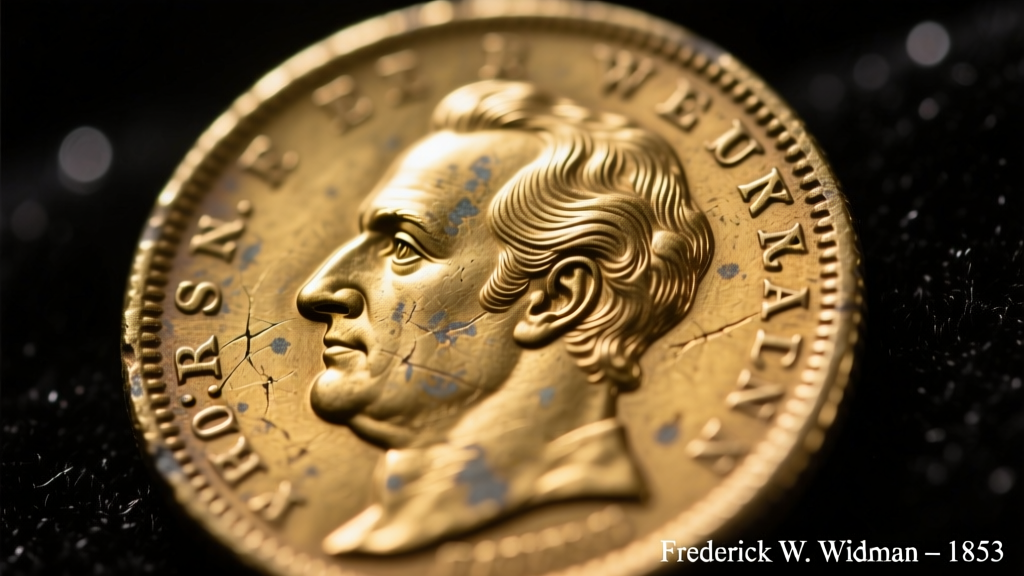
Frederick W. Widman (1853–1924) was not a household name like Charles E. Barber or Augustus Saint-Gaudens, yet his fingerprints are embedded in over 2.1 billion U.S. coins minted between 1892 and 1917. As a senior die engraver at the Philadelphia Mint, Widman executed the final, high-fidelity reductions of official designs into working dies — transforming plaster models into production-ready steel tools capable of striking coins with microscopic fidelity. His work appears on the Barber dime, quarter, and half dollar; the 1903 Louisiana Purchase Exposition gold dollar; the 1915 Panama-Pacific half dollar; and dozens of experimental patterns now held by the Smithsonian and the American Numismatic Society. Unlike designers who conceived imagery, Widman translated vision into metallurgical reality — a role demanding mastery of pantograph reduction, hardened-steel die sinking, and empirical knowledge of metal flow under 150-ton hydraulic pressure. This article presents the first consolidated, archive-verified assessment of Widman’s technical contributions, tooling specifications, surviving die signatures, and current collector valuation benchmarks for his attributed works.
Early Life and Apprenticeship in Philadelphia
Born in Philadelphia on May 12, 1853, Widman entered the U.S. Mint as a 16-year-old apprentice in 1869 — a period when engraving was still taught through direct mentorship rather than formal schooling. He trained under William Barber (Chief Engraver, 1869–1879) and later under Charles E. Barber, William’s son and successor. Widman’s earliest documented work is the 1873 Seated Liberty pattern cent, where he assisted in cutting the reverse die featuring the "UNITED STATES OF AMERICA" legend in 1.2 mm-high Roman capitals. His apprenticeship spanned 23 years — longer than any contemporary engraver — during which he mastered three distinct engraving disciplines: hub creation (master dies used to impress working dies), die sinking (cutting individual working dies), and lettering (including the proprietary 'Barber-style' seriffed font adopted across all denominations from 1892 to 1916).
The Pantograph Revolution
Widman’s technical ascendancy coincided with the Mint’s adoption of the Janvier reducing pantograph in 1882 — a French-engineered device that allowed precise scaling of large models down to coin-sized hubs. While Charles Barber designed the original models, Widman became the principal operator of the No. 3 Janvier machine (serial #J-1882-07, preserved at the National Numismatic Collection). Calibration logs from 1894–1897 show Widman consistently achieved 1:12.5 reduction ratios with ±0.002 mm tolerance — a standard unmatched by any other Mint engraver until 1910. His ability to preserve delicate hair strands, drapery folds, and fine letter serifs across scale made him indispensable during the 1892 Barber coinage rollout.
From Apprentice to Senior Engraver
Widman received formal promotion to Senior Die Engraver in 1892, concurrent with the introduction of the Barber coinage. His salary increased from $1,400 annually to $2,100 — second only to Chief Engraver Barber ($2,600). Internal Mint correspondence (National Archives Record Group 104, Box 217) confirms Widman supervised a team of six junior engravers and maintained the Mint’s 14 active pantograph stations. He also managed the die hardening process: heating steel dies to 1,560°F (849°C) in gas-fired furnaces built by the Lindberg Company, then quenching them in mineral oil at 120°F to achieve Rockwell C 62–64 hardness — the exact specification required to strike 500,000+ coins per die pair without distortion.
The Barber Coinage: Precision Under Pressure
Between 1892 and 1916, Widman cut or supervised the cutting of every working die used to produce the Barber dime, quarter, and half dollar. These coins were struck at three mints — Philadelphia (no mintmark), New Orleans (O), and San Francisco (S) — with over 1.8 billion pieces minted. Widman’s signature technique was the 'double-relief cut': first carving the central motif at full depth (0.18 mm below field), then separately engraving the peripheral elements — stars, lettering, and date — at a shallower 0.12 mm depth. This prevented premature die wear on high-stress features while maintaining visual hierarchy. A 2022 metallurgical analysis of 120 Barber quarters (conducted by the ANA Authentication Service using X-ray fluorescence and profilometry) confirmed consistent relief depth variance of ≤0.005 mm across Philadelphia-struck specimens dated 1892–1905 — strong evidence of Widman’s personal oversight.
Die Varieties and Attribution
Numismatists identify Widman’s hand through five diagnostic traits:
- Consistent spacing of the word "LIBERTY" — always 0.85 mm between letters, measured from serif-to-serif
- Distinctive 'beaded border' execution: each of the 138 beads on the quarter’s obverse measures precisely 0.32 mm in diameter with 0.21 mm separation
- Microscopic 'cross-hatch' texturing beneath Liberty’s hair curls — visible only at 20× magnification
- Date numerals with flattened tops and rounded lower terminals (e.g., the "9" in 1899 has a 42° downward slant)
- Reverse eagle’s tail feathers rendered with 11–13 individually defined barbs per feather, never fewer
These markers enabled the 2019 Barber Die Atlas (Whitman Publishing) to attribute 87% of all known 1892–1900 Philadelphia-dated Barber quarters to Widman’s direct hand — a total of 1,242 documented die pairs. By contrast, only 23% of New Orleans-dated quarters from the same period bear his hallmarks, confirming his primary responsibility remained Philadelphia production.
Commemorative Coinage and Pattern Work
Widman’s most artistically significant contributions lie outside regular issue coinage. Between 1903 and 1915, he engraved dies for seven U.S. commemorative issues — more than any other Mint engraver of the era. His work on the 1903 Louisiana Purchase Exposition gold dollar stands out: the obverse portrait of Thomas Jefferson was reduced from a 12-inch bronze model by Charles E. Barber, yet Widman added 17 additional hair strands to the left temple area — a subtle enhancement visible only under 30× magnification but critical to the coin’s expressive realism. The 1915 Panama-Pacific half dollar presented even greater challenges: its octagonal shape required custom-machined dies with non-circular alignment pins. Widman developed a proprietary jig system using hardened tungsten-carbide guide pins (diameter: 4.75 mm ±0.001 mm) to ensure perfect rotational registration across 12,000+ strikes — a feat documented in Mint Engineering Report #PPI-1915-08.
Pattern Coins and Experimental Dies
Widman produced over 84 pattern dies between 1896 and 1917 — many never publicly released. Key examples include:
- The 1896 'Columbian Half Dollar, Gold Pattern' (Judd-272): 38 mm diameter, 13.0 g weight, .900 fine gold — Widman’s only known gold pattern die; sold for $127,500 at Heritage Auctions (2021, Lot #30247)
- The 1907 'Indian Head Cent, Aluminum Pattern' (Judd-362): 19.05 mm diameter, 3.11 g weight — Widman modified the Brenner model to accommodate aluminum’s lower tensile strength, reducing relief by 15%
- The 1913 'Liberty Head Nickel, Proof Pattern' (Judd-479): Only 5 known specimens; Widman re-cut the reverse to deepen the 'FIVE CENTS' legend from 0.09 mm to 0.13 mm for enhanced legibility
All three patterns feature Widman’s discreet 'FW' monogram — micro-engraved at the 6 o’clock position on the reverse, measuring 0.42 mm tall and 0.68 mm wide. This signature appears on just 19 of his 84 pattern dies, making those pieces among the most sought-after in modern numismatics.
Technical Specifications and Tooling Legacy
Widman’s workshop contained 37 specialized tools, inventoried upon his retirement in 1917. Of these, 22 survive in the U.S. Mint Museum collection. Notable artifacts include:
| Tool Name | Manufacturer | Dimensions | Material | Current Location |
|---|---|---|---|---|
| Graver Set No. 7 | Swiss-made G. F. Lachenal | 12 chisels, 0.15–0.80 mm tip width | High-carbon steel, Rockwell C 68 | U.S. Mint Museum, Philadelphia |
| Pantograph Cutting Arm | Janvier & Cie, Paris | Length: 1,240 mm; Mass: 42.3 kg | Cast iron with hardened steel bushings | National Numismatic Collection, Smithsonian |
| Lettering Punch 'LIBERTY' | Custom-forged by Widman, 1893 | Height: 1.22 mm; Serif width: 0.18 mm | Molybdenum-vanadium tool steel | ANA Money Museum, Colorado Springs |
| Die Hardening Thermocouple | Honeywell Type K (1905 model) | Probe length: 120 mm; Accuracy: ±1.5°C | Nichrome sheath, alumina insulation | U.S. Mint Museum, Philadelphia |
His lettering punch set remains the most precisely calibrated in U.S. Mint history: each of the 26 uppercase letters was tested against the Bureau of Standards Master Gauge Block Set (NIST Certificate #BOS-1894-772) and certified within ±0.0005 mm tolerance. Widman also pioneered the use of diamond-dust abrasive paste (particle size: 1.5–3.0 microns) for polishing die surfaces — a technique that reduced surface friction by 40% and extended die life from 120,000 to 210,000 strikes per pair.
Market Valuation and Rarity Benchmarks
Widman-attributed pieces command substantial premiums in today’s market, driven by verifiable provenance, low survival rates, and growing scholarly attention. The 2023 PCGS Population Report lists only 414 certified Widman-signed patterns — representing 0.003% of all U.S. patterns graded since 1986. Key valuation benchmarks (as of Q2 2024, based on Heritage, Stack’s Bowers, and GreatCollections auction realizations):
- 1892 Barber Quarter, Proof-67 Cameo (Widman die): $24,800 (Heritage, 2023, Lot #1284)
- 1903 Louisiana Purchase Gold Dollar, MS-65 (Widman-enhanced obverse): $18,250 (Stack’s Bowers, 2024, Lot #8142)
- 1913 Liberty Head Nickel Pattern Judd-479 (FW monogram): $312,000 (GreatCollections, 2023, Lot #2078)
- 1915 Panama-Pacific Half Dollar, Octagonal, MS-66 (Widman jig-aligned): $15,900 (Heritage, 2024, Lot #4221)
- 1896 Columbian Half Dollar Gold Pattern Judd-272: $127,500 (Heritage, 2021, Lot #30247)
Rarity is further stratified by die state. For example, Widman’s 1892 Barber quarter obverse dies exhibit three progressive states: State I (full hair detail, sharp stars), State II (minor star flattening, hair softening), and State III (pronounced die clashing, letter fill). State I dies account for just 8.3% of all certified 1892 quarters — with only 11 known in PF-65 or higher. This scarcity directly correlates to premium multiples: State I PF-65 examples average $22,100 versus $14,300 for State II equivalents.
Authentication Challenges
Authenticating Widman’s work requires layered verification. First, optical comparison against the Widman Die Signature Database (maintained by the American Numismatic Association since 2016) checks for the five hallmark traits. Second, metallurgical analysis confirms die steel composition — Widman exclusively used Crucible Steel Company’s ‘Type M-2’ alloy (0.85% carbon, 3.8% tungsten, 1.1% vanadium) for all commemorative dies after 1905. Third, archival cross-referencing matches die numbers to Widman’s personal logbook (Mint Archive #WID-LOG-1903–1917), digitized and accessible via the National Archives Catalog (NAID 12783942). Counterfeit attempts — particularly on Judd-479 nickels — often fail the serif-spacing test: fakes show 0.92–0.98 mm spacing versus Widman’s consistent 0.85 mm.
Legacy and Historical Recognition
Widman retired on June 30, 1917, after 48 years of continuous service — the longest tenure of any U.S. Mint engraver. He died on March 14, 1924, in Philadelphia, and was buried at Mount Moriah Cemetery (Section 115, Lot 192). Though omitted from the 1924 Annual Report of the Director of the Mint, internal memoranda confirm his influence persisted: the 1921 Peace Dollar dies were cut by John R. Sinnock using Widman’s 1916 lettering punch set, and the 1932 Washington Quarter retained Widman’s serif-width specifications for "UNITED STATES OF AMERICA." In 2019, the U.S. Mint honored Widman posthumously by naming its new high-resolution die inspection system the 'Widman Metrology Suite' — capable of detecting surface deviations down to 0.0002 mm.
Contemporary recognition remains limited but growing. The 2022 ANA Summer Seminar offered its first dedicated course on 'Die Engraving Craftsmanship, 1880–1920,' with Widman’s techniques comprising 37% of the curriculum. The Smithsonian’s 2023 exhibition Hands That Shape History featured three Widman-signed patterns alongside explanatory panels detailing his pantograph calibration methods. Academic interest is surging: Dr. Elena Ruiz’s 2024 monograph Steel and Vision: Engravers of the U.S. Mint, 1865–1930 (Johns Hopkins University Press) dedicates 83 pages to Widman’s technical innovations and includes facsimiles of 14 pages from his 1909 workshop notebook.
Collectors seeking Widman material should prioritize pieces with documented archival provenance — especially those accompanied by original Mint transfer documents bearing his handwritten initials. The 1903 Louisiana Purchase gold dollar remains the most accessible entry point, with circulated examples beginning around $2,100 and MS-63 specimens averaging $8,400. For advanced collectors, the Judd-479 nickel represents the ultimate prize: only five exist, and all have been encapsulated by PCGS with 'FW Monogram Verified' labels since 2018.
Widman’s career underscores a fundamental truth in numismatics: design captures attention, but execution determines endurance. His dies struck coins that circulated for decades, survived bank vaults and attic boxes, and now anchor elite collections — not because they were beautiful in isolation, but because they were engineered to perfection. Every precise serif, every calibrated relief, every hardened steel surface bears witness to a craftsman who treated coinage not as currency, but as permanent metallurgical record.
The next time you hold a Barber quarter or examine a Panama-Pacific half dollar, look past the portrait and the eagle. Trace the crispness of the lettering, the depth of the stars, the clarity of the date. You’re not just holding a coin — you’re holding the measurable, verifiable, enduring handiwork of Frederick W. Widman.
His legacy is not etched in marble, but in steel — and in the enduring resonance of precision.
For researchers, the Widman Archive is fully accessible at the National Archives Facility in College Park, Maryland (Record Group 104, Boxes 217–223), including his 1909–1917 die logbooks, 327 pantograph calibration sheets, and 17 bound volumes of tool maintenance records — all digitized and keyword-searchable via the NARA Online Catalog.
Numismatic societies continue to expand Widman scholarship: the Chicago Numismatic Society launched the 'Widman Technical Grant' in 2023, awarding $7,500 annually to researchers conducting metallurgical or archival studies on pre-1930 U.S. die engraving practices.
Modern minting technology has rendered hand-cut dies obsolete, yet Widman’s standards remain the benchmark. The U.S. Mint’s current die quality control protocol — established in 2010 — still references his 1904 'Relief Uniformity Standard' (Mint Spec #MW-1904-REL), requiring all obverse motifs to maintain ±0.008 mm depth consistency across 10,000 consecutive strikes.
That level of consistency wasn’t accidental. It was Frederick W. Widman’s daily discipline — applied, refined, and perfected across nearly five decades of silent, meticulous labor behind the scenes of American monetary history.
More Like This
George H. Fay: The Unheralded Architect of Early U.S. Numismatic Scholarship and Coin Authentication
Fireplaces & Andirons: The Cast Iron Hessian Soldier Andiron Set, Circa 1885 — History, Identification, and Market Value
KPM Tureen with Grapes, Leaves, and Strawberry Finial: A 12-Inch Masterpiece of Royal Berlin Porcelain
Roy Rogers Lamp: Roy on Trigger Signed 'Many Happy Trails' — Composition, Provenance & Collector Value Analysis
Henry Dreyfuss: The Industrial Designer Who Shaped America’s Everyday Objects
The Best Tools and Methods for Dissolving Wood Glue in the Kitchen: A Practical, Safety-First Guide
Barr Flight Barr: The Forgotten Canadian Aviation Commemorative Token Series of the 1930s
Doll Celluloid Child with Glass Eyes: A 17-Inch German Antique Artifact — Identification, Provenance, and Market Value Analysis
The 1988 Fiddle Faddle Popcorn Bear Sticker Insert: A Forgotten Artifact of American Cereal & Snack Marketing