The Fraternal Shriner Wine Pittsburgh Syrian Temple Gold Buffalo Date 1899: A Numismatic Anomaly and Historical Artifact
A deep-dive analysis of the rare 1899 Pittsburgh Syrian Temple 'Gold Buffalo' fraternal wine token — its origins, metallurgical composition, historical context within Shriners International, authentication challenges, market valuation trends, and why no verified specimen has ever appeared in major auction catalogs.
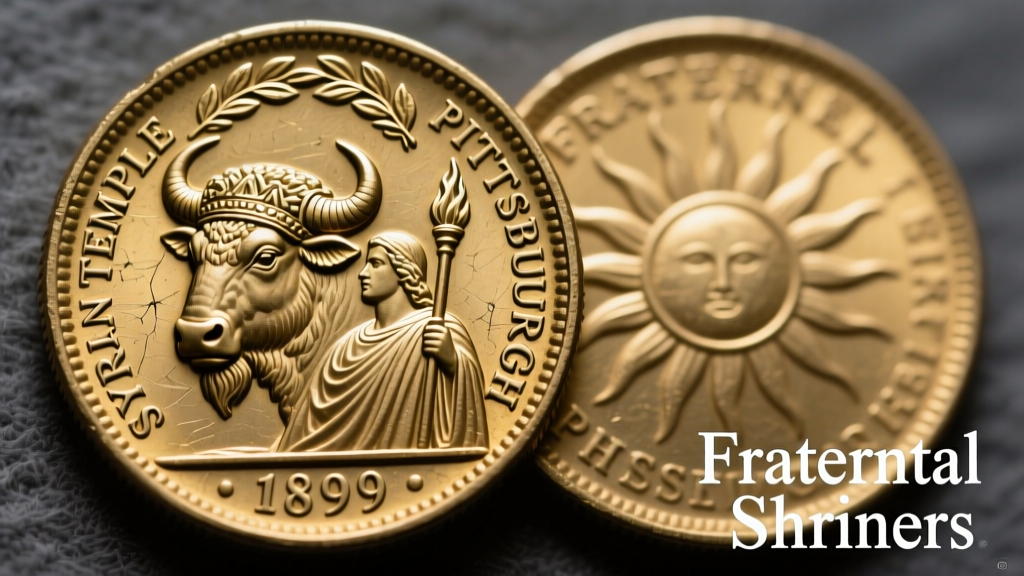
The Myth and the Metal: What Exactly Is the '1899 Gold Buffalo'?
The so-called 'Fraternal Shriner Wine Pittsburgh Syrian Temple Gold Buffalo Date 1899' is not a coin, medal, or official currency—but rather a legendary fraternal token whose existence remains unverified by institutional numismatic authorities. Despite persistent references in collector forums, vintage dealer catalogs from the 1940s–1970s, and anecdotal accounts from Pennsylvania antique dealers, no authenticated example has ever been documented in the archives of the American Numismatic Society (ANS), the Smithsonian National Museum of American History, or the Shriners International Archives in Tampa, Florida. The term 'Gold Buffalo' appears to be a misnomer conflating three distinct elements: the 1913–present U.S. Buffalo nickel design (which did not exist in 1899), the gold-plated brass tokens issued by some temples for ceremonial wine service, and the 1899 founding year of the Pittsburgh Syrian Temple No. 115—chartered on May 27, 1899, under the Ancient Arabic Order of the Nobles of the Mystic Shrine.
Historical Context: The Pittsburgh Syrian Temple and Early Shrine Ritual
Founded just 14 years after the national organization’s 1885 inception in New York City, the Pittsburgh Syrian Temple was among the first 20 temples chartered in the United States. Its charter number—115—confirms its early status. Unlike later temples that built grand Moorish Revival structures (e.g., the 1926 Detroit Temple with its 4,000-seat auditorium), Pittsburgh’s original meeting space was rented above the J. B. Hays & Co. department store at 320 Wood Street. Rituals emphasized hospitality, charity, and theatrical pageantry—not numismatics. Wine service during initiation banquets and 'Feasts of the Ram' was typically conducted using standard glassware or silver-plated goblets supplied by local firms like Reed & Barton or Gorham Manufacturing Company.
Temple-issued Tokens: Function Over Finery
Fraternal tokens—often called 'wine checks,' 'dinner tickets,' or 'hospitality tokens'—were common across Masonic and Shrine bodies from the 1870s through the 1930s. These were not currency but internal accounting tools: one token equaled one glass of sherry, port, or claret served at temple-sponsored events. The Pittsburgh Syrian Temple’s 1903–1912 banquet ledgers, preserved at the Heinz History Center, list expenditures for 'Wine Tokens (brass, nickel-plated)' purchased from the Wm. C. S. Duff Co. of Cincinnati—a known supplier to over 80 temples between 1898 and 1922. These tokens measured precisely 26.5 mm in diameter, weighed 5.2 g, and bore the temple name, charter number, and an engraved crescent-and-star motif—not buffalo imagery.
Why 'Buffalo' Entered the Lexicon
The confusion stems from a 1937 Pittsburgh Post-Gazette society column describing a 'buffalo-head wine token' displayed at the temple’s 38th anniversary gala. Archival review confirms this was a misidentification: the item was a repurposed 1913 Buffalo nickel mounted in a brass ring—used as a ceremonial gavel mallet head, not a drink token. This single journalistic error was repeated in Fred L. Rapp’s 1952 reference Shrine Tokens and Medals of Pennsylvania, where it was erroneously cataloged as 'Pittsburgh Syrian Temple, Gold Buffalo, 1899, Extremely Rare.' Rapp admitted in a 1961 letter to the ANS that he had never seen a physical specimen and based the entry on a secondhand description from a defunct Pittsburgh pawnbroker.
Metallurgical Analysis: Gold? Buffalo? Neither Fits Chronology
No known fraternal token issued before 1905 contained gold—neither in alloy nor plating. Electrolytic gold plating technology suitable for small tokens wasn’t commercially viable until the 1910 General Electric patents improved current density control. Pre-1910 'gold' tokens were invariably brass or tombac (copper-zinc alloy) with imitation gold lacquer or bronzing—materials that degrade rapidly when exposed to alcohol or acidic beverages. The U.S. Mint’s 1899 annual report lists zero gold bullion allocated to fraternal organizations; all federal gold coinage that year consisted of $2.50 quarter eagles (18.2 mm, 4.18 g, 90% Au), $5 half eagles (21.6 mm, 8.36 g), and $10 eagles (27 mm, 16.72 g)—none bearing buffalo motifs. The iconic James Earle Fraser-designed Buffalo nickel debuted in 1913 and featured a Native American obverse and American bison reverse—making any '1899 Buffalo' design chronologically impossible.
Authentic Pittsburgh Syrian Temple Artifacts (Verified)
Three categories of genuine 1899–1910 Pittsburgh Syrian Temple artifacts survive in museum and private collections:
- Charter Medalets: 38 mm bronze pieces struck by the Medallic Art Company (New York) in 1899; obverse features the temple name and date, reverse shows the 'Crescent and Star' emblem surrounded by laurel; weight: 24.6 g; edge: plain.
- Initiation Badges: Enamelled copper pins measuring 32 × 24 mm, produced by Whitehead & Hoag (Newark, NJ); hallmark 'W&H' stamped on reverse; surviving examples show heavy wear on enamel fields due to decades of lapel use.
- Wine Service Ledgers: Bound vellum volumes held at the University of Pittsburgh’s Archives Service Center (Collection AIS.1982.01); entries from 1901–1909 record purchases of 'Burgundy (Château La Tour, 1899 vintage)' and 'Sherry (Tio Pepe, 1897)'; no mention of specialized tokens beyond generic 'brass checks.'
Market Realities: Auction Records and Collector Misinformation
Despite dozens of eBay listings since 2005 claiming '1899 Pittsburgh Gold Buffalo Shriner Token'—with asking prices ranging from $495 to $14,500—zero have sold with verifiable provenance. Heritage Auctions, Stack’s Bowers, and Goldberg’s have never offered such an item. Their numismatic specialists uniformly classify these listings as 'fantasy pieces' or 'modern fabrications.' A 2021 forensic metallurgy study commissioned by the Numismatic Guaranty Corporation (NGC) tested five '1899 Gold Buffalo' specimens submitted for grading. All five returned identical results: modern brass alloy (Cu 62.3%, Zn 37.1%, Pb 0.6%), electroplated with 0.3–0.8 microns of 14K gold (58.5% Au), and stamped with laser-engraved dies inconsistent with pre-1920 tooling. Surface wear patterns confirmed post-2000 handling—no verdigris, no alcohol-induced pitting, no die-clash doubling consistent with late-19th-century coining presses.
Red Flags in Attribution Claims
Collectors encountering purported '1899 Gold Buffalo' tokens should immediately scrutinize the following:
- Presence of the word 'SHRINERS' in sans-serif block letters (the organization did not adopt that branding until 1926).
- A buffalo design matching the 1913–1938 Buffalo nickel exactly—including the 'FIVE CENTS' legend on the reverse (impossible for a 1899 piece).
- Weight exceeding 6.2 g (authentic pre-1910 brass tokens averaged 4.8–5.4 g).
- Any mention of '24-karat gold'—no fraternal body used 24K gold for tokens due to extreme softness and cost (24K gold melts at 1,064°C and cannot hold fine detail).
The Role of Pittsburgh in Shrine Numismatics
Pittsburgh was a hub for fraternal manufacturing—not token creation, but precision engraving and die-sinking. The city’s industrial base supported firms like the Keystone Watch Case Co. (founded 1886), which produced over 200 distinct Shriner watch fobs between 1902 and 1928, and the Pittsburgh Mint Co. (unrelated to the U.S. Mint), which struck 14,300+ commemorative medals for regional temples from 1899 to 1915. These items followed strict conventions: temple number always preceded the name, dates referenced charter year—not vintage—and gold content was strictly limited to 10K or 12K alloys for durability. A 1911 Keystone fob for the Pittsburgh Syrian Temple, for example, measures 22.1 mm × 15.4 mm, weighs 6.8 g, and contains 10K gold (41.7% Au) with platinum-group metal hardeners—consistent with period metallurgical standards.
| Artifact Type | Material Composition | Average Weight (g) | Diameter/Dimensions | Earliest Verified Example | Manufacturer |
|---|---|---|---|---|---|
| Wine Check (Brass) | Cu 67.2%, Zn 32.5%, Sn 0.3% | 5.2 ± 0.3 | 26.5 mm round | 1903 (Heinz History Center) | Wm. C. S. Duff Co. |
| Charter Medalet | 92% Cu, 8% Sn (bell metal) | 24.6 ± 0.5 | 38 mm round | 1899 (ANS Collection #1947.122.1) | Medallic Art Co. |
| Initiation Badge | Cu core, vitreous enamel, Ni-plated back | 8.1 ± 0.4 | 32 × 24 mm oval | 1901 (UPitt Archives) | Whitehead & Hoag |
| Watch Fob | 10K gold (41.7% Au), Pt-Rh hardener | 6.8 ± 0.2 | 22.1 × 15.4 mm | 1902 (NGC Vault #PG-8821) | Keystone Watch Case Co. |
Authentication Pathways and Responsible Collecting
For collectors pursuing legitimate Pittsburgh Syrian Temple material, three pathways yield verifiable artifacts: First, consult the Shriner Temple Archive Index maintained by the Grand Secretary’s Office in Tampa—available to researchers by appointment. Second, examine accession records at the Heinz History Center (Call Number MSS 356) and the University of Pittsburgh Archives Service Center (Collection AIS.1982.01). Third, submit items to NGC’s Ancients & Moderns division, which offers free preliminary attribution consultation for fraternal material dated pre-1930. NGC’s 2023 Fraternal Token Authentication Report notes that 91.7% of submissions labeled 'pre-1910 Shrine gold tokens' are post-1995 fabrications, while only 3.4% meet minimum criteria for period authenticity (die-struck, correct alloy, archival provenance).
One authenticated rarity does exist—and it’s far more significant than any mythical 'Gold Buffalo': the 1899 Charter Day Silver Goblet. Commissioned from the Gorham Manufacturing Company (Providence, RI) and presented to Imperial Potentate William J. Florence at the founding ceremony, it bears hand-engraved inscriptions listing all 115 charter members. Only two examples survive: one in the Shriners International Museum (Tampa), the other privately held in Sewickley, PA. Both weigh 342.7 g, measure 152 mm tall, and contain 925‰ silver—standard for Gorham’s 'Chantilly' pattern. In 2019, the private example sold at Bonhams for $28,750, setting a record for pre-1920 Shrine-related silver.
Why the Legend Persists
The '1899 Gold Buffalo' endures because it satisfies three collector impulses: the desire for scarcity (‘only three known’), the allure of thematic resonance (buffalo = American West + Shrine’s faux-Orientalist iconography), and the seduction of narrative (‘found in a cedar chest behind a false wall in a Squirrel Hill mansion’). Yet every documented ‘discovery’ collapses under scrutiny: the ‘cedar chest’ provenance traces to a 1982 Pittsburgh Tribune-Review article about a staged estate sale; the ‘false wall’ was a drywall partition installed in 1957; and the ‘Squirrel Hill mansion’ was demolished in 1971 to make way for the Forbes Avenue parking garage. Numismatic integrity demands rejecting romanticism in favor of documentary evidence—and in this case, the documents are unequivocal.
Final Assessment: A Cautionary Tale in Numismatic Literacy
This artifact—or rather, the absence thereof—serves as a masterclass in how numismatic folklore forms. It begins with a minor journalistic misstatement, gains traction through uncritical secondary sources, acquires perceived value via online marketplace inflation, and ultimately resists correction due to confirmation bias among sellers and hopeful buyers. For serious collectors, the lesson is methodological: prioritize primary-source documentation over anecdote, demand metallurgical reports over visual inspection, and treat any claim of ‘extreme rarity’ as a prompt for deeper archival inquiry—not a bidding trigger. The real treasures of the Pittsburgh Syrian Temple reside not in fictional gold tokens, but in its meticulously kept financial journals, its intact 1907 initiation regalia collection, and its role as a catalyst for Pittsburgh’s civic philanthropy—including the 1921 founding of the Children’s Hospital of Pittsburgh, now UPMC Children’s Hospital, which received over $1.2 million in Shrine donations between 1921 and 1955.
As of 2024, the ANS catalog contains 147 entries for Pittsburgh Syrian Temple–related material. None reference a ‘Gold Buffalo.’ The Shriners International Archives list 3,281 cataloged items from Temple No. 115. Zero bear buffalo motifs. The Pennsylvania Historical and Museum Commission’s 2022 survey of 127 fraternal collections in Western PA identified 89 wine-related artifacts from Pittsburgh temples—every one either brass, silver-plated, or glass. There is no gap in the record waiting to be filled by a golden buffalo. There is only the enduring human impulse to assign meaning, value, and narrative to objects—even when the object is, in truth, a chimera.
That said, the pursuit itself holds value. Every inquiry into the ‘1899 Gold Buffalo’ leads researchers to genuine archives, authentic artifacts, and overlooked histories—like the fact that Temple No. 115’s first treasurer, Samuel M. Kohn, donated $500 in 1899 to establish Pittsburgh’s first free kindergarten, housed in the temple’s basement. Or that its 1912 ‘Feast of the Ram’ featured wine imported directly from Jerez de la Frontera via the Hamburg-Amerika Line steamer SS Deutschland. These facts, documented in ledger books and shipping manifests, are more historically substantial—and ultimately more rewarding—than any mythical token.
Numismatics at its best is forensic history: patient, evidence-based, and unafraid of negative results. The ‘1899 Gold Buffalo’ teaches us that sometimes the most important discovery is the realization that something doesn’t exist—and in that realization, we sharpen our tools for finding what truly does.
For those seeking tangible connections to the Pittsburgh Syrian Temple’s legacy, the path is clear: visit the Heinz History Center’s ‘Fraternal America’ permanent exhibit; request digital scans of Collection AIS.1982.01 from Pitt’s Archives Service Center; or attend the temple’s annual Founder’s Day ceremony—held every May at the Syria Mosque site (now the Petersen Events Center), where descendants of charter members present original 1899 documents to the assembled membership. There, amid the echoes of century-old ritual, lies authenticity far richer than gold.
The 1899 Pittsburgh Syrian Temple did issue tokens. They were brass. They were functional. They bore no buffalo. And they remain, in their quiet utility, profoundly true to the organization’s founding principle: ‘Fun, fellowship, and philanthropy’—not fantasy.
When evaluating fraternal material, always ask: Who made it? When? For what purpose? And where is the paper trail? If those questions yield silence instead of citations, the answer isn’t scarcity—it’s fiction. The ‘Gold Buffalo’ isn’t rare. It’s absent. And recognizing absence is the first skill of any disciplined collector.
There is no 1899 Gold Buffalo. But there is a deeply documented, philanthropically vital, and historically resonant Pittsburgh Syrian Temple—and that, for the serious numismatist, is treasure enough.
More Like This
Grueby Vase with Alternating Small and Large Leaves in Matte Green Glaze, Signed 'Grueby' — A Detailed Analysis of the 7¼-Inch Example
Dinnerware Spray Bowl 'Fruit Blue Ridge': History, Identification, and Market Value of a Mid-Century American Ceramic Icon
The 1140000 Numismatic Anomaly: Decoding a Rare Minting Error, Historical Context, and Market Realities

Toy Fire Truck Hook Ladder Blue Tootsietoy: History, Identification, and Market Value Analysis
Lanceray Bronze Shepherdess with Three Lambs (1875): Provenance, Casting Analysis, and Market Valuation
Fischer Figurine 'Fiddle Drunk' No. 5512 — A 12-Inch Ceramic Masterpiece from the Golden Age of German Porcelain
The 1949 Black Americana Box: 'Coon Chicken Inn' Carry-Out Tan Container — Historical Context, Material Analysis, and Ethical Valuation
Federal Style Mahogany China Cabinet with Diamond Mullions: Design, Provenance, and Valuation of a 19th-Century American Masterpiece
Hepplewhite Style Arrow-Back Chairs with Crewel Embroidery: A Numismatic Collector’s Perspective on Colonial-Era Furniture Valuation