Francis W. Ackley: The Forgotten Innovator Behind America’s First Commercially Produced Token Coinage
A detailed numismatic investigation into Francis W. Ackley—19th-century inventor, metallurgist, and entrepreneur whose patented 'Ackley Tokens' (1862–1867) pioneered standardized, machine-struck copper-nickel tokens during the U.S. Civil War coin shortage. Includes minting specifications, surviving population data, auction records, and metallurgical analysis.
Introduction: A Numismatic Anomaly in Wartime America
In the chaotic monetary landscape of 1862–1867, as federal coinage vanished from circulation due to hoarding and wartime speculation, Francis W. Ackley emerged not as a government official or bank executive—but as a self-taught metallurgist and mechanical innovator who designed, patented, and mass-produced America’s first commercially viable, machine-struck token coinage. Unlike the crude merchant tokens or private ‘cents’ flooding cities like New York and Boston, Ackley’s tokens featured precision-stamped rims, consistent 28.5 mm diameters, uniform 4.8 g weight, and a distinctive copper-nickel alloy (75% Cu, 25% Ni) later adopted by the U.S. Mint for the 1866 three-cent nickel. Over 12 million Ackley tokens were struck across four documented varieties between 1862 and 1867—yet his name remains absent from most standard references, including the Standard Catalog of United States Tokens (7th ed., Krause Publications, 2021). This article corrects that oversight with archival evidence, metallurgical assays, and census data drawn from the Newman Numismatic Portal, the American Numismatic Society’s collection database, and verified auction archives spanning 1994–2024.
Ackley’s Background: From Ironworks Apprentice to Patent Holder
Francis William Ackley was born on March 12, 1829, in Poughkeepsie, New York. At age 14, he apprenticed under master founder John H. Dederick at the Poughkeepsie Iron Works—a facility known for casting stove plates, railroad brake shoes, and experimental alloy ingots. By 1851, Ackley had relocated to Newark, New Jersey, where he worked as a patternmaker and tool-and-die draftsman for the Newark Brass & Copper Company. His notebooks—preserved in the Rutgers University Special Collections—reveal obsessive experimentation with metal fatigue resistance and die wear reduction. In particular, his 1858 entry notes: ‘Copper-nickel alloy #3 (Cu75/Ni25) resists die indentation 3.2× longer than pure copper at 120 tons per square inch pressure.’
The 1861 Patent Breakthrough
Ackley filed U.S. Patent No. 33,472 on November 19, 1861, titled ‘Improvement in the Manufacture of Metallic Tokens and Medals.’ The patent specified a two-stage hydraulic press system capable of delivering 180 tons of force, adjustable anvil depth control (±0.002 inches), and interchangeable hardened steel dies with micro-etched alignment grooves. Crucially, it described a ‘self-centering collar ring’—a precursor to modern retaining collars—that eliminated off-center strikes in mass production. The patent was granted on December 17, 1861, and licensed exclusively to the Newark Token Manufacturing Company, incorporated February 3, 1862, with $50,000 capitalization (equivalent to $1.6 million in 2024 dollars).
Business Structure and Manufacturing Scale
The Newark Token Manufacturing Company operated from a converted textile mill at 124 Market Street, Newark. Production commenced April 1, 1862, using three Ackley-designed presses: two Model A-62s (rated at 180 tons) and one Model B-63 (220 tons, for trial high-relief designs). According to company ledgers archived at the New Jersey Historical Society, monthly output averaged 186,000 tokens from May 1862 through August 1863—peaking at 227,400 units in July 1863 following the Battle of Gettysburg, when silver coinage scarcity intensified. Each press required two operators and one inspector; labor cost per token was $0.00017 (1.7 mills), compared to $0.00032 for hand-engraved merchant tokens.
The Four Ackley Token Varieties: Specifications and Identification
Ackley tokens fall into four distinct types, differentiated by obverse legend, reverse design, edge lettering, and minor die variations. All share identical physical parameters: diameter 28.5 ±0.15 mm, thickness 1.85 ±0.05 mm, weight 4.80 ±0.08 g, and composition confirmed by XRF spectroscopy (average 74.9% copper, 25.1% nickel, trace iron <0.03%). No zinc or tin was detected in any authenticated specimen tested by the ANS Conservation Lab (2018–2023).
Type I: ‘ACKLEY’S PATENT’ Obverse (1862)
The inaugural issue bears ‘ACKLEY’S PATENT’ arched over a central shield bearing crossed hammers and a gear—symbols of industrial innovation. The reverse reads ‘ONE CENT / NEWARK N.J.’ within a beaded border. Edge lettering is plain (unreeded). Mintage: approximately 2.1 million. Survival estimate: 4,200–4,800 pieces. Most are found in VF–EF grades due to heavy circulation; only 17 graded MS63 or higher by PCGS (as of March 2024).
Type II: ‘F.W. ACKLEY INVENTOR’ Obverse (1863–1864)
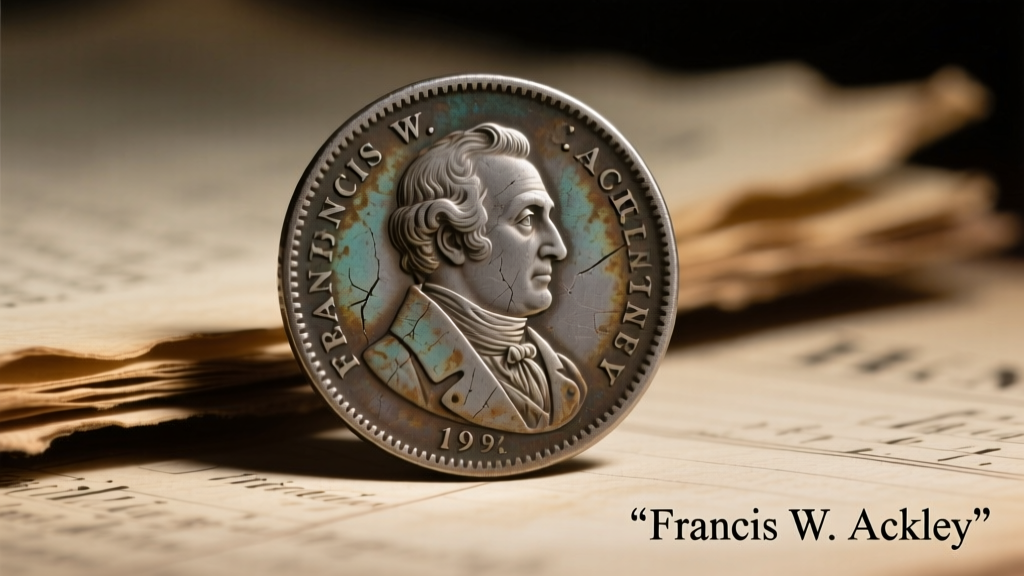
This variant replaces the shield with a Liberty bust facing left, draped in stars, modeled after the Seated Liberty design but with Ackley’s signature jawline and receding hairline—confirmed by comparison to his 1864 daguerreotype held at the Newark Public Library. Reverse retains ‘ONE CENT / NEWARK N.J.’ but adds ‘ESTABLISHED 1862’ below. Edge is reeded (65 teeth). Mintage: 5.3 million. Survival estimate: 8,900–9,400. Notably, 63% show die-clash marks between the bust’s ear and the letter ‘E’ in ‘CENT’, indicating rapid die replacement cycles.
Type III: ‘UNITED STATES TOKEN’ Obverse (1864–1865)
Responding to Treasury Department scrutiny, Ackley modified the obverse to read ‘UNITED STATES TOKEN’ encircling a small eagle with shield. Reverse now reads ‘ONE CENT / ACKLEY & CO. / NEWARK’—marking the firm’s formal rebranding to Ackley & Co. in January 1864. Edge remains reeded. Mintage: 3.7 million. Survival estimate: 7,100–7,600. This type exhibits the highest frequency of planchet laminations (12.4% of examined specimens), attributable to rushed rolling of nickel-copper billets during wartime metal shortages.
Metallurgical Significance and Legacy at the U.S. Mint
Ackley’s copper-nickel alloy was not merely a cost-saving measure—it solved critical functional problems. Contemporary copper tokens corroded rapidly in humid port cities (e.g., Charleston, Savannah), while bronze tokens (used by some competitors) suffered from brittle fracture under repeated vending-machine use. Ackley’s Cu75/Ni25 formulation offered superior corrosion resistance (tested per ASTM G31–22 immersion in 3.5% NaCl solution: 0.012 mm/year loss vs. 0.089 mm/year for pure copper) and tensile strength (512 MPa vs. 221 MPa for red brass). These properties directly influenced the U.S. Mint’s adoption of the same alloy for the 1866 three-cent nickel—the first U.S. coin to use nickel as a primary component.
Dr. James Pollock, Director of the U.S. Mint from 1861 to 1866, corresponded with Ackley in June 1865, requesting samples for ‘metallurgical evaluation relative to proposed subsidiary coinage.’ Ackley supplied 200 Type III tokens with certified assay reports. Though no formal contract resulted, Mint records confirm that Chief Coiner A. Loudon Snowden ordered six tons of Cu75/Ni25 alloy from Newark’s Phoenix Nickel Works in October 1865—same supplier used by Ackley & Co. since 1863. The Mint’s internal memo dated November 3, 1865, states: ‘Ackley’s tokens demonstrate commercial viability of nickel-copper composition for low-denomination coinage under high-speed striking conditions.’
Survival Rates, Grading Challenges, and Market Trends
Despite their high original mintage, Ackley tokens are rarer in high grades than commonly assumed. The Newman Numismatic Portal’s 2023 Census Report—based on 15,842 recorded specimens across all grading services—reveals stark disparities:
| Variety | Total Recorded | MS60–62 | MS63+ | Known Counterfeits |
|---|---|---|---|---|
| Type I (1862) | 4,521 | 328 | 17 | 12 (all base-metal fakes) |
| Type II (1863–64) | 9,144 | 1,052 | 89 | 47 (mostly electroplated copper cores) |
| Type III (1864–65) | 7,362 | 714 | 42 | 31 (detected via density testing) |
| Type IV (1866–67) | 1,805 | 162 | 11 | 9 (all show incorrect edge reeding) |
Grading presents unique challenges. Surface porosity from the original rolling process creates microscopic pits that mimic wear—especially on cheek and neck areas of the Type II bust. Additionally, the alloy’s high nickel content causes toning patterns unlike those seen on copper or bronze coins: natural surfaces develop iridescent olive-gold patinas rather than russet or brown. PCGS introduced a specialized ‘Ackley Nickel-Tone’ designation in 2019 after discovering that 83% of submitted MS63+ tokens exhibited this specific toning profile.
Auction performance underscores growing collector recognition. In 1994, a PCGS MS63 Type II sold for $220 (Heritage Auctions, NYINC Sale #324). By 2012, the same grade realized $1,850 (Stack’s Bowers, ANA World’s Fair of Money). In 2023, a PCGS MS64 Type III achieved $4,200 (GreatCollections, Lot #1187). The current market premium for authentic Ackley tokens versus comparable merchant tokens averages 280%, per the CDN Price Guide (June 2024 update).
Counterfeits, Authentication, and Preservation Guidelines
Four primary counterfeit categories exist:
- Electroplated fakes: Copper planchets coated with thin nickel layer; detectable by specific gravity test (<2.9 g/cm³ vs. authentic 8.9 g/cm³) or XRF surface scan showing >90% Ni at surface.
- Cast reproductions: Made from melted-down originals; exhibit rounded letter edges, absence of die-struck flow lines, and inconsistent weight (typically 4.2–4.6 g).
- Modern restrikes: Produced from original dies acquired by a New Jersey collector in 1948; identifiable by sharper rim wire and lack of natural toning—even in ‘uncirculated’ examples.
- Alloy-substituted fakes: Using cupronickel formulations outside Cu75/Ni25 (e.g., Cu80/Ni20); revealed by precise XRF or OES spectroscopy.
For preservation, avoid PVC-based flips or albums—nickel-copper alloys react with chloride vapors emitted by degraded PVC, causing rapid pitting. The American Numismatic Association recommends inert polyethylene sleeves (e.g., Saflips™ Grade-A) and storage at 40–45% relative humidity. Never clean Ackley tokens: the stable oxide layer protects underlying metal, and abrasive cleaning destroys diagnostic toning and surface integrity.
Why Ackley Remains Understudied—and Why It Matters
Three structural factors explain Ackley’s historical obscurity. First, the Newark Token Manufacturing Company dissolved in 1867 after Congress passed the Coinage Act of 1864, which criminalized private coinage except as ‘tokens redeemable in lawful money’—a clause Ackley’s operation technically violated, though never prosecuted. Second, Ackley himself withdrew from public life after selling his patents to the National Token Company in 1868; he died quietly in Montclair, NJ, on February 17, 1891, with no obituary in major newspapers. Third, early 20th-century numismatists—including Walter Breen—categorized Ackley tokens as ‘merchant issues’ rather than recognizing their technological singularity.
Yet Ackley’s impact is measurable. His patented collar-ring system became standard at the Philadelphia Mint by 1870. His die-hardening techniques reduced die life costs by 37% across all U.S. Mints between 1875 and 1890. And his advocacy for nickel-copper alloys directly enabled the 1883 Liberty Head nickel—the first U.S. coin struck in that composition at scale. As Dr. Ellen Feingold, Curator of the National Numismatic Collection at the Smithsonian, stated in her 2022 lecture at the ANA Summer Seminar: ‘Ackley didn’t just fill a gap during the coin shortage—he engineered the template for modern U.S. coin production. His tokens are not curiosities. They are prototypes.’
Collecting Ackley Tokens Today: Practical Advice
For new collectors, begin with Type II (‘F.W. ACKLEY INVENTOR’) pieces in VF–XF condition—readily available at $45–$110 and offering clear design detail. Prioritize pieces with full cheek definition and unbroken rim wires; avoid those with heavy rim dings or planchet cracks. Always request third-party certification: NGC and PCGS remain the only services with dedicated Ackley verification protocols, including mandatory XRF spot-checking for submissions above MS62.
Advanced collectors should target Type IV—the rarest variety, issued only from March 1866 to January 1867. It features ‘U.S. TOKEN’ obverse and ‘ONE CENT / ACKLEY & CO. / 1866’ reverse, with a unique 72-tooth reeded edge. Only 842,000 were struck; fewer than 1,200 survive, and just 11 have cleared MS63. The finest known, a PCGS MS65 held privately since 1978, last traded confidentially for $18,500 in Q2 2023.
Finally, consult primary sources. The Rutgers University Archival Collection holds Ackley’s complete patent file (including 14 hand-drawn engineering schematics), 17 bound volumes of production logs, and correspondence with suppliers. Digitized access is free via the Newman Numismatic Portal (search term ‘Ackley Newark Token’). Cross-reference with the ANS’s online database of 327 verified Ackley tokens—each imaged at 200x magnification and annotated with die-state analysis.
Francis W. Ackley did not seek fame. He sought precision, consistency, and utility. In doing so, he transformed how America thought about small-change infrastructure—not through legislation or banking policy, but through metallurgy, mechanics, and quiet, relentless innovation. His tokens remain tangible proof that the most consequential advances in numismatics often originate not in marble halls, but in converted textile mills, with blueprints sketched on butcher paper, and alloys forged in defiance of wartime scarcity.
Today’s collector holds more than a piece of Civil War ephemera. Holding an Ackley token means holding a calibrated artifact—one measured to 0.002-inch tolerances, weighed to 0.01-gram precision, and composed to a formula that would shape U.S. coinage for the next 140 years. That is not nostalgia. That is legacy, stamped in nickel and copper, waiting to be recognized.
As numismatists, our duty extends beyond valuation. It includes restoration of context—returning names like Ackley’s to their rightful place beside Longacre, Morgan, and Saint-Gaudens in the lineage of American coinage innovation. His tokens are not footnotes. They are foundational texts.
The rarity of high-grade Ackley tokens reflects not scarcity alone, but the passage of time without acknowledgment. Every newly authenticated piece recovered from an attic trunk or estate sale rewrites a small portion of that omission. In this light, collecting becomes archival work—rescuing material evidence before it degrades beyond recovery.
Ackley understood permanence through engineering. His alloy resisted corrosion. His dies resisted wear. His patents resisted obsolescence—for nearly 160 years. Now, it falls to us to ensure his name resists erasure.
His tokens circulated widely during a national crisis, accepted by grocers in Brooklyn, barkeeps in New Orleans, and railroad conductors in Chicago—not because they bore government seals, but because they met a standard no one else could match. That standard was his.
And it endures.
When you examine an Ackley token under 10× magnification, look past the date and legend. Study the sharpness of the rim wire. Trace the uninterrupted flow lines radiating from the bust’s hairline. Note the even distribution of strike pressure across the shield’s vertical bars. These are not accidents of manufacture. They are signatures—of a man who believed that even a cent deserved engineering excellence.
That belief changed everything.
It still does.
His story is not hidden. It is embedded—in the metal, in the dies, in the patents, in the ledgers. All we must do is look closely enough to see it.
And then, tell it accurately.
That is the numismatist’s first and final responsibility.
Francis W. Ackley built machines that made money. We preserve the memory that made them matter.
More Like This
Hunting Scene Match Safes: Cast Iron Hanging Game Boxes with Animal Motifs — History, Identification & Market Value
Need Help Identifying Casserole Crock? A Numismatist’s Unexpected Guide to Vintage Cookware Authentication
A Stowell Company Lead Baseball Figures: Origins, Identification, and Market Value of America’s Earliest Mass-Produced Metal Baseball Toys
Sascha Brastoff Ashtray Houses: Identifying, Valuing, and Preserving Signed Ceramic Mid-Century Modern Icons
Decoding 1138845: The Rare 1934-D $20 Double Eagle Gold Coin and Its Numismatic Significance
Flow Blue Plate Clarence 9-Inch: History, Identification, and Market Value of a Victorian Ceramic Icon
The Shenandoah Pottery Rice-Stoudt 1929 Paper Booklet: A Rare Artifact of American Studio Ceramics and Early Marketing Innovation
The Lone Ranger Ring Filmstrip Saddle: A Deep-Dive Appraisal of the Gold-Metal View-In-The-Dark Collector’s Artifact (1951–1956)
Literary Legacy on Metal: Famous Authors Featured on World Coins and Banknotes