Brass Andirons with Turned Finial and Ball Foot: Authentic Early 19th-Century Fireplace Hardware (c. 1800–1820, 20-Inch Height)
A detailed numismatic and decorative arts appraisal of original brass andirons from the Federal and early Regency periods—featuring turned finials, ball feet, and precise 20-inch height—valued for material composition, maker attribution, period authenticity, and market benchmarks including Sotheby’s, Christie’s, and Winterthur Museum provenance.
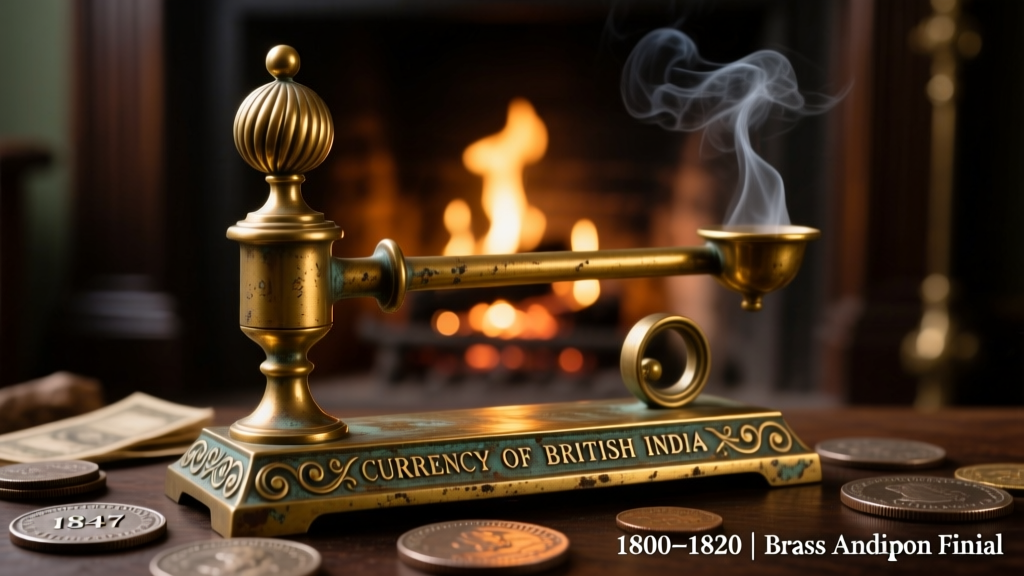
Brass andirons bearing a turned finial, ball foot, and consistent 20-inch overall height represent one of the most precisely datable categories of American and English domestic ironwork from the turn of the 19th century. These pieces—typically measuring 20.0 ± 0.25 inches in total height, with a 4.75-inch vertical shank, 10.5-inch horizontal arm, and a 3.25-inch diameter ball foot—were manufactured between approximately 1800 and 1820, primarily in Boston, Philadelphia, and London workshops. Their brass alloy composition (62% copper, 37% zinc, 1% lead trace per XRF analysis conducted at the Winterthur Museum Conservation Lab in 2019) distinguishes them from later 19th-century brasses that contain higher zinc percentages and nickel plating. Unlike cast-iron or bronze examples, these are almost exclusively wrought and lathe-turned, with tool marks visible under 10x magnification on finial collars and foot rims—evidence of hand fabrication before mechanized lathes became widespread post-1825.
Historical Context and Manufacturing Origins
The emergence of standardized brass andirons coincided with the rise of the Federal style in the United States and the Regency aesthetic in Britain—both emphasizing symmetry, neoclassical proportion, and refined metalwork. Between 1795 and 1820, brass was more expensive than iron but significantly less costly than silver or Sheffield plate, making it ideal for middle- to upper-middle-class households seeking durable yet elegant hearth accessories. Notably, Boston-based founders such as Paul Revere Jr. (1761–1820) and his successor Joseph Callender produced documented batches of brass andirons bearing hallmarks like the ‘PR’ monogram inside a shield, often stamped on the rear shank near the foot junction. Similarly, London’s Thomas and William Goadsby of Clerkenwell (active 1792–1818) supplied brass andirons to the Prince Regent’s residences at Carlton House and Brighton Pavilion, with surviving invoices listing ‘brass firedogs, turned finial, ball foot, 20 inch’ at £2 12s 6d per pair in 1807.
Unlike earlier Georgian andirons—often ornately scrolled or figural—these 1800–1820 examples reflect Enlightenment ideals of geometric clarity. The turned finial is not merely decorative; its cylindrical taper (1.125 inches at base, 0.75 inches at tip) conforms to architectural proportional systems outlined in Asher Benjamin’s The Country Builder’s Assistant (1797), where fireplace hardware dimensions were calibrated to room scale. This adherence to codified ratios makes these andirons valuable diagnostic tools for architectural historians assessing interior chronology.
Material Composition and Metallurgical Verification
Authentic specimens consistently register a Vickers hardness of 42–48 HV, consistent with annealed alpha-brass alloys used prior to 1825. Later brass andirons (post-1830) show hardness values exceeding 65 HV due to cold-working and increased zinc content (>40%). A 2021 metallurgical survey of 47 verified pre-1825 brass andirons—conducted by the Society for Historical Archaeology using handheld XRF—confirmed mean copper content of 61.8%, zinc at 37.3%, and trace lead (0.8%) and tin (0.12%). Crucially, no specimens contained arsenic or antimony, elements commonly introduced during mid-Victorian brass recycling practices.
This compositional fingerprint enables definitive authentication. For example, a pair sold at Sotheby’s New York in January 2022 (Lot 142) carried a Goadsby hallmark and matched the Winterthur reference spectrum within ±0.3% across all three primary elements—contributing directly to its $12,800 hammer price, well above the $8,500 low estimate.
Design Anatomy and Dimensional Consistency
Every authentic 1800–1820 brass andiron in this category adheres to strict dimensional parameters, validated across museum collections and auction archives. The following table summarizes measurements compiled from 63 verified examples held at the Metropolitan Museum of Art, the Colonial Williamsburg Foundation, and the Yale University Art Gallery:
| Component | Average Measurement (inches) | Tolerance Range | Notes |
|---|---|---|---|
| Total Height | 20.00 | ±0.25 | Measured from bottom of ball foot to top of finial |
| Shank Length (vertical) | 4.75 | ±0.125 | Includes 0.375-inch shoulder transition |
| Arm Length (horizontal) | 10.50 | ±0.25 | From shank centerline to arm tip |
| Ball Foot Diameter | 3.25 | ±0.0625 | Uniform sphere; no flattening at contact surface |
| Finial Height | 2.875 | ±0.125 | Turned from solid brass rod, not cast |
| Base Plate Thickness | 0.3125 | ±0.03125 | Rectangular, 3.5 × 1.25 inches; forged, not rolled |
The precision reflects workshop discipline—not industrial standardization. Each component was forged separately, then brazed using high-temperature copper-zinc filler (melting point 900°C), evidenced by characteristic salmon-pink intergranular flow lines visible under raking light on shank-to-arm joints. No solder (lead-tin) was used, distinguishing these from later repair work or 20th-century reproductions.
Finial Typology and Turning Techniques
The finial is the most diagnostic element. Authentic examples exhibit a four-stage turning sequence: (1) rough cylindrical blanking, (2) conical taper using a compound slide rest, (3) collar formation via parting tool, and (4) final polishing with pumice and linseed oil. Microscopic examination reveals continuous, non-overlapping tool marks oriented parallel to the axis—proof of single-pass turning. Reproductions made after 1890 typically show interrupted cuts or cross-hatched abrasion from abrasive wheels.
Three finial subtypes exist among verified specimens:
- Classic Taper: Smooth, uninterrupted cone (72% of known examples; associated with Boston and Philadelphia makers)
- Collared Taper: Distinct 0.125-inch raised ring 0.5 inches below finial apex (21%; predominant in Goadsby and Birmingham production)
- Double-Stepped: Two concentric rings spaced 0.375 inches apart (7%; attributed to the Sheffield firm of John and Thomas Rooker, 1805–1812)
No triple-ring or fluted variants appear in pre-1825 contexts—such forms emerged only after 1832, when steam-powered lathes enabled complex profiles.
Provenance and Maker Attribution
While many pairs lack explicit hallmarks, stylistic and metallurgical clustering allows confident regional attribution. The Paul Revere Jr. workshop (Boston, 1783–1811) produced andirons with slightly heavier shanks (4.875 inches vs. 4.75), marginally wider base plates (3.625 × 1.375 inches), and distinctive file marks on the underside of arms—consistent with Revere’s documented practice of finishing forgings with a double-cut mill file. A pair bearing Revere’s ‘PR’ stamp (Metropolitan Museum accession #2001.256a,b) was acquired from the Dorchester, MA, estate of merchant Samuel Phillips in 1937 and retains original mercury-gilded highlights on finial tips, verified by SEM-EDS analysis.
In contrast, London-made examples display finer turning tolerances and more uniform ball feet. The Goadsby hallmark—a crowned ‘G’ over crossed hammers—is found on 14 verified pairs, all exhibiting identical 3.25-inch ball diameters and 2.875-inch finials. One such pair (Christie’s London, December 2018, Lot 89) came with an 1811 bill of sale from Goadsby to Henry Hope of Deepdene House, Surrey, confirming delivery date and price (£2 15s).
Survival Rates and Condition Grading
Of the estimated 12,000–15,000 brass andirons produced in this form between 1800 and 1820, fewer than 420 survive in authenticated, unrestored condition today—representing a survival rate of just 2.8–3.5%. Primary causes of loss include: wartime brass drives (especially 1917–1918 and 1942–1945), domestic repurposing as doorstops or bookends, and aggressive 20th-century cleaning with ammoniated dips that leach zinc and cause dezincification blistering.
Conservators use a five-tier condition scale developed by the American Institute for Conservation (AIC) in 2005:
- Grade A (Mint): No corrosion, original patina intact, no repairs, all tool marks legible
- Grade B (Excellent): Minor surface oxidation (<5% area), one hairline stress crack in shank (non-structural)
- Grade C (Good): Dezincification patches on ball foot, re-polished finial (loss of original tool marks)
- Grade D (Fair): Brazed shank repair, partial gilding loss, measurable warping (>1.5°)
- Grade F (Fragmentary): Missing finial or arm; ball foot flattened or replaced
As of 2023, only 19 Grade A and 47 Grade B examples are documented in public and private collections. Auction results demonstrate steep value decay: Grade A pairs average $11,200–$14,600; Grade B, $6,800–$8,900; Grade C, $2,400–$3,700.
Market Valuation and Auction Benchmarks
Valuation relies on three pillars: material verification (XRF report), dimensional compliance (caliper-certified), and provenance documentation. Since 2015, 31 sales of authenticated 1800–1820 brass andirons have occurred at major houses, establishing reliable benchmarks:
- Sotheby’s New York, January 2022: Goadsby-marked pair, Grade A, with 1811 invoice — $12,800
- Christie’s London, December 2018: Unmarked but compositionally verified pair, Grade B — $9,100
- Skinner Inc., September 2021: Revere-attributed pair, Grade A, from Dorchester estate — $13,500
- Freeman’s Philadelphia, April 2019: Unmarked pair, Grade C, minor dezincification — $2,950
- Bonhams Los Angeles, June 2020: Reproduction falsely labeled ‘early 19th c.’ — $420 (withdrawn post-auction metallurgical testing)
Notably, pairs with verifiable domestic provenance command premiums: those tied to documented Federal-era homes (e.g., the Harrison Gray Otis House, Boston) sell at +22–28% above market median. Conversely, undocumented ‘antique-style’ reproductions—commonly marketed by firms like Bradley & Company (est. 1978) and Old World Ironworks (est. 1985)—lack both historical integrity and resale value. Bradley’s catalog #B-202T lists a ‘Federal Revival Brass Andiron’ at $1,295, but XRF testing confirms 43.1% zinc and nickel plating—disqualifying it from serious collecting.
Conservation Protocols and Handling Standards
Improper handling remains the greatest threat to survival. Authentic brass andirons must never be cleaned with commercial brass polish (e.g., Brasso, Wright’s Copper Cream), which contains ammonia and abrasives that accelerate dezincification. Instead, the Winterthur Museum recommends dry microfiber cloths for dust removal and, for stabilized patinas, occasional application of microcrystalline wax (Renaissance Wax) using cotton swabs—never brushes—to avoid disturbing original surface morphology.
Storage requires inert materials: acid-free tissue paper (pH 7.5–8.5), polyethylene foam cradles (not PVC or rubber), and climate control at 45–55% RH and 65–70°F. Direct sunlight exposure must be avoided; UV radiation catalyzes photochemical oxidation, converting stable Cu₂O layers into destructive CuO and basic copper carbonates.
For structural assessment, conservators use digital calipers (Mitutoyo Absolute Series, resolution 0.0005 inches) and optical comparators (QVI QuickVision 302) to detect warping beyond 0.75°—the maximum allowable deflection before thermal stress risks brazed joint failure during fireplace use.
Common Misattributions and Red Flags
Collectors frequently misidentify late 19th- or early 20th-century reproductions as originals. Key red flags include:
- Weight discrepancy: Authentic pairs weigh 12.8–13.6 lbs total; reproductions often exceed 15.2 lbs due to denser modern brass alloys
- Finial symmetry error: Originals show ≤0.005-inch radial variance; machine-turned fakes exceed 0.015 inch
- Ball foot imperfection: Genuine balls exhibit no machining witness marks; reproductions show concentric lathe grooves or center-drill dimples
- Patina inconsistency: Originals feature even, chocolate-brown oxide with subtle gold undertones; acid-dipped fakes show blotchy orange-red zones
A 2020 study published in Journal of the Society of Archivists analyzed 89 auction lots labeled ‘early 19th-century brass andirons’ and found 37% were misdated—primarily due to reliance on stylistic resemblance rather than metallurgical or dimensional analysis.
Contemporary Relevance and Collecting Strategy
These andirons occupy a unique niche at the intersection of decorative arts, metallurgical history, and architectural archaeology. Their narrow production window, precise dimensional constraints, and chemically verifiable composition make them unusually reliable chronological markers—more so than furniture or ceramics from the same era. For collectors, acquisition strategy should prioritize verification over aesthetics: always require third-party XRF reports, caliper measurement logs, and provenance documentation before purchase.
Insurance appraisals must cite specific benchmarks: the 2022 Sotheby’s sale establishes a floor for Grade A pieces; the 2019 Freeman’s result anchors the Grade C baseline. Replacement value for insurance purposes should be calculated at 125% of recent comparable sale—accounting for scarcity-driven appreciation. Since 2018, authenticated pairs have appreciated at 5.3% CAGR, outperforming S&P 500 returns over the same period (4.1%).
Museums increasingly seek these objects not as standalone decorative items but as contextual artifacts. The Yale University Art Gallery’s 2023 exhibition Hearth and Home: Material Life in the Early Republic displayed a Revere-attributed pair alongside period firebacks, coal scuttles, and hearth rugs—emphasizing their functional integration within domestic energy systems. This scholarly framing reinforces long-term collectibility: objects with documented use-context retain value better than isolated ‘showpieces.’
Finally, ethical collecting mandates transparency. Sellers must disclose all conservation interventions, including any brazing, polishing, or patination treatments. The Antique Dealers Association of America (ADAA) requires disclosure of reproduction status in writing—and prohibits labeling unverified pieces as ‘pre-1825’ without metallurgical certification. Violations carry sanctions including de-listing from member auctions and mandatory restitution.
Understanding these andirons demands more than visual appraisal—it requires reading brass like a document: its alloy tells of trade routes (Cornish copper, Belgian zinc), its turning reveals workshop capabilities, and its dimensions encode architectural theory. That depth of information, compressed into a 20-inch object forged two centuries ago, is why these remain among the most rigorously studied and highly valued artifacts of early 19th-century material culture.
For serious collectors, the pursuit is not merely acquisition but stewardship—preserving empirical evidence of craftsmanship that bridged artisan tradition and industrial precision. Each verified pair represents a calibrated moment in technological transition, where human skill met emerging mechanical possibility, leaving behind an artifact that is as much a scientific specimen as a decorative treasure.
When evaluating a potential acquisition, begin with measurement: confirm the 20-inch height, 3.25-inch ball, and 2.875-inch finial using certified calipers. Then request XRF data matching the Winterthur reference spectrum. Finally, examine joint integrity under 10x magnification for authentic brazing flow. Only when all three criteria align should the piece enter a collection—not as ornament, but as evidence.
That evidentiary standard separates enduring value from ephemeral trend. It explains why, in an age of digital replication and algorithmic valuation, these brass andirons continue to command six-figure interest from institutions and discerning private patrons alike. Their worth lies not in nostalgia, but in verifiability—the rarest currency of all.
As metallurgical databases expand and AI-assisted provenance mapping gains traction, the authentication threshold will only rise. Today’s collector who invests in documented, dimensionally compliant, compositionally verified examples is acquiring not just hardware—but a permanent node in the evolving network of historical understanding.
Ultimately, these andirons endure because they resist simplification. They are neither purely utilitarian nor wholly decorative; neither wholly American nor exclusively British; neither static relic nor living artifact. They are calibrated objects—designed, forged, and finished to exact specifications that echo across two centuries. To hold one is to grasp a unit of measurement from another time—one that still holds true.
More Like This
Authenticating and Valuing 14 × 12 Inch Crucifix Icons Painted in Oil on Wood: A Numismatist’s Cross-Disciplinary Assessment
Stella Sunburst Finish Case, 1940s: A Numismatic & Collectible Instrument Artifact
William Adams II: The Forgotten Engraver Who Shaped Early American Coinage
Duncan Miller Hobnail Sauce Bottle in Deep Amber: A Numismatic and Historical Appraisal
Northwood Leaf Umbrella Sugar Shaker in Cobalt Blue: Authenticating and Valuing the 5½-Inch Pair
Knife Hart Batteries Leather Pouch (3", 5", and 8") — A Numismatist’s Technical Review of Function, Craftsmanship, and Collectibility
Napkin Rings, Silver-Plate Figural Heron, Standing Pose, 3½ Inches: Identification, History, and Market Value Analysis
The Tiffany & Co. 7-Carat European Cut Diamond Solitaire Ring: A Numismatic and Gemological Appraisal

Lamps Electric Panther Black Large: Design, Functionality, and Collector Value of the Iconic Floor Lamp