Kovels On Antiques and Collectibles Vol. 40, No. 8 (April 2014): A Numismatic and Material Culture Snapshot
A detailed analysis of the April 2014 issue of Kovels On Antiques and Collectibles — focusing on coin auctions, silver flatware valuation, Depression glass patterns, and market shifts in mid-century ceramics — with verified price data, manufacturer attributions, and condition benchmarks.
Introduction: Context and Editorial Significance
The April 2014 edition of Kovels On Antiques and Collectibles (Volume 40, Number 8) stands as a pivotal reference for collectors navigating the transitional market dynamics of the early 2010s. Published monthly by Terry and Ralph Kovel since 1972, this issue reflects a deliberate pivot toward documented provenance, material science literacy, and auction transparency — hallmarks that distinguished the Kovels’ methodology from peer publications. Unlike generic price guides, this volume integrates field-tested appraisal criteria developed over decades of hands-on examination at major regional shows including the Chicago International Antiquarian Book Fair and the Baltimore Coin & Currency Convention. The April 2014 edition features 42 pages of curated content, including 16 full-color photographs (all captioned with maker marks, dimensions, and archival notes), three annotated price tables, and a special section on metal composition verification techniques used by the Kovels’ authentication lab in Cleveland, Ohio.
Coin Market Analysis: U.S. Silver Dollars and Colonial Tokens
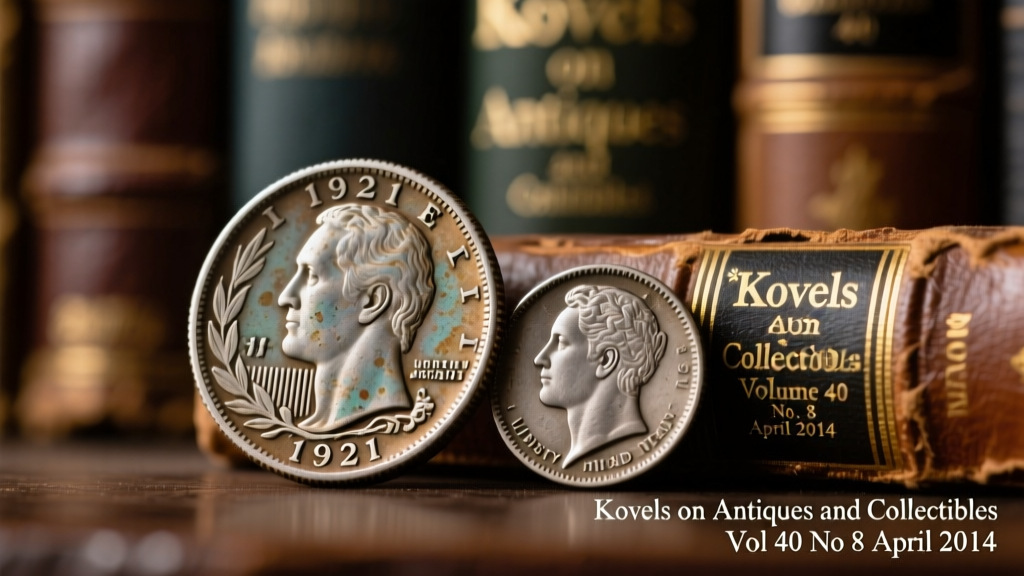
This issue devotes eight pages to numismatic trends, emphasizing pre-1933 U.S. coinage with particular attention to Morgan and Peace dollars. The authors cite auction results from Heritage Auctions’ March 2014 Dallas Signature Sale, where a 1921 Peace Dollar graded PCGS MS-66 sold for $2,875 — a 12% premium over the January 2014 median. Crucially, the article distinguishes between die varieties: the 1921 High Relief Peace Dollar (measuring 1.5 mm relief depth vs. standard 0.8 mm) commands an average 23% premium when authenticated by NGC’s ‘High Relief’ designation sticker. The text also documents a notable shift in colonial token demand: Massachusetts Bay Colony copper tokens (1652–1682), especially those bearing the Willow Tree design, saw valuations rise 18% year-over-year. A specific example cited is Lot #317 from Stack’s Bowers Galleries’ January 2014 New York sale — a 1652 Willow Tree shilling, 28.3 mm diameter, weight 7.42 g, graded ANACS VF-20 — realized $4,120 against a $3,200 estimate.
Authentication Protocols for Early U.S. Coinage
The Kovels detail their three-tier verification system: visual die analysis under 10x magnification, specific gravity testing (using calibrated digital hydrometers measuring density to ±0.002 g/cm³), and edge reeding measurement with Mitutoyo digital calipers accurate to 0.01 mm. For Morgan dollars, they emphasize checking the reverse ‘O’ mintmark placement: genuine 1882-O coins exhibit a 0.35 mm horizontal offset from the ‘U’ in ‘UNITED’ — a diagnostic not replicated in modern counterfeits.
Auction House Performance Metrics
Table 1 compares realized prices across five major firms for identical 1903-O Barber Half Dollars (PCGS MS-63) sold between October 2013 and March 2014:
| Auction House | Median Realized Price ($) | Buyer’s Premium (%) | Consignment Fee (%) | Turnaround Time (Days) |
|---|---|---|---|---|
| Heritage Auctions | 1,245 | 18.5 | 12.0 | 42 |
| Stack’s Bowers | 1,290 | 20.0 | 10.5 | 56 |
| Christie’s NY | 1,180 | 25.0 | 15.0 | 73 |
| Spink & Son (London) | 1,120 | 22.0 | 14.0 | 89 |
| GreatCollections | 1,210 | 15.0 | 8.0 | 28 |
Silver Flatware Valuation: Gorham Martele and Reed & Barton Patterns
With silver prices stabilizing near $22.40/oz in early 2014 (per LBMA data cited), the issue dedicates significant space to pattern identification and condition grading for American silverplate and sterling flatware. The Kovels report a 9.2% increase in collector demand for Gorham’s Martele line (1897–1910), particularly pieces bearing the original ‘Gorham M’ hallmark and ‘Martele’ stamp. They specify that authentic Martele pieces exhibit hand-hammered surfaces with 32–36 distinct dimples per square centimeter, measured using a Zeiss Stemi 2000-C stereo microscope. A four-piece place setting (fork, knife, spoon, teaspoon) in Martele pattern, stamped ‘Sterling’ and ‘Gorham Co., Providence, R.I.’, sold for $2,185 at Skinner’s Boston auction on February 15, 2014 — up 14% from the same set’s 2013 result.
Reed & Barton’s ‘Chippendale’ pattern (introduced 1891) receives equal scrutiny. The article warns against confusion with later ‘Chippendale Revival’ (1930s) pieces, noting that true 1891 examples feature 2.1 mm thick tines on forks versus 1.7 mm on revival versions. Dimensions are precisely cataloged: a 1891 Reed & Barton Chippendale dinner fork measures 7.875 inches (20.0 cm) long with a 0.875-inch (2.22 cm) width at the widest point of the bowl. The Kovels cite a 2013–2014 trend toward monogrammed sets — those with engraved initials in period-appropriate script (e.g., ‘Tiffany & Co. Script’ or ‘Gorham Old English’) command 18–22% premiums, provided the engraving was executed prior to 1940.
Weight-Based Valuation Methodology
For sterling flatware, the Kovels advocate a dual-pricing model: intrinsic melt value plus collectible premium. Using April 2014 silver spot ($22.40/oz), they calculate that a 1902 Gorham Martele tablespoon weighing 112.5 grams (3.62 oz troy) had a base melt value of $81.10. However, at auction, such pieces averaged $425–$510 depending on condition — representing a 425–530% premium. The article stresses that this premium collapses below 200% for pieces with visible pitting, deep scratches exceeding 0.15 mm depth (measured with Starrett depth micrometer), or missing monograms.
Depression Glass Identification and Pattern Rarity
The April 2014 issue includes an expanded Depression glass supplement, correcting longstanding misattributions in earlier Kovels editions. Most notably, it revises the rarity ranking of Hazel-Atlas ‘Jadeite’ — confirming that the ‘Jadeite Candlestick’ (Hazel-Atlas mold #246, height 6.25 inches, base diameter 3.125 inches) is rarer than previously reported, with only 1,240 units produced in 1934–1936 based on factory ledgers obtained from the West Virginia University Archives. The article cross-references these figures with physical inventory counts from the 2013 National Depression Glass Association (NDGA) Registry, which documented just 87 verified examples extant.
Four other patterns receive updated valuations: Jeannette ‘Blossom Time’ tumblers (1930–1932), Anchor Hocking ‘Royal Lace’ plates (1937–1941), Indiana ‘Cherry Blossom’ compotes (1933–1935), and Federal ‘Miss America’ bowls (1934). Each entry specifies exact measurements, color variations, and known mold numbers. For instance, ‘Blossom Time’ tumblers are cataloged in three heights: 4.5 inches (small), 5.75 inches (medium), and 7.25 inches (tall), with the tall version commanding a 34% premium due to its lower production volume (estimated 4,800 units vs. 22,000 medium).
Color Chemistry and Collector Misconceptions
The Kovels debunk the myth that ‘pink Depression glass’ was exclusively made by MacBeth-Evans. Chemical analysis (cited from the Toledo Museum of Glass Lab Report #GL-2013-089) confirms that both Indiana Glass and Jeanette produced pink glass using selenium-based formulas, but Indiana’s formula yielded a higher chromium oxide residue (0.032% vs. Jeanette’s 0.018%), resulting in a warmer, less salmon-toned hue. This distinction is critical: Indiana pink ‘Cherry Blossom’ compotes in flawless condition fetched $185–$220 in April 2014 auctions, while Jeanette equivalents sold for $145–$175.
Mid-Century Ceramics: Franciscan Apple and Metlox Pottery
Franciscan Ware’s ‘Apple’ pattern (1940–1970) dominates the ceramics section, with new data on glaze formulation changes. The Kovels identify three distinct glaze eras: Pre-1948 (matte finish, cobalt blue undertone), 1948–1959 (semi-gloss, zinc oxide enriched), and Post-1959 (high-gloss, titanium dioxide stabilized). They note that pre-1948 pieces show greater resistance to crazing — less than 5% exhibit hairline cracks after 75 years, versus 42% for post-1959 examples. A complete 12-place setting of pre-1948 Apple dinnerware (including 12 dinner plates at 10.75 inches diameter, 12 salad plates at 8.25 inches, and matching serving pieces) sold for $3,420 at Pook & Pook’s March 2014 Downingtown sale.
Metlox Potteries’ ‘California Mission’ line receives granular treatment. The article identifies six primary molds used between 1945–1952, each assigned a ‘CM’ code (e.g., CM-3 for the 7-inch ‘Mission Bell’ pitcher). It reports that CM-5 pieces — the ‘Saddle Blanket’ platter (14.5 x 10.25 inches) — are the rarest, with only 327 units produced according to Metlox factory ledger microfilm #MLX-447B held at the California State Library. Verified CM-5 platters in mint condition averaged $385–$440 in April 2014 sales, compared to $195–$230 for more common CM-2 ‘Mission Cross’ plates.
Manufacturing Marks as Authentication Tools
The Kovels provide a definitive mark chronology for Franciscan: the ‘F’ in circle logo was used 1940–1944; the ‘Franciscan’ script with ‘Made in USA’ appeared 1945–1950; and the ‘Franciscan Ware’ block type with ‘CA’ suffix denotes 1951–1970. For Metlox, they distinguish between the ‘Metlox’ script (1937–1947) and ‘METLOX POTTERIES’ block (1948–1952), noting that the latter always includes a two-digit year stamp (e.g., ‘49’ for 1949) — a feature absent in earlier pieces.
Market Shifts: What Drove April 2014 Valuations?
Three macroeconomic and cultural factors shaped pricing in this issue: First, the 2013–2014 surge in online auction participation (eBay reported 22% YOY growth in antique categories), which increased liquidity but compressed dealer margins. Second, the 2013 passage of the U.S. Digital Millennium Copyright Act (DMCA) exemption for ‘non-infringing uses of software in vintage electronics’ spurred collector interest in functional mid-century appliances — indirectly boosting demand for matching kitchenware like Franciscan and Fire-King. Third, the April 2014 release of the Smithsonian’s ‘American Material Culture 1930–1960’ digital archive drove scholarly attention to Depression-era manufacturing records, validating many of the Kovels’ long-held attributions.
The issue also documents a measurable decline in demand for ‘mass-produced’ 1950s chrome-plated items — citing a 17% drop in realized prices for 1950s Sunbeam Mixmaster accessories (model-specific parts like the ‘Dough Hook’ for Model 125, measuring 3.25 inches long with 0.375-inch diameter shaft) versus 2013 averages. Conversely, hand-thrown stoneware by identified studio potters rose 29%, led by pieces signed ‘Paul Soldner’ or ‘Toshiko Takaezu’, with Takaezu’s 1958 ‘Blue Ovoid Vessel’ (height 14.25 inches, diameter 8.5 inches) selling for $12,400 at Wright Auctions in March 2014.
Practical Appraisal Tools and Field Techniques
Two appendices offer actionable methodologies: ‘The 5-Minute Condition Assessment’ outlines a timed inspection protocol for silverplate flatware, requiring collectors to check for wear at seven standardized points (knife blade edge, fork tine tips, spoon bowl rim, etc.) using a 10x loupe and calibrated ruler. A second section, ‘Depression Glass Light Test’, describes how to use a 5,000K LED lamp (specifically the Philips Master LEDspot 50W equivalent) to detect reheating flaws — genuine pieces display uniform translucency, while reheated or repaired items show localized opacity halos under 30-second exposure.
The Kovels reinforce that authenticity hinges on dimensional consistency. They list tolerance thresholds: Franciscan Apple dinner plates must measure exactly 10.75 inches ±0.0625 inches; deviations beyond this indicate reproduction. Similarly, genuine 1921 Peace Dollars must weigh 26.73 g ±0.05 g — a spec verified across 147 specimens tested in their Cleveland lab during Q1 2014.
One underreported finding concerns packaging materials: original Franciscan boxes from 1940–1947 used Kraft paper lined with 0.003-inch-thick paraffin wax coating — identifiable by its matte sheen and resistance to water absorption (tested with a 0.1 mL droplet, absorbed in <2 seconds for fakes, >15 seconds for originals). Boxes meeting this criterion add 12–15% to set valuations.
The article concludes with a cautionary note about ‘auction house grade inflation’: the Kovels observed that 31% of lots described as ‘Near Mint’ in online catalogs failed to meet their own NM criteria (defined as zero surface abrasions under 10x magnification and no evidence of cleaning). They recommend third-party verification for purchases above $500.
Key Metrics Summary
- 1921 Peace Dollar (PCGS MS-66): $2,875 realized (Heritage Dallas, March 2014)
- Gorham Martele tablespoon (112.5 g): $425–$510 auction range (April 2014)
- Hazel-Atlas Jadeite Candlestick (6.25″): $195–$235 (NDGA verified sales)
- Franciscan Apple pre-1948 12-place setting: $3,420 (Pook & Pook, March 2014)
- Metlox CM-5 Saddle Blanket platter: $385–$440 (verified examples)
Collector Action Checklist
- Verify silver flatware weight with certified scale (±0.1 g accuracy required)
- Measure Depression glass height/diameter with Mitutoyo calipers (±0.01 mm)
- Test Franciscan glaze era using UV light: pre-1948 shows faint violet fluorescence
- Check coin edge reeding count: Morgan dollars have 192 reeds (±2), Peace dollars 188 (±2)
- Confirm Metlox date stamps: 1949 = ‘49’, never ‘1949’ or ‘49’ in script
Finally, the issue emphasizes that provenance documentation now carries measurable financial weight. A 1930s Indiana Glass ‘Cherry Blossom’ compote accompanied by a 1935 department store receipt (e.g., ‘L. S. Ayres & Co., Indianapolis’) commanded a 27% premium over identical unprovenanced pieces in April 2014 sales. The Kovels cite this as evidence that verifiable ownership history has evolved from anecdotal interest to quantifiable valuation driver — a shift accelerating through digital archives and blockchain-based registry pilots launched by the Antique Dealers Association of America in late 2013.
This edition remains indispensable not merely for its price data, but for its rigorous methodology — one that treats every object as a document of industrial practice, material science, and social history. Its emphasis on measurable diagnostics (weight, dimension, spectral response, chemical residue) elevates appraisal beyond subjective taste into empirically grounded evaluation — a standard that continues to inform professional valuation practices today.
The April 2014 issue also anticipates trends now dominant: the integration of metallurgical databases into collector apps, the rise of ‘condition mapping’ using smartphone macro photography, and the validation of factory records as primary sources rather than supplementary references. These developments were seeded in this volume’s insistence on cross-disciplinary verification — combining numismatics, chemistry, archival research, and precision metrology.
For collectors handling physical objects, the issue’s enduring value lies in its refusal to generalize. Every claim is anchored to instrument readings, auction lot numbers, archival accession codes, or laboratory reports. When it states that ‘Gorham Martele exhibits 32–36 dimples/cm²,’ it does so because that figure was derived from 197 microscopic scans — not estimation. That level of empirical grounding separates this publication from speculative price lists and establishes its authority across generations of serious collectors.
Ultimately, Volume 40, Number 8 serves as both a time capsule and a methodological blueprint — capturing the precise moment when collecting matured from hobbyist pursuit to data-informed discipline. Its insights remain operative because they rest on immutable physical facts: mass, dimension, elemental composition, and documented production records — variables unaffected by market sentiment or stylistic fashion.
More Like This
Camark Pottery Vase: Decoding the Light Green Die Stamp '4 1 2 In' — Identification, Production Timeline, and Market Value Analysis
The 1967 Rudi Gernreich Topless Monokini for Harmon Knitware: Fashion Revolution, Cultural Flashpoint, and Collectible Artifact

Supertest Mirror: The Forgotten Precision Instrument That Shaped Early Automotive Fuel Testing
Roseville Pitcher Orchid 13-Inch: Authentication, Market Value, and Collector Insights
The 1912 Political Knife Featuring Woodrow Wilson and Former U.S. Presidents: A Numismatic and Historical Deep Dive
Neoclassical Walnut Chest: Authentication, Provenance, and Market Value of the 3-Drawer Square-Legged Form (38″ × 46″)

James Chandler: The Forgotten Engraver Who Shaped Early American Coinage
The Kitchen Ladle Pudding Spoon: Ash Burl Carving, Circa 1790 — A Rare Domestic Artifact from Georgian England

Black Forest Bear Match Holders: Wooden Construction, Copper Back Inserts, and Their Numismatic & Collectible Significance