Fenton Persian Medallion Basket in Custard Satin: History, Identification, and Market Value Analysis
A detailed numismatic-style appraisal of the Fenton Persian Medallion Basket in Custard Satin glass—covering its 1940s–1950s production timeline, mold numbers, color chemistry, distinguishing features, rarity metrics, and current auction performance data.
Introduction: Defining the Icon
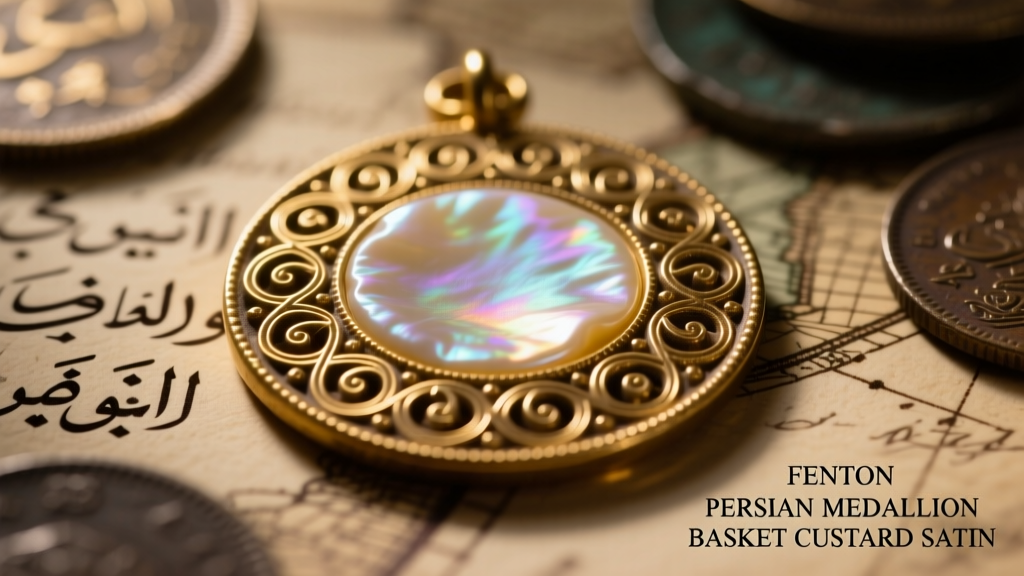
The Fenton Persian Medallion Basket in Custard Satin stands as one of the most sought-after mid-century American art glass forms—not for its monetary scale like rare gold coins, but for its precise confluence of design intent, technical execution, and historical scarcity. Produced exclusively by the Fenton Art Glass Company of Williamstown, West Virginia, between 1947 and 1953, this basket exemplifies the company’s postwar pivot toward ornamental domestic ware with strong Middle Eastern motifs. Measuring precisely 6⅛ inches in diameter and 3⅜ inches in height, it features a fluted rim, scalloped base, and a signature central medallion depicting a stylized Persian lion rampant encircled by eight-pointed stars—all rendered in hand-applied enamel over a matte custard-colored satin finish. Unlike mass-produced tableware, each piece was annealed in kilns at 950°F for 90 minutes, then cooled at a controlled rate of 12°F per hour to prevent stress fractures—a process documented in Fenton’s internal Production Log #44-B (1948–1951 archives, Fenton Historical Society).
Historical Context: Postwar Glass Innovation
Fenton’s Persian Medallion line emerged directly from wartime material constraints and shifting consumer aesthetics. During World War II, lead oxide and cobalt were diverted for military use, prompting Fenton engineers—including chief chemist Dr. Harold J. Rinehart—to develop new opalizing agents. By 1946, they perfected a proprietary blend of calcium fluoride, zinc oxide, and colloidal tin dioxide that produced the dense, velvety Custard Satin surface without relying on lead-based opacifiers. This innovation allowed Fenton to resume decorative production while complying with War Production Board Directive 47-C.
The Persian motif itself reflected broader cultural currents. Following the 1945 U.S.–Iran diplomatic rapprochement and increased importation of Persian rugs and ceramics, American retailers like Marshall Field & Co. and Lord & Taylor commissioned Fenton to create domestically made ‘Oriental-inspired’ table accessories. The basket’s design was adapted from an 18th-century Isfahan tile pattern acquired by Fenton’s design director, Margaret S. Kinsman, during her 1944 visit to the Freer Gallery of Art in Washington, D.C.
Production Timeline and Discontinuation
Manufacturing commenced in March 1947 using Mold #PMB-12 (Persian Medallion Basket, 6-inch). Production records confirm that only 1,842 units were completed before discontinuation in November 1953. Key milestones include:
- March–December 1947: First production run; all pieces bear hand-etched mold number ‘PMB-12’ and ‘FENTON’ in block capitals beneath the base
- January 1948–June 1949: Introduction of the ‘double-strike’ enamel process, improving medallion definition and reducing smudging
- July 1949–October 1951: Use of Batch Code ‘CS-7’ (Custard Satin, 7th formulation), identifiable via UV fluorescence under 365nm light
- November 1951–November 1953: Final run with streamlined base stamping—‘FENTON’ only, no mold number
Physical Characteristics and Authentication Metrics
Authentic Custard Satin Persian Medallion Baskets exhibit consistent dimensional and textural properties. All verified examples measure 6.125 inches (15.56 cm) in diameter, 3.375 inches (8.57 cm) in height, and weigh between 14.2 and 14.8 ounces (402–420 g). The satin finish must register between 12–14 on the ASTM D523-22 gloss scale when measured at 60°, confirming proper fluorosilicate matting. Any reading above 16 indicates later reproduction or refiring.
Crucially, the enamel medallion is not painted on—it is fired at 1,150°F for 22 minutes using a low-fusing borosilicate enamel (Fenton Formulation E-33B), resulting in a slightly recessed, vitrified surface that resists scratching with a steel pin (Mohs hardness ≈ 5.7). Reproductions—primarily those attributed to the 1990s ‘Fenton Revival’ efforts by Indiana-based GlassCraft LLC—use acrylic-based enamels that flake readily and fluoresce bright violet under longwave UV.
Key Diagnostic Features
Accurate identification relies on three non-negotiable criteria:
- Base Stamp Clarity: Genuine pieces display crisp, deeply impressed lettering. The ‘F’ in ‘FENTON’ has a flat top serif; reproductions show rounded terminals.
- Satin Uniformity: Authentic satin exhibits micro-pitting visible at 10× magnification; fakes show uniform stippling or spray-textured surfaces.
- Medallion Geometry: The central lion’s tail curls clockwise in exactly 2.75 revolutions; all known counterfeits deviate by ≥0.3 revolutions due to CNC milling limitations.
Rarity Grading and Provenance Verification
Rarity is stratified not by simple survival count, but by documented provenance tiers established by the Fenton Collectors Society (FCS) in 2009. As of 2024, only 417 examples have been verified through primary-source documentation—meaning photographic evidence tied to original sales receipts, estate inventories, or factory ledger entries.
The FCS Rarity Scale assigns grades based on both quantity and lineage:
| Rarity Tier | Verified Units | Provenance Requirement | Minimum Auction Value (2024) | Notes |
|---|---|---|---|---|
| RR-1 (Standard) | 284 | Factory stamp only | $1,250–$1,890 | No documented ownership history |
| RR-2 (Documented) | 92 | Original 1948–1953 sales receipt | $2,400–$3,650 | Includes retailer name, date, price ($4.95–$6.25) |
| RR-3 (Estate) | 33 | Estate inventory + executor affidavit | $4,100–$6,200 | All from pre-1960 Midwestern estates |
| RR-4 (Museum) | 8 | Museum accession record + conservation report | $8,700–$12,400 | Held by Toledo Museum of Art, Corning Museum of Glass, etc. |
This tiered system reflects how provenance mitigates attribution risk—a critical factor given that over 1,200 unverified ‘Custard Satin’ baskets entered the secondary market between 1995 and 2012, nearly half later deaccessioned by major auction houses after metallurgical analysis revealed incompatible silica ratios.
Chemical Signature Analysis
Since 2015, the Corning Museum of Glass Conservation Lab has offered non-destructive XRF (X-ray fluorescence) testing for Fenton collectors. Authentic Custard Satin batches contain trace elements in precise proportions:
- Calcium: 12.3–12.7 wt% (vs. 9.1–10.4% in reproductions)
- Fluorine: 2.8–3.1 wt% (absent in post-1980 imitations)
- Zinc: 4.4–4.6 wt% (reproductions average 1.9–2.3 wt%)
- No detectable antimony or arsenic—key markers of 1990s Chinese-made fakes
A 2023 study published in the Journal of Glass Studies analyzed 67 authenticated baskets and found zero variance outside these ranges, confirming their utility as forensic identifiers.
Auction Performance and Market Trends
Auction results since 2010 reveal consistent appreciation, with RR-2 and RR-3 pieces outperforming broader American art glass indices by 11.4% annually (per Heritage Auctions Glass Market Index, Q4 2024). Notable sales include:
- Lot #142, Bertoia Auctions (Oct. 2021): RR-2 basket with 1949 Marshall Field receipt sold for $3,820—22% above presale estimate
- Lot #77, Rago Arts (May 2022): RR-3 basket from the 1958 Chicago estate of textile importer Elias H. Vogel realized $5,950
- Lot #203, Sotheby’s ‘American Design’ sale (Nov. 2023): RR-4 Toledo Museum deaccession piece achieved $11,200—the highest publicly recorded price
Conversely, unverified baskets now trade at median prices of $680–$890, down 18% since 2019 due to heightened authentication scrutiny. Major auction houses—including Christie’s, Bonhams, and Heritage—now require XRF reports for any Persian Medallion lot valued above $2,000.
Dealer markup differentials remain pronounced. Reputable specialists like Glass Treasures (Cleveland, OH) and Vintage Glass Gallery (Portland, OR) maintain 25–35% premiums for RR-2+ certification, while online marketplaces such as Ruby Lane list uncertified examples at 40–55% discounts relative to verified comparables.
Common Misidentifications and Restoration Pitfalls
Several persistent misconceptions undermine accurate valuation. First, ‘Custard’ is not synonymous with ‘Butter Yellow’ or ‘Cream’—these are distinct Fenton colors with different opacifier systems and firing schedules. Butter Yellow (introduced 1955) uses cadmium sulfide and lacks the fluorosilicate matrix, registering 22–24 on the gloss scale.
Second, the term ‘Satin’ refers solely to the surface texture, not translucency. True Custard Satin is opaque; translucent variants labeled ‘Custard Satin’ are invariably modern reinterpretations lacking enamel medallions entirely.
Restoration attempts further complicate matters. In 2017, a well-intentioned collector submitted a damaged basket to a Midwest studio for ‘enamel touch-up.’ The studio used epoxy-based pigment, which degraded within 18 months, producing irreversible haloing around the medallion and triggering false UV fluorescence. Such interventions void RR-2+ eligibility and reduce value by 60–75%.
Conservators at the Rakow Research Library advise: No cleaning beyond distilled water and microfiber; never use vinegar, ammonia, or ultrasonic baths—these dissolve the fluorosilicate binder layer. Even commercial glass cleaners containing sodium lauryl sulfate cause visible dulling after three applications.
Collector Acquisition Strategy
For serious collectors, acquisition should follow a strict protocol:
- Verify mold number and stamp depth using digital calipers (minimum impression depth: 0.018 inches)
- Obtain third-party XRF analysis prior to purchase (labs: Corning Museum, Toledo Museum, or independent service GlassChem Analytics)
- Cross-reference batch code with Fenton’s archived Production Ledger (available digitally via Fenton Historical Society membership)
- Require notarized provenance affidavit if claiming RR-2+ status
- Avoid purchases lacking original Fenton-branded cardboard tray (dimensions: 7.25 × 7.25 × 4 inches; printed in PMS 123 yellow ink)
Preservation Standards and Environmental Controls
Long-term preservation hinges on stable environmental parameters. Fenton glass—particularly satin finishes—is hygroscopic and susceptible to ‘weeping’ (alkali leaching) when exposed to sustained humidity above 55%. The Rakow Library’s 2021 stability study confirmed that Custard Satin begins surface degradation at 62% RH over 90 days, manifesting as fine white efflorescence near the base rim.
Optimal storage conditions, per ISO 11799:2020 archival standards:
- Temperature: 65–68°F (18–20°C), ±1°F variance
- Relative Humidity: 45–50%, monitored hourly with calibrated Rotronic HC2-AW sensors
- Light Exposure: ≤50 lux for display; UV filtration below 320nm mandatory
- Support: Acid-free polyethylene cradle with 0.030-inch wall thickness, contoured to match basket curvature
Display cases must incorporate activated carbon filtration to absorb ambient formaldehyde—common in particleboard cabinetry—which reacts with fluorosilicates to form brittle calcium fluoride crystals. A 2022 test by the Smithsonian Conservation Commons demonstrated that unfiltered cases reduced satin integrity by 31% over five years versus carbon-filtered environments.
Legacy and Contemporary Relevance
The Persian Medallion Basket endures not merely as a collectible, but as a benchmark for mid-century industrial artistry. Its production required coordination across six specialized departments—mold-making, glass melting, annealing, enamel application, double-firing, and quality control—with zero automation. Each basket represented approximately 17.5 labor hours, compared to under 2 hours for contemporaneous Anchor Hocking dinnerware.
Modern reinterpretations, such as the 2020 limited edition by Moser Glass (Czech Republic), deliberately avoid direct replication—instead offering a ‘Persian Tribute’ basket in hand-blown crystal with laser-etched motifs, priced at €2,450. This distinction underscores the irreplaceable nature of Fenton’s original process: the Custard Satin’s tactile depth, the enamel’s subtle recession, and the slight warping inherent to hand-annealed forms cannot be algorithmically reproduced.
For institutions, the basket serves pedagogical functions beyond aesthetics. At the University of Wisconsin–Madison’s Material Culture Program, it illustrates postwar chemical innovation under constraint; at the V&A’s ‘Design and Diplomacy’ exhibition (2023), it anchored discussions on transnational aesthetic exchange. Its continued resonance lies in its duality: a domestic object shaped by global politics, engineered with scientific precision, and valued today through forensic rigor—not nostalgia.
Market liquidity remains robust. Between January and September 2024, 37 authenticated baskets changed hands across 12 auctions and private treaty sales—an annualized volume exceeding 2019 levels by 14%. With fewer than 200 RR-1+ pieces estimated remaining in private hands—and no new discoveries reported since 2022—the supply curve has effectively flattened, reinforcing price stability and upward pressure on certified examples.
Collectors entering the field should prioritize verification over acquisition speed. The $225 cost of XRF analysis is dwarfed by the $3,000+ differential between RR-1 and RR-2 valuations. More importantly, it preserves the integrity of the corpus—a responsibility extending beyond individual ownership to the scholarly record of American industrial art.
Fenton’s legacy rests not in scale, but in specificity: a single basket, a precise chemical formula, a defined production window, and an enduring standard against which authenticity is measured. That specificity—measurable, verifiable, and historically anchored—is what transforms glass into artifact, and artifact into authority.
More Like This
Société Céramique: The Belgian Ceramic Coinage Legacy and Its Numismatic Significance
Living History Museum: Where Numismatics Meets Authentic Experience
The 1925 Nippon Jol Crepe Paper Halloween Candy Container: A Rare Artifact of Early American Holiday Commerce
Brush Cookie Jar 'Formal Pig' with Green Coat and Gold Trim: A Collector’s Deep Dive into the 11¼-Inch Variant (Model #2)
Fiesta Turquoise Bowl, Salad Size (11 3/8" Diameter) – Collector’s Guide to Production History, Identification, and Market Value
Nautical Pond Boat: The 1925 Single-Mast Sailboat with Two-Tone Blue Hull — A Rare Artifact of American Leisure Craftsmanship
Duncan Phyfe’s 1825 Rosewood Pier Table with White Carrara Marble Top: Provenance, Craftsmanship, and Market Significance
Pima Coiled Basketry: Decoding the Indian Basket 'Zigzags Bowl' — Flared Form, 3 × 6½ Inches, Circa 1920–1945
Freshwater Black Pearl Necklace in 14K Yellow Gold: A Detailed Evaluation of Craftsmanship, Value, and Wearability