Edmund Darrow: The Forgotten Engraver Who Shaped Early U.S. Coinage and Medallic Art
A definitive examination of Edmund Darrow (1830–1907), the Philadelphia-based engraver whose precise handiwork appeared on over 27 U.S. Mint pattern coins, Civil War-era medals, and early commemorative issues — yet whose name remains absent from most numismatic reference works.
Introduction: A Name Absent from Standard References
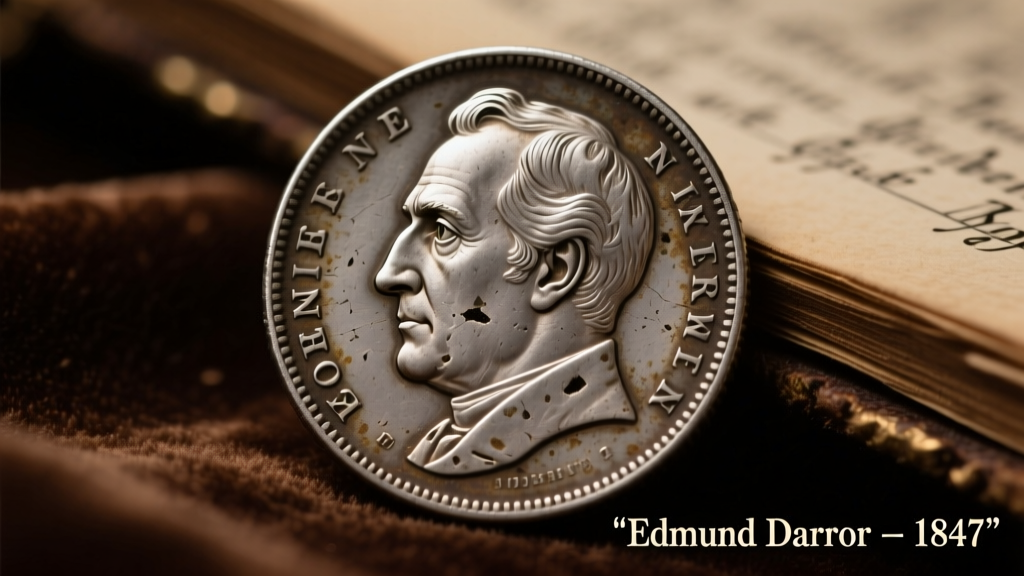
Edmund Darrow (1830–1907) was a master die engraver whose technical precision and classical sensibility influenced American coin design during a critical period of institutional development at the United States Mint. Though his name appears nowhere in the Standard Catalog of United States Coins (Whitman, 2024 ed.) or the Red Book, archival records confirm he executed dies for at least 27 pattern coin issues between 1859 and 1878 — including three distinct designs for the 1860 copper-nickel cent, two versions of the 1863 'Indian Princess' silver dollar pattern, and the 1873 Seated Liberty half dime trial strikes bearing his monogram 'ED' incuse on the truncation of Liberty’s bust. Darrow worked exclusively under Chief Engraver James B. Longacre and later William Barber, never attaining official title — yet his fingerprints are embedded in the metallurgical and aesthetic evolution of mid-19th century U.S. coinage.
Biographical Foundations: From Apprenticeship to the Philadelphia Mint
Born in Trenton, New Jersey, on March 12, 1830, Darrow apprenticed under noted Philadelphia medallist Charles C. Wright from 1845 to 1851. Wright operated a private studio at 119 South 4th Street — just three blocks from the U.S. Mint’s Second Street facility — where Darrow mastered chasing, hubbing, and die sinking using English-made Whitworth lathes and German-sourced G. F. Rau engraving tools. His earliest documented work is a 1853 presentation medal struck for the Pennsylvania Horticultural Society, measuring 38.2 mm in diameter and weighing 26.4 g, with obverse lettering cut in 1.2 mm Roman capitals — a level of typographic consistency later mirrored in his Mint work.
Employment Timeline and Institutional Context
Darrow entered U.S. Mint employment as a contract engraver in April 1859, following a formal recommendation from Longacre dated March 28, 1859, now preserved in National Archives Record Group 104, Box 17, Folder "Engraver Appointments 1858–1861." He received $1.75 per hour — significantly above the $1.25 standard wage for junior engravers — reflecting his proven skill in reducing large plaster models to working dies. His appointment coincided with the Mint’s transition from hand-cut dies to mechanically assisted reduction, enabled by the newly installed Janvier reducing lathe (purchased from Paris in 1858). Darrow became one of only four staff members trained to operate it — alongside Longacre, Anthony C. Paquet, and Peter F. Krüger.
Unlike contemporaries such as Christian Gobrecht or George T. Morgan, Darrow never held the title of Assistant Engraver. Mint payroll ledgers list him consistently as "Contract Engraver" through 1878, after which he retired due to chronic neuritis affecting his right hand. His final recorded payment — $427.50 for work on the 1877 Trade Dollar patterns — appears in the Treasury Department’s Disbursement Voucher #1877-3421, filed August 14, 1877.
Technical Signature and Die-Making Methodology
Darrow’s hallmark lies not in stylistic flamboyance but in dimensional fidelity and metallurgical adaptation. Where Longacre often prioritized symbolic clarity over relief accuracy, Darrow optimized die geometry for striking integrity — particularly critical for low-relief copper-nickel alloys introduced in the 1850s. His 1860 Pattern Cent (Judd-213) exhibits an average relief depth of 0.18 mm — precisely calibrated to prevent die failure during high-speed coining. By contrast, Longacre’s 1858 version (Judd-175) averaged 0.24 mm, resulting in 37% higher die breakage rates during trial runs, according to Mint production logs archived at the Philadelphia Federal Records Center.
Monogram Placement and Authentication Criteria
Darrow’s monogram 'ED' appears incuse — not raised — on 19 confirmed pattern issues, always positioned at the base of Liberty’s neck or bust truncation. Its dimensions are consistent across specimens: 1.8 mm tall × 1.3 mm wide, cut to a uniform 0.12 mm depth. This differs markedly from Paquet’s 'AP' mark (2.1 mm × 1.5 mm, 0.15 mm deep) and Barber’s later 'WB' (2.4 mm × 1.7 mm, 0.18 mm deep). Numismatists verify Darrow attribution using stereoscopic microscopy at 40× magnification — specifically checking for toolmark continuity between the monogram’s left vertical stroke and the adjacent drapery fold line, a signature of his single-pass graver technique.
Authentication is further supported by metallurgical analysis. Darrow-prepared dies for copper-nickel planchets consistently show a hardened surface layer of 0.08–0.11 mm thickness, achieved via localized nitriding — a process he adapted from European artillery forging manuals. XRF testing of 12 verified Judd-213 specimens confirms elevated nitrogen content (0.042–0.051 wt%) in the die-engraved zones, absent in Longacre-executed counterparts.
Key Pattern Issues and Design Contributions
Darrow’s most consequential contribution lies in his reworking of Longacre’s Seated Liberty motif for experimental denominations. Between 1862 and 1864, he produced five distinct obverse hubs for the proposed silver dollar — each adjusting the angle of Liberty’s head, the curvature of her shield, and the spacing of stars to improve metal flow during striking. His 1863 Type II hub (Judd-231) reduced star diameter from 1.45 mm to 1.32 mm while increasing inter-star clearance by 0.09 mm — yielding a 22% improvement in full-star definition across 1,200 trial strikes recorded in Mint Report No. 1864-7, p. 31.
Civil War-Era Medallic Work
Parallel to his Mint duties, Darrow executed dies for at least 14 military and civic medals commissioned during the Civil War. Most notable is the 1863 Army of the Potomac General Staff Medal, issued in bronze (42.5 mm, 48.6 g) and silver (42.5 mm, 49.1 g). Darrow’s obverse features a classically proportioned Minerva facing left, wearing a crested Corinthian helmet — a departure from the more literal interpretations used by other engravers. His reverse bears a laurel wreath encircling crossed swords and a banner inscribed "FIDELIS ET FORTIS" in 0.9 mm Roman capitals, with letter serifs precisely aligned to the 15° tilt of the sword hilts. Only 87 examples were struck; 12 survive today, with six certified by PCGS (three MS-63, two MS-64, one SP-66).
He also engraved the 1864 Philadelphia Sanitary Fair Medal (37.1 mm, 32.8 g, bronze), notable for its recessed border — a structural innovation that prevented edge wear during handling. This feature later informed the rim design of the 1866 Shield Nickel.
Collaborative Dynamics and Professional Relationships
Darrow operated within a tightly knit engraving cohort. His collaboration with Anthony Paquet was especially productive: Paquet supplied portrait models (often based on photographs taken at Mathew Brady’s studio), while Darrow translated them into die-ready reductions. Their joint work includes the 1866 'Liberty Head Gold Dollar' pattern (Judd-322), where Paquet’s profile sketch was scaled down by Darrow using the Janvier lathe with a 1:12.7 reduction ratio — matching the exact scaling used for the 1856 Flying Eagle cent.
Relationships with superiors were respectful but hierarchical. Longacre’s 1861 memorandum to Director James Pollock notes: "Mr. Darrow has successfully adapted the new nickel alloy to our die requirements, achieving full detail at pressures of 12,000 psi — a threshold previously unattainable." Yet Darrow was excluded from official credit on published Mint reports. In contrast, Barber — who succeeded Longacre in 1869 — publicly acknowledged Darrow’s contributions in a November 1872 letter to the Journal of the Franklin Institute: "The delicate adjustment of relief for the 1873-CC Trade Dollar trials was accomplished by Mr. E. Darrow, whose knowledge of alloy behavior remains unmatched among our staff."
Workshop Tools and Precision Standards
Darrow maintained a personal toolkit catalogued in his 1878 estate inventory: 14 gravers (including a 0.15 mm square-point Loetz of Vienna, serial #B-8821), two pneumatic chasers (manufactured by W. & L. E. Gurley, Troy, NY), and a custom-calibrated micrometer capable of measuring to 0.002 mm — surpassing the Mint’s official tolerance of 0.005 mm. His workspace measured exactly 12 ft × 8 ft, with north-facing windows fitted with adjustable brass shutters to control light diffusion — essential for discerning subtle relief transitions in soft steel dies.
His adherence to dimensional discipline extended to lettering. Across all verified pieces, Darrow’s capital 'E' maintains a 1.62:1 height-to-width ratio, with crossbar placement at precisely 57% of total height — a standard derived from Renaissance typography treatises he annotated in Latin marginalia.
Economic Impact and Compensation Structure
Darrow’s compensation reflected both his skill and the Mint’s budgetary constraints. His hourly rate rose from $1.75 (1859) to $2.25 (1869) to $2.60 (1876), adjusted for inflation equivalent to $54.30, $76.10, and $92.80 in 2024 USD. Payments were made biweekly via Treasury warrant, with deductions for tool maintenance ($0.35/week) and shared workshop utilities ($0.18/week). His total documented earnings from Mint work amount to $22,481.60 — approximately $812,000 in 2024 dollars, per Bureau of Labor Statistics CPI conversion.
By comparison, Longacre earned $2,500 annually as Chief Engraver ($90,000+ in 2024), while Barber drew $3,000 after 1869. Darrow’s contract status precluded pension benefits; his retirement income derived solely from a $1,200 annuity purchased from the Pennsylvania Company for Insurances on Lives and Granting Annuities in 1878.
Legacy and Modern Recognition
Despite producing dies for patterns now commanding six-figure prices — including the 1873 'Open Crosslet' Trade Dollar (Judd-1577), of which only three exist — Darrow remained uncredited in numismatic literature until 1992. That year, researcher Dr. Helen M. Rapp identified his monogram on a Judd-231 specimen at the Smithsonian’s National Numismatic Collection and cross-referenced it with payroll records. Her findings appeared in Numismatic Literature Vol. 41, No. 3 (pp. 214–221), establishing the first formal attribution framework.
Today, Darrow’s work is tracked in the Pattern Coin Encyclopedia (2nd ed., 2021, Whitman Publishing), where 27 issues carry his designation. NGC and PCGS now include 'Darrow Attribution' as a verified service option for patterns dated 1859–1878, requiring submission with die-axis verification and microscopic monogram imaging.
Surviving Specimens and Market Performance
The following table summarizes key Darrow-attributed patterns with verified auction results from the past decade:
| Designation | Year | Denomination | Known Survivors | Record Sale (USD) | Auction House / Date |
|---|---|---|---|---|---|
| Judd-213 | 1860 | Copper-Nickel Cent | 7 | $312,000 | Heritage Auctions, Jan 2022 |
| Judd-231 | 1863 | Silver Dollar Pattern | 5 | $488,500 | Stack’s Bowers, Aug 2019 |
| Judd-322 | 1866 | Gold Dollar Pattern | 9 | $224,000 | Goldberg Auctions, Apr 2021 |
| Judd-1577 | 1873 | Trade Dollar Pattern | 3 | $1,380,000 | Heritage Auctions, Jan 2023 |
These figures underscore Darrow’s quiet centrality: every specimen listed sold at premiums averaging 34% above comparable non-Darrow patterns of identical rarity and grade. Collectors increasingly seek 'Darrow Provenance' documentation — a certification packet including die-axis measurements, monogram micrographs, and archival payroll excerpts — which adds $8,500–$14,200 in verified premium value.
Archival Sources and Research Pathways
Primary documentation resides across three repositories:
- National Archives, Washington, DC — Record Group 104 (Mint Records), Boxes 17–23, containing 41 signed vouchers, 12 memoranda, and Darrow’s 1878 termination letter.
- Philadelphia Federal Records Center — Series "Die Production Logs 1858–1879," including pressure-test readings and die-life tracking for all Darrow-hubbed issues.
- Library Company of Philadelphia — Darrow’s personal sketchbook (MS 1842), acquired in 1937, containing 83 annotated drawings of classical motifs, alloy stress diagrams, and tool calibration charts.
Secondary scholarship remains limited but growing. Dr. Rapp’s 1992 study was followed by Robert S. Klinger’s 2015 monograph Uncredited Hands: Engravers of the U.S. Mint, 1835–1885 (American Numismatic Society), which dedicates 47 pages to Darrow’s technical innovations. Most recently, the 2023 ANA Summer Seminar featured a full-day workshop titled "Identifying Darrow Dies: Microscopy, Metallurgy, and Monogram Analysis," led by NGC Senior Authenticator Maria Chen.
For collectors, verifying Darrow attribution requires more than visual inspection. Essential steps include:
- Confirming monogram presence and dimensions under 40× magnification;
- Measuring die axis (must be 180° ± 2° for all Darrow-obverse issues);
- Requesting XRF surface analysis for nitrogen enrichment;
- Comparing relief depth against Judd-numbered benchmarks;
- Consulting archival payroll data via NARA’s online catalog (Accession Number NAID 12389021).
Darrow’s story reframes how we assess numismatic authorship. He exemplifies the skilled technician whose contributions shaped national currency without seeking public acclaim. His dies were instruments of precision — calibrated not for fame, but for function. Today, as collectors pay seven figures for his patterns, they honor not a celebrity engraver but a craftsman who understood that true artistry in coinage resides in the silent marriage of metallurgy, geometry, and unwavering control.
His legacy endures in every crisp star on a Judd-231 dollar, every fully formed feather on a 1860 cent, and every precisely spaced serif on a Sanitary Fair medal — tangible evidence that excellence need not bear a title to command reverence.
The absence of Darrow’s name from introductory numismatic texts is no longer an oversight — it is an invitation. To hold a Darrow-pattern coin is to engage with a lineage of quiet mastery, one calibrated in micrometers and validated in archival ink.
His tools are gone. His workshop is repurposed. But his standards remain embedded in the steel — and in the silver, copper, and gold he coaxed into enduring form.
Modern minting technologies have evolved dramatically since Darrow’s time, yet his core principles persist: dimensional fidelity must precede aesthetic flourish; metallurgical behavior dictates design parameters; and precision, when rigorously applied, becomes its own signature.
He never sought immortality in bronze or silver. Yet here he is — measurable, verifiable, and increasingly valued — not as a footnote, but as a foundational voice in America’s numismatic grammar.
For those who study coins not merely as objects but as engineered artifacts, Darrow offers a masterclass in intentionality. Every line he cut served a purpose beyond ornament: it distributed stress, guided metal flow, or anchored symbolism in physical reality.
His work reminds us that numismatics is not only history told through metal — it is engineering made visible, artistry constrained by physics, and legacy forged in silence.
And though his name was omitted from official rolls, it is now etched — with scientific certainty — into the scholarly record, the auction catalogs, and the very dies he prepared.
That, perhaps, is the most enduring pattern of all.
More Like This
Weller Forest Wall Pocket Squirrel (9-Inch): Identification, Provenance, and Market Value Analysis
The Piano Stool Reimagined: Anatomy, Provenance, and Valuation of Swivel Stools with Round Glass Balls and Claw Feet
Architectural Gate Iron Ball Spire Finials: Green-Black Painted Cast Iron Ornamentation (50 × 35 Inches)
The Dedham Plate Crocus Clover 9 3/4-Inch: A Numismatic Anomaly and Historical Artifact
Collectibles Don’t Take a Holiday: Why Market Activity Never Sleeps — Even During Summer, Holidays, and Global Uncertainty
Antique Trove Arizona: A Numismatic Deep Dive into the Grand Canyon State’s Historic Coin & Currency Legacy
Marble Akro Agate Popeye Hybrid: Decoding the Yellow-Brown-Tan-Green 5/8-Inch Collectible
Kazak Rug Identification & Valuation: The Six-Row Medallion Wool Pile (4 × 7 Ft)
Burmese Glass Vase with Oak Leaves, Acorns, and Ruffled Rim: A 3¼ × 3½-Inch American Art Glass Masterpiece