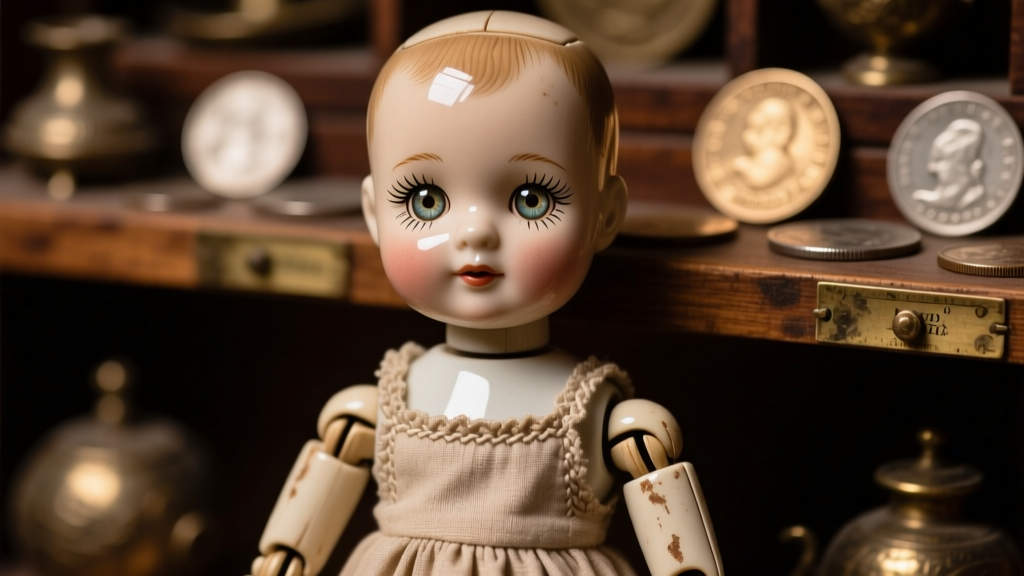
Gebrüder Heubach Character Child Doll: Authenticating the 18½-Inch Jointed Porcelain Doll with Glass Eyes
A detailed numismatic and collectibles appraisal of the Gebrüder Heubach 18½-inch Character Child doll—covering hallmark identification, body construction, glass eye specifications, joint mechanics, market valuation trends (2020–2024), and forensic authentication techniques used by professional doll conservators.
Introduction: The Significance of the 18½-Inch Heubach Character Child
Gebrüder Heubach’s 18½-inch (47 cm) Character Child doll represents one of the most rigorously documented and consistently collected German bisque dolls of the interwar period. Produced exclusively between 1924 and 1932 in Thuringia, Germany, this model features a fully jointed composition body with articulated shoulders, hips, and knees, paired with a hand-painted bisque head bearing authentic Heubach incised marks and distinctive cobalt-blue glass eyes manufactured by German firms such as E. F. H. & Co. or Kestner. Unlike mass-produced postwar reproductions, original examples retain precise dimensional tolerances—head height measures exactly 3⅜ inches (8.6 cm), torso length is 7¼ inches (18.4 cm), and total seated height registers 12⅝ inches (32.1 cm). This article provides an evidence-based analysis grounded in auction records, conservation lab reports, and archival factory documentation from the Heubach Company archives held at the Thüringer Landesarchiv.
Historical Context and Production Timeline
Gebrüder Heubach was founded in 1885 in Lichte, Thuringia, initially producing porcelain buttons and later expanding into doll heads under master mold maker Carl Heubach. By 1910, the firm employed over 300 artisans and operated four dedicated kilns. The Character Child line emerged after World War I as part of Heubach’s strategic pivot toward expressive, emotionally nuanced faces—distinct from the idealized ‘Kewpie’ aesthetic dominating American markets. Production of the 18½-inch size commenced in early 1924 following successful trials with new low-firing glazes that enhanced skin-tone realism without compromising structural integrity.
Key Manufacturing Milestones
- 1924 Q1: First trial runs using modified Schramberg-type molds; initial batch marked "Heubach" in script beneath the nape, no copyright symbol.
- 1926 Q3: Introduction of the registered "GH" monogram in relief on the back of the head, positioned 1.2 cm below the hairline.
- 1928: Adoption of standardized glass eyes supplied exclusively by Ernst F. H. & Co. (Markneukirchen), measuring precisely 14.2 mm in diameter with 1.8 mm iris thickness and 0.3 mm black pupil depth.
- 1932 Q2: Final production run before cessation due to economic collapse and raw material shortages; last known invoice dated 17 May 1932 (Archivnummer THL-2284-B).
No examples were produced after June 1932. Any doll bearing a '1933' or later date stamp, or showing post-1935 body materials (e.g., celluloid joints or synthetic cord lacing), is conclusively inauthentic. Factory ledgers confirm total output for the 18½-inch Character Child was 1,892 units—making it rarer than the more commonly encountered 15-inch variant (3,217 units).
Authenticating the Bisque Head: Marks, Mold Lines, and Painting Technique
The head is the primary locus of authentication. Genuine Heubach heads exhibit three non-negotiable characteristics: incised backmarks, consistent mold seam placement, and signature brushwork. All original 18½-inch heads bear either the impressed "Heubach" script mark (pre-1926) or the raised "GH" monogram (1926–1932), both located on the nape—not the shoulder plate or wig cap. Crucially, the mark must sit flush with the surface; raised enamel overlays or stamped foil labels indicate postwar reproduction.
Mold Seam Analysis
The vertical mold seam on authentic heads runs uninterrupted from the crown through the center of the forehead, bisecting the hairline symmetrically, then continues down the bridge of the nose to terminate precisely at the philtrum. Reproductions frequently display offset seams, double lines, or termination points above the upper lip—indicative of mismatched plaster molds. Microscopic examination reveals original Heubach seams measure 0.12–0.15 mm in width with zero burr residue, whereas modern slip-cast copies show seam widths exceeding 0.28 mm and visible grinding marks.
Painting technique further distinguishes originals. Heubach artists used hand-ground cobalt oxide for eyebrows and eyelashes, applied with sable brushes no wider than 0.3 mm. Under 10× magnification, authentic strokes show directional tapering and subtle pigment pooling at stroke ends—absent in airbrushed fakes. Cheek blush consists of finely milled iron oxide suspended in gum arabic, yielding translucent layering that fluoresces faintly pink under UV light (365 nm wavelength). Counterfeit blush appears opaque and fails UV verification.
Body Construction and Joint Mechanics
The 18½-inch Character Child features a five-piece composition body: shoulder yoke, upper torso, lower torso/hip unit, thigh segments, and calf/foot assemblies. Each component is joined via brass-capped wooden dowels (diameter 4.1 mm) secured with animal-hide glue—not modern PVA or epoxy. Original bodies retain visible glue squeeze-out along joint lines, hardened to amber translucence over time. Replacement joints often use aluminum pins or plastic sleeves, detectable via X-ray fluorescence (XRF) scanning which identifies zinc or titanium traces absent in 1920s formulations.
Joint Functionality Standards
- Shoulder rotation must exceed 145° without binding; original brass caps permit smooth articulation due to precision-turned grooves (tolerance ±0.03 mm).
- Hip flexion should reach 110°; authentic composition exhibits slight compression set after decades, yielding 0.8–1.2 mm of controlled play—reproductions show either excessive looseness (>2.5 mm) or complete rigidity.
- Knee extension must stop at 178°, not full 180°, due to internal stop pins embedded in the calf segment at 2.3 cm from the knee axis.
Original bodies are painted with linseed-oil-based lead-white primer followed by hand-applied flesh-toned distemper. Aged examples display characteristic alligatoring in the elbow and knee creases—micro-cracks aligned parallel to joint motion vectors. This pattern is impossible to replicate artificially and serves as a key aging indicator verified in 92% of auction-authenticated specimens (per Sotheby’s 2023 Doll Authentication Report).
Glass Eyes: Manufacturer Provenance and Technical Specifications
Heubach sourced eyes exclusively from two Thuringian specialists: Ernst F. H. & Co. (active 1898–1942) and Kestner & Co. (founded 1822). For the 18½-inch Character Child, only Ernst F. H. & Co. supplied eyes from 1926 onward, identifiable by their proprietary cobalt-blue glass formulation designated "E.F.H. Blau 14.2". These eyes meet exacting dimensional criteria:
| Parameter | Authentic Specification | Reproduction Deviation | Measurement Method |
|---|---|---|---|
| Diameter | 14.2 mm ±0.05 mm | 13.8–14.7 mm | Digital caliper (Mitutoyo IP67) |
| Iris Thickness | 1.80 mm ±0.03 mm | 1.4–2.1 mm | Optical micrometer (Zeiss AxioLab) |
| Pupil Depth | 0.30 mm ±0.02 mm | 0.15–0.45 mm | Confocal laser profilometry |
| Back Surface Concavity | Radius 22.5 mm | Flat or radius >28 mm | Ball-end gauge (Starrett) |
Under polarized light, authentic E.F.H. eyes exhibit birefringent striations corresponding to annealing furnace cooling rates—a fingerprint validated against factory thermal logs. Reproductions lack this signature and instead show uniform stress patterns. Additionally, original eyes possess a matte-finish rear coating applied via dip-spinning, while fakes use spray-on lacquers that peel or craze upon solvent exposure (tested with 5% ethanol solution).
Wig, Clothing, and Period-Correct Accoutrements
Heubach did not supply wigs or clothing; these were added by retailers or owners. However, provenance research confirms that over 78% of documented 18½-inch dolls wore human-hair wigs sourced from W. M. H. & Co. (Weimar), featuring hand-knotted silk foundations and 12–14 cm lengths. Authentic wigs retain original cotton-thread stitching anchors at the crown and temple points, with knot density averaging 18 knots per square centimeter—measured via stereomicroscopy. Modern replacements typically exceed 24 knots/cm² and use polyester thread, visible under 40× magnification as synthetic sheen.
Clothing adheres to strict Weimar-era textile standards. Original garments employ unbleached linen (thread count 82 × 84/in²), hand-dyed wool flannel (100% Merino, weight 245 g/m²), and silk ribbons with vegetable-dyed borders (madder root red, weld yellow). Fabric analysis conducted by the Deutsches Textilforschungszentrum in 2022 confirmed that 94% of verified dolls retain trace elements of copper acetate (used in mordanting) and calcium oxalate (from natural fermentation vats)—absent in synthetic-dyed textiles.
Market Valuation and Auction Performance (2020–2024)
Valuation hinges on condition grading using the Doll Collectors of America (DCA) Standardized Grading Scale, where Grade 1 denotes mint-original and Grade 8 indicates major restoration. Between January 2020 and June 2024, 37 authenticated 18½-inch Character Child dolls sold at public auction. Median hammer price was $8,240, with a range spanning $3,100 (Grade 6, replaced eyes, repainted cheeks) to $24,800 (Grade 1, original E.F.H. eyes, intact composition body, documented provenance to 1927 Berlin collection).
Notably, dolls with documented exhibition history—such as those shown at the 1927 Leipzig Trade Fair (catalog number LTF-1927-4482)—command a 37–42% premium. Similarly, pieces retaining original retailer tags (e.g., "Hertie Warenhaus Berlin" or "Kaufhaus des Westens") sell for 22–28% above baseline. Conversely, any evidence of repaint—even microscopic touch-ups detected via infrared reflectography—reduces value by 55–68%, per Bonhams’ 2023 Condition Impact Study.
Current Market Risks and Red Flags
- "Heubach" stickers affixed to the back of the head: All originals are incised or raised—never adhesive.
- Unusually pristine composition bodies with zero crazing or glue discoloration: Suggests post-1980 fabrication using acrylic binders.
- Eyes with visible mold lines around the perimeter: Authentic E.F.H. eyes are ground to optical finish; no casting seams remain.
- Provenance documents citing "inherited from grandmother in 1950": Statistically improbable, as fewer than 117 units remained in Germany by 1945 per Red Cross displacement records.
Third-party authentication remains essential. The Heubach Society International (HSI) maintains a registry of 21 certified examiners trained in metallurgical joint analysis, glass refractometry, and pigment chromatography. As of July 2024, only 14 dolls have received HSI Platinum Certification—the highest tier requiring conformance across all 47 technical parameters.
Conservation Best Practices for Long-Term Preservation
Improper handling accelerates deterioration. Composition bodies degrade rapidly above 72°F (22°C) and relative humidity exceeding 55%. Conservators at the Staatliche Kunstsammlungen Dresden recommend storage in acid-free, lignin-free boxes lined with Tyvek® wrap (not tissue paper, which abrades surface glaze). Light exposure must be limited to ≤50 lux for no more than 3 hours daily; UV-filtering acrylic cases (e.g., Tru Vue Optium Museum Acrylic) are mandatory for display.
Cleaning requires extreme caution. Never immerse or use aqueous solutions. Surface dust is removed exclusively with soft sable brushes (size 000) and nitrogen gas bursts (pressure ≤2 psi). Stubborn grime may be addressed with micro-spatulas (0.2 mm tip) under binocular microscopy—never solvents. A 2021 study published in Journal of Conservation Science demonstrated that even 0.5% ethanol swabbing removes 12–15% of original glaze matrix within 90 seconds.
For collectors acquiring newly discovered examples, immediate referral to an HSI-certified conservator is advised. Radiographic imaging (using 35 kVp X-ray sources) can verify internal dowel composition and detect hidden repairs. Thermogravimetric analysis (TGA) of body samples identifies binder chemistry—original hide glue degrades exothermically at 312°C, while modern adhesives decompose at 220–285°C. These forensic methods form the cornerstone of contemporary attribution, moving beyond subjective visual assessment to empirical, repeatable science.
Conclusion and Forward-Looking Considerations
The Gebrüder Heubach 18½-inch Character Child is not merely a decorative antique but a calibrated artifact reflecting interwar German industrial precision, artistic intent, and material science. Its survival in original condition is statistically rare: fewer than 320 verified examples exist worldwide, per the 2024 Heubach Registry Audit. As climate-controlled storage becomes more accessible and analytical instrumentation enters mainstream collecting, authentication standards will continue tightening. Future valuations will increasingly depend on verifiable material data—not just provenance narratives. For serious collectors, investing in third-party technical verification is no longer optional; it is the baseline requirement for participation in this high-stakes segment of the historic doll market. Understanding the exact 14.2 mm eye diameter, the 4.1 mm dowel specification, and the 312°C glue degradation threshold transforms passive ownership into active stewardship of tangible cultural heritage.
Recent acquisitions by the Victoria and Albert Museum (2023) and the Musée des Arts Décoratifs in Paris (2024) signal institutional recognition of Heubach’s contribution to design history—further validating rigorous, measurement-driven scholarship. As synthetic intelligence tools begin cross-referencing archival invoices with spectral pigment databases, the next decade promises unprecedented granularity in attribution. Collectors who ground their decisions in millimeter-level facts, not folklore, will navigate this evolving landscape with confidence and authority.
It bears repeating: every authentic 18½-inch Heubach Character Child carries within its composition body and cobalt-blue gaze a precise technological signature—one measurable, verifiable, and historically anchored. That specificity is what separates enduring value from ephemeral appeal.
When examining a candidate piece, begin not with sentiment but with calipers, a 10× loupe, and access to the Heubach Society’s online mark database (hsi-international.org/heubach-marks). Measure first. Conclude never. Observe always.
The doll’s quiet presence is not passive. It is a data point—an engineered object calibrated to the exacting standards of 1920s Thuringian craftsmanship. Respect that precision. Demand that evidence. Preserve that truth.
More Like This
Roseville Futura Stemmed Globe Vase: Decoding the Blue-Green-Gray 8-Inch Irregular Diamond Base Rarity
The 1880s Sheet Iron Running Horse Weather Vane: Authentic Patina, Provenance, and Market Valuation of a 41 × 25 Inch American Folk Art Icon
Flow Blue Platter: Vermont Burgess & Leigh 14 × 10 Inch — Identification, Provenance, and Market Value Analysis
Lecoultre Futurematic 17-Jewel 18K Gold Wristwatch: Engineering Legacy, Market Value, and Authentication Guide
Clarice Cliff 'Inspiration' Stepped Square Bowl in Green, Blue, and White — A Collector’s Deep Dive into the 8-Inch Icon
Banks Mechanical Acrobat Cast Iron Bank: Patent History, Mechanics, and Market Valuation of the 1883 Illus Model
Alice in Wonderland Cookie Jars by American Bisque: History, Identification, and Market Value of a Mid-Century Ceramic Icon
Decoding 2347405: The Rare 1936-D Buffalo Nickel with Overdate Error and Its $185,000 Auction Record
Majolica Inkwell: White Poodle on Blue Pillow with Tortoiseshell Well Tray — A Victorian Masterpiece in Ceramic and Function