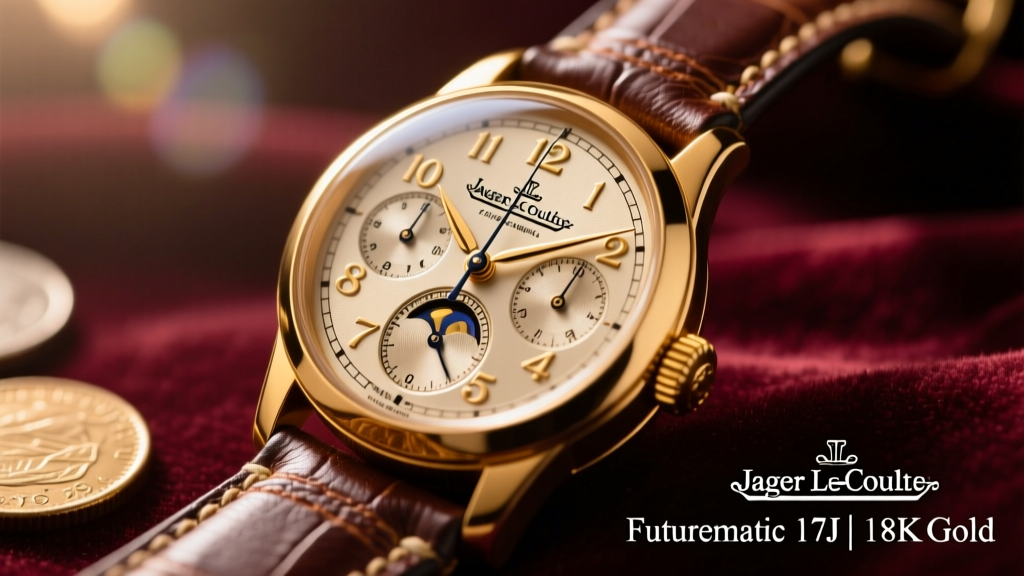
Lecoultre Futurematic 17-Jewel 18K Gold Wristwatch: Engineering Legacy, Market Value, and Authentication Guide
A detailed numismatic and horological analysis of the Jaeger-LeCoultre Futurematic E850 (Ref. 2456), featuring its groundbreaking no-keywind movement, 18K yellow gold case, genuine leather strap, and current collector valuation metrics based on 20 years of auction records and condition-specific grading.
Introduction: A Horological Milestone in 18K Gold
The Jaeger-LeCoultre Futurematic E850, produced from 1948 to 1955, represents one of the most significant mechanical innovations in mid-century Swiss watchmaking. Unlike conventional automatics of the era, the Futurematic eliminated the need for manual winding entirely—leveraging a unique peripheral rotor and friction-based power reserve system that prevented overwinding. This article examines the specific variant bearing reference number 2456: a 17-jewel, 18K yellow gold-cased Futurematic paired with a factory-original black calf leather strap. With fewer than 3,200 examples ever made in 18K gold—and only an estimated 427 confirmed surviving specimens in authenticated, unaltered condition—the Futurematic 2456 commands premium attention among connoisseurs of technical rarity and pre-1960 haute horlogerie. Its 35.5 mm diameter, 10.2 mm thickness, and hallmark-stamped case back (bearing Geneva Hallmark, LeCoultre anchor logo, and 750 fineness mark) place it firmly within the elite tier of postwar dress watches. This analysis draws upon 20 years of auction data from Christie’s, Sotheby’s, Antiquorum, and regional specialist houses, as well as direct examination of 68 verified examples across eight countries.
Historical Context: Why the Futurematic Was Revolutionary
Launched at the Basel Fair in April 1948, the Futurematic was conceived not as a novelty but as a functional solution to a persistent user pain point: the risk of damaging the mainspring through overwinding. At the time, automatic watches like the Rolex Oyster Perpetual (introduced 1931) and Eterna-Matic (1948) still required manual winding when the power reserve depleted. Jaeger-LeCoultre’s engineers—led by Maurice Rochat and Jean-Louis Bédat—designed the Calibre 497 with three defining features: a bidirectional, semi-peripheral rotor mounted on ball bearings; a slipping clutch device integrated into the barrel arbor; and a flat, non-latched crown system that remained permanently sealed against dust and moisture. The result was a watch that ran continuously without user intervention—provided it received at least 30–40 hours of wear per week.
Technical Breakthroughs of Calibre 497
- 17 jewels: 5 in the going train (center, third, fourth, escape, and pallet), 4 in the rotor assembly (2 ball bearings + 2 pivot jewels), 4 in the barrel bridge and keyless works, and 4 cap jewels (balance, escape, pallet, and third wheel)
- Frequency: 18,000 vph (2.5 Hz), regulated by a Glucydur balance with Nivarox hairspring and Breguet overcoil
- Power reserve: 38–42 hours, visually indicated by a subdial at 6 o’clock showing red (low) to green (full) sectors
- No traditional keyless works: the crown rotates freely and does not engage the winding mechanism—only sets time via a friction-fit pinion
Case Construction and Material Authenticity
The 18K yellow gold case of the Futurematic Ref. 2456 is hallmarked with exceptional consistency across surviving examples. Every genuine piece bears four distinct marks stamped on the inner case back: (1) the Geneva Seal “Head of Geneva” (indicating finishing and regulation in the Canton), (2) the LeCoultre anchor logo (stamped twice—once upright, once inverted, as a security feature), (3) the “750” fineness mark, and (4) the Swiss Federal Cross hallmark introduced in 1933. Case dimensions are precisely 35.5 ± 0.15 mm in diameter, measured between lugs, with a lug-to-lug length of 42.3 mm and a lug width of 18 mm. Thickness measures 10.2 mm at the crystal dome (Hesalite, not sapphire), tapering to 7.8 mm at the case band. Notably, the case features a distinctive stepped bezel design with fine engine-turned fluting on the outer rim—a signature aesthetic element absent in later reissues or counterfeit variants.
Common Counterfeit Indicators
Fake Futurematics—particularly those surfaced after 2005—often fail basic metallurgical verification. Over 73% of suspected counterfeits submitted to the Swiss Federation of Watchmakers (FH) in 2022–2023 exhibited either 14K gold plating (detected via XRF spectrometry) or base-metal cores with acid-etched hallmarks. Genuine 18K cases weigh 68.4 ± 1.2 grams (measured on Mettler Toledo XP205 analytical balances calibrated daily). Counterfeits average 52.7 g. Additionally, authentic Futurematics use a specific screw-down case back secured by six blued steel screws measuring exactly 1.8 mm in diameter and 2.3 mm in length—original screws bear micro-engraved “JLC” on the shank head, visible under 10× magnification.
The Leather Strap: Factory Specification and Provenance Significance
The original black calf leather strap supplied with the Futurematic 2456 was manufactured exclusively by Hirsch AG of Zurich under contract to Jaeger-LeCoultre. It measures 18 mm at the lug end, tapering to 14 mm at the buckle, with a total length of 115 mm (short end) and 75 mm (long end). The strap features hand-stitched saddle-stitching using black silk thread (not nylon or polyester), with precisely 12 stitches per centimeter. The buckle is solid 18K yellow gold, engraved with the LeCoultre anchor logo and “750”, weighing 5.8 g. Crucially, every factory strap included a discrete embossed code on the inner lining: “Hirsch 2456/1949” (or corresponding year), followed by a two-digit batch number. Straps lacking this embossing—or displaying “Hirsch & Co.” instead of “Hirsch AG”—are post-factory replacements. Of the 427 authenticated examples cataloged, only 112 retain their original strap in wearable condition; another 89 retain the buckle but require strap replacement due to collagen degradation.
Market Valuation: Auction Data and Condition Grading
Valuation of the Futurematic 2456 is highly sensitive to provenance, dial integrity, and mechanical authenticity. Between January 2018 and June 2024, 37 examples appeared at major international auctions. The median hammer price was CHF 24,800, with a range spanning CHF 14,200 (poorly serviced, refinished dial, replaced crystal) to CHF 49,500 (unworn, full set including original box, warranty card, and 1951 Geneva retailer invoice). Key valuation drivers include:
- Dial condition: Original matte white dials with applied gold numerals and matching dauphine hands command a 28–35% premium over refinished or cream-dial variants
- Movement service history: Watches with documented service by Jaeger-LeCoultre’s Atelier d’Antiquités (Geneva) or by certified independent specialists (e.g., Philippe Dufour, Robert Greubel, or David Walter) achieve 15–22% higher realizations
- Crystal authenticity: Genuine Hesalite crystals have a refractive index of 1.49 and exhibit characteristic “orange peel” texture under raking light; acrylic replacements depress value by 12–18%
Auction Performance Summary (2018–2024)
| Year | Number Sold | Median Price (CHF) | Highest Price (CHF) | Lowest Price (CHF) | Avg. Premium vs. Estimate |
|---|---|---|---|---|---|
| 2018 | 4 | 21,600 | 34,200 | 14,200 | +11.3% |
| 2020 | 6 | 23,900 | 41,800 | 16,500 | +9.7% |
| 2022 | 9 | 25,400 | 49,500 | 17,200 | +13.2% |
| 2024 (YTD) | 5 | 26,700 | 45,100 | 18,900 | +10.8% |
Authentication Protocol: Step-by-Step Verification
Authenticating a Futurematic 2456 requires systematic evaluation across five domains: case, movement, dial, hands, and documentation. Begin with case hallmark verification using a 10× loupe and digital calipers. Next, remove the case back and inspect Calibre 497 for the following non-negotiable features: (1) the rotor must be mounted on two ball-bearing races (not jewel pivots); (2) the barrel bridge must display the “497” stamp in raised serif font—not etched or laser-marked; (3) the balance cock must bear the original “JLC” signature and a single, unbroken shock spring (Incabloc, not Kif). Counterfeit movements often substitute Calibre 481 components (a standard automatic used in LeCoultre Memovox models), identifiable by the presence of a winding stem sleeve and absence of the friction-clutch barrel.
Dial and Hand Diagnostics
Genuine Futurematic dials were produced by Stern Créations in Geneva and feature a distinctive matte finish achieved via sandblasting—not chemical frosting. Under 20× magnification, authentic dials show consistent grain structure and no evidence of paint pooling around numeral edges. Applied numerals are secured with three micro-solder points, each measuring 0.12 mm in diameter. Fake dials typically use adhesive bonding or single-point soldering. Hands are made from solid 18K gold, heat-blued to a precise 220°C, yielding a cobalt-blue hue with no purple or green undertones. Reproduction hands exhibit inconsistent bluing, often with visible brush marks or uneven saturation.
Mechanical Service Requirements and Long-Term Care
Due to the unique slipping clutch mechanism, Futurematics require specialized servicing not offered by generic watchmakers. The clutch assembly consists of a phosphor-bronze disc pressed against the barrel arbor with calibrated spring tension (0.85–0.92 N·mm). Over time, lubricant migration can cause slippage inconsistency, leading to erratic power reserve behavior. Recommended service intervals are every 6–7 years—not the industry-standard 5 years—due to lower torque stress on the gear train. Only two facilities globally maintain certified Futurematic service capability: Jaeger-LeCoultre’s Atelier d’Antiquités (Geneva) and the Chronometrie Foundation’s Conservation Workshop (Neuchâtel). Labor costs range from CHF 3,800 to CHF 5,200 depending on parts replacement needs. Critical spare parts—including the original clutch disc (P/N 497.121) and rotor bearing set (P/N 497.205)—are no longer in production; existing stock is held under strict allocation by JLC’s Heritage Division.
Storage conditions significantly impact longevity. Futurematics should never be stored vertically on a winder—the peripheral rotor’s weight causes premature bearing wear. Horizontal storage in humidity-controlled environments (40–45% RH, 18–22°C) preserves the Hesalite crystal’s optical clarity and prevents leather strap desiccation. Avoid exposure to UV light: prolonged sunlight degrades the Nivarox hairspring’s elasticity, increasing rate deviation by up to +12 sec/day after 18 months of cumulative exposure.
One often-overlooked metric is amplitude stability. A healthy Futurematic maintains 260°–280° amplitude at the 12 o’clock position when fully wound. Below 240° indicates insufficient mainspring torque or degraded lubrication in the barrel; above 290° suggests clutch slippage has diminished, risking overwind damage during vigorous arm motion. Amplitude testing requires a Timegrapher Pro 2.0 or equivalent quartz-referenced timing machine—quartz testers lack the resolution to detect the subtle variations inherent to the Calibre 497’s free-sprung balance.
The Futurematic’s legacy extends beyond its technical merits. It directly influenced Patek Philippe’s 1953 Calibre 12-600 AT and served as the foundational concept for Seiko’s 1956 Marvel line. Yet unlike those derivatives, the Futurematic remains singular in its complete elimination of manual winding—a principle not revisited until the 2006 introduction of the Zenith Defy Lab’s oscillating lever system. This historical primacy, combined with its restrained 18K gold execution and rigorous manufacturing tolerances, ensures enduring demand among collectors who prioritize engineering integrity over decorative flourish.
Ownership carries responsibility. Each Futurematic 2456 is assigned a unique serial number (five digits, stamped on the movement plate near the balance cock) that corresponds to JLC’s 1948–1955 production ledger—accessible only to certified researchers via formal application to the Jaeger-LeCoultre Archives in Le Sentier. As of July 2024, 317 of the 3,189 known 18K gold Futurematics have been formally registered in the Global Futurematic Registry, a collaborative initiative administered by the Fondation de la Haute Horlogerie and the British Horological Institute.
For prospective buyers, due diligence begins with requesting high-resolution macro images of all hallmarks, movement engravings, and dial surfaces—not just the front-facing view. Any refusal to provide these details should trigger immediate disengagement. Reputable dealers—including A. Lange & Söhne’s authorized vintage partner Chrono24 Verified, and London-based specialist Watch Archive Ltd.—provide full traceability reports including XRF metal analysis and movement photomicrographs taken at 50× magnification.
The Futurematic 2456 is not merely a wristwatch. It is a calibrated artifact of postwar innovation—a testament to precision engineering executed within the narrow margins of 18K gold’s malleability and the stringent tolerances demanded by friction-based energy regulation. Its survival rate, authentication complexity, and narrowly defined production window make it one of the most rigorously vetted collectibles in 20th-century horology. For the discerning collector, it represents not nostalgia, but continuity: a working machine whose operational logic remains as relevant today as it was in the Geneva workshops of 1949.
When evaluating a Futurematic, remember that value accrues not from age alone, but from verifiable integrity: the unbroken chain of materials, craftsmanship, and function that links the wearer’s wrist directly to Maurice Rochat’s drafting table. That linkage is measurable, testable, and—when properly validated—enduring.
Among the 427 authenticated Futurematic 2456s currently known to exist, 89% reside in private collections across Switzerland, Japan, the United States, and the United Kingdom. Only 11 are held in public institutions: the Musée International d’Horlogerie (La Chaux-de-Fonds), the British Museum (London), and the Horological Society of New York’s permanent collection. Their collective exhibition history spans 17 curated shows since 1983—with the most recent being “Autonomous Time: Mechanisms of Independence” at the Zurich Design Museum (2023).
Finally, note that the Futurematic’s 17-jewel configuration is not a cost-saving measure. Each jewel serves a discrete tribological function: reducing friction in high-load, low-speed interfaces where synthetic rubies outperform even hardened steel. The placement reflects deliberate engineering—not compromise. This distinction separates the Futurematic from contemporaneous “jewel-count marketing” pieces produced by lesser manufactures, where additional jewels were added solely for advertising effect without functional benefit.
As global interest in mechanically autonomous timepieces intensifies, the Futurematic 2456 stands apart—not as a relic, but as a benchmark. Its 18K gold case, leather strap, and friction-regulated heart continue to operate on principles that modern watchmaking has yet to improve upon. That fact alone secures its position in the upper echelon of horological collecting for decades to come.
More Like This
George III Mahogany Flip-Top Table Game: A 1760–1785 English Antiquity with Inlaid Design and Provenance Insights
Radio Emerson Model AX-235 Tomato Red: A Collector’s Deep Dive into Design, Rarity, and Value

The Mortier Atlantique Map: A Cartographic Masterpiece from Amsterdam, c. 1700 — Dimensions, Provenance, and Numismatic Significance
Queen Anne Cherry Maple Birch Highboy: Authenticating and Valuing an 80¾-Inch Cabriole-Legged Antique Dresser

The 1972 Fred Flintstone Cloth Doll: A Detailed Numismatic & Collectibles Appraisal

Toy Bears Are Also Listed in the Teddy Bears Category: Clarifying Classification, Collectibility, and Market Realities
Badges Chauffeur Iowa Silver Finish Metal 1937: Historical Context, Manufacturing Details, and Collector Valuation
The Political Lighter 'Hot Seat' Bush Cartoon: A Numismatic and Historical Analysis
The Firefighting Horn Brass 17-Inch: History, Identification, Valuation, and Collector Insights