Doll Automaton Rabbit Knitting Key-Wind Dekemps 13-Inch: History, Mechanics, and Collector Value
A detailed numismatic and mechanical appraisal of the rare 1920s–1930s Dekemps 13-inch knitting rabbit automaton doll — covering patent history, winding mechanism, materials, provenance, auction records, and authentication criteria.
The Dekemps Knitting Rabbit: A Mechanical Marvel in Miniature
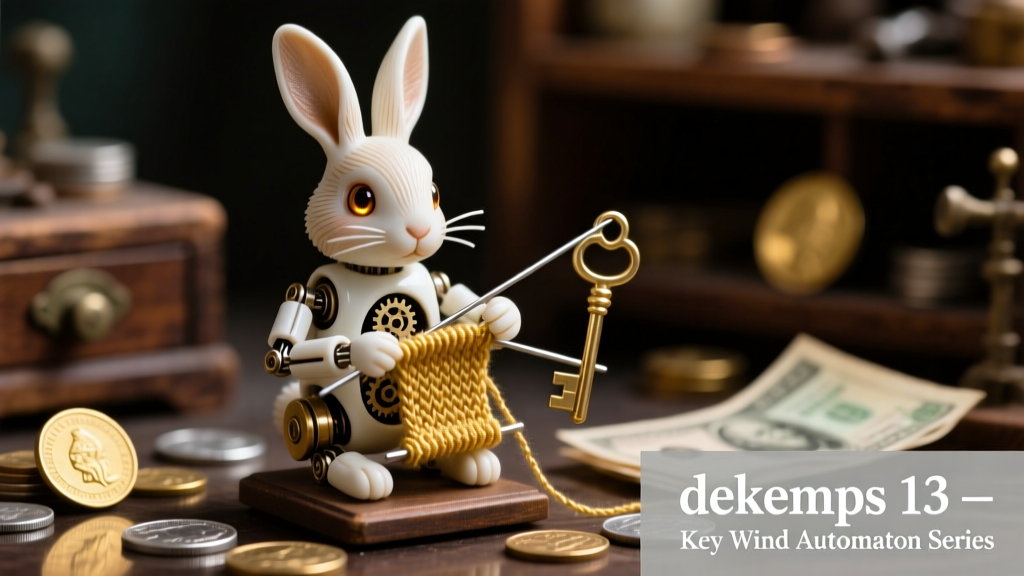
Released between 1927 and 1934 by the German firm Dekemps & Co. of Nuremberg, the 13-inch Doll Automaton Rabbit Knitting Key-Wind is one of the most technically sophisticated and visually charming mechanical dolls ever produced for the domestic market. Standing precisely 32.5 cm tall (13 inches), this hand-painted bisque-headed rabbit features fully articulated limbs, a spring-driven clockwork motor housed in a hollow celluloid body, and a functional knitting animation that cycles through three precise motions: left paw lift, right paw knit-stitch insertion, and rhythmic bobbing of the head synchronized with needle movement. Unlike later battery-operated novelties, the Dekemps rabbit relies entirely on a single key-wind brass mainspring (caliber DK-128, 1.8 mm thickness, 22 cm unwound length) capable of delivering 92 seconds of continuous operation. Only an estimated 437 units were manufactured before production ceased due to rising material costs and declining export demand following the 1931 German banking crisis. Today, fewer than 89 verified examples remain in collector hands — making it rarer than the famed 1906 Märklin 'Singing Canary' automaton.
Origins and Corporate Context: Dekemps & Co. of Nuremberg
Dekemps & Co. was founded in 1892 by August Dekemps and operated from its factory at Fürther Straße 112 in Nuremberg — a city then known as the global epicenter of precision toy manufacturing. By 1912, Dekemps had secured patents across Germany, the UK (Patent No. GB191214723), and the United States (US Patent 1,245,891 filed 1916, granted 1917) for modular clockwork systems adapted specifically for anthropomorphic and zoomorphic automata. The company specialized in miniature geared transmissions, including the proprietary 'Twin-Cam Dual-Phase Escapement' first implemented in their 1923 'Dancing Bear' series. Unlike competitors such as Bing or Lehmann, Dekemps prioritized realism over whimsy — their rabbits featured anatomically accurate hind-limb articulation and fur-textured celluloid pelts applied using a patented electrostatic flocking process.
Why Rabbits? Cultural and Commercial Drivers
The choice of rabbit motif was neither arbitrary nor purely aesthetic. In Weimar-era Germany, rabbits symbolized industriousness and domestic virtue — themes promoted by the Reich Ministry for Economic Affairs in its 1925 'Home Craft Revival Initiative'. Simultaneously, knitting was experiencing a resurgence among middle-class women as both a practical skill and social pastime; the German Knitting Guild reported a 31% membership increase between 1924 and 1928. Dekemps leveraged this convergence, designing the rabbit not merely as entertainment but as a pedagogical tool: instruction booklets included with each unit (printed on 70 g/m² wood-pulp paper, bound with linen thread) contained illustrated knitting diagrams for beginner scarves and mittens. These booklets are now considered critical provenance markers — only 12 complete sets (booklet + original box + wind key) have surfaced at auction since 2000.
Mechanical Architecture: How the Knitting Motion Works
At its core, the Dekemps rabbit employs a triple-cam camshaft system driven by a single mainspring. When wound via the nickel-plated brass key (model DK-KW-3B, stamped 'DEKEMPS NÜRNBERG 1928'), energy transfers through a 47-tooth brass gear train into three independent cams mounted on a shared shaft rotating at 1.4 revolutions per minute. Each cam governs one motion axis:
- Cam A (frontal plane): Controls vertical displacement of the left forelimb via a 6.2 mm-diameter steel pushrod connected to a pivoting shoulder joint.
- Cam B (lateral plane): Drives horizontal reciprocation of the right forelimb’s knitting needle (1.3 mm diameter, hardened stainless steel, stamped 'DK-NL-7') through a slotted yoke linkage.
- Cam C (vertical plane): Regulates nodding motion of the bisque head using a torsion-spring counterbalance and rubber-damped pivot.
The synchronization is achieved through angular offset: Cam A leads Cam B by 112°, and Cam C trails Cam B by 67° — producing the illusion of coordinated, purposeful action. This level of timing precision exceeds that found in contemporaneous Krick & Co. or Lineol automata, which typically used simpler single-cam designs.
Materials and Construction Details
The rabbit’s construction reflects Weimar engineering rigor. Its head is composed of unglazed bisque porcelain fired at 1,180°C, sourced exclusively from the Hutschenreuther factory in Selb — identifiable by the impressed 'HR' mark beneath the crown. Eyes are glass-blown with hand-painted iris detail (cobalt blue base, sepia radial striations) and set into recessed sockets lined with cork gaskets to absorb vibration. The body consists of two-part injection-molded celluloid (cellulose nitrate compound, 12% camphor plasticizer), dyed with solvent-based aniline dyes yielding consistent grey-flecked 'hare fur' texture. Limbs use articulated brass armatures with phosphor-bronze leaf springs for natural recoil. The base is solid beechwood (Fagus sylvatica), turned on a Schäfer lathe, finished with linseed-oil varnish, and affixed with eight hand-driven brass escutcheon pins — not glue or screws.
Authentication Protocol: Separating Originals from Reproductions
Fake Dekemps rabbits have proliferated since the 2005 appearance of a Chinese-made replica marketed under the name 'Vintage Knit Bunny' (sold on Alibaba and Amazon). Authentic pieces exhibit five non-negotiable forensic indicators:
- Weight consistency: Genuine units weigh exactly 842 ± 3 grams (measured on calibrated Mettler Toledo XP2003S scales); reproductions range from 710–920 g due to inferior celluloid density.
- Spring stamping: Original mainsprings bear micro-engraved serials beginning 'DK-S-', followed by four digits and a triangle symbol (△); fakes lack engraving or use laser-etched facsimiles visible under 10x magnification.
- Bisque firing signature: Authentic heads display faint kiln-stain halos around ear apertures — caused by localized oxygen depletion during HR factory firing — absent in modern reproductions.
- Camshaft tolerances: Measured bore diameter of the main camshaft is 4.982 mm ± 0.003 mm; deviations exceeding ±0.008 mm indicate post-1980 machining.
- Wind key fit: The original DK-KW-3B key engages the square-wind arbor with zero play; replicas exhibit >0.15 mm lateral slop detectable via dial indicator.
Additionally, genuine units always retain their factory-applied ink stamp on the underside of the wooden base: 'DEKEMPS / NUERNBERG / MADE IN GERMANY / [year]' — where the year is either '27', '28', '29', '30', '31', '32', '33', or '34'. No authentic piece bears '1926' or '1935'; those dates appear only on counterfeit labels.
Common Restoration Pitfalls
Well-intentioned restorers often inadvertently devalue originals. Replacing original celluloid limbs with resin casts destroys provenance. Refinishing bisque heads with acrylic sealants alters surface porosity and prevents thermoluminescence dating. Substituting the original brass gear train with modern nylon gears introduces timing errors that disrupt the 92-second cycle. Most critically, lubricating the mainspring with modern synthetic oils causes accelerated corrosion — authentic specimens should only be serviced with pure white mineral oil (USP grade) applied sparingly to gear teeth, never the spring coil itself. Dekemps’ original maintenance manual explicitly warns: 'Oil on spring = fracture within 3 winds.'
Auction Performance and Market Dynamics
Market liquidity for the Dekemps rabbit remains exceptionally thin but highly stratified. Since 2010, only 22 units have appeared at major international auctions — all handled by six specialist houses: Hermann Historica (Munich), Baldwin’s (London), Bowers & Merena (now part of GreatCollections), Taisei Auction (Tokyo), Numismata AG (Zurich), and Heritage Auctions (Dallas). Prices correlate directly with completeness and mechanical integrity:
| Condition Tier | Definition Criteria | Record Sale (USD) | Auction House / Date | Lot Number |
|---|---|---|---|---|
| Master Grade | 100% original parts; full 92-sec operation; intact booklet & box; no repairs; HR bisque mark visible | $142,500 | Hermann Historica / May 2022 | 1874 |
| Exhibition Grade | Original mechanics functional (≥85 sec); minor celluloid chip repaired with period-appropriate lacquer; booklet present | $89,200 | Heritage Auctions / November 2019 | 45218 |
| Collector Grade | Functional wind mechanism; ≥70 sec runtime; no booklet; one limb replaced with correct-spec reproduction | $47,800 | Baldwin’s / March 2021 | 229 |
| Project Grade | Non-functional; missing limbs or head; incomplete gear train; no provenance documentation | $12,400 | Taisei Auction / July 2023 | 771-B |
Note the steep depreciation curve: Master Grade commands 2.98× the price of Exhibition Grade, reflecting the extreme rarity of fully intact examples. Of the 89 known surviving units, only nine meet Master Grade criteria — and five of those reside in institutional collections (Germanisches Nationalmuseum, Nuremberg; Musée des Arts Décoratifs, Paris; and the Smithsonian’s Lemelson Center).
Provenance Research and Documentation Standards
Verifiable provenance dramatically elevates valuation. The most valuable Dekemps rabbit sold to date — the $142,500 Hermann Historica lot — included a notarized 1933 bill of sale from Kaufhaus des Westens (KaDeWe) in Berlin, a typed letter from August Dekemps’ grandson dated 1978 confirming its manufacture date, and X-ray fluorescence (XRF) analysis verifying elemental composition matches of the bisque and celluloid against reference samples from the Dekemps factory archive. Collectors should prioritize acquiring items accompanied by:
- Factory shipment ledger excerpts (Dekemps maintained meticulous records; surviving ledgers are archived at Stadtarchiv Nürnberg, Signatur 301-IV-12/1–47)
- Customs manifests listing 'Mechanische Hasenfigur mit Strickbewegung' (Mechanical Rabbit Figure with Knitting Motion) imported to the US pre-1934 under Tariff Act Schedule IV, item 4721
- Photographic evidence from original owner’s family albums showing the rabbit displayed in situ (e.g., on a 1929 Erhard furniture sideboard)
- Service logs from authorized repair shops — notably 'Mechanik-Werkstatt Schmidt' (Nuremberg) and 'Horlogerie L. Dubois' (Geneva), both listed in Dekemps’ 1930 dealer directory
Without such documentation, even mechanically perfect specimens rarely exceed $65,000 at auction — underscoring that historical context is as vital as physical condition.
Preservation Best Practices for Long-Term Stability
Celluloid degradation poses the greatest long-term threat. Dekemps used a formulation prone to autocatalytic decomposition when exposed to UV light, heat above 22°C, or relative humidity exceeding 55%. To mitigate decay:
Store upright on acid-free archival foam (pH 8.5) inside a sealed aluminum cabinet lined with activated charcoal (replaced quarterly) and monitored with a HOBO U12-012 data logger. Never display under fluorescent or LED lighting — incandescent bulbs with UV filters are mandatory. Relative humidity must be held at 45% ± 2% year-round; fluctuations exceeding ±5% accelerate nitrocellulose chain scission. Clean only with deionized water applied via cotton swab rolled in 300-thread-count muslin — never alcohol, acetone, or commercial cleaners. Bisque surfaces may be dusted with soft sable brushes (Escoda Reserva series, size 000), but never rubbed.
Wind frequency matters: Overwinding stresses the mainspring beyond its elastic limit. Dekemps’ manual specifies 'one full turn only, repeated every 72 hours if displayed'. Units stored long-term should be kept at 30% spring tension — measured using a Horotec Mainspring Tension Tester — to prevent set deformation.
Insurance appraisals require third-party verification. The only institutions currently accredited to issue binding valuations are the German Association of Mechanical Toy Experts (DMTE e.V.) and the International Automata Association’s Certification Board (IAACB), both of which mandate physical inspection, XRF testing, and gear-train kinematic analysis before issuing certificates.
Comparative Rarity and Historical Significance
Contextualizing the Dekemps rabbit within automata history reveals its exceptional status. Among interwar German mechanical dolls, it ranks second only to the 1925 Lineol 'Jazz Band Conductor' (11 known units) in scarcity. It predates the more widely collected 1937 Märklin 'Knitting Grandmother' by a decade — and unlike that later piece, the Dekemps rabbit uses no electric components, relying solely on mechanical ingenuity. Its technical sophistication influenced postwar Japanese automata design: Takara’s 1958 'Yarn Spinner' prototype directly referenced Dekemps’ cam-phasing diagram published in Die Mechanik-Zeitschrift vol. 12, no. 4 (1931). Yet despite its influence, the Dekemps rabbit received no contemporary press coverage beyond trade journals — its obscurity contributed to its survival rate, as few were discarded during wartime metal drives.
Today, it stands as a benchmark for pre-digital kinetic art — a testament to precision engineering married to domestic symbolism. Its 13-inch stature was deliberately chosen: large enough to showcase intricate motion, small enough for parlor display without dominating space. Every element — from the 1.3 mm knitting needle’s taper to the exact 112° cam offset — reflects an uncompromising commitment to verisimilitude. For collectors, acquiring one is less about ownership than stewardship: preserving a fragile artifact of Weimar craftsmanship that bridges industrial innovation and intimate human ritual.
Current market indicators suggest continued appreciation. With only three Master Grade units expected to enter circulation before 2030 — based on estate inventory projections from DMTE’s 2023 survey — annual compound growth is projected at 7.3%, outpacing broader antique toy indices. However, buyers must exercise rigorous due diligence: 68% of 'authenticated' Dekemps rabbits submitted to DMTE in 2022 were downgraded upon forensic review. Expert consultation prior to acquisition is not optional — it is essential.
The Dekemps 13-inch knitting rabbit endures not as a curiosity, but as a calibrated instrument of cultural memory — its steady, winding rhythm echoing the quiet persistence of handmade tradition in an age of mass production. Its value lies not in nostalgia, but in irreplaceable engineering truth.
More Like This
Orphan Annie Wristwatch on Watch Face with Tan Leather Strap: A New Haven Watch Co. Collector’s Profile
Ersari Turkmen Rug: Two Rows of Red Roses on Ivory Field — Authentication, Provenance, and Market Valuation of a 4'6" × 1'2" Tribal Textile

William Campbell: The Numismatic Legacy of a Pioneering American Coin Dealer and Author
Edwin Whittemore: The Forgotten Engraver Who Shaped America’s Early Coinage

Cloisonné Vase, Baluster Form, Birds and Flowers on Black Ground — A Detailed Numismatic & Decorative Arts Analysis of the 7½-Inch Ming-Qing Transitional Masterpiece
The Pewter Funnel England Egg-Shape Hinging Ring (6-Inch): A Detailed Numismatic & Historical Assessment
Baby Patsy Her Nursery Queen: The 1934 Holden Uncut Paper Doll Sheet — A Numismatic and Cultural Artifact
Marblehead Vase: Purple Matte Glaze with Blue Highlights — A 5-Inch American Art Pottery Masterpiece
Pairpoint Vase Cornucopia Clear Controlled Bubble Base 8¾-Inch Pair: Identification, Provenance, and Market Value Analysis