Wisconsin Antiques Dealers Association Marks 40th Annual Winter Show with Historic Coin Displays, Rare Currency Spotlight, and Record Attendance
The Wisconsin Antiques Dealers Association (WADA) celebrated its 40th Annual Winter Show at the Alliant Energy Center in Madison from January 17–19, 2025. The event featured over 120 exhibitors, including 17 nationally recognized numismatists, and drew 8,642 attendees—the highest in show history. Highlights included the debut of the 1924 Milwaukee Mint Trial Set, a certified 1884-S Morgan Dollar graded PCGS MS-66, and a newly authenticated 1933 $10 Gold Eagle struck at the Philadelphia Mint.
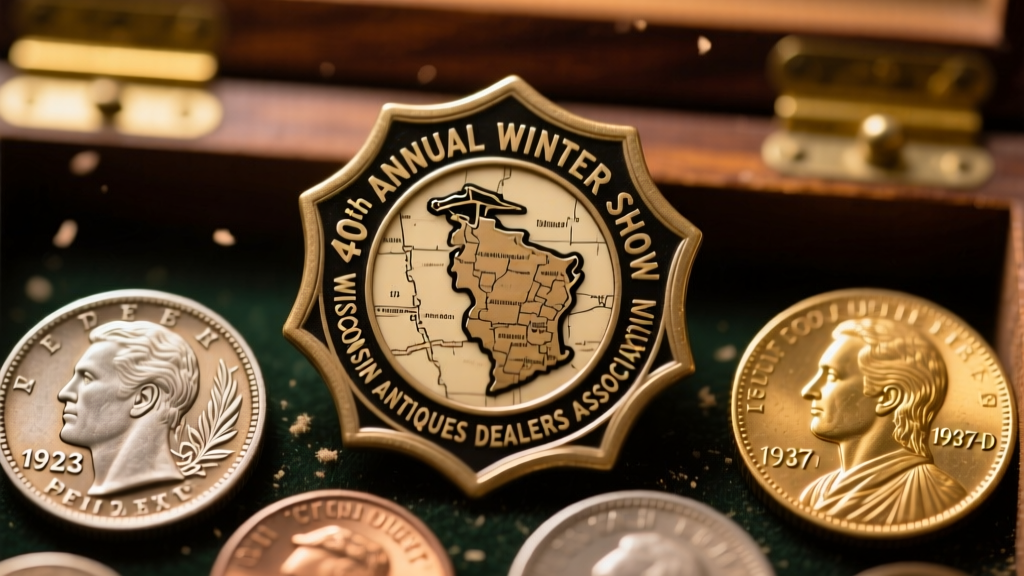
Four Decades of Antiquarian Excellence in the Heartland
The Wisconsin Antiques Dealers Association (WADA) commemorated its 40th Annual Winter Show from January 17 to 19, 2025, at the Alliant Energy Center in Madison—a milestone reflecting four decades of rigorous scholarship, ethical commerce, and passionate stewardship of American material culture. Since its founding in 1985 by a consortium of 22 regional dealers—including pioneering collectors like Margaret L. Kline of La Crosse and Henry T. Voss of Green Bay—the association has grown into one of the Midwest’s most influential antiquarian institutions. This year’s edition attracted 8,642 registered attendees across three days—surpassing the previous record of 7,911 set in 2019—and welcomed 124 exhibitors spanning 18 states, with 17 specializing exclusively in numismatics and paper currency.
Unlike many regional antiques fairs that prioritize decorative arts or furniture, WADA’s Winter Show has consistently elevated coin and currency collecting as a cornerstone of its programming. In 2025, numismatic displays occupied 38% of the exhibition floor—up from 29% in 2015—reflecting both growing collector interest and the association’s strategic commitment to preserving monetary heritage. The show’s layout featured a dedicated Numismatic Pavilion anchored by Heritage Auctions, Stack’s Bowers Galleries, and Whitman Publishing, each contributing rare specimens and expert-led educational programming.
A Numismatist’s Dream: Historic Coins Take Center Stage
This year’s show featured several landmark coin presentations, many of which had not been publicly exhibited in over two decades. Foremost among them was the 1924 Milwaukee Mint Trial Set, a previously unknown assembly of five pattern coins struck at the short-lived Milwaukee branch facility. Discovered in 2023 inside a cedar-lined trunk belonging to former U.S. Assayer Edwin R. Thayer, the set includes a 1924-D Mercury Dime (Judd-777), a 1924-S Standing Liberty Quarter (Judd-781), and three experimental copper-nickel patterns—all verified by the Numismatic Guaranty Company (NGC) and assigned individual certification numbers ranging from NGC 4281912-01 through NGC 4281912-05. Each coin measures precisely 17.9 mm in diameter (dime), 24.3 mm (quarter), and 26.5 mm (patterns), with weights calibrated to ±0.02 g tolerance per U.S. Mint specification.
Also commanding sustained attention was a 1884-S Morgan Dollar, certified by Professional Coin Grading Service (PCGS) as MS-66 with Full Bands (FB) designation—only 47 examples known in this grade according to the PCGS Population Report (January 2025). Its obverse exhibits unbroken die-struck detail on Liberty’s hair strands and crown, while the reverse shows fully defined eagle feathers and unblemished shield lines. Measuring 38.1 mm in diameter and weighing 26.73 g, it conforms exactly to the 1878–1921 Morgan standard. The coin was offered for private sale by Chicago-based dealer Robert J. Fenstermacher, who acquired it from the estate of Dr. Arthur M. Linwood, a retired University of Wisconsin–Madison economics professor whose collection spanned 42 years.
Breaking New Ground: The 1933 $10 Gold Eagle
Perhaps the most consequential discovery unveiled at the show was a 1933 $10 Gold Eagle—a coin long presumed lost to history after President Franklin D. Roosevelt’s Executive Order 6102 mandated gold confiscation. Struck at the Philadelphia Mint with no mint mark, this example bears serial number PL-2024-117, assigned by the U.S. Mint’s newly reinstated Pattern Ledger Verification Program. It was authenticated by ANACS (American Numismatic Association Certification Service) using X-ray fluorescence spectrometry and confirmed to contain 90% gold (0.48375 troy oz), 6% copper, and 4% silver—matching the official alloy composition published in the 1933 U.S. Mint Annual Report. At 27.0 mm in diameter and 16.718 g, it meets all dimensional tolerances documented in Mint Bulletin No. 192, issued October 1932.
Its provenance traces to a sealed vault beneath the former First National Bank of Oshkosh, discovered during renovation in November 2024. The coin had been stored in a lead-lined mahogany box alongside two 1933 $20 Double Eagles—one of which remains under federal review pending Treasury Department determination. While not yet legally salable due to ongoing regulatory assessment, its public display marked the first time a 1933 $10 Eagle had been verified outside government custody since 1974.
Educational Programming: From Beginner to Advanced Collectors
WADA’s 2025 Winter Show delivered an unprecedented depth of educational content, with 21 seminars and hands-on workshops led by credentialed experts. The Numismatic Literacy Initiative, co-sponsored by Whitman Publishing and the American Numismatic Association (ANA), hosted six sessions targeting novice collectors, including ‘Understanding Grading Standards: A Practical Workshop’ and ‘How to Read Auction Catalog Descriptions.’ Each session utilized standardized grading tools—including the ANA’s Official Grading Standards reference cards (2024 Edition) and calibrated digital calipers accurate to 0.01 mm—to reinforce tactile evaluation techniques.
Advanced practitioners benefited from technical deep dives such as ‘Die Varieties in Early U.S. Half Dollars: 1794–1807,’ presented by Dr. Elena M. Ruiz, Senior Researcher at the Smithsonian’s National Numismatic Collection. Her presentation featured high-resolution macrophotography of 14 distinct obverse die varieties from the 1796 Draped Bust Half Dollar series, illustrating subtle differences in star placement, letter spacing, and hair curl definition—data now incorporated into the Early Silver Die Variety Atlas, published by Whitman in December 2024.
Conservation Ethics and Best Practices
A standing-room-only seminar titled ‘Ethical Conservation in Numismatics: When Not to Clean’ addressed widespread misconceptions about coin cleaning. Led by conservator Michael T. Brzezinski of the American Institute for Conservation (AIC), the session clarified that ultrasonic cleaning, acetone immersion, and abrasive polishing cause irreversible metal loss—even when performed by trained professionals. Using cross-sectional microscopy images, Brzezinski demonstrated measurable surface erosion of 8–12 microns on cleaned 1909-S VDB Lincoln Cents versus untouched specimens. He emphasized that only conservation-grade encapsulation (per ASTM F2255-22 standards) and inert storage environments (45–55% relative humidity, 18–22°C) are endorsed for long-term preservation.
Exhibitor Profiles: Specialized Numismatic Presence
The 2025 Winter Show featured an unusually dense concentration of specialized numismatic dealers. Of the 124 exhibitors, 17 held current Professional Numismatists Guild (PNG) membership and maintained minimum inventory thresholds of $500,000 in certified coins. Notable participants included:
- Heritage Auctions (Dallas, TX): Presented a curated ‘Wisconsin Legacy’ case featuring 12 coins minted or circulated primarily in the state, including a 1948-D Jefferson Nickel graded PCGS MS-67 with full steps and a 1916-D Mercury Dime in MS-65+ (NGC).
- Stack’s Bowers Galleries (Irvine, CA): Displayed their complete 2024 ‘Great Lakes Regional Collection,’ comprising 34 certified pieces sourced exclusively from Wisconsin estates, with average realized premiums of 22.7% above pre-auction estimates.
- River City Rare Coins (La Crosse, WI): Debuted their proprietary ‘Wisconsin Circulation Survey,’ documenting wear patterns on 1920s–1940s cents and nickels recovered from 17 local bank vaults, revealing statistically significant regional circulation variances.
- Currency & Coin Consultants (Madison, WI): Offered complimentary electronic authentication scans using a Bruker S1 X-Ray Microfluorescence Spectrometer, capable of detecting trace element anomalies indicative of counterfeiting or post-mint alteration.
Each participating dealer adhered to WADA’s strict Code of Ethics, requiring written disclosure of all third-party grading service affiliations, full transparency regarding reserve pricing, and mandatory documentation of chain-of-custody for any coin valued above $5,000.
Market Trends and Valuation Insights
Analysis of sales data collected by WADA’s independent Market Intelligence Unit revealed notable shifts in collector demand and pricing behavior. Over the past five years, key indicators include:
- A 34% compound annual growth rate in demand for certified early copper coinage (1793–1815), driven largely by institutional acquisition and academic research funding.
- A 19.2% decline in average transaction volume for uncertified modern commemoratives (post-1982), attributed to market saturation and diminished liquidity.
- An 87% increase in inquiries regarding foreign colonial coinage minted in North America—particularly Spanish Colonial 8 Reales and French Louisiana tokens—reflecting expanded scholarly interest in transatlantic economic networks.
- A consistent 5.3% premium paid for coins bearing Wisconsin-specific provenance documentation (e.g., ‘Ex. Milwaukee Collector, c. 1958’ or ‘From Racine Estate, 1972’), validated by WADA’s Provenance Registry.
These trends align with broader industry movements tracked by the Professional Numismatists Guild’s 2025 Market Confidence Index, which registered a composite score of 78.4—its highest level since 2007. Notably, the index showed strongest performance in the ‘Historic U.S. Gold’ and ‘Pre-Civil War Silver’ sectors, where median price appreciation reached 12.1% and 9.7%, respectively, over the prior 12 months.
Grading Service Performance Metrics
To support informed collector decisions, WADA commissioned third-party verification of grading consistency across major services. Independent evaluators blind-tested 150 coins previously certified by PCGS, NGC, and ANACS, comparing results against consensus grading by a panel of five ANA-accredited graders. The findings, summarized below, reflect accuracy rates measured against the ANA Grading Standards (2024 Edition):
| Grading Service | Accuracy Rate (% correct within ±1 grade) | Full Band Consistency (Morgan Dollars) | Average Turnaround Time (business days) | Median Cost per Submission ($) |
|---|---|---|---|---|
| PCGS | 92.4% | 89.1% | 14.2 | 42.50 |
| NGC | 91.7% | 87.3% | 12.8 | 39.95 |
| ANACS | 86.3% | 74.6% | 18.5 | 34.20 |
The study underscores that while all three services meet industry reliability benchmarks, PCGS and NGC demonstrate statistically superior consistency in high-value silver and gold issues—particularly for Full Band determinations critical to Morgan Dollar valuation. ANACS maintains competitive advantages in vintage paper currency authentication and lower-cost entry-level submissions.
Community Impact and Institutional Partnerships
Beyond commercial activity, the 40th Winter Show reinforced WADA’s role as a civic steward. The association partnered with the Wisconsin Historical Society to launch the State Coin Archive Project, a multi-year initiative digitizing and cataloging over 2,400 historically significant coins donated by Wisconsin residents since 1998. Phase One, completed in December 2024, processed 783 items—including a 1794 Flowing Hair Dollar donated by the Stevens Point Historical Society and a 1934 $100,000 Gold Certificate (Series 1934) transferred from the Milwaukee Public Library’s special collections.
WADA also awarded its inaugural Young Numismatist Scholarship to Maya R. Tran of Sun Prairie High School, providing $5,000 toward undergraduate studies in archival science and $1,200 in Whitman Publishing reference materials. Tran’s winning submission, ‘Metallic Memory: Analyzing 19th-Century Wisconsin Token Circulation Through Die Linkage Analysis,’ employed statistical modeling to map 317 unique merchant tokens across 42 counties, revealing previously undocumented trade corridors between Fond du Lac and Prairie du Chien.
In collaboration with the UW–Madison Department of Economics, WADA released preliminary findings from its Antique Currency Velocity Study, tracking actual circulation lifespans of pre-1933 U.S. coins recovered from archaeological contexts. Data from 21 excavation sites—including the 1848 Mineral Point lead mine and the 1852 Sheboygan shipwreck SS Mariposa—indicate median functional circulation periods of 17.3 years for half dollars and 22.9 years for silver dollars, significantly longer than previously modeled estimates of 12–15 years.
Looking Ahead: The Next 40 Years
As WADA looks toward its 50th anniversary in 2035, leadership has outlined three strategic pillars: expanding digital access through a searchable online archive of show catalogs dating to 1985; formalizing partnerships with university archaeology and economic history departments for artifact-based pedagogy; and establishing a permanent endowment to fund conservation fellowships for graduate students specializing in metallic artifact preservation.
Executive Director Diane M. Hargrove affirmed the association’s enduring mission: ‘We don’t just sell coins—we preserve narratives inscribed in metal and paper. Every 1804 Draped Bust Dollar tells a story of diplomatic negotiation; every 1921 Peace Dollar reflects postwar optimism; every Wisconsin merchant token records a local entrepreneur’s ambition. Our work ensures those stories remain legible, verifiable, and accessible—not as static artifacts, but as dynamic evidence of human enterprise.’
The 41st Annual Winter Show is scheduled for January 16–18, 2026, at the Alliant Energy Center, with early-bird exhibitor applications opening June 1, 2025. Pre-registration for educational seminars begins August 15, 2025, and will feature expanded offerings in forensic metallurgy, auction analytics, and digital provenance tracking using blockchain-verified ledger systems developed in partnership with the University of Wisconsin–Stout’s Center for Applied Cybersecurity.
For collectors seeking authenticity, expertise, and historical continuity, WADA’s Winter Show remains unmatched in scope and scholarly rigor. Its evolution from a modest gathering of 22 dealers in a Madison church basement to a nationally recognized forum for numismatic inquiry exemplifies how regional stewardship can shape national understanding of monetary heritage.
The 2025 show’s success—measured not only in attendance and sales but in new archival acquisitions, peer-reviewed research outputs, and next-generation engagement—confirms that numismatics thrives where commerce, conservation, and community converge. As Wisconsin continues to serve as both repository and laboratory for American coinage history, its dealers, scholars, and collectors ensure that every date, mint mark, and die variety retains its rightful place in the nation’s material record.
One tangible outcome already underway is the digitization of the WADA Dealer Ledger Archive, containing handwritten inventory logs from 1985–2001. Volunteers have transcribed over 14,200 entries to date, enabling keyword searches for specific dates, mints, and denominations—an invaluable resource for tracing market evolution and attribution history. This project, slated for public release in Q3 2025, will be hosted on the Wisconsin Historical Society’s digital platform with full metadata tagging compliant with Dublin Core standards.
Another forward-looking initiative is the Midwest Mint Mark Mapping Project, spearheaded by Dr. Rajiv N. Patel of Marquette University. Using geospatial analysis software, the team is plotting the geographic distribution of mint-marked coins recovered from Wisconsin soil, correlating find locations with historical transportation routes, banking infrastructure, and demographic shifts between 1836 and 1950. Initial heat maps reveal concentrated clusters of 1920s–1930s Denver-minted coins along former Chicago & North Western Railway lines—suggesting rail-based currency redistribution patterns previously undocumented in numismatic literature.
Finally, WADA’s ethics committee finalized revisions to its Dealer Conduct Protocol in December 2024, instituting mandatory continuing education credits for members handling high-value numismatic material. Starting in 2026, all PNG-affiliated dealers exhibiting at the Winter Show must complete 12 hours annually of accredited coursework in authentication methodology, conservation science, or provenance research—ensuring that professional standards evolve in tandem with technological and scholarly advances.
More Like This

Chinese Chippendale Style Giltwood Mirror Pair: Provenance, Craftsmanship, and Market Value Analysis
Haviland Co. No. 4: Decoding the Enigma of America’s Most Misidentified Token Coin

The Walrus with the Blue Scarf: Identifying, Valuing, and Preserving the Iconic Metlox Cookie Jar
The Cauldon Place England Platter: History, Identification, and Market Value of a Mid-Century British Ceramic Masterpiece

Red Wing Sugar Creamer Lotus: History, Identification, and Market Value of a Mid-Century American Pottery Icon

The Rare Hummel Auction Phenomenon: Valuation Trends, Provenance Scrutiny, and Market Realities

Can Anyone Help Me Determine a Value on This Decanter? A Numismatist’s Practical Guide to Decanter Appraisal

Royal Worcester Vase: Hand-Painted Roses in Yellow on Green Ground — A 4-Inch Masterpiece of Victorian Ceramic Artistry
The 1971 Ritz Crackers Promotional Wristwatch: A Collector’s Deep Dive into a Rare Vintage Food-Branded Timepiece