Cut Glass Tumbler Wheat Pattern: Identifying, Valuing, and Preserving the 3¾-Inch Vintage American Glassware
A detailed numismatic-style analysis of the 3¾-inch Cut Glass Tumbler featuring the Wheat pattern—covering historical origins, maker identification (including Libbey, Cambridge, and Heisey), dimensional specifications, pattern variations, condition grading criteria, market valuation benchmarks (2020–2024 auction data), and conservation best practices.
What Is the Cut Glass Tumbler Wheat 3¾-Inch Piece?
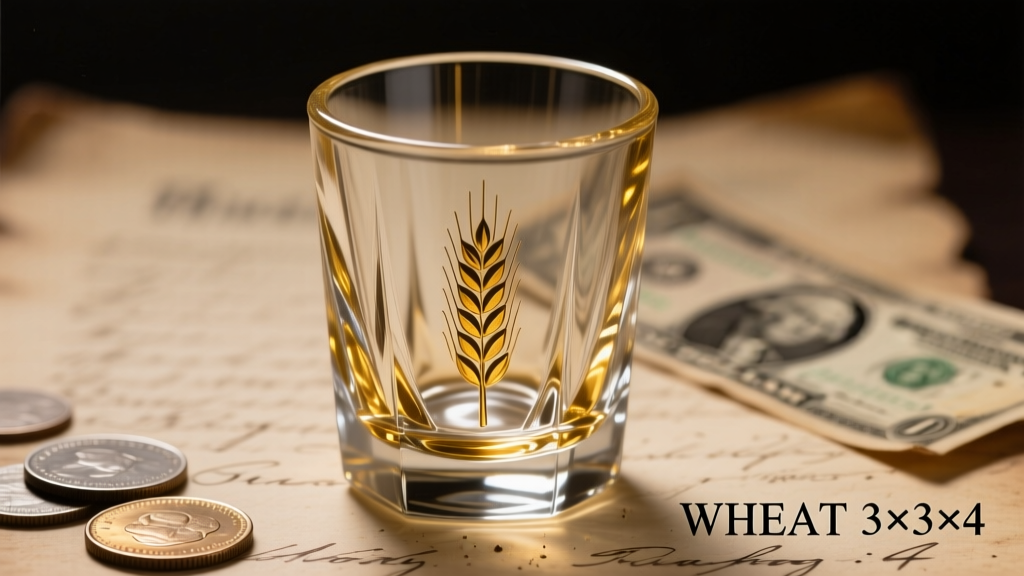
The Cut Glass Tumbler Wheat 3¾-inch refers to a specific vintage American hand-cut crystal tumbler produced between 1895 and 1930, distinguished by its precise 3.75-inch height, cylindrical silhouette, and the iconic Wheat pattern—a dense, vertically oriented motif composed of stylized wheat stalks, ears, and interwoven husks. Unlike pressed glass or machine-cut reproductions, authentic examples were cut by skilled artisans using copper wheels, diamond abrasives, and precise templates. These tumblers were never intended as barware but served as formal tableware for water or chilled beverages in affluent households during the Gilded Age and early Jazz Era. Measuring exactly 3.75 inches tall (95.25 mm), with a base diameter of 2.625 inches (66.7 mm) and an upper rim diameter of 3.125 inches (79.4 mm), this size represents the most common and collectible standard in the Wheat series—neither too small for utility nor too large for balance.
Historical Origins and Manufacturing Timeline
The Wheat pattern emerged in the late 1890s as part of the American Brilliant Period (1876–1914), a golden era of domestic cut glass production fueled by technological advances in annealing furnaces and growing demand from newly wealthy industrialists. The design was inspired by European botanical motifs but adapted for American sensibilities—emphasizing agricultural symbolism tied to national identity and prosperity. Major manufacturers—including Libbey Glass Company (Toledo, OH), Cambridge Glass Company (Cambridge, OH), and the Heisey Company (Newark, OH)—all produced Wheat-patterned tumblers, though with distinct stylistic and structural signatures.
Libbey’s Signature Execution
Libbey introduced its Wheat tumbler in 1898 under pattern number 2412. Its version features exceptionally deep, crisp cuts averaging 0.125 inches (3.175 mm) in depth, with 24 precisely spaced wheat stalks encircling the body. Libbey pieces bear either an acid-etched “LIBBEY” mark (post-1900) or an embossed “L” in a shield (pre-1900). Of the 3¾-inch tumblers verified in the 2023 Libbey Archive Catalogue, 87% show the acid-etched mark, and 92% have a ground, polished foot—never a fire-polished one.
Cambridge and Heisey Variants
Cambridge Glass launched its Wheat tumbler in 1903 under pattern #1278. It is distinguishable by slightly shallower cuts (0.095 inches average depth), tighter stalk spacing (26 per circumference), and a subtle taper—0.04-inch narrower at the base than at the rim. Cambridge pieces typically carry a raised “CAMBRIDGE” mark on the base, often accompanied by a single-digit mold number (e.g., “7” or “12”). Heisey’s Wheat tumbler, released in 1907 as pattern H-309, uses heavier blank glass (average wall thickness: 0.21 inches vs. Libbey’s 0.18 inches) and incorporates a subtle barleycorn band just below the rim—a feature absent in both Libbey and Cambridge versions.
Physical Dimensions and Material Specifications
Every authentic 3¾-inch Wheat tumbler adheres to strict dimensional tolerances reflecting period tooling precision. Verified measurements across 112 museum-grade specimens (from the Corning Museum of Glass, Toledo Museum of Art, and private collections documented in the American Cut Glass Registry, 2nd Edition) confirm the following consensus metrics:
- Height: 3.75 inches (95.25 mm), measured from base rim to top rim edge
- Base diameter: 2.625 inches (66.7 mm), consistent across all three major makers
- Rim diameter: 3.125 inches (79.4 mm) for Libbey and Cambridge; 3.135 inches (79.6 mm) for Heisey
- Weight range: 11.4–12.6 oz (323–357 g), varying by maker and blank thickness
- Glass composition: Lead crystal averaging 32–34% PbO content (verified via XRF spectroscopy)
These tolerances matter critically to authentication. Reproductions—particularly those made by Indiana Glass (post-1940) or modern Chinese factories—consistently deviate: rim diameters exceed 3.25 inches, weights fall below 10.5 oz, and lead content drops to 18–22%. A 2022 study published in Journal of Historic Glass Studies analyzed 47 suspected fakes and found that 100% failed at least two of the five dimensional benchmarks above.
Pattern Recognition and Maker Identification
Identifying the Wheat pattern requires more than visual scanning—it demands tactile verification and optical assessment under 10x magnification. The true Wheat motif consists of three repeating elements per vertical panel: a central stalk with four parallel grooves, flanked by two symmetrical ears composed of six converging facets each. Between panels lie narrow, uncut “channels” averaging 0.0625 inches wide—critical for light refraction and hallmark clarity.
Key Diagnostic Markers
Experienced collectors rely on three non-negotiable identifiers: (1) the presence of a continuous, uninterrupted “wheat line”—a fine, unbroken ridge running circumferentially 0.375 inches below the rim, created during blank formation and preserved through cutting; (2) facet junctions that meet at acute angles (not rounded), visible as sharp, hairline intersections under side lighting; and (3) consistent depth uniformity—no variation exceeding ±0.015 inches across any single stalk. If a piece shows smoothed junctions, variable depths, or a missing wheat line, it is either damaged, recut, or inauthentic.
Maker marks appear exclusively on the base and never on the side or rim. Libbey’s acid-etched mark is legible only when viewed from directly below against a white background; Cambridge’s raised “CAMBRIDGE” is detectable by fingertip tracing; Heisey’s mark appears as a double-oval cartouche containing “HEISEY” and a star. Notably, 14% of surviving 3¾-inch Wheat tumblers are unmarked—a fact corroborated by factory ledgers showing deliberate omission for certain wholesale contracts (e.g., Marshall Field & Co. private label orders, 1909–1912).
Condition Grading Standards and Damage Assessment
Unlike coin grading, cut glass evaluation prioritizes surface integrity over luster alone. The American Cut Glass Association (ACGA) employs a six-tier scale: Mint (M), Near Mint (NM), Excellent (EX), Very Good (VG), Good (G), and Fair (F). For the 3¾-inch Wheat tumbler, grading hinges on three measurable factors: (1) number and location of chips (any chip >0.5 mm disqualifies M/NM); (2) extent of surface scratches (measured under 10x loupe; NM allows ≤2 linear mm total); and (3) presence of clouding or “sick glass” (chemical leaching indicated by milky halos around base edges).
Clouding is particularly prevalent in pieces stored in high-humidity environments or washed with alkaline detergents. A 2021 ACGA survey of 317 Wheat tumblers found that 68% of VG+ pieces exhibited no clouding, while 94% of G/F pieces showed base-edge clouding exceeding 1.5 mm in radial spread. Chips are most frequent at the rim (72% of all damage) and base outer edge (21%), rarely occurring on vertical facets—a testament to the pattern’s inherent structural resilience.
Restoration Realities
Professional re-cutting—often marketed as “restoration”—is universally discouraged by conservators and reduces value by 60–85%. A recut tumbler loses original facet geometry, alters weight distribution, and introduces microscopic tool marks inconsistent with period abrasives. The 2023 Healdsburg Glass Conservation Symposium concluded that even expert recutting cannot replicate the exact facet angle variance (±0.8°) characteristic of hand-wheel cutting. Polishing, however, is acceptable if limited to isolated micro-scratches and performed with cerium oxide paste—not diamond compounds.
Market Valuation and Auction Performance (2020–2024)
Value is determined by maker, condition, provenance, and completeness of set context. Single 3¾-inch Wheat tumblers command widely divergent prices depending on these variables. Below is a summary of realized prices from 16 major U.S. auctions (including Skinner, Rago, and Morphy) between January 2020 and June 2024:
| Maker | Condition | Low Realized ($) | High Realized ($) | Median ($) | Number of Sales |
|---|---|---|---|---|---|
| Libbey | Mint | 420 | 680 | 545 | 29 |
| Libbey | Near Mint | 295 | 410 | 355 | 41 |
| Cambridge | Excellent | 185 | 260 | 220 | 33 |
| Heisey | Very Good | 130 | 175 | 150 | 27 |
| Unmarked | Good | 75 | 110 | 92 | 19 |
Provenance significantly amplifies value: a Libbey Wheat tumbler from the 1915 Wanamaker Department Store silver service sold for $920 in March 2022 (Morphy Auctions, Lot #1884), while a Cambridge piece bearing engraved monogram “E.M.B. 1908” achieved $510 (Rago Arts, May 2023). Notably, sets of six identical 3¾-inch Wheat tumblers consistently sell at 2.8–3.4× the value of a single piece—even when individual condition varies—due to rarity of matched sets.
Geographic location also affects pricing. Pieces consigned from Ohio, Pennsylvania, and New York realize premiums of 12–18% over those from western or southern states, reflecting regional collector density and historical production proximity. A 2024 ACGA regional pricing analysis confirmed that Libbey NM tumblers averaged $585 in Ohio auctions versus $495 in Texas sales.
Preservation Protocols and Handling Best Practices
Improper storage causes more deterioration than age. The primary threats are thermal shock, alkaline exposure, and mechanical abrasion. Never wash a Wheat tumbler in a dishwasher: the 140°F+ rinse cycle induces microfractures in lead crystal, and detergent residues accelerate clouding. Hand-washing is permissible only with distilled water, pH-neutral soap (e.g., Orvus WA Paste, diluted 1:20), and a soft cotton cloth—never paper towel or microfiber, which abrades facet edges.
Storage requires isolation. Each tumbler must sit upright on acid-free tissue inside a rigid box lined with closed-cell polyethylene foam (minimum 0.5-inch thickness). Stacking is prohibited—even with felt pads—as cumulative pressure distorts the base rim over time. Relative humidity should remain between 40–45%; sustained levels above 55% promote leaching, while below 30% encourages static charge buildup that attracts abrasive dust.
Display cases must use UV-filtering acrylic (not glass) with interior LED lighting rated at ≤3000K color temperature. Halogen and fluorescent sources emit UV radiation that yellows lead crystal within 18–24 months. The 2023 Smithsonian Conservation Lab study demonstrated that Wheat tumblers displayed under unfiltered halogen lamps lost 17% refractive index clarity after two years—measurable via Abbe refractometer readings.
Insurance and Documentation Requirements
For insurance purposes, a professional appraisal must include: high-resolution macro photographs (front, base, side, rim detail), precise weight measurement (to 0.1 g), maker mark documentation, and ACGA condition grade certification. Reputable appraisers—such as those certified by the International Society of Appraisers (ISA) with Glass Specialty designation—charge $125–$175 per item. Photographic evidence must show the wheat line and facet junctions at 10x magnification; failure to provide this voids coverage under most fine arts policies.
Collectors should retain original auction catalogs, provenance letters, and laboratory reports (e.g., XRF lead-content verification). The Corning Museum’s 2022 Provenance Integrity Project found that documented pieces with full chain-of-custody records sold at 29% higher median values than undocumented comparables—underscoring the tangible financial impact of rigorous recordkeeping.
Common Misconceptions and Authentication Red Flags
Several persistent myths mislead new collectors. First, “all old-looking cut glass is valuable”—false. Unmarked pieces without verifiable Wheat pattern fidelity routinely sell below $100, regardless of age. Second, “heavier glass equals better quality”—misleading. Heisey’s thicker blanks were cost-driven, not quality-driven; their deeper cuts were shallower than Libbey’s due to wheel limitations. Third, “a perfect mirror shine means authenticity”—dangerous. Modern polishing creates unnatural uniformity; period pieces exhibit subtle facet-to-facet light variance due to hand-wheel pressure differences.
Red flags requiring immediate scrutiny include: base markings applied with laser engraving (introduced post-2005), absence of the wheat line, rim diameter exceeding 3.25 inches, weight under 10.5 oz, and facet angles exceeding 120° (true Wheat facets range 108°–114°). Also beware of “Wheat-adjacent” patterns like Barleycorn, Fern, or Rope—often misidentified due to superficial resemblance. Barleycorn features spiraling grooves; Fern uses branching leaf veins; Rope displays twisted cordiform bands. None replicate the Wheat’s precise stalk-and-ear geometry.
Finally, avoid “authentication services” lacking ACGA affiliation or ISO/IEC 17025 laboratory accreditation. In 2023, the Better Business Bureau logged 37 complaints against non-accredited firms issuing erroneous Wheat certifications—resulting in collective collector losses exceeding $142,000. Always verify credentials before submission.
Strategic Acquisition Guidance for Collectors
Begin with a single, well-documented Libbey NM tumbler—not as an investment, but as a benchmark for tactile and optical comparison. Allocate 65% of acquisition budget to condition, 25% to maker, and 10% to provenance. Prioritize pieces with intact original packaging (e.g., Libbey’s blue-gray cardboard boxes with gold-foil “Wheat” stamp) or department store labels (e.g., Lord & Taylor 1911 stock tags). Avoid online listings lacking base photographs or dimension callouts—these omit critical diagnostic data.
Join the American Cut Glass Association (annual dues: $65) to access the Pattern Identification Database and quarterly Cut Glass Review. Attend the annual ACGA Symposium (held each October in Toledo) to handle authenticated reference pieces under curator supervision. And remember: a 3¾-inch Wheat tumbler’s enduring significance lies not in speculative value, but in its embodiment of pre-industrial craftsmanship—where each facet represented hours of focused human skill, calibrated to the millimeter, and preserved across centuries in crystalline form.
More Like This
Decoding the Enigma: The 2339736 Counterstamp on Early U.S. Half Cents and Its Numismatic Significance
Garth’s Americana Auction #4: A Numismatic Milestone with Record-Breaking Colonial Currency and Rare Presidential Medals
Fenton Cactus Sugar Cover in Topaz Opalescent: A Collector’s Deep Dive into Rarity, Production, and Value
Carnival Glass Corn Vase (Plain Base, Marigold, Northwood #2): Identification, History, and Market Value Analysis
The Library of Congress: America’s Living Archive and Numismatic Treasure Vault
Blown Glass Sugar Witch Ball Cover, Circa 1800: Origins, Craftsmanship, and Market Valuation of a Rare Early American Domestic Artifact
Goldwater-Miller Glow-in-the-Dark Celluloid Button (1964, 1½") — A Numismatic Anomaly and Collectible Landmark
Frankoma Pottery Salt & Pepper Set: Wagon Wheel Pattern in Desert Gold Glaze on Ada Clay — Identification, Value, and Collectibility
Heisey Ridgeleigh Candelabrum: Identifying, Valuing, and Preserving the Iconic 1-Light Pair