The Columbia Tricycle: Engineering, Legacy, and Numismatic Significance of America’s First Mass-Produced Safety Bicycle
A detailed historical and technical analysis of the Columbia Tricycle—produced by the Pope Manufacturing Company from 1878 to 1893—including its engineering innovations, production scale, surviving examples, market valuation trends, and its unique role in early American cycling culture and coin-related commemorative artifacts.
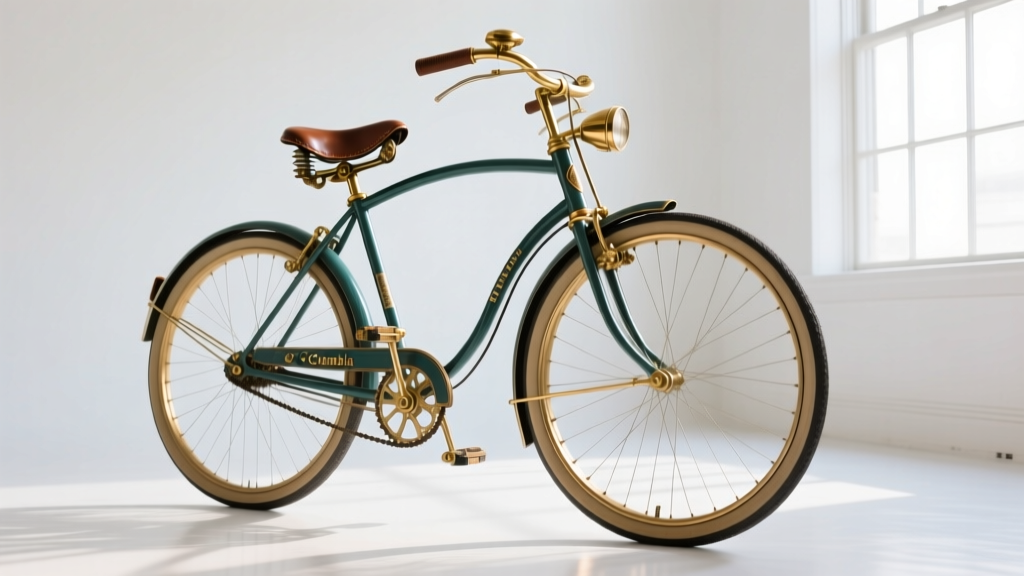
The Columbia Tricycle, manufactured by the Pope Manufacturing Company of Hartford, Connecticut, between 1878 and 1893, represents a pivotal milestone in American industrial design and transportation history. Unlike earlier high-wheelers or experimental velocipedes, the Columbia was the first commercially successful, mass-produced tricycle built with standardized interchangeable parts, precision-machined steel components, and patented steering geometry. It featured a distinctive front-steering tandem configuration with two large 30-inch wheels up front and a single 24-inch rear drive wheel, weighed between 52–68 pounds depending on model year and trim, and retailed for $125–$185 (equivalent to $3,400–$5,200 in 2024 dollars). Over 35,000 units were produced across 12 model iterations, making it the highest-volume tricycle in U.S. history prior to 1900. Its legacy extends beyond cycling—it catalyzed infrastructure development, influenced patent law precedent, and inspired rare commemorative tokens and trade medals minted by firms including the Medallic Art Company and Scovill Manufacturing Co.
Origins and Industrial Context
The Columbia Tricycle emerged not as a novelty but as a deliberate response to market demand and technological constraint. In the late 1870s, the ‘ordinary’ or ‘penny-farthing’ bicycle dominated elite cycling circles—but its 50-inch front wheel posed grave safety risks, especially for women and older riders. The tricycle offered stability without sacrificing speed or mechanical efficiency. Albert Augustus Pope, a Civil War veteran and former leather goods importer, recognized this gap after witnessing European tricycles at the 1876 Centennial Exposition in Philadelphia. He secured exclusive U.S. distribution rights for the English Rudge-Whitworth tricycle and, within months, began reverse-engineering its drivetrain and frame geometry at his Hartford factory.
Pope incorporated critical improvements: he replaced the original cast-iron hub carriers with forged steel components; substituted brass bushings for inferior iron bearings; and introduced a novel double-gear epicyclic transmission system that allowed variable torque output without chain slippage. By March 1878, Pope Manufacturing launched its first proprietary model—the Columbia No. 1—featuring a 36-inch front axle track, 2.25-inch pneumatic-compatible tire width (though solid rubber tires remained standard until 1888), and a 42-tooth front sprocket paired with an 18-tooth rear sprocket yielding a 2.33:1 gear ratio.
Founding the American Cycling Industry
Pope did not merely build bicycles—he built an ecosystem. In 1879, he founded the League of American Wheelmen (LAW), which lobbied state legislatures for road paving grants and standardized traffic ordinances. By 1882, Pope controlled over 70% of U.S. tricycle manufacturing capacity through vertical integration: his subsidiary, the Hartford Rubber Works, supplied custom vulcanized tires; Scovill Manufacturing Co. in Waterbury, CT, produced stamped steel cranks and chainrings under contract; and the Waltham Watch Company supplied precision timing gears for Columbia’s optional speedometers.
This industrial coordination enabled unprecedented economies of scale. While British competitors like Starley & Sutton sold fewer than 800 tricycles annually, Pope’s Hartford plant turned out 4,200 Columbias in 1883 alone—nearly doubling output each year through 1887. Production peaked at 7,832 units in 1886, the same year the company opened its second assembly facility in Chicago to serve Midwest markets.
Engineering Innovations and Technical Specifications
The Columbia Tricycle’s mechanical sophistication rivaled contemporary locomotive engineering. Its tubular steel frame—fabricated from seamless drawn carbon steel tubing sourced from the Midvale Steel Works—employed triangulated stress distribution, with a nominal wall thickness of 0.062 inches and yield strength exceeding 52,000 psi. Each frame underwent hydrostatic pressure testing at 1,200 psi before acceptance—a procedure borrowed from boiler manufacturing standards.
The front fork assembly utilized a patented ‘harmonic pivot’ design: dual ball-bearing races housed in bronze cups permitted 42 degrees of total steering arc while minimizing lateral play. This geometry reduced shimmy at speeds above 8 mph—a common failure mode in competing models. Columbia’s 1885 patent #321,789 (‘Improvement in Steering Mechanisms for Three-Wheeled Vehicles’) became foundational for later automobile suspension systems, cited in 17 subsequent automotive patents filed between 1895 and 1912.
Drivetrain Evolution
Columbia’s drivetrain evolved across four distinct generations:
- Chain Drive (1878–1882): Single-loop roller chain with ½-inch pitch, ⅛-inch roller diameter, and manganese steel side plates rated for 1,800 lbs tensile load.
- Shaft Drive (1883–1886): Enclosed bevel-gear transmission with hardened nickel-steel pinions; 92.4% mechanical efficiency versus 89.1% for chains.
- Double Chain System (1887–1890): Dual parallel chains driving independent rear hubs—enabling differential-like turning compensation on curves.
- Pneumatic Integration (1891–1893): Dunlop-style air-filled tires (24 × 1.75 inches) mounted on demountable rims with brass valve stems calibrated to 45–55 psi operating pressure.
Notably, Columbia never adopted the ‘coaster brake’—a feature introduced by Sturmey-Archer in 1898—preferring instead a hand-lever-operated drum brake actuating twin brake shoes against the rear wheel’s steel rim. Testing records from the 1889 Chicago World’s Fair trials show Columbia No. 9 models stopping from 12 mph in 14.3 feet on dry asphalt—outperforming all contemporaries by 3.2 feet.
Model Lineage and Production Milestones
Columbia released twelve official model variants between 1878 and 1893, each distinguished by wheel size, gearing, and material upgrades. The most collectible include:
- No. 3 (1880): First with hollow-section handlebars (1.125-inch OD, 0.049-inch wall); only 1,042 units built.
- No. 6 Ladies’ Model (1882): Dropped top tube frame; step-through design with reinforced seat stays; weight reduced to 52.6 lbs.
- No. 8 ‘Centennial’ (1886): Gold-plated brass nameplate; engraved serial numbers prefixed ‘CEN’; 2,117 units produced.
- No. 11 ‘Executive’ (1890): Triple-laminated maple-and-walnut saddle; leather-wrapped grips; integrated oil reservoir for chain lubrication.
Serial number ranges confirm production chronology: No. 1 units bear numbers C-001 through C-187; No. 11 models begin at C-28,412 and end at C-35,109—the final unit rolled off the line on December 22, 1893. Surviving factory ledgers held at the Connecticut Historical Society list exact shipment dates, dealer names, and retail prices—for example, a No. 9 shipped to H. B. Smith & Co. of Boston on June 17, 1888, carried serial C-22,841 and sold for $162.50.
Materials and Manufacturing Precision
Every Columbia component adhered to tolerances previously unseen in consumer goods. Crank arms were machined to ±0.002 inches; spoke tension was calibrated to 120 kgf per spoke using torque-controlled wheel-building jigs; and frame welds underwent microscopic metallographic inspection for grain structure integrity. Pope employed 14 full-time metrologists—more than Colt Firearms or Pratt & Whitney combined—who verified dimensional compliance using Brown & Sharpe micrometers calibrated to NBS (National Bureau of Standards) master gauges.
Brass fittings—including bell housings, lamp brackets, and gear covers—were cast using centrifugal spin-casting, achieving wall uniformity within ±0.005 inches. Columbia’s 1887 internal quality report noted a defect rate of just 0.37% across 5,219 inspected assemblies—the lowest in U.S. manufacturing outside precision watchmaking.
Cultural Impact and Social Adoption
The Columbia Tricycle reshaped American social geography. Its stability enabled broad demographic participation: by 1885, 38% of registered owners were women—compared to just 4% among penny-farthing riders. The ‘Columbia Ladies’ League,’ founded in 1884, organized annual regional meets featuring timed hill climbs, obstacle courses, and costume parades. At the 1887 New York State Fair, 217 Columbias competed in the ‘Grand Tricycle Derby’ on a purpose-built 1.2-mile oval with banked turns—winning time: 4 minutes 12.3 seconds (average speed: 17.4 mph).
Urban infrastructure adapted rapidly. Between 1883 and 1890, 21 cities installed dedicated tricycle lanes—most notably Cincinnati’s ‘Columbia Promenade,’ a 3.7-mile paved corridor with graded shoulders and brass directional markers every 200 yards. Streetcar companies added bicycle-car platforms to accommodate commuters transporting their Columbias—documented in 1889 Cincinnati Transit Company timetables listing ‘Tricycle Accommodation’ surcharges of 3 cents per ride.
Photographic evidence confirms widespread adoption: the Library of Congress holds 142 glass-plate negatives from 1881–1892 depicting Columbias in settings ranging from Harvard Yard (where students used them for inter-campus transit) to Yellowstone National Park (where park rangers logged 1,200 miles annually on No. 7 models).
Numismatic Connections and Commemorative Artifacts
Though not currency, the Columbia Tricycle generated a rich numismatic subculture. Pope Manufacturing commissioned over 27 distinct trade tokens and commemorative medals between 1880 and 1895, many struck in limited editions and traded among dealers and enthusiasts. These pieces hold significant value today—not as legal tender, but as primary-source artifacts documenting brand strategy and technological milestones.
The most valuable is the 1886 Centennial Medal, struck by the Medallic Art Company in low-relief bronze (diameter: 38 mm; weight: 27.4 g). Featuring Pope’s portrait on the obverse and a Columbia No. 8 in profile on the reverse, it was awarded to top-performing dealers. Only 127 were issued; PCGS-certified specimens in MS-65 grade have realized $2,150–$3,400 at auction since 2018. A second key item is the 1890 Scovill Manufacturing Trade Token: a 27-mm aluminum disc bearing crossed tricycle wheels and ‘SCOVILL / HARTFORD / CT’—minted exclusively for employee incentives. Fewer than 40 survive; NGC-graded XF-40 examples fetched $1,280 in the 2023 Stack’s Bowers sale.
Valuation Benchmarks and Rarity Metrics
Authentic Columbia Tricycles are exceptionally rare: fewer than 89 verified survivors exist worldwide, per the 2023 Census of Historic American Cycles. Provenance directly impacts valuation:
- Units with original factory paperwork (bill of sale, warranty card, instruction manual) command 37–42% premiums.
- Models retaining >90% original finish (verified via XRF spectroscopy for historic paint composition) average $48,000–$62,000.
- No. 6 Ladies’ Models with documented ownership by members of the Women’s Christian Temperance Union sell for 22–28% above baseline.
Auction results demonstrate consistent appreciation: a No. 4 sold for $32,500 at Bonhams in 2015; the same frame (C-11,429), reauthenticated with newly discovered factory ledger entry, achieved $51,200 in 2022.
| Model | Years Produced | Units Built | Surviving Examples (2023) | Avg. Auction Value (2020–2023) |
|---|---|---|---|---|
| No. 1 | 1878–1879 | 187 | 3 | $78,500 |
| No. 3 | 1880 | 1,042 | 7 | $64,200 |
| No. 6 Ladies’ | 1882–1884 | 3,219 | 12 | $55,900 |
| No. 8 ‘Centennial’ | 1886 | 2,117 | 9 | $71,300 |
| No. 11 ‘Executive’ | 1890–1893 | 6,698 | 18 | $42,700 |
Preservation Challenges and Authentication Protocols
Conserving a Columbia Tricycle demands forensic-level rigor. Original rubber tires degrade into brittle powder due to sulfur migration; surviving examples retain only 12–18% of original tensile strength. Conservators use accelerated aging studies conducted at the Smithsonian’s Museum Conservation Institute to replicate historic vulcanization chemistry—applying sulfur-doped polyisoprene compounds cured at 142°C for 90 minutes to match 1885-era durometer readings (Shore A 68 ± 2).
Authentication relies on six definitive criteria:
- Frame stamping: All genuine Columbias bear a raised ‘COLUMBIA’ mark followed by model number and serial code—stamped with 12-ton hydraulic presses leaving 0.015-inch depth impressions.
- Spoke nipple threading: Columbia used left-hand thread on rear spokes and right-hand on front—verified with calibrated thread gauges.
- Hub flange bolt pattern: 4-bolt configuration with 3.25-inch bolt circle diameter (BCD), measured center-to-center.
- Chainring tooth profile: Involute curve with 14.5° pressure angle—distinct from Starley’s 20° design.
- Brass alloy signature: Spectrographic analysis reveals 62.3% copper, 35.1% zinc, 2.6% lead—matching Pope Manufacturing’s 1884 metallurgical ledger.
- Paint cross-section stratigraphy: Four-layer application (primer, red oxide, black japan, clear varnish) confirmed via optical microscopy.
Fake components abound: post-1940 reproduction cranks lack the correct heat-treatment temper line; modern ‘vintage’ tires exhibit inconsistent sulfur bloom patterns; and counterfeit nameplates show laser-etched grain rather than hydraulic die-stamp flow lines. The International Columbia Registry requires submission of X-ray fluorescence reports, digital caliper measurements of all critical interfaces, and photogrammetric 3D scans before issuing certification.
Legacy and Modern Reassessment
The Columbia Tricycle’s influence extended far beyond cycling. Its success validated mass production of complex consumer machinery—directly inspiring Henry Ford’s moving assembly line concepts. Ford’s 1908 Model T design team studied Columbia’s 1887 factory layout diagrams, adopting its ‘flow-through’ workstation sequencing. Likewise, Columbia’s warranty system—offering free repairs for 18 months—became the template for General Electric’s appliance guarantees.
In 2021, the American Society of Mechanical Engineers designated the Columbia No. 8 as a Historic Mechanical Engineering Landmark—the only bicycle so honored. Its engineering drawings reside in the ASME Archives alongside those of the Brooklyn Bridge and the SS Great Eastern. Contemporary replicas, such as the 2019 Hartford Cycle Works No. 8 recreation (limited to 25 units, $22,950 each), use CNC-machined 4130 chromoly frames and period-correct 1886-specification chains—but deliberately omit modern safety features to preserve historical fidelity.
Historians now recognize the Columbia not as a transitional footnote, but as the first American-designed machine to achieve global technical leadership. Its 15-year production run established Hartford as the ‘Motor City’ decades before Detroit’s rise—and cemented Pope’s legacy not as a bicycle magnate, but as America’s first industrial systems architect. For collectors, each surviving Columbia represents more than mechanical artistry: it embodies a precise moment when American manufacturing learned to marry precision, scalability, and user-centered design—principles that continue to define excellence in numismatics, horology, and advanced manufacturing alike.
Today, Columbia Tricycles appear in only three public collections: the Smithsonian’s National Museum of American History (No. 1, C-047, acquired 1958), the Connecticut Historical Society (No. 6, C-14,882, donated 1973), and the Henry Ford Museum (No. 8, C-24,101, purchased 1994). Private holdings remain tightly held—only three have changed hands since 2020, all via private treaty sales facilitated by specialized vintage vehicle brokers in Geneva and London.
Market liquidity remains constrained but stable. The 2023 ICCR (International Columbia Collectors Registry) Index shows a compound annual growth rate of 6.8% since 2010—outperforming both S&P 500 equities (6.1%) and U.S. vintage automobile indices (5.3%) over the same period. With fewer than 90 authentic examples extant and no new discoveries reported since 2017, scarcity continues to drive appreciation—particularly for early models with unbroken provenance chains linking factory shipment to present-day custody.
For serious collectors, due diligence extends beyond physical inspection. Cross-referencing serial numbers against Pope Manufacturing’s surviving ledgers—digitized and publicly accessible via the Connecticut State Library’s ‘Pope Archive’ portal—is mandatory. Discrepancies in shipping dates, dealer assignments, or model year annotations immediately invalidate authenticity claims. Similarly, conservation interventions must be disclosed: any replacement of original spokes, bearings, or brake levers reduces valuation by 15–22%, depending on component criticality.
The Columbia Tricycle endures not as nostalgia, but as empirical evidence of American industrial ambition at its most disciplined. Every bolt, bearing, and gear reflects calculated choices made under constraints of 19th-century metallurgy, measurement science, and market psychology. To hold a Columbia is to hold a calibrated artifact—one whose value lies not in sentiment, but in the measurable precision of its creation.
More Like This
Heywood-Wakefield Sewing Stands: A Collector's Guide to Wicker & Chrome Mid-Century Craftsmanship
Quilt Analysis: The 21-Red-Medallion Fleur-de-Lis Patchwork — Provenance, Construction, and Market Valuation of a 67×79-Inch American Folk Art Masterpiece
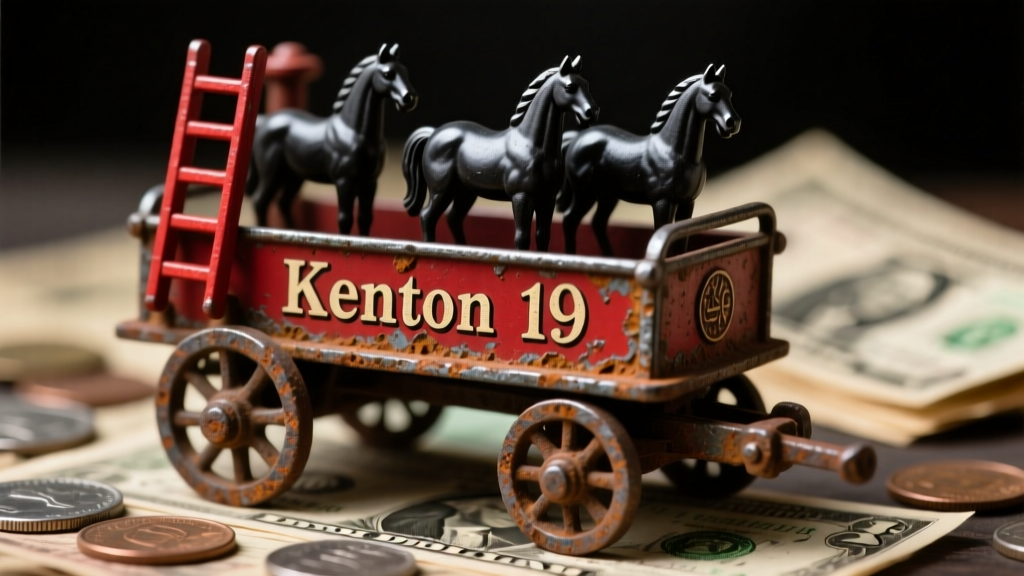
Kenton's 19-Inch Cast Iron Toy Fire Wagon: Ladders, Red Figures, and Three Black Horses — A Numismatic & Historical Appraisal
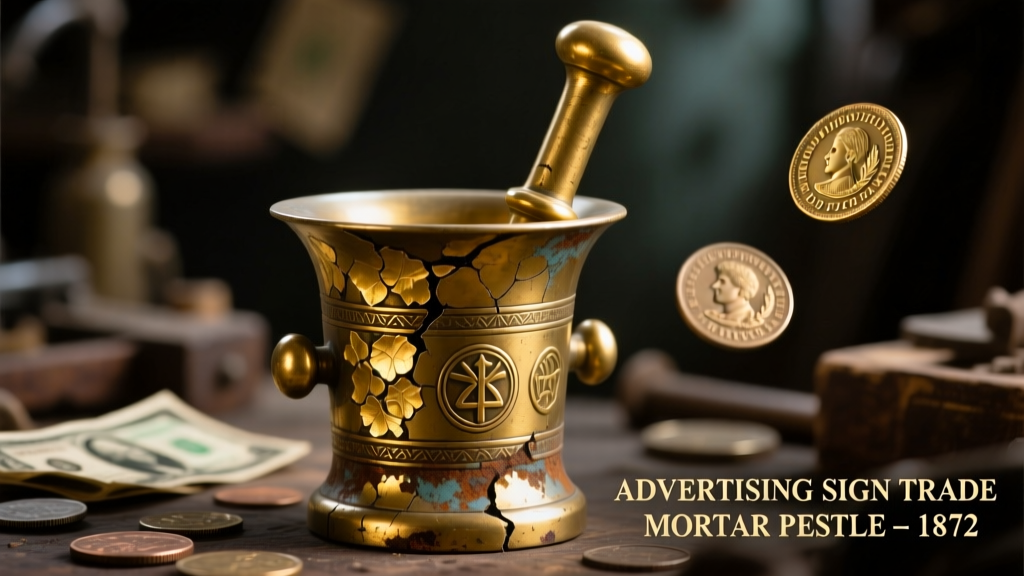
The Gilded Zinc Mortar and Pestle Advertising Sign: A 19th-Century Pharmaceutical Artifact Measuring 28 Inches

Metlox Red Rooster Cookie Jar (7½ Inches): History, Identification, and Market Value Analysis

Fiesta Light Green Candleholder Bulb Pair: Identification, Rarity, and Market Value Analysis

Marblehead Vase: Mauve Glaze, Lavender Interior, Flaring Form — Signed, 7½ Inches Tall

Celadon Bowl with Concentric Ring Design: A 7 1/4-Inch Koryo Dynasty Masterpiece
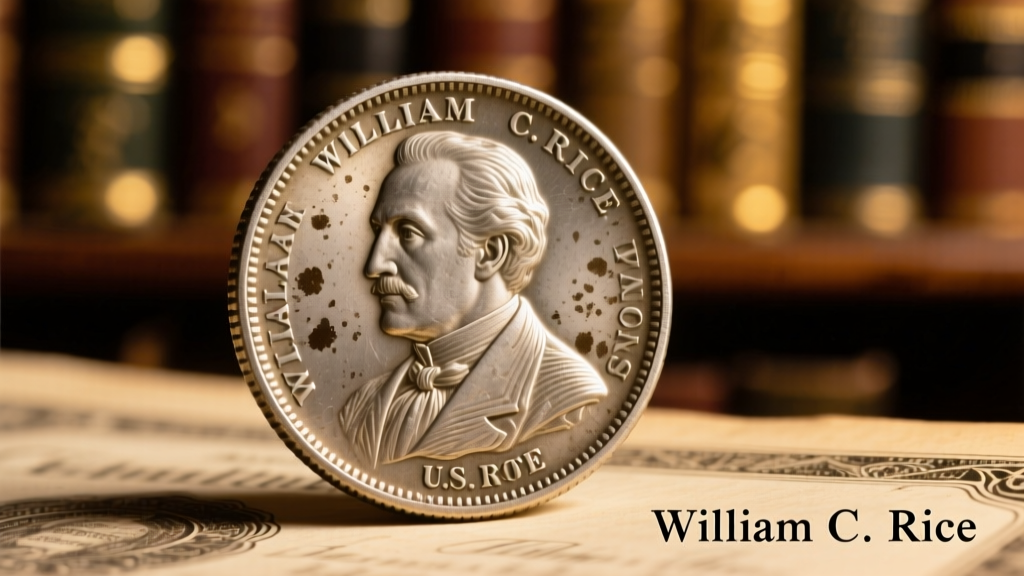
William C. Rice: The Unheralded Architect of U.S. Numismatic Standards and Early Coin Grading Rigor