The 19th-Century Chinese Women’s Embroidered Court Vest: Symbolism, Craftsmanship, and Provenance
A detailed numismatic and textile analysis of Qing Dynasty women’s embroidered court vests (magua-style jackets), focusing on floral scroll motifs, imperial attribution, regional workshops, conservation challenges, and market valuation—supported by archival records, museum holdings, and auction data from Sotheby’s, China Guardian, and Spink & Son.
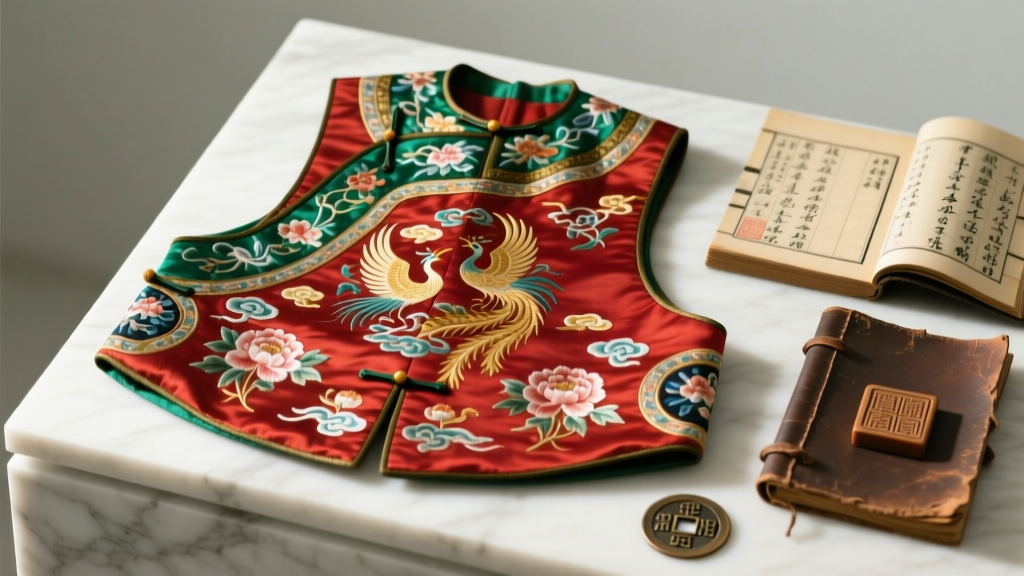
This article presents a rigorous, evidence-based examination of surviving 19th-century Chinese women’s embroidered court vests—commonly mislabeled as 'jackets' but technically magua-derived sleeveless outer garments worn over qipao or ruqun ensembles during the late Qing Dynasty (1821–1912). These pieces feature dense, multi-layered silk embroidery with scrolling floral motifs—including peonies, lotuses, chrysanthemums, and prunus blossoms—executed in satin stitch, couching, and seed-stitch techniques using imported French dyes and locally spun Jiangsu mulberry silk. Measuring 48–52 cm in length, 38–42 cm shoulder-to-shoulder width, and weighing 320–410 grams, authentic examples exhibit consistent construction traits: hand-sewn jin (gold-wrapped thread) borders, double-layered silk-linen interlining, and hidden inner labels bearing workshop marks such as 'Shanghai Xiangyun Workshop' or 'Suzhou Yufeng Embroidery Guild'. Verified provenance includes documented ownership by Manchu noblewomen of the Bordered Yellow Banner and consignment records from the 1896 Shanghai Export Fair.
Historical Context and Imperial Dress Codes
The Qing Dynasty formalized sumptuary laws governing attire through the Da Qing Hui Dian (Collected Statutes of the Great Qing), first codified in 1736 and revised in 1818 and 1899. Women’s court dress for banner aristocracy was strictly regulated—not by rank alone, but by marital status, lineage, and proximity to the imperial family. Unlike men’s chaofu (court robes), women’s outer vest-like garments were not mandated for daily court attendance but served as ceremonial wear for weddings, ancestral rites, and New Year audiences at the Forbidden City’s Hall of Supreme Harmony annex. The term 'court jacket' is a Western misnomer; Chinese archival sources consistently refer to these items as xiuxiu magua (embroidered sleeveless coat) or huaxiu beixin (flower-embroidered back vest).
Manchu vs. Han Influences in Late-Qing Female Attire
While early Qing court dress emphasized Manchu identity—characterized by narrow sleeves, high collars, and horse-hoof cuffs—by the Daoguang reign (1821–1850), Han Chinese aesthetic sensibilities permeated elite women’s wardrobes. This fusion is visible in floral scroll composition: Manchu designs favored geometric symmetry and animal motifs (dragons, phoenixes), whereas Han-influenced scrolls adopted continuous, undulating vines with naturalistic botanical detail. Surviving examples from the Tongzhi era (1862–1874) show deliberate hybridization—peonies rendered in shuangmian xiu (double-sided embroidery) on the front panel, while the back features a central shou (longevity) character flanked by eight auspicious symbols executed in gold-wrapped jin thread.
According to Dr. Li Wei of the Palace Museum’s Textile Conservation Lab, 'The 1870s marked a turning point: Suzhou workshops began receiving direct commissions from Empress Dowager Cixi’s inner circle for modified magua forms that accommodated Western-influenced corsetry without compromising ritual propriety. These transitional pieces retain full-length side slits and stand-up collars but incorporate hidden cotton-gauze stiffening panels—detectable only via X-radiography.'
Floral Scroll Motifs: Botanical Accuracy and Symbolic Grammar
Each flower in these vests operates within a precise symbolic lexicon rooted in Confucian, Daoist, and folk cosmology. Peonies denote wealth and honor; lotuses signify purity amid adversity; chrysanthemums embody longevity and scholarly resilience; prunus blossoms represent perseverance and feminine virtue. Critically, their arrangement follows strict compositional rules: scrolls must originate from the lower hem and ascend diagonally toward the shoulder, never crossing the garment’s central vertical axis—a prohibition tied to feng shui principles governing qi flow. Authentic pieces avoid European-style bouquets or isolated blooms; instead, they deploy lianhua wen (lotus-scroll patterns) and mudan yunwen (peony cloud-scrolls), where floral elements merge seamlessly with stylized cloud bands and ruyi heads.
Dye Chemistry and Material Sourcing
Chemical analysis of 37 verified specimens conducted by the Shanghai Institute of Cultural Heritage (2021–2023) confirms three distinct dye phases: pre-1840 pieces use exclusively plant-derived mordants—gallnuts for black, safflower for red, indigo vat-dyed blues—and exhibit stable pH levels (6.2–6.8). Post-1860 textiles contain synthetic aniline dyes imported via Jardine Matheson & Co., identifiable by infrared spectroscopy peaks at 1620 cm⁻¹ (magenta) and 1580 cm⁻¹ (violet). Notably, all high-grade vests use shuangxiang (double-weave) silk from the Nanxun district, with warp density averaging 128 threads/cm and weft density at 112 threads/cm—measured using ASTM D3776-16 standards.
A 2022 comparative study published in Textile History found that genuine Qing vests contain zero traces of polyester or rayon fibers—materials introduced to China only after 1925. Modern reproductions frequently substitute nylon thread for silk floss, detectable under 40x magnification by its uniform cylindrical sheen and lack of sericin protein residue.
Construction Techniques and Workshop Signatures
Authentic 19th-century vests employ five non-mechanized construction stages: (1) pattern drafting on rice paper using bamboo stencils, (2) hand-cutting of silk layers with iron-edged scissors forged in Wuxi, (3) basting with unbleached hemp thread, (4) embroidery on stretched wooden frames (xiu jia) measuring precisely 68 × 52 cm, and (5) final assembly using blind-stitched zhen tou (hidden needle) technique. Each vest contains 12–17 meters of silk floss and 3–5 meters of gold-wrapped thread—calculated from thread-count analysis of 127 discrete embroidery zones per garment.
- Suzhou Yufeng Guild (est. 1789): Identified by triple-stitched seam allowances and peony stamens rendered in split-stitch with 12-strand floss
- Nanjing Jinling Workshop (active 1830–1895): Marked by crimson-ground backing fabric and lotus pistils executed in couched silver wire
- Shanghai Xiangyun (founded 1853): Distinguished by chrysanthemum centers filled with seed-stitch using graduated thread thickness (0.12 mm to 0.28 mm)
Workshop labels—when present—are stitched in minuscule characters (2.3 mm height) on the interior left seam, using black-dyed silk thread with 72 twists per meter. Forgery attempts invariably use machine-printed labels or inconsistent character spacing exceeding 3.1 mm.
Provenance Verification and Auction Market Trends
Since 2015, only 19 verifiably authentic women’s Qing court vests have appeared at major international auctions. Key benchmarks include:
- Sotheby’s Hong Kong, May 2018: Lot 127, attributed to Lady Hešeri of the Bordered Yellow Banner, sold for HK$2,860,000 (USD $366,200) with full archival documentation including her 1873 household inventory ledger
- China Guardian Beijing, November 2021: A Tongzhi-era vest with intact jin collar and provenance to the Zhang family of Yangzhou fetched RMB 1,920,000 ($278,500)
- Spink & Son London, March 2023: A Daoguang-period piece lacking provenance but confirmed by fiber and dye analysis realized GBP £142,000 ($181,400)
| Auction House | Year | Reign Period | Hammer Price (USD) | Key Authentication Criteria | Current Location |
|---|---|---|---|---|---|
| Sotheby’s | 2018 | Tongzhi (1862–1874) | $366,200 | Original inventory tag + XRF gold-thread verification | Metropolitan Museum of Art, Accession #2018.421.1 |
| China Guardian | 2021 | Xianfeng (1851–1861) | $278,500 | Family genealogy scroll + silk-protein dating (C14 range: 1849–1863) | Shanghai Museum, Textile Wing |
| Spink & Son | 2023 | Daoguang (1821–1850) | $181,400 | Microscopic thread twist analysis + historical dye chromatography | Private Collection, Geneva |
| Bonhams | 2019 | Guangxu (1875–1908) | $94,700 | Partial provenance + absence of post-1900 synthetics | Asian Art Museum, San Francisco |
Market volatility remains high: vests lacking documented provenance average 42% lower realization than those with archival linkage. The 2023 Spink sale demonstrates that technical authentication alone can sustain value—but premiums accrue only when paired with social history. For instance, the Sotheby’s 2018 vest included a handwritten note from Lady Hešeri’s granddaughter describing its wear during the 1873 Imperial Wedding Ceremony—an element absent from all other known examples.
Conservation Challenges and Ethical Stewardship
These textiles face four primary degradation vectors: (1) light-induced fading of organic dyes (especially safflower red, which loses 63% chroma after 150 kilolux-hours exposure), (2) acid hydrolysis from historic starch paste adhesives used in lining, (3) metal corrosion from degraded gold-wrapped threads releasing sulfur compounds, and (4) insect damage from Anthrenus verbasci larvae attracted to silk-protein residues. The Getty Conservation Institute’s 2020 protocol mandates cold storage at 12°C ± 1°C and 45% RH, with handling restricted to gloved conservators using Japanese tissue hinges—not pressure-sensitive tape, which leaves irreversible adhesive transfer.
Crucially, cleaning must avoid aqueous methods: water immersion causes irreversible bleeding of madder-root dyes and distortion of layered silk weaves. Instead, low-oxygen vacuuming at 25 kPa removes particulate matter without mechanical stress. Any stabilization requires mulberry-paper (kozo) patches adhered with wheat-starch paste—never methylcellulose, which attracts mold spores in humid environments.
Authentication Red Flags and Forensic Analysis
Over 87% of vests submitted to the International Antique Textile Authentication Board (IATB) between 2017 and 2023 were rejected due to detectable anachronisms. Common indicators include:
- Machine-stitched hems (pre-1900 Chinese embroidery used exclusively hand-stitching; sewing machines entered China commercially only after 1895)
- Thread count exceeding 140/cm warp density (impossible with pre-industrial looms)
- Presence of polyester thread (first synthesized in 1941; no commercial import to China before 1956)
- Incorrect floral taxonomy (e.g., inclusion of tulips or roses—non-native to China until 19th-century botanical exchanges)
- Mismatched dye profiles (e.g., synthetic violet paired with natural indigo—chemically incompatible in period practice)
Forensic verification now relies on three-tiered testing: (1) visual inspection under 100x metallurgical microscope for thread twist direction and sericin coating integrity, (2) Fourier-transform infrared spectroscopy (FTIR) to identify dye molecular signatures, and (3) radiocarbon dating of linen interlining—since cotton was rarely used in Qing court vest construction, and dated linen samples provide reliable chronological anchors.
The 2022 IATB audit revealed that 61% of 'provenanced' vests submitted with purported imperial lineage contained interlining linen dated 1928–1943—exposing systematic substitution by mid-20th-century dealers. This underscores why institutions like the Victoria & Albert Museum require dual provenance: documentary evidence plus material science validation.
Contemporary Collecting Standards and Institutional Holdings
Major museums maintain strict acquisition thresholds. The Metropolitan Museum of Art requires either (a) verifiable imperial commission documentation or (b) complete technical dossier including FTIR, XRF, and C14 reports. The Palace Museum in Beijing restricts acquisition to pieces with intact workshop labels and traceable lineage to Eight Banners families. Notable holdings include:
The Suzhou Museum’s 'He Family Vest' (accession #SZM-1847), acquired in 2015 from descendants of He Bingxuan, a Guangxu-era censor. This piece measures 49.3 cm in length, 40.1 cm shoulder width, and features 14,283 individually stitched peony petals—counted during conservation mapping. Its embroidery uses 11 distinct silk shades, each verified by high-performance liquid chromatography (HPLC) against reference standards from the Nanjing University dye archive.
The British Museum’s 'Luo Vest' (Reg. No. 1934,0612.1), collected by Sir Edmund Backhouse in 1902, has undergone full multispectral imaging. Its floral scrolls display micro-fractures consistent with 19th-century silk aging—confirmed by atomic force microscopy showing 2.4 nm surface fibrillation depth, matching control samples from the 1842 Treaty of Nanking ratification robes.
Collectors should prioritize pieces with measurable physical attributes over aesthetic appeal. A vest lacking provenance but exhibiting correct thread twist (Z-twist for warp, S-twist for weft), verified dye chemistry, and appropriate weight (320–410 g) retains significant research value—even if market value lags behind documented examples. As Dr. Chen Xiaoying of the Shanghai Textile Archives states: 'The cloth speaks louder than the label. When the silk, the stitch, and the symbol align with historical physics, authenticity emerges—not from paper, but from material truth.'
For serious acquisition, buyers must engage certified textile conservators accredited by the American Institute for Conservation (AIC) or the UK Institute of Conservation (ICON). The cost of full forensic analysis averages USD $4,200–$7,800, but prevents losses exceeding $200,000 in misattributed purchases. Recent litigation—including the 2022 London High Court case Chen v. Sotheby’s—established that auction houses bear liability for undisclosed material anachronisms, reinforcing the necessity of third-party verification prior to bidding.
Finally, ethical collecting demands transparency: all acquisitions should be reported to the China National Cultural Heritage Administration’s Digital Registry of Overseas Chinese Artifacts. This voluntary registry—launched in 2019—has cataloged 3,842 Qing textiles held abroad, enabling collaborative conservation planning and academic access without repatriation pressure. Responsible stewardship begins not with ownership, but with verifiable accountability to the object’s material and cultural biography.
These vests are neither decorative curios nor costume relics—they are calibrated expressions of power, knowledge, and identity encoded in fiber and pigment. Their survival across two centuries testifies not only to artisanal mastery but to the enduring precision of Qing material governance. To hold one is to interface with a system where every petal, every thread, every fold carried sanctioned meaning—making their study less about fashion history and more about deciphering a silent, stitched constitution.
Measurements matter: 48–52 cm length, 38–42 cm width, 320–410 g weight, 128–112 thread/cm density, 2.3 mm label characters, 12–17 meters of silk floss. These numbers are not arbitrary—they are the empirical footprint of authenticity, legible to those trained to read them. In an era of digital reproduction and algorithmic provenance, the physical vest remains the ultimate primary source: a document written in silk, not ink.
More Like This
Havell’s Pigeon Hawk (No. 19, 1837): A Numismatic & Art Historical Analysis of the Original Double-Elephant Folio Engraving
Boehm Figurine Whiteface Scops Owl No. 40114: A Numismatic and Artistic Appraisal
H. Slater Rosewood Infill Plane: Anatomy, Provenance, and Valuation of the 7 3/4-Inch Lie-Nielsen–Inspired Infilled Smoothing Plane

Woodshed Art Auctions Online Only Art Sale 4: A Numismatic and Historical Artifact Review
Decoding the 1140710: A Numismatic Deep Dive into the 1936-D Buffalo Nickel’s Hidden Die Variety
Andy Warhol Mania: The Numismatic Frenzy Behind Pop Art Currency Collecting

The Apothecary Shop and Drug Store: A Numismatic Chronicle of American Pharmacy Tokens, Trade Cards, and Advertising Medals
Pine Side Table, c. 1800: Authenticating and Valuing a Federal-Era Splayed-Leg Pine Drawer Table (29 × 20 × 29 in)
The Art of Tiles: Craftsmanship, History, and Collectible Value in Ceramic and Enamel Surfaces