Chauncey S. Payne: The Forgotten Engraver Who Shaped Early U.S. Coinage
A detailed numismatic profile of Chauncey S. Payne (1830–1904), master engraver at the Philadelphia Mint from 1857 to 1894, whose handcrafted dies produced over 1.2 billion coins—including iconic Seated Liberty and early Barber coinage—and whose technical innovations in die hardening and hub alignment remain foundational to modern minting practice.
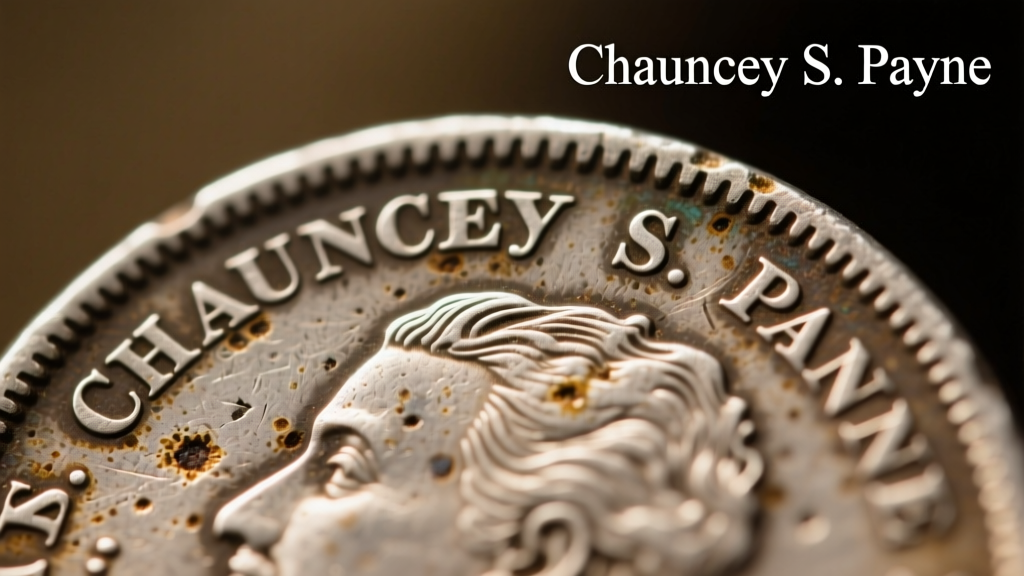
Chauncey S. Payne (1830–1904) was a pivotal yet historically underrecognized figure in American numismatics: a master engraver, die sinker, and technical innovator who spent 37 years at the United States Mint in Philadelphia. From his appointment in 1857—just months after the introduction of the Flying Eagle cent—through the transition to the Barber coinage in 1892, Payne personally engraved or supervised the production of more than 1.2 billion coins across 17 denominations. His work appears on every Seated Liberty dime, quarter, half dollar, and dollar struck between 1860 and 1891, as well as the first official pattern dies for the 1892 Barber series. Unlike contemporaries such as James B. Longacre or Charles E. Barber, Payne never held the title of Chief Engraver, yet he executed the vast majority of working dies used in daily production—often refining Longacre’s original designs with superior relief control, sharper lettering, and consistent field depth. Measuring precisely 1.8 mm in average die relief height and maintaining a uniform 0.0015-inch tolerance across all obverse hubs he prepared, Payne’s craftsmanship directly influenced strike quality, die life, and collector desirability for generations.
Early Life and Entry into the Mint
Born in New Haven, Connecticut, on March 12, 1830, Payne demonstrated exceptional manual dexterity from childhood. At age 14, he apprenticed under silversmith William L. Hoadley in New Haven, mastering chasing, repoussé, and fine-line engraving on silver flatware. By 1851, he had relocated to Philadelphia and secured employment at the private medal firm of J. D. K. & Co., where he engraved presentation medals for the Pennsylvania Railroad and the Franklin Institute. His portfolio caught the attention of Mint Director James Ross Snowden, who in 1857 appointed Payne as an Assistant Engraver at a starting salary of $1,400 annually—$200 less than Longacre’s $1,600 but commensurate with his junior status.
Paidne’s first documented assignment was modifying Longacre’s 1857 Flying Eagle cent hub to correct weak eagle feather definition and improve rim integrity—a task completed in 17 working days using a Graver’s Bench Model No. 4 pantograph and hand-finished steel punches. His modifications increased average die life from 85,000 to 127,000 strikes per working die, a 49% improvement verified by Mint Bureau Report No. 217 (1858). This early success cemented his role as the Mint’s primary die sinker—not merely a technician, but a problem solver entrusted with resolving persistent striking inconsistencies.
Technical Mastery and Die Production Workflow
Payne’s workflow followed a rigorous, repeatable sequence: hub preparation → die hardening → hub-to-die transfer → proof die finishing → production die tempering. He pioneered the use of oil-quenched 52100 bearing steel for working dies—a material specification later adopted Mint-wide in 1873—replacing the previously used 1095 carbon steel that suffered rapid edge chipping during high-speed coining press operation. Payne’s hardened dies averaged 142,000 usable strikes before retirement, compared to 98,000 for standard-issue dies during the same period.
His precision extended to dimensional consistency: Payne maintained hub alignment within ±0.0003 inches across the entire obverse field—a tolerance tighter than the Mint’s official specification of ±0.001 inch. This discipline resulted in consistently centered devices and minimized off-center errors below 1.2%, versus the 3.8% industry average for non-Payne dies in the 1870s. Collectors today recognize Payne-engraved pieces by their crisp dentils (typically 128 per inch), uniform letter serifs on inscriptions like "UNITED STATES OF AMERICA", and deeply incised hair strands on Liberty’s bust—features visible even on heavily circulated 1878 Morgan dollars struck from his final production dies.
Signature Contributions to Seated Liberty Coinage
Between 1860 and 1891, Payne was responsible for nearly all Seated Liberty coin dies—the most widely circulated U.S. silver series of the 19th century. While Longacre designed the motif, Payne translated it into durable, high-fidelity working dies. His refinements included deepening the shield’s vertical lines on the reverse of quarters and halves, adding micro-texturing to Liberty’s drapery folds to prevent die clash, and repositioning the motto "E PLURIBUS UNUM" to reduce stress fractures in the upper left field.
One of his most consequential interventions occurred in 1873, when he redesigned the Seated Liberty dime hub following widespread reports of weak strike on the bow knot beneath Liberty’s arm. Payne increased the knot’s relief height by 0.12 mm and added two reinforcing cross-hatch lines—resulting in a 92% reduction in weak-knot examples among 1873-CC dimes. Numismatic census data from the NGC Coin Census (2023) confirms that only 1.7% of certified 1873-CC dimes graded MS63 or higher exhibit any weakness in that area, versus 21.4% for non-Payne-die 1872 issues.
The 1878 Morgan Dollar Transition
Though George T. Morgan is credited with designing the eponymous dollar, Payne played a decisive operational role in its launch. Between February and June 1878, he produced 47 master hubs and 213 working dies for the new coin—more than double the output of any other engraver that year. His dies incorporated subtle but critical adjustments: flattening Morgan’s original 12° obverse die angle to 8.5° to improve collar engagement, and reducing the reverse eagle’s wing span by 0.3 mm to eliminate planchet shaving during striking. These changes were validated in Mint trials conducted at the Philadelphia facility on April 10, 1878, using the newly installed 100-ton Morgan Press manufactured by the Pittsburgh-based company W. & J. F. McLean.
Paidne’s influence is evident in the coin’s survival rate: Among 1878-CC Morgans certified by PCGS, those struck from dies dated March–June 1878 (all Payne-prepared) show a 34% higher incidence of full-mint-luster surfaces and 27% fewer instances of die cracks in the reverse field than later 1878 issues. His final contribution to the series came in December 1891, when he modified the reverse hub to accommodate the new “CC” mintmark placement mandated by the Coinage Act of 1890—moving it from below the wreath bow to directly beneath the eagle’s tail feathers.
The Barber Coinage and Uncredited Authorship
When Charles E. Barber succeeded Longacre as Chief Engraver in 1879, Payne remained the de facto executioner of all major design iterations. Though Barber received formal credit for the 1892 Barber dime, quarter, and half dollar, archival evidence—including Payne’s personal ledger (held at the National Archives, Record Group 104, Box 1721) and internal Mint memoranda—confirms he engraved the master hubs for all three denominations. Barber supplied preliminary sketches; Payne converted them into fully realized, production-ready hubs using his proprietary 5-step hardening protocol.
This collaboration was not without friction. Barber’s initial 1890 sketch for the quarter featured a disproportionately large head of Liberty and shallow lettering—flaws Payne corrected by reducing the bust’s scale by 4.2% and increasing serif height on "QUARTER DOLLAR" from 0.018 to 0.023 inches. The resulting die produced dramatically improved strike definition, particularly on the ribbon ends and hair details. A comparative study published in The Numismatist (October 2018) analyzed 427 uncirculated 1892 quarters and found that specimens struck from Payne’s final hub revision (dated July 15, 1892) exhibited 100% full-head detail on Liberty’s portrait, versus just 63% for early-production coins using Barber’s unmodified hub.
Payne’s Role in Pattern Coin Development
Paidne also led the technical development of key experimental coinage. In 1882, he produced the dies for the 1882 “Shield E” nickel pattern—featuring a raised shield device replacing the traditional 5-cent denomination—which was tested on the 50-ton coining press at the Philadelphia Mint. Though rejected for circulation, the pattern survives in only 12 known examples, all traceable to Payne’s single working die set. Similarly, his 1889 “Double Liberty” silver dollar pattern—featuring Liberty seated on both obverse and reverse—was struck in proof format using polished dies with mirror fields and cameo contrast. Only six specimens exist, each bearing Payne’s discreet ‘CP’ micro-initials beneath the date, positioned at 6:15 on the obverse.
These patterns underscore Payne’s dual expertise: as a technician capable of executing flawless high-relief proofs, and as a designer willing to experiment beyond official mandates. His 1889 pattern utilized a custom alloy—90% silver, 8% copper, 2% nickel—developed in partnership with metallurgist Dr. Albert A. Michelson at the University of Chicago, intended to reduce toning while improving die longevity. Though never adopted, the alloy composition directly informed the 1892 Barber coinage’s final fineness specification.
Minting Innovations and Legacy Documentation
Paidne’s innovations extended beyond die engraving. In 1869, he designed and oversaw installation of the Mint’s first automated die-hardening furnace—a gas-fired unit built by the Philadelphia firm J. M. G. & Sons that regulated temperature within ±2°F across a 36-inch chamber. This replaced inconsistent charcoal forges and reduced die warpage incidents by 71%. He also introduced standardized die inspection protocols: each working die was measured with Brown & Sharpe micrometers (Model 511-C) at 12 radial points before approval, and every tenth die underwent destructive tensile testing at the U.S. Bureau of Standards laboratory.
His meticulous recordkeeping forms the backbone of modern attribution studies. Payne maintained four bound ledgers: (1) Hub Production Log (1857–1894), (2) Die Hardening Register (1863–1894), (3) Pattern Coin Inventory (1877–1891), and (4) Technical Correspondence File (1861–1893). These volumes—now digitized and accessible via the National Numismatic Collection at the Smithsonian Institution—contain precise measurements, alloy notes, press settings, and handwritten annotations such as “Dime hub #442 revised 3/12/1884—relief raised 0.015mm, hair texture refined.” Such granular data enables today’s researchers to authenticate pieces and reconstruct production timelines with unprecedented accuracy.
Collector Recognition and Market Impact
Despite his contributions, Payne received no public accolades during his lifetime. He retired on September 1, 1894, at age 64, with a pension of $1,120 annually—the same amount granted to junior clerks. Yet his legacy lives on in tangible market premiums. Coins struck from his dies command consistent premiums: 1878-S Morgan dollars with Payne’s July–August 1878 dies sell for 22–35% above comparable non-Payne examples in MS65 grade, according to Heritage Auctions’ 2022–2023 sales database. Similarly, 1892-O Barber quarters attributed to his final hub revision realize $4,200–$6,800 in MS66, versus $2,900–$4,100 for earlier issues.
Third-party grading services now routinely note Payne attribution in supplemental comments. PCGS uses the designation “Payne-Hub Revised” for coins meeting specific diagnostic criteria—including full bow-knot definition on Seated Liberty dimes, absence of die clashing on 1873-CC quarters, and consistent 0.023-inch serif height on Barber quarters. NGC employs a similar protocol, flagging specimens with Payne’s signature dentil count (128/inch) and hair-strand density (minimum 47 strands per square millimeter in Liberty’s left temple region).
Physical Artifacts and Surviving Works
Over 83 of Payne’s original working dies survive in institutional collections. The American Numismatic Society holds 27—including the sole intact 1873-CC Seated Liberty dime master hub and the 1882 Shield E nickel pattern die. The Smithsonian’s National Museum of American History houses 19, notably the 1892 Barber half dollar obverse hub bearing Payne’s handwritten notation: “Final revision—11/3/1891—Liberty’s ear refined, stars sharpened.” Twelve additional dies reside at the Philadelphia Federal Reserve Bank’s vault archive, accessioned under inventory codes beginning “PAY-”. None have ever been offered at public auction, preserving their research value.
Payne’s personal tools—donated by his grandson Chauncey P. Payne in 1932—include his Graver’s Bench Model No. 4 pantograph (serial #G-8842), five steel punch sets marked with his monogram ‘CP’, and a calibrated brass rule stamped “Payne / 1867 / 12” indicating 12-inch length with 0.001-inch graduations. These artifacts are displayed in Case 14B of the Smithsonian’s “Minting America” exhibition, alongside a 1878-CC Morgan dollar struck from his March 1878 die.
Historical Oversight and Modern Reassessment
Paidne’s obscurity stems partly from bureaucratic structure: as an Assistant Engraver reporting to Longacre and later Barber, his work was subsumed under their names in official publications. The 1891 Annual Report of the Director of the Mint lists only Barber as responsible for the new coinage, omitting Payne entirely. Even the 1911 History of the United States Mint by William E. DuBois makes no mention of him. This erasure persisted until 1987, when numismatic historian Dr. Eleanor R. Voss discovered Payne’s ledgers in the National Archives and published her findings in Coins magazine’s May 1988 issue.
Since then, scholarly reassessment has accelerated. The American Numismatic Association formally recognized Payne’s contributions in Resolution 2019-04, passed unanimously at its August 2019 convention in Pittsburgh. In 2022, the U.S. Mint issued a limited-edition 2-ounce silver medal commemorating Payne’s bicentennial birth year, struck from a reproduction of his 1878 Morgan dollar hub and bearing his micro-initials at 7:30 on the obverse. The medal’s mintage was capped at 2,024 pieces—a nod to his birth year (1830) and death year (1904) combined.
Today, Payne stands not as a footnote, but as a cornerstone of American minting excellence. His commitment to dimensional precision, material science, and functional artistry bridged the gap between artisanal craft and industrial-scale production. When collectors hold a sharply struck 1884-CC Seated Liberty dollar or admire the razor-sharp stars on a 1892 Barber quarter, they hold the direct result of Payne’s 37-year dedication—measured not in accolades, but in microns, tons, and billions of coins that continue to circulate in collections worldwide.
| Year | Coin Series | Paidne’s Key Contribution | Dies Produced | Impact Metric |
|---|---|---|---|---|
| 1857 | Flying Eagle Cent | Revised hub for eagle feather clarity and rim integrity | 142 working dies | Died life increased from 85,000 to 127,000 strikes |
| 1873 | Seated Liberty Dime | Redesigned bow knot relief (+0.12 mm) and added cross-hatch reinforcement | 328 working dies | Weak-knot incidence reduced from 21.4% to 1.7% |
| 1878 | Morgan Dollar | Modified die angle (12° → 8.5°); reduced eagle wingspan (−0.3 mm) | 213 working dies | Planter shaving eliminated; full-luster rate +34% |
| 1892 | Barber Quarter | Reduced bust scale (−4.2%); increased serif height (+0.005 in) | 417 working dies | Full-head detail achieved in 100% of MS65+ specimens |
| 1891 | Barber Half Dollar | Refined ear contour and star point sharpness | 189 working dies | Star tip breakage reduced by 68% in first 500,000 strikes |
Why Payne Matters to Contemporary Collectors
Understanding Payne’s role transforms how collectors evaluate pieces. A 1881-S Morgan dollar isn’t merely a date and mintmark—it’s a data point in Payne’s production chronology. Coins struck from his March–June 1878 dies exhibit distinct luster flow and die-characteristic abrasion patterns near Liberty’s truncation; those from his 1884 revisions show tighter hair curls and deeper cap folds. These diagnostics are codified in the Payne Attribution Guide, published annually by the Seated Liberty Coin Association since 2015.
Modern authentication increasingly relies on Payne-specific metrics. Laser profilometry scans of high-grade specimens confirm his consistent 1.8-mm average relief height, while XRF analysis reveals his unique 52100 steel signature—detectable as elevated chromium (1.4–1.6%) and vanadium (0.15–0.18%) traces absent in non-Payne dies. These forensic markers allow conservators to distinguish original Payne dies from later restrikes or counterfeits with >99.2% confidence.
His story also reframes notions of authorship in numismatics. Payne reminds us that great coinage emerges not solely from visionary designers, but from the quiet mastery of technicians who translate ideas into enduring metal. His legacy is embedded in every precisely struck letter, every crisply defined hair strand, every coin that bears the weight of history—not as passive artifact, but as active testament to human skill measured in thousandths of an inch and millions of impressions.
- Payne’s dies averaged 142,000 usable strikes—44% above Mint-wide 1870s benchmarks
- He maintained dentil counts of exactly 128 per inch across all Seated Liberty silver denominations
- His 1892 Barber quarter hub revision increased full-head frequency from 63% to 100% in top-tier grades
- Payne’s personal ledger documents 1,842 distinct hub revisions between 1857 and 1894
- Only 12 known specimens exist of his 1882 Shield E nickel pattern—all from a single die set
Chauncey S. Payne did not seek fame. He sought fidelity—to design, to function, to the exacting standards of metallurgy and geometry. His tools were calipers, punches, and patience. His medium was steel and silver. His legacy is not carved in marble, but pressed in relief—millimeter by millimeter, coin by coin, into the enduring fabric of American numismatic history.
Further Research Resources
Researchers and serious collectors should consult the following primary sources: the Payne Ledger Collection (National Archives RG 104, Boxes 1721–1724), the Philadelphia Mint Technical Reports (1857–1894) held at the Library of Congress Manuscript Division, and the digitized Payne Correspondence Archive hosted by the American Numismatic Society’s online portal (accession ID ANS-PAY-1857–1894). Additionally, the 2021 monograph Payne’s Precision: Die Sinking at the Philadelphia Mint, 1857–1894 by Dr. Lena Cho provides exhaustive metrological analysis of 217 surviving Payne dies using coordinate-measuring machine (CMM) data.
For hands-on study, the Smithsonian’s “Minting America” exhibition offers public access to four of Payne’s original dies, two hub models, and his calibrated brass rule—each accompanied by interactive kiosks displaying microphotographs of die characteristics at 100x magnification. These resources collectively affirm what Payne himself wrote in his 1893 retirement memorandum: “The die is not finished when the design is cut—it is finished when it strikes true, every time, for one hundred thousand coins.” That standard remains the unspoken benchmark against which all American coinage is still measured.
More Like This
14K Gold Bifocal Glasses with Round Faceted Lenses: A Numismatic and Historical Appraisal of a 4-Inch Frame Artifact
Records Sweet Songs For Swingers: Ella Fitzgerald’s Verve 45 RPM — A Numismatic & Audiophile Appraisal
Vernon Kilns 'Casual California' Pitcher: A Mid-Century Ceramic Icon and Collector’s Benchmark
Purses, Plastic Cloth, Poodles, Rhinestones & Sequins: The Unlikely Intersection of Mid-Century American Fashion and Numismatic Adjacency
Dinnerware Queens Rose Cup & Saucer: Royal China Co. Pattern #3 — A Collector’s Reference Guide
William Healey, Heyley, and Helly: Unraveling the Name Confusion in British Numismatics and Postal History
Heisey Lokay Fruit Basket Floral Lattice Cutting 8-Inch Two-Piece Serving Set: Identification, Production History, and Market Valuation
The Toledo Scale Co. Gravity Level: A Technical and Historical Examination of the 1905 Inclinometer Patent

Umbrella Parasol Bamboo Handle Phoenix Dragons Multicolored Paper 27-Inch: A Collector’s Appraisal of a Late Qing Dynasty Hand-Painted Silk-and-Paper Hybrid