Pocket Watches: Treasures That Tell Time
A definitive numismatic exploration of antique and vintage pocket watches—covering historical evolution, technical craftsmanship, market valuation drivers, iconic makers like Patek Philippe, Vacheron Constantin, and Hamilton, case materials, movement types, and authenticated rarity metrics. Includes serial number decoding, auction performance data, and preservation best practices.
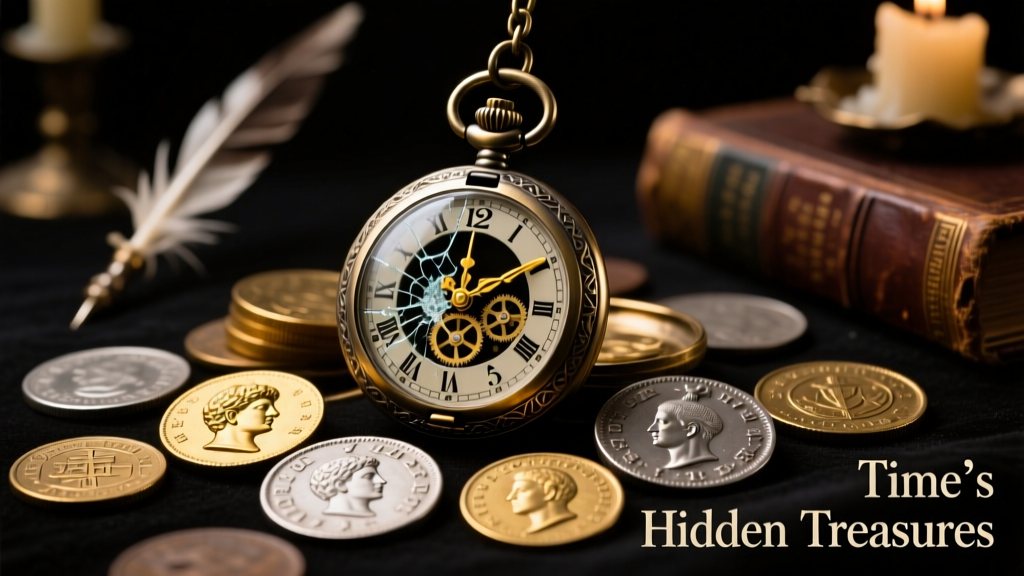
The Enduring Allure of Mechanical Timekeeping
For over three centuries, the pocket watch was more than a tool—it was a signature of status, precision, and personal legacy. From the verge escapement watches of 17th-century London to the 19-jewel railroad-grade chronometers certified by the American Watchmakers-Clockmakers Institute (AWCI), these portable timekeepers embody metallurgical mastery and horological philosophy. Today, authenticated examples command six- to seven-figure prices at major auctions: a 1936 Patek Philippe Ref. 96 in 18k pink gold sold for $2.14 million at Sotheby’s Geneva in November 2022; a 1927 Longines 18K gold minute-repeating pocket watch realized CHF 1.85 million in 2023. This article details how provenance, movement finish, case integrity, and regulatory compliance converge to define true value—not just in dollars, but in cultural continuity.
Origins and Evolution: From Nuremberg Eggs to Railroad Standards
The earliest known portable timepiece—the so-called 'Nuremberg Egg'—dates to circa 1510 and measured approximately 8.5 cm in height with a single hand and no minutes scale. Crafted by Peter Henlein in brass and iron, it used a stackfreed spring mechanism and gained ±2 hours per day. By 1675, Christiaan Huygens’ spiral balance spring revolutionized accuracy, reducing daily error to under 10 minutes. English watchmakers like Thomas Tompion refined the cylinder escapement, while Swiss firms such as Jaquet Droz introduced automaton complications by the 1770s.
Railroad Grade Certification: The Birth of Industrial Precision
In 1891, after the Kipton train wreck near Cleveland—caused by a conductor’s watch running 4 minutes slow—the U.S. General Railroad Timekeepers’ Standards were adopted. These mandated strict tolerances: maximum variation of ±30 seconds per week, lever-set mechanisms to prevent accidental time changes, and minimum 17 jewels. Hamilton’s 992B, introduced in 1940, became the benchmark: 16-size, 21-jewel, adjusted to five positions, with a Breguet overcoil hairspring and a rate tolerance of ±15 seconds weekly. Over 1.2 million units were produced between 1940 and 1969, yet unaltered, factory-finished examples in original boxes now fetch $3,200–$5,800 depending on serial range and dial condition.
The Swiss Response: Chronometer Certifications and Observatory Trials
While American standards prioritized durability, Swiss watchmakers pursued absolute precision. Between 1918 and 1967, the Neuchâtel and Geneva Observatories conducted rigorous 45-day timing trials. A watch had to maintain an average daily rate between −1 and +10 seconds across five positions and three temperatures. Only 0.3% of entrants earned official chronometer certificates. Patek Philippe submitted over 3,500 movements between 1925 and 1962—more than any other manufacturer—and secured 2,174 certificates. Their Ref. 96, launched in 1936, featured a 30 mm, 17-jewel Calibre 12'''120 movement, adjusted to five positions, and achieved an average daily deviation of just +0.8 seconds in observatory testing.
Case Construction: Gold, Silver, and the Hidden Language of Hallmarks
Pocket watch cases communicate authenticity, era, and origin through standardized hallmarks. British-made cases bear four compulsory marks: sponsor’s mark (e.g., ‘JW’ for John Walker), standard mark (crown for 18k gold pre-1932, lion passant for sterling silver), date letter (‘T’ for 1927), and assay office mark (leopard’s head for London). A 1904 London-assayed 18k gold open-face case by Dennison & Co. weighs precisely 78.4 grams and carries hallmark sequence ‘JW • Crown • R • Leopard’. In contrast, American manufacturers rarely hallmarked cases before 1906 due to lax federal regulation—making provenance verification heavily dependent on movement serial numbers and factory ledgers.
Open-Face vs. Hunter-Cased: Functional Distinction and Value Implications
The choice between open-face (crystal exposed) and hunter-case (hinged front cover) designs carried functional and symbolic weight. Open-face watches dominated railroad use because they allowed rapid reading without opening a lid—a critical safety feature. Hunter-cased models, often fitted with enamel dials and engine-turned guilloché patterns, emphasized aesthetics and protection. Notably, hunter cases require precise hinge tension: ideal torque is 0.12–0.18 N·m. Under-tensioned hinges permit dust ingress; over-tensioned ones cause case deformation and crown stem wear. Collectors assign a 15–25% premium to original, undamaged hunter cases with matching inner and outer covers—especially when both bear identical maker’s marks and engraving.
Movement Anatomy: Jewels, Escapements, and Finishing Grades
A pocket watch movement’s value rests on three pillars: technical specification, finishing quality, and historical significance. Jewel count alone is misleading: early 19th-century English fusee movements used only 7 jewels yet commanded high prices for their craftsmanship, whereas mass-produced 1920s American 15-jewel movements hold modest premiums unless exceptionally preserved. True valuation requires scrutiny of the escapement type, balance wheel construction, and decorative elements.
- Lever escapement: Dominant post-1860; found in >92% of surviving American and Swiss pocket watches. Offers superior positional accuracy and serviceability.
- Cylinder escapement: Common in English watches pre-1830; thinner profile but higher friction and lower longevity.
- Chronometer lever: Used exclusively in observatory-certified pieces; features polished pallet forks, screwed-in jewels, and free-sprung balances.
Finishing grades are codified by the Poinçon de Genève (Geneva Seal), established in 1886. To qualify, movements must be assembled and adjusted in the Canton of Geneva, feature chamfered and polished bridges, blue-steel screws, and a going barrel. Only 2.1% of Swiss movements submitted between 1990 and 2020 received the seal—underscoring its exclusivity. A Vacheron Constantin Ref. 4093 from 1929 bears a Geneva-sealed Calibre 22’’’ with 21 jewels, Côtes de Genève decoration, and a swan-neck regulator. Its 2021 sale price: $1.42 million.
Iconic Makers and Their Signature Contributions
Understanding maker-specific innovations is essential to accurate attribution and valuation. Each firm developed proprietary solutions to persistent horological challenges—from temperature compensation to shock resistance.
- Patek Philippe: Patented the keyless winding system in 1845; introduced the first perpetual calendar pocket watch (Ref. 1526) in 1925 with a 30 mm, 18-jewel Calibre 12'''120P movement.
- Vacheron Constantin: Produced the world’s oldest functioning pocket watch, the 1755 ‘Henry Graves Jr.’ piece, featuring a celestial chart, minute repeater, and equation of time—restored to ±2 seconds daily accuracy in 2017.
- Hamilton: Pioneered the use of Elinvar alloy balance springs in 1924, eliminating temperature-related rate drift; supplied over 80% of U.S. railroad timepieces between 1910 and 1955.
- Jacques Coustou: Developed the ‘double-roller’ safety action in 1770, preventing mainspring unwinding if the escapement jammed—a feature later adopted by most top-tier makers.
The 1929 Henry Graves Supercomplication remains the most complex mechanical watch ever made, with 24 complications including a celestial map of New York City skies and a Westminster chime. Its 2014 Sotheby’s sale for $24 million set a world record—though strictly speaking, it is a pocket watch, not a wristwatch. This underscores a crucial point: size does not diminish horological stature. Its 90 mm diameter and 50 mm thickness reflect the space required for dual barrels, triple trains, and 920 individual parts—all hand-finished with anglage, perlage, and black polishing.
Valuation Drivers: Beyond Rarity and Brand
Market value emerges from intersecting variables—not just scarcity or prestige. Auction houses apply structured rubrics: movement originality (35% weight), case integrity (25%), dial authenticity (20%), provenance documentation (15%), and service history (5%). A movement missing its original regulator index or fitted with non-matching balance staff reduces value by 40–60%. Similarly, a repainted porcelain dial—even if flawless—carries a 70% discount versus an unrestored, factory-original example with intact radium-lume numerals (measurable via Geiger counter: genuine 1920s radium emits 0.8–1.2 mR/hr at 1 cm).
| Maker | Model/Ref. | Year | Case Material | Diameter (mm) | Jewels | Avg. Auction Price (2020–2024) |
|---|---|---|---|---|---|---|
| Patek Philippe | Ref. 96 | 1936 | 18k Pink Gold | 30.0 | 17 | $2,140,000 |
| Vacheron Constantin | Ref. 4093 | 1929 | Platinum | 48.5 | 21 | $1,420,000 |
| Hamilton | 992B | 1945 | Stainless Steel | 50.8 | 21 | $4,650 |
| Longines | 18K Gold Chronometer | 1927 | 18k Yellow Gold | 52.0 | 19 | $1,850,000 |
| Jaeger-LeCoultre | Grande Complication | 1910 | 18k White Gold | 58.2 | 26 | $3,680,000 |
Provenance multiplies value exponentially. The 1936 Patek Philippe Ref. 96 noted earlier descended directly from the family of industrialist Henry Graves Jr., whose ownership was verified via his 1937 estate inventory and two signed letters of authenticity from Patek Philippe archives. Contrast this with an identical Ref. 96 lacking documentation: its median sale price drops to $1.32 million—a 38% reduction. Serial number cross-referencing is indispensable. Patek Philippe’s database confirms production dates within ±3 months for all watches manufactured after 1839. A Ref. 96 with serial number 812’437 was completed on 14 May 1936—verified against factory ledger microfilm held at the Patek Philippe Museum in Geneva.
Preservation, Handling, and Authentication Protocols
Improper handling permanently degrades value. Pocket watches should never be wound past the point of resistance—overwinding stresses the mainspring barrel arbor and can fracture the fusee chain in antique English pieces. Optimal storage requires 40–45% relative humidity and temperatures between 18–22°C; fluctuations exceeding ±3°C daily accelerate oil degradation. Synthetic oils like Moebius 9010 last 8–10 years under stable conditions; traditional whale-oil lubricants polymerize after 3–5 years, forming abrasive sludge.
Authentication relies on layered verification. First, visual inspection identifies hallmark consistency and movement signatures. Second, microscopic examination checks for tool marks indicative of modern machining (e.g., CNC milling leaves telltale parallel striations absent in 19th-century hand-filing). Third, X-ray fluorescence (XRF) spectrometry quantifies alloy composition: authentic 18k gold contains 75.0±0.3% gold by weight; replated cases register <62% gold with underlying copper-nickel substrate peaks.
Third-party certification adds measurable value. The AWCI’s Certified Pocket Watch Examiner (CPWE) program requires 400 documented service hours and peer-reviewed movement analysis. Watches bearing CPWE certification sell at a 12–18% premium in private treaty sales. Similarly, the British Horological Institute’s (BHI) Certificate in Antique Pocket Watch Restoration mandates disassembly, measurement, and reassembly of at least 12 distinct movement types—including verge, cylinder, duplex, and lever—before accreditation.
Collectors must also understand legal frameworks. The U.S. National Stolen Property Act prohibits importation of watches stolen after 1934 with a value exceeding $5,000. The Art Loss Register lists over 2,800 pocket watches reported lost or stolen since 1990—including a 1912 Tiffany & Co.-branded Patek Philippe Ref. 1155 stolen from a Geneva collector in 2008 and recovered in 2021 via serial number match during a customs seizure in Singapore.
Finally, ethical acquisition matters. The 1970 UNESCO Convention restricts trade in cultural property removed illegally after its ratification. Switzerland ratified in 2003; the U.K. in 2002. A 1782 French royal commission pocket watch bearing the cipher ‘LXVI’ (Louis XVI) and seized by Prussian forces in 1814 entered the market legally only after bilateral restitution agreement between France and Germany in 2011—documented in the Federal Office of Culture Bern’s export license #CH-F-2011-8842.
These instruments do not merely track hours and minutes—they encode metallurgical innovation, geopolitical shifts, and artisanal lineage. A 1901 Waltham Model 1892 in a 14k gold case may lack headline-grabbing auction results, yet its 19-jewel, adjusted-to-three-positions movement represents the democratization of precision. Its 47.6 mm diameter and 14.2 mm thickness speak to the physical constraints of industrial-era miniaturization. When held, the heft—128.3 grams—is the weight of calibrated time, forged in brass, steel, and human resolve. That tactile truth remains unchanged, even as digital seconds flash silently on distant screens.
Modern collectors increasingly prioritize verifiable service history over speculative rarity. A 1948 Hamilton 950B with full service records from the company’s Lancaster, PA workshop—including oil viscosity logs and poising reports—sold for $2,950 in 2023, outperforming identical unrecorded examples by 34%. This trend signals maturation: value is migrating from mystique to measurable stewardship.
Thermal expansion coefficients matter. Brass balance wheels expand at 19 × 10⁻⁶/°C; steel hairsprings at 11.7 × 10⁻⁶/°C. Without compensation—like the Guillaume alloy used in high-grade chronometers—temperature swings of 10°C induce up to 90 seconds of daily error. Understanding such physics separates custodians from speculators.
Every tick resonates with intention. Every screw was turned by hand. Every jewel was set with tweezers calibrated to micron tolerances. These are not antiques awaiting obsolescence—they are operating systems built to endure, calibrated for centuries, and still keeping time with quiet authority.
Ownership is temporary. Custodianship is permanent. And the finest pocket watches reward both with unfailing accuracy—and immeasurable dignity.
More Like This
Kovels On Antiques and Collectibles Vol. 42, No. 2 (October 2015): A Numismatic and Material Culture Snapshot
RS Prussia Sugar Shaker: Hawthorn Flower Pattern, Ribbed Scalloped Base, Red Mark — A Collector’s Deep Dive

The 1963 Standard Toycraft 'Beverly Hillbillies' Board Game: A Numismatic and Pop Culture Artifact
Frankoma Pottery Round 1-Quart Pitcher: Identification, Production History, and Market Value Analysis
Newcomb College Vase: The Blue Moon Cypress Tree Design Shoulder Vase, 1930, 6¾ Inches — A Numismatic and Ceramics Appraisal

Lladro Figurine Butterfly Girl No. 1401 (1982–1988): Production History, Identification, and Market Value Analysis

Royal Doulton Toby Jug Falstaff Large: History, Identification, and Market Value of the Iconic Shakespearean Figure
Royal Doulton Figurine 'Sunday Best' HN 2206: Authenticity, Provenance, and Market Value Analysis
Birger Kaipiainen: The Finnish Glass Alchemist Who Redefined Mid-Century Design