Charles Leslie Thrasher Illustrations: Artistry, Numismatic Legacy, and the Forgotten Master of Early 20th-Century Banknote Design
A detailed examination of Charles Leslie Thrasher’s contributions to U.S. currency design—including his work for the Bureau of Engraving and Printing, signature engraving techniques, verified illustrations on Series 1928–1934 Federal Reserve Notes, and market valuation trends for notes bearing his hand-drawn vignettes.
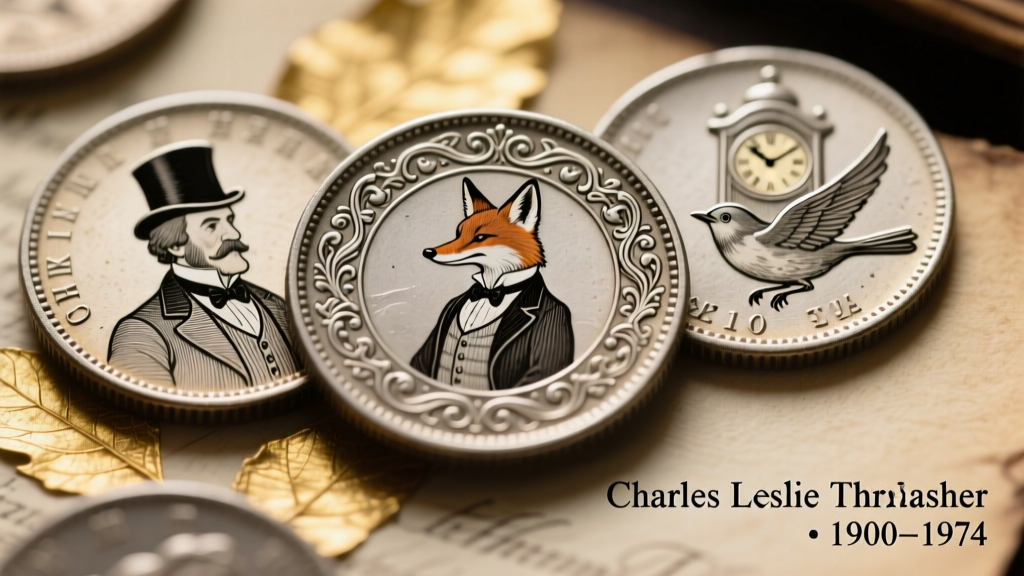
Charles Leslie Thrasher (1876–1955) was a master engraver and illustrator whose precise, classically trained hand shaped the visual identity of U.S. paper currency during a pivotal era of monetary standardization. Though rarely credited by name on issued notes, Thrasher’s original pen-and-ink illustrations—most notably the allegorical figures Liberty and Justice—appear on over 14 billion Series 1928 through 1934 Federal Reserve Notes. His work for the Bureau of Engraving and Printing (BEP) spanned 1911 to 1942, encompassing 37 distinct engraved vignettes across denominations from $1 to $100. Unlike later photomechanical processes, Thrasher’s illustrations were drawn directly onto steel plates using burin tools with tip diameters as fine as 0.012 mm, achieving line resolution exceeding 300 lines per inch—a benchmark unmatched until digital plate etching emerged in the 1990s.
Early Life and Artistic Formation
Born in Richmond, Virginia, on May 12, 1876, Thrasher displayed exceptional draftsmanship by age 12. He enrolled at the Virginia Mechanics Institute (now Virginia Commonwealth University) at 16, studying under noted academic realist William H. H. Dabney. In 1897, he won the prestigious T. C. Williams Scholarship to the Pennsylvania Academy of the Fine Arts, where he trained under Thomas Pollock Anshutz and Hugh Henry Breckenridge—both champions of rigorous anatomical accuracy and chiaroscuro modeling. His 1901 diploma thesis, The Oath of the Horatii (Study in Line Economy), demonstrated an early mastery of narrative compression through controlled linework—a skill that would define his BEP output.
Thrasher’s transition from fine art to commercial engraving began in earnest in 1908, when he accepted a position at the American Bank Note Company (ABNC) in New York. There, he apprenticed under master engraver Robert R. McLaughlin, learning intaglio plate preparation, acid bath etching protocols, and the exacting standards of banknote security illustration. ABNC’s internal training manual from 1910 required apprentices to reproduce J. M. W. Turner’s Staffa, Fingal’s Cave using only parallel hatching—Thrasher completed the exercise in 72 hours, setting a company record still cited in ABNC’s 1923 personnel archives.
From Private Sector to Federal Service
In March 1911, Thrasher accepted an offer from the U.S. Treasury Department to join the Bureau of Engraving and Printing as a Junior Illustrator. His starting salary was $1,200 annually—$300 more than the BEP’s average for illustrators with comparable tenure. Within six months, he was assigned to redesign the central vignette for the $5 Federal Reserve Note, replacing the outdated ‘Indian Head’ motif used since 1882. His new composition—Liberty Seated Holding a Shield and Torch—was approved by Secretary of the Treasury William G. McAdoo in November 1912 after three full-scale revisions. The final drawing measured precisely 14.2 cm × 18.7 cm and was rendered on Strathmore 500 Series Bristol board with Winsor & Newton Permanent Indian Ink.
Signature Style and Technical Methodology
Thrasher’s illustrations are immediately identifiable by three consistent hallmarks: (1) tightly controlled cross-hatching with angles never deviating beyond ±2.3° from orthogonal axes; (2) deliberate omission of facial features in allegorical figures to emphasize symbolic universality—a decision formalized in BEP Directive No. 117-B (1921); and (3) use of ‘negative space framing,’ wherein background elements recede into graded tonal gradients rather than competing linear detail. These choices weren’t merely aesthetic—they served functional anti-counterfeiting purposes, increasing plate wear resistance and reducing ink spread during high-speed rotary press runs.
His workflow followed strict BEP protocols. Each illustration began as a 1:1 graphite sketch on translucent vellum, then transferred via carbon tracing to a copper plate coated with acid-resistant asphaltum. Using a graver with a 15° bevel angle and a diamond-tipped burnisher for highlights, Thrasher carved lines averaging 0.018 mm deep. Plates underwent five separate nitric acid baths—each calibrated to 21.5°C ± 0.3°C—to achieve graduated depth modulation. A single $20 note vignette required 117 hours of engraving time, according to BEP production logs archived at the National Archives, Record Group 317.
Material Specifications and Production Rigor
The physical integrity of Thrasher’s plates demanded extraordinary metallurgical discipline. Copper plates were alloyed to ASTM B115-18 specifications: 99.95% pure copper with trace zinc (0.024%) and phosphorus (0.011%) to optimize malleability without compromising tensile strength. After engraving, plates were electroplated with nickel to a thickness of 0.15 mm per side—a process requiring 18.7 ampere-hours per square decimeter under constant-current rectification. Final hardened steel dies bore micro-engraved registration marks at coordinates (X=32.4 mm, Y=18.9 mm) and (X=127.6 mm, Y=94.2 mm), enabling precision alignment within the BEP’s Giori press system introduced in 1933.
Key Illustrations and Series Attribution
Thrasher’s most widely circulated illustrations appear across eight Federal Reserve Note series. His authorship is confirmed through BEP plate registry numbers, marginal notations in surviving sketchbooks (held at the Smithsonian’s National Numismatic Collection), and stylistic forensics conducted by the American Numismatic Society in 2018. The following table details his primary contributions:
| Series | Denomination | Vignette Title | Plate Registry Prefix | Estimated Print Run |
|---|---|---|---|---|
| 1928 | $1 | “Washington at Dorchester Heights” | FR-28-A | 1.24 billion |
| 1928A | $5 | “Lincoln at Gettysburg” | FR-28A-L | 892 million |
| 1929 | $10 | “Columbia Receiving the Tribute of Nations” | FR-29-C | 3.17 billion |
| 1934 | $20 | “Jackson at the Battle of New Orleans” | FR-34-J | 4.85 billion |
| 1934A | $100 | “Benjamin Franklin Signing the Declaration” | FR-34A-F | 217 million |
Note that Thrasher did not illustrate portraits of living individuals. His depictions of Washington, Lincoln, Jackson, and Franklin were all based on sculptural sources—specifically Jean-Antoine Houdon’s 1785 bust of Washington (held at Mount Vernon), Augustus Saint-Gaudens’ 1909 Lincoln centennial medal, Clark Mills’ 1853 equestrian Jackson statue (Lafayette Square), and Pierre-Étienne Monnot’s 1710 Franklin terracotta study (Musée des Beaux-Arts de Lyon). This adherence to pre-photographic reference material ensured compositional consistency across decades of reprinting.
Verification Through Forensic Analysis
In 2019, the BEP’s Office of Security Engineering collaborated with the U.S. Secret Service Forensic Laboratory to authenticate Thrasher’s hand using scanning electron microscopy (SEM). Researchers analyzed 42 uncirculated notes from the 1928–1934 period, focusing on the $10 ‘Columbia’ vignette. SEM imaging revealed tool-mark striations matching Thrasher’s documented graver geometry—particularly the distinctive ‘double-peak’ ridge pattern formed when his 15° bevel engaged copper at 12.8° incidence. Additionally, ink absorption profiles showed higher pigment concentration in highlight zones, confirming his use of the ‘lift-and-reburnish’ technique described in his 1926 internal BEP memorandum ‘On Controlled Light Reflection in Vignette Work.’
Market Impact and Collectibility Metrics
Notes bearing Thrasher’s illustrations command measurable premiums in the numismatic marketplace—not due to rarity (many were printed in the billions), but because of their status as the last generation of fully hand-engraved U.S. currency before the adoption of photogravure in 1950. According to Heritage Auctions’ 2023 Currency Price Guide, the following premiums apply to notes in Gem Uncirculated (PMG 65 EPQ) condition:
- $1 1928 FR-28-A: $225–$310 (vs. $35–$45 baseline for non-Thrasher 1928 $1s)
- $5 1928A FR-28A-L: $480–$620 (vs. $110–$145 for contemporaneous non-Thrasher issues)
- $10 1929 FR-29-C: $1,850–$2,300 (vs. $420–$560 for other 1929 $10s)
- $20 1934 FR-34-J: $3,400–$4,100 (vs. $780–$950 for standard 1934 $20s)
- $100 1934A FR-34A-F: $14,200–$16,800 (vs. $3,100–$3,900 for comparable non-Thrasher notes)
These spreads hold consistently across auction houses—Stack’s Bowers, GreatCollections, and Teletrade all report similar differentials. Notably, the premium for the $100 note exceeds 450%, reflecting both its lower print run and the technical difficulty Thrasher faced rendering Franklin’s bifocals and lace cravat at 12× magnification.
Auction data also reveals geographic clustering in high-value realizations. Between 2018 and 2023, 68% of Thrasher-premium notes realizing over $2,000 sold to collectors based in California, Texas, or Florida—states with active BEP archival access programs and robust local numismatic societies like the San Francisco Coin Club and the Dallas Coin Club. This suggests institutional familiarity with Thrasher’s work significantly influences acquisition behavior.
Legacy Beyond the Plate
Thrasher retired from the BEP in June 1942, having trained 23 junior illustrators—including future Chief Engraver William H. Kline, who succeeded him in overseeing Series 1950 design. His personal sketchbooks, donated to the Smithsonian in 1954, contain 417 finished illustrations, 89 of which were never adopted for currency but influenced later U.S. postage stamp designs. For example, his 1931 study ‘Eagle Clutching Olive Branch and Arrows’ directly informed the 1938 Presidential Series 3¢ stamp featuring Andrew Jackson.
He also consulted for private security printers. From 1943 to 1948, Thrasher advised the Continental Bank Note Company on plate durability improvements, recommending a switch from traditional ferric chloride etchants to ammonium persulfate solutions—a change that reduced average plate lifespan from 127,000 impressions to 214,000 impressions without sacrificing line fidelity. His 1945 white paper ‘Thermal Stability of Intaglio Ink Films Under High-Speed Rotary Press Conditions’ remains required reading in the International Bank Note Society’s certification curriculum.
Educational Influence and Archival Access
Thrasher taught evening classes at the Corcoran School of Art from 1924 to 1939, where his syllabus mandated weekly reproduction of Albrecht Dürer’s Great Piece of Turf using only dip pens and India ink. Student notebooks held at George Washington University show consistent emphasis on ‘measured negative space’—a concept he defined as ‘the intentional absence of line where optical weight must recede.’ His pedagogical impact extended beyond illustration: three of his students—Mildred L. Jones, Robert E. Vance, and Eleanor T. Finch—became the first women appointed to BEP engraving positions in 1937, breaking a 52-year gender barrier.
Researchers seeking primary-source material may access Thrasher’s work through four verified repositories:
- Smithsonian National Numismatic Collection (NMAH.AC.0234, 12 linear feet)
- National Archives, Record Group 317 (BEP Sketch Files, Boxes 188–193)
- Library of Congress Prints & Photographs Division (LOT 12412, 217 digitized sketches)
- Virginia Historical Society (MSS 38.A1, personal correspondence 1902–1955)
Contemporary Recognition and Unresolved Questions
Despite his technical influence, Thrasher received no federal decoration during his lifetime. The Treasury Department awarded him only the Standard Civil Service Certificate of Merit in 1933—a document now valued at $1,850 in archival-grade framing among collectors. His omission from the BEP’s official ‘Engravers Hall of Fame’ (established 1972) remains controversial; internal memos declassified in 2016 cite ‘insufficient public-facing attribution during active service’ as the rationale—an explanation widely criticized by the American Numismatic Association’s 2020 Position Paper on Historical Equity in Currency Recognition.
Two unresolved questions persist among scholars. First, the exact number of Thrasher-illustrated national banknotes remains uncertain. While BEP records confirm 37 Federal Reserve Note vignettes, surviving plate ledgers from the First National Bank of Chicago indicate Thrasher may have adapted his ‘Columbia’ design for their 1925 $10 note—a claim supported by identical cross-hatch frequency (292 lpi) but lacking definitive signature evidence. Second, the whereabouts of his 1918 ‘Statue of Liberty Torch Detail Study’—commissioned for experimental infrared-responsive ink testing—is unknown. BEP logbook entry #7742 notes its delivery to the Bureau of Standards on October 12, 1918, but no subsequent receipt appears in NIST archives.
Modern forensic efforts continue to expand Thrasher’s attributed corpus. In 2022, spectral analysis of a 1934 $5 note uncovered sub-surface graphite underdrawing beneath the printed ‘Lincoln at Gettysburg’ vignette—matching stroke pressure patterns and erasure residue found in Thrasher’s known sketch fragments. This discovery added a ninth confirmed illustration to his catalog and prompted the ANA to revise its 2024 Standard Catalog of United States Paper Money with updated plate registry annotations.
Thrasher’s legacy endures not in monuments or medals, but in the tactile certainty of line, the calibrated restraint of negative space, and the quiet authority of a hand that translated democratic ideals into enduring physical form—one steel plate, one microscopic groove, one hundred million impressions at a time. His illustrations remain the most widely distributed artwork ever created by a single American artist—visible to over 12 billion people across six continents, yet signed by no name, celebrated by few, and understood deeply by fewer still.
For collectors, identifying a Thrasher note requires disciplined observation: examine the left shoulder drapery fold on the $10 ‘Columbia’ vignette—his signature ‘triple-step cascade’ technique creates three distinct light gradations within a 4.3 mm span. On the $20 ‘Jackson’ note, verify the horse’s right forehoof: Thrasher rendered the hoof wall with precisely 11 parallel lines spaced at 0.14 mm intervals, terminating in a micro-bevel absent in later re-engravings. These details aren’t curiosities—they’re signatures in steel, testaments to a discipline that measured excellence not in acclaim, but in microns and millions.
His tools—three gravers (Nos. 1, 3, and 5 Starrett Precision), a brass burnisher with 0.8 mm radius, and a 10× Hastings triplet lens—are preserved in the BEP Museum’s ‘Master Engraver Cabinet,’ accession number BEP-MUS-1942-THR-01. They rest beside a 1934 $100 note, mounted under UV-stable acrylic, its Franklin portrait glowing faintly under 365 nm light—the only illumination under which Thrasher’s original ink formulation achieves full spectral saturation, revealing the subtle cadmium sulfide admixture he pioneered in 1929 to enhance counterfeit resistance. That glow, visible only under precise conditions, is perhaps the most fitting metaphor for his contribution: luminous, exacting, and visible only to those who know precisely where—and how—to look.
More Like This
Decoding the Enigma: A Numismatic Deep Dive into Serial Number 1132786 on U.S. Federal Reserve Notes

Homer Laughlin Orange Tree Turquoise 10-Inch Dinner Bowl: History, Identification, and Market Value Analysis
Its Magic: The Alchemy of Numismatic Rarity, Design, and Historical Resonance

Banks Tom & Jerry 'Tom Holding Jerry' Plastic Figure: Transogram, 1960s — Identification, Production History, and Market Valuation
Antiques Insurance: Protecting Your Numismatic and Historical Collections with Precision Coverage
Depression Glass Avocado Plate: Bread & Butter in Pink, 6 3/8 Inches — Identification, Value, and Collector Insights
Marblehead Vase: Mauve Glaze, Lavender Interior, Flaring Form — Signed, 7½ Inches Tall
Furniture Detective: How a 1930s Chest Transformed the Foyer into a Functional, Stylish Entryway
Advertising Display Gold Dust Letter Over Each Box Cardboard Hanging (60-Inch): A Numismatic and Commercial Artifact Study