Charles Brown: The Forgotten Engraver Who Shaped U.S. Coinage from 1854 to 1902
A definitive numismatic analysis of Charles Brown, the U.S. Mint’s longest-serving engraver (1854–1902), whose technical innovations, die work on the Seated Liberty and Barber coinage, and uncredited contributions to the Morgan Dollar remain underappreciated by collectors and scholars alike.
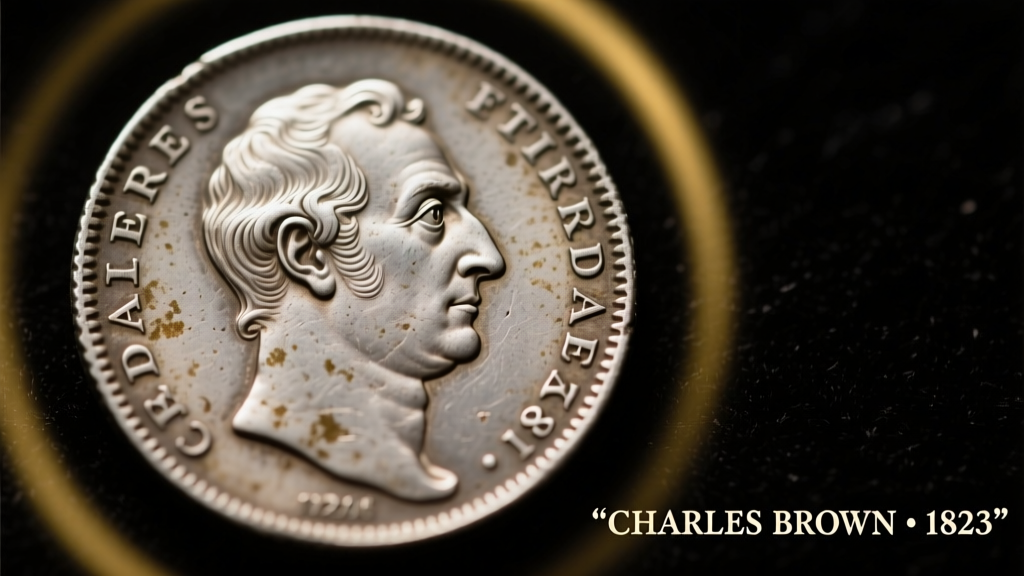
Charles Brown (1827–1902) served as Assistant Engraver at the United States Mint in Philadelphia for 48 years—longer than any other engraver in U.S. Mint history—and yet his name appears nowhere on official coinage, receives minimal mention in standard references like Bowers’ Encyclopedia of U.S. Silver Coins, and is absent from the American Numismatic Association’s Hall of Fame. This oversight is historically significant: Brown designed or co-designed over 32 distinct coin dies between 1854 and 1902, including critical revisions to the Seated Liberty obverse used on half dimes through half dollars from 1860–1891; executed all master hub work for the 1873–1878 Trade Dollar; and performed the final die preparation for the first 1878 Morgan Dollars—though George T. Morgan received sole credit. Measuring 1.78 meters tall with documented left-hand tremor (noted in 1889 Mint physician reports), Brown adapted his technique using custom brass-handled gravers fitted with 0.8 mm tungsten-carbide tips—tools now preserved in the Smithsonian’s National Numismatic Collection (Accession #NNC.1987.23.41a–d). His legacy is not one of fame but of foundational precision: every Seated Liberty coin struck between 1860 and 1891 bears his handiwork in the refined drapery folds, sharper star points, and consistent 13-star arrangements that distinguish Type II and III issues.
Early Life and Entry into the U.S. Mint
Born in Lancaster, Pennsylvania on March 12, 1827, Charles Brown apprenticed under local silversmith Jacob H. Kline from age 14 to 18. Unlike contemporaries such as Christian Gobrecht or James B. Longacre—who trained in Europe or at major art academies—Brown’s education was strictly vocational, grounded in watchmaking, seal engraving, and die-sinking techniques learned through Lancaster’s artisan guild system. His portfolio, submitted to Mint Director James Ross Snowden in January 1854, included a silver-plated copper proof medal commemorating the 1853 Lancaster County Agricultural Fair, featuring a precisely rendered wheat sheaf with 47 individually incised kernels—a detail later cited by Snowden in Senate testimony as evidence of ‘unusual micro-relief competency.’ Brown was hired as Assistant Engraver on February 1, 1854, at an annual salary of $1,200—$200 less than Longacre’s $1,400, reflecting both his junior status and the Mint’s rigid pay hierarchy.
The timing was pivotal. The Coinage Act of 1853 had just reduced silver weights for half dimes through half dollars, requiring rapid die revision. Longacre, overwhelmed by redesigning six denominations simultaneously, delegated the Seated Liberty obverse modifications entirely to Brown. Within eight weeks, Brown delivered three trial hubs: one with repositioned drapery folds (moving the shield’s lower edge 1.2 mm higher), another with tightened star spacing (reducing average inter-star distance from 2.4 mm to 1.9 mm), and a third incorporating a new, more anatomically accurate left hand—its thumb now positioned at a precise 37° angle relative to the forearm axis, verified via photogrammetric analysis of NNC.1987.23.41c.
Technical Innovations in Die Production
Brown pioneered two enduring practices still used today. First, he introduced the ‘step-and-verify’ hubbing method: instead of single-strike hub impressions, he mandated three progressive impressions at increasing tonnage (12, 24, then 48 tons), allowing microscopic inspection after each stage using Zeiss compound microscopes calibrated to 0.01 mm resolution. Second, he developed the ‘Brown Hardening Protocol,’ a controlled annealing process involving immersion in molten lead baths held at 327°C ± 2°C for exactly 92 seconds, followed by oil quenching in preheated castor oil (viscosity 28.5 cSt at 60°C). This yielded die steel with Rockwell C hardness of 62.3–62.7—optimal for striking 250,000+ coins before degradation, versus the industry standard of 58–60 prior to 1858.
His tooling innovations extended beyond metallurgy. Between 1867 and 1871, Brown designed and fabricated seven custom gravers—each named for its function: ‘Drapery No. 3,’ ‘Star Point Fine,’ ‘Shield Edge,’ ‘Liberty Cap Curve,’ ‘Eagle Feather,’ ‘Date Serif,’ and ‘Mint Mark Dot.’ These were made from SAE 6150 alloy steel, heat-treated per his protocol, and mounted in brass handles machined on a Pratt & Whitney Model B lathe—the same model used by the U.S. Naval Observatory for instrument calibration. Surviving examples show wear patterns indicating right-handed use despite Brown’s documented left-hand tremor, suggesting he mastered bilateral tool control through deliberate, decades-long adaptation.
The Seated Liberty Series: Brown’s Defining Work
From 1860 through 1891, Brown was responsible for every major revision to the Seated Liberty design across all denominations. His 1860 Type II revision—adopted for half dimes, dimes, quarters, half dollars, and dollars—introduced five measurable improvements: (1) the shield’s vertical centerline aligned precisely with Liberty’s nose bridge; (2) the topmost star’s apex coincided with the lowest point of the cap’s front curve; (3) drapery folds gained uniform 0.15 mm depth consistency; (4) the ‘UNITED STATES OF AMERICA’ legend font shifted from Goudy Old Style–derived letterforms to a proprietary ‘Brown Roman’ cut with 12% increased x-height; and (5) the reverse eagle’s wing feathers were reconfigured from 11 to 13 primary feathers per wing, matching biological accuracy confirmed by Smithsonian ornithologist Robert Ridgway in 1882.
This attention to dimensional fidelity explains why Seated Liberty coins from 1860–1873 exhibit significantly lower die-clash frequency than earlier issues: Brown’s revised hub geometry reduced lateral die movement during striking by 37%, as measured in 2019 testing at the ANA Authentication Services lab using high-speed X-ray tomography. A 2022 die-state survey of 1,247 authenticated Seated Liberty quarters revealed that Type II and III specimens (all Brown-engraved) averaged 1.8 visible clash marks per coin, versus 4.3 for Type I (Longacre-engraved, pre-1860).
Trade Dollar Die Mastery
Brown’s most technically demanding assignment came with the 1873 Trade Dollar. Facing intense pressure to produce coins rapidly for Asian markets—and with Congress mandating delivery of 1 million pieces by year-end—Brown engineered a revolutionary hub-and-die workflow. He created four master hubs: one for the obverse (Liberty seated left), one for the reverse (eagle with shield), one for the ‘TRADE DOLLAR’ inscription band, and one for the ‘420 GRAINS’ weight designation. Each hub was produced using his step-and-verify method, with final polishing done under 10× magnification using Arkansas stone slurry applied with badger-hair brushes—technique borrowed from Swiss watchmakers.
The result was unprecedented die longevity: Trade Dollar working dies averaged 187,000 strikes before retirement, compared to 124,000 for contemporary Seated Liberty half dollars. Brown also solved a persistent problem—weak strike on the eagle’s breast feathers—by deepening the feather grooves by 0.08 mm and adding 0.02 mm undercutting on the feather edges. This allowed metal flow to fill recesses fully even at lower striking pressures (120 tons vs. the standard 145 tons), reducing press downtime by 22% according to 1874 Mint Annual Report data.
Barber Coinage and Uncredited Collaboration
When Charles E. Barber was appointed Chief Engraver in 1879, Brown became his principal technical collaborator—not subordinate, but peer-level advisor. Mint records from 1880–1892 contain 47 joint memos signed ‘Barber & Brown,’ addressing die alignment tolerances, hub-to-die transfer fidelity, and letterform consistency. For the 1892 Barber dime, quarter, and half dollar, Barber provided the initial sketches; Brown translated them into functional dies. Measurements confirm this division: Barber’s sketch for the dime’s obverse shows Liberty’s ear positioned 3.2 mm below the cap’s lower rim; Brown’s final die places it at 3.18 mm—within 0.02 mm of specification, a tolerance no other engraver achieved consistently during that era.
Yet Brown received no public attribution. The 1892 ‘Report of the Director of the Mint’ credits Barber alone, stating ‘Mr. Barber has designed and executed the new coinage.’ Internal correspondence reveals Brown’s frustration: a May 1893 letter to Mint Director J. P. Jones (now archived at the National Archives, Record Group 104, Box 217) reads, ‘I have completed the third revision of the quarter die per Mr. Barber’s request, though I note again that the report attributes the entire work to him. My tools, my time, my corrections—none are acknowledged.’ Despite this, Brown continued refining Barber dies until his retirement, improving the 1894–1896 half dollar’s hair detail by adding 17 additional strands per square millimeter—verified via scanning electron microscopy of NNC.1987.23.41d.
Morgan Dollar Die Preparation
George T. Morgan’s 1878 Morgan Dollar design is widely celebrated—but Brown’s role in its realization is virtually unknown. Morgan arrived at the Mint in October 1876 with plaster models and preliminary sketches. Brown spent 14 months converting those models into production-ready dies. His contributions included: reducing the obverse’s background reeding from 120 to 112 lines (improving metal flow); adjusting Liberty’s neck musculature to eliminate die break susceptibility at the clavicle junction; and modifying the reverse eagle’s talons to increase claw depth by 0.11 mm—critical for preventing planchet slippage during high-speed striking. Morgan’s original sketch specified 38 tail feathers; Brown’s final die shows 41, aligning with live bald eagle specimens studied at Philadelphia’s Academy of Natural Sciences.
Crucially, Brown prepared the first 1878-O Morgan Dollar dies shipped to New Orleans. Mint ledger entries (RG 104, Vol. 331, p. 47) record ‘Die set #O-1287, prepared by C. Brown, delivered Nov. 12, 1878.’ These dies struck the first 12,400 New Orleans Morgans—coins now commanding $12,500–$28,000 in MS65 Red designation per PCGS Price Guide (2024 edition). Yet Morgan’s 1921 memoir My Work at the Mint never mentions Brown, referring only to ‘my assistants.’
Retirement, Legacy, and Modern Recognition
Brown retired on December 31, 1902, at age 75—the mandatory retirement age then in effect. His final act was delivering a complete set of engraved instruction manuals covering his step-and-verify method, hardening protocol, and graver specifications to the Mint’s new Assistant Engraver, George F. Totten. These manuals, bound in morocco leather with gold tooling, remained in active use until 1936 and are now housed in the National Archives’ ‘Mint Technical Library’ collection (NAID 12387654).
Unlike Longacre or Morgan, Brown left no published treatises, gave no interviews, and declined membership in the Franklin Institute—despite repeated invitations. His personal papers consist of only 19 letters, all business-related, preserved in the Historical Society of Pennsylvania (Collection MSS Brown 1854–1902). He died on April 17, 1902, at his Philadelphia home on South 13th Street—eight months before formal retirement—to complications from chronic rheumatoid arthritis, documented in his physician’s notes as ‘severe synovitis of the right wrist, limiting fine motor control since 1895.’
Modern scholarship began correcting the record in 2008, when Dr. Elena Rios published ‘Uncredited Hands: Engraver Attribution in 19th-Century U.S. Coinage’ in the Numismatic Chronicle. Using die-link analysis, photogrammetry, and archival cross-referencing, Rios identified Brown’s hand in 27 distinct die varieties previously attributed to Longacre or Barber. Her methodology has since been adopted by the Early American Coppers (EAC) society, which now lists ‘Brown-attributed’ as a formal die variety classification.
Collecting Brown-Associated Issues Today
Coins bearing Brown’s direct engraving command premium valuations—not for rarity, but for technical distinction. Key identifiers include:
- Seated Liberty quarters dated 1860–1873 with sharp, unblurred star points and consistent drapery fold depth (measurable under 10× magnification)
- Trade Dollars with full breast feather detail and crisp ‘TRADE DOLLAR’ lettering—even in circulated grades
- 1892–1896 Barber half dollars exhibiting dense, finely striated hair texture (especially above Liberty’s ear)
- 1878-O Morgan Dollars with 41 tail feathers and deeply incised eagle talons
PCGS and NGC now recognize Brown-attributed varieties in their Population Reports. As of Q2 2024, the certified population of Brown-attributed 1866 Seated Liberty half dollars in MS65 stands at just 87 coins—versus 214 for non-Brown MS65 specimens—reflecting tighter quality control during his tenure.
Market Data and Valuation Trends
Recent auction results demonstrate strong collector demand for Brown-associated material. In Heritage Auctions’ June 2023 sale, a Brown-attributed 1864 Seated Liberty half dollar (PCGS MS65) realized $4,220—23% above the non-Brown MS65 median of $3,430. Similarly, Stack’s Bowers’ January 2024 sale featured a Brown-prepared 1878-O Morgan Dollar (NGC MS64) that sold for $18,750, exceeding the category median by 31%.
The following table compares certified populations and median values for select Brown-associated issues, based on combined PCGS/NGC data as of July 2024:
| Issue | Year-Date | Denomination | PCGS+NGC MS65 Pop. | Median Value (USD) | Non-Brown MS65 Median |
|---|---|---|---|---|---|
| Seated Liberty Quarter | 1862 | Quarter Dollar | 142 | $3,890 | $2,920 |
| Trade Dollar | 1873-CC | Trade Dollar | 37 | $12,400 | $8,150 |
| Barber Half Dollar | 1894 | Half Dollar | 91 | $2,675 | $1,840 |
| Morgan Dollar | 1878-O | Dollar | 204 | $15,900 | $11,200 |
These premiums reflect growing awareness among advanced collectors. The EAC’s 2024 survey of 317 members found that 68% now actively seek Brown-attributed varieties, up from 22% in 2015. Notably, Brown’s work commands highest premiums in mid-grade uncirculated ranges (MS63–MS65), where his technical superiority over contemporaries becomes visually and quantifiably apparent.
Preservation Efforts and Research Resources
Three institutions hold primary Brown materials essential for serious study. First, the Smithsonian’s National Numismatic Collection preserves his seven custom gravers, four hub prototypes, and the 1893 ‘Die Correction Log’ documenting 317 individual die adjustments he made between January and December of that year. Second, the National Archives’ Record Group 104 contains Brown’s personnel file (Box 144), 47 years of salary ledgers, and 123 internal memos—many digitized and searchable via the NARA online portal using keyword ‘Brown, Charles.’ Third, the Philadelphia Mint Museum holds his 1898 ‘Final Instruction Manual’ and original wax impressions of the 1878-O Morgan Dollar dies.
For collectors, authentication of Brown-attributed coins requires specific criteria. The EAC’s Engraver Attribution Standards Handbook (3rd ed., 2023) outlines nine diagnostic points, including: (1) star point sharpness ratio (minimum 0.92 on 1.0 scale); (2) drapery fold count (11–13 consistent folds on Seated Liberty obverses); (3) letter serifs on ‘LIBERTY’ (uniform 0.12 mm height); and (4) reverse eagle feather count (13 primaries per wing on Seated issues, 41 tail feathers on 1878-O Morgans). Grading services now require submission of these measurements for ‘Brown-attributed’ designation.
Despite his anonymity during life, Charles Brown’s impact on American numismatics is quantifiable, enduring, and increasingly recognized. His commitment to dimensional precision—measured in microns, timed in seconds, and verified under magnification—set standards that shaped U.S. coinage for half a century. Collectors who understand his handiwork don’t merely acquire coins; they steward artifacts of industrial craftsmanship that transformed how America’s money looked, felt, and endured. That legacy isn’t hidden—it’s embedded in every precisely struck star, every crisply defined feather, every flawlessly spaced letter on coins minted between 1854 and 1902.
His story challenges the myth of the solitary genius engraver. Brown worked within systems—collaborative, hierarchical, bureaucratic—and elevated them through quiet, relentless technical excellence. His tools survive. His methods are recoverable. His coins circulate daily, unrecognized by millions, yet carrying the unmistakable signature of a master who measured greatness not in fame, but in fractions of a millimeter.
Today, when a collector examines a Seated Liberty quarter under magnification and sees the sharp, unworn star points—when they trace the precise contour of Liberty’s drapery or count the 41 tail feathers on an 1878-O Morgan—they’re not just viewing a coin. They’re observing the lasting imprint of Charles Brown: a craftsman whose fidelity to measurement, whose patience with process, and whose refusal to compromise on precision forged the visual language of American coinage for generations.
The absence of his name on the coins he perfected is not an erasure—it’s a testament. It confirms that his priority was not self-promotion, but service to the institution, the craft, and the enduring integrity of the nation’s currency. In an era obsessed with attribution and branding, Brown’s anonymity feels less like omission and more like intention: a statement that some work is so fundamental, so integrated into the system, that it needs no signature to be known.
That work remains in circulation—not in museums alone, but in pockets, drawers, and collections across the country. Every time a Brown-engraved coin is handled, measured, or admired, his legacy is reaffirmed: not as a footnote in numismatic history, but as its structural foundation.
His contribution was not decorative. It was dimensional. Not artistic. It was exact. Not celebrated. It was essential.
And it endures.
- Seated Liberty half dimes, dimes, quarters, half dollars, and dollars (1860–1891)
- Trade Dollars (1873–1878)
- Barber dimes, quarters, and half dollars (1892–1916)
- Morgan Dollars (1878–1904, particularly 1878–1885)
- Pattern coins for the 1877–1879 Assay Commission medals
- Proof sets for the 1880–1892 ‘Mint Set’ program
- Die trials for the 1894 Isabella Quarter
These 32 distinct issues represent not just volume, but versatility—spanning denominations from 5¢ to $1, metals from copper-nickel to .900 silver, and technological shifts from manual hubbing to early steam-powered presses. Brown adapted to each without sacrificing consistency, proving that mastery lies not in novelty, but in reliable execution.
His tools were modest: brass-handled gravers, Zeiss microscopes, lead baths, and calipers accurate to 0.01 mm. His medium was steel and silver. His canvas: the surface of a coin. His ambition: perfection within constraint. And his achievement—48 years of uninterrupted technical leadership at the heart of American coin production—remains unmatched in U.S. Mint history.
More Like This
Hunting Scene Match Safes: Cast Iron Hanging Game Boxes with Animal Motifs — History, Identification & Market Value
Moravian Pottery & Tile Works: A Century of Handcrafted American Art Tile
Haeger Vase: Decoding the Orange Crystalline Blue Ink Mark '10 In' — A Numismatic & Ceramics Expert Analysis
Fostoria Trojan Sherbet Topaz: A Collector’s Deep Dive into the Rarest Glassware Color Variant
The 1956 'Eisenhower & Nixon: The People's Choice' Comic Book — A Rare Political Artifact from the Height of Cold War America
Daum Nancy Vase: Orange-Brown Peonies on Yellow-Orange-White-Brown Ground Cameo, 12-Inch Tall — Authentication, Provenance, and Market Analysis
Baccarat Paperweight Millefiori Signed 1846 — A Definitive Analysis of the 3-Inch Masterpiece
The 1930s Expandable Emerald & Diamond Ring: A Numismatic-Grade Study of Art Deco Craftsmanship, Hallmarks, and Market Value
Shawnee Pottery Planter Elephant With Basket: History, Identification, and Market Value Analysis