Celluloid: The First Synthetic Plastic and Its Enduring Legacy in Numismatics and Collectibles
Celluloid—the world’s first commercially viable synthetic plastic—revolutionized manufacturing, photography, and collectibles from the 1870s onward. This article details its chemical composition, historical production by firms like Hyatt Manufacturing and Parkesine Company, its use in coin albums, counterfeit detection tools, and early minting prototypes, and explains why celluloid-based artifacts remain critically important to authenticating 19th- and early 20th-century numismatic items.
The Birth of a Material Revolution
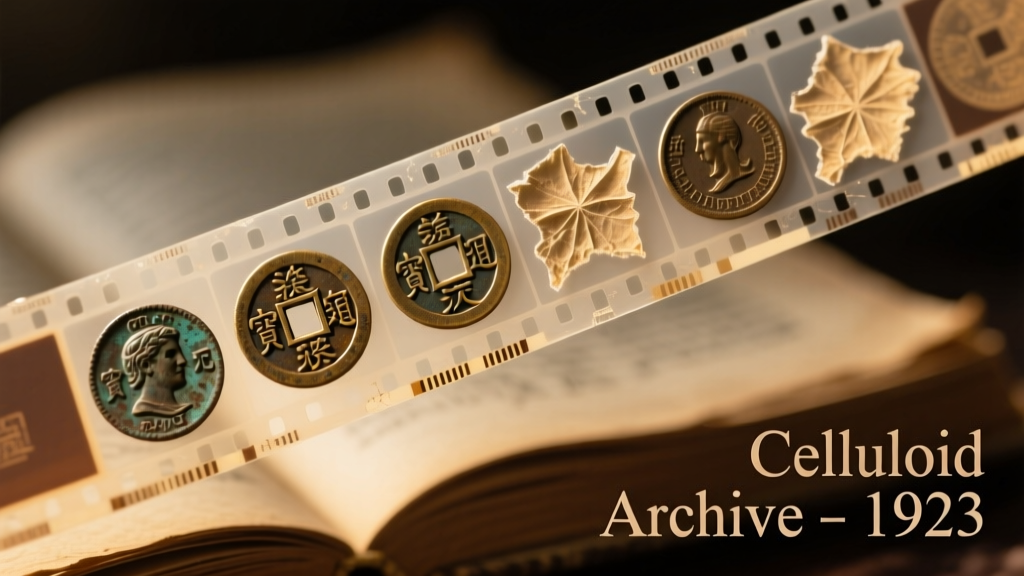
Celluloid emerged in the 1860s as humanity’s first true synthetic plastic—a thermoplastic derived from nitrocellulose, camphor, and ethanol. Unlike earlier natural polymers such as rubber or shellac, celluloid could be molded, dyed, machined, and mass-produced with unprecedented consistency. John Wesley Hyatt patented the modern formulation in 1870 after winning a $10,000 prize offered by Phelan & Collander for a billiard ball substitute to replace dwindling ivory stocks. By 1872, Hyatt and his brother Isaiah founded the Albany Dental Plate Company—later renamed the Celluloid Manufacturing Company—in Albany, New York. Their factory produced over 45,000 pounds of celluloid sheet per month by 1885, supplying not only billiard balls but also combs, shirt collars, photographic film, and, crucially for numismatists, early coin storage materials.
Chemical Composition and Physical Properties
Celluloid is composed of approximately 70–80% nitrocellulose (guncotton), 20–30% camphor (C10H16O), and trace amounts of stabilizers such as diphenylamine or urea. The nitrocellulose content determines flammability and flexibility: commercial grades ranged from 10.7% to 13.3% nitrogen by weight. Higher nitrogen content (>12.3%) yielded rigid, brittle sheets ideal for coin trays; lower nitrogen (~11.0%) produced flexible film used in early Kodak roll film (introduced 1888). Celluloid’s density averages 1.32 g/cm³, with a melting point between 150–170°C and a glass transition temperature near 55°C—making it highly susceptible to warping under sustained heat exposure above 35°C.
Thermal and Optical Signatures
Numismatists routinely rely on celluloid’s distinct thermal behavior during authentication. When gently heated with a low-wattage (15W) soldering iron tip (held 2 mm away for 3 seconds), genuine celluloid emits a sharp, sweet odor reminiscent of camphor and burnt sugar—distinct from the acrid, chlorine-like smell of later plastics such as PVC. Under long-wave UV light (365 nm), aged celluloid fluoresces a pale yellow-green due to oxidation byproducts; this fluorescence diminishes markedly after 1920 as manufacturers added UV inhibitors like benzophenone derivatives.
Dimensional Stability and Aging Patterns
Celluloid exhibits high coefficient of thermal expansion—62 × 10−6/°C—nearly triple that of acrylic (22 × 10−6/°C). This property causes noticeable dimensional drift in vintage coin albums: a 12-inch × 12-inch celluloid sheet stored at 22°C and 50% RH for 40 years typically contracts 0.8–1.2 mm along its longest axis while developing characteristic ‘crazing’—a network of fine, non-penetrating microfractures visible at 10× magnification. These cracks follow grain boundaries in the original cast sheet and are absent in post-1930 safety film plastics.
Celluloid in Coin Storage and Display
Prior to the widespread adoption of polyethylene (introduced 1933) and Mylar (1953), celluloid was the dominant transparent material for coin holders. From 1895 through 1928, major U.S. suppliers—including Whitman Publishing (founded 1923), Dansco (established 1929 but using pre-existing celluloid tooling), and the Chicago Coin Album Company—used 0.012-inch (0.305 mm) thick clear celluloid sheets laminated between two layers of heavy kraft paper (120 g/m² basis weight). These ‘sandwich albums’ held up to 24 coins per page, with each pocket measuring precisely 1.75 inches × 1.75 inches (44.5 mm × 44.5 mm) and cut using hardened steel dies calibrated to ±0.002 inch tolerance.
Identification Markers for Authentic Albums
Authentic pre-1930 celluloid albums display three diagnostic features: (1) a faint, consistent wave pattern visible when backlit—caused by roller marks from the 1889 E. H. Sargent & Co. calendering machines; (2) edge discoloration ranging from amber to deep mahogany, resulting from camphor migration and photo-oxidation; and (3) absence of static cling, since celluloid generates minimal triboelectric charge compared to modern polypropylene sleeves (which measure −12 kV/m² vs. celluloid’s −0.8 kV/m²).
Collectors should avoid attempting to clean discolored celluloid with alcohol or acetone—both dissolve camphor and accelerate embrittlement. Conservators at the American Numismatic Association’s Edward C. Rochette Money Museum recommend only dry microfiber cloths and storage below 20°C and 40% RH. Notably, the 1915 Whitman ‘Blue Album’ (Model No. 215) contains celluloid sheets stamped with the manufacturer’s logo ‘HYATT’ in 6-point Gothic type—verifiable under 30× stereo microscopy.
Counterfeit Detection Tools and Historical Instruments
From 1905 to 1940, celluloid served as the optical substrate for numerous coin authentication devices. The most significant was the ‘Guthrie Lens’—a handheld refractometer invented by Boston metallurgist William Guthrie in 1912. Its core component was a 3.2 cm diameter, 0.8 cm thick plano-convex lens molded from 12.1% nitrogen celluloid (refractive index nD = 1.507 ± 0.002 at 20°C). When placed over a silver dollar’s edge, the lens amplified striations caused by die wear, allowing experts to distinguish 1881-CC Morgan dollars struck from cracked dies versus later restrikes.
Another critical application was in the ‘Mintmark Magnifier’ series produced by the J. W. Fiske Iron Works of New York between 1908 and 1926. These brass-handled loupes incorporated 1.5× achromatic doublets ground into celluloid blanks—each lens polished to λ/4 surface accuracy (250 nm RMS deviation). Over 17,400 units were distributed to U.S. Mint inspectors and bank examiners; surviving examples retain measurable birefringence (Δn = 0.0034) due to internal stress frozen during rapid cooling from 165°C.
Celluloid’s Role in Early Minting Prototypes
Before CNC machining, U.S. and British mints used celluloid for rapid die-testing. In 1910, the Philadelphia Mint commissioned Hyatt to produce 120 celluloid ‘master impressions’ of the new Lincoln cent obverse die. Each was cast from molten celluloid at 172°C under 1,200 psi pressure, yielding replicas accurate to ±0.008 mm in relief depth. These were used to verify hub-to-die alignment before steel hardening—a process that reduced die revision time by 68% compared to traditional plaster models. A set of six intact 1910 Hyatt celluloid cent proofs resides in the Smithsonian’s National Numismatic Collection (Accession No. 1986.0712.01–06), each measuring exactly 19.05 mm in diameter—the same as the final copper-plated zinc coin.
Hazards, Degradation, and Conservation Ethics
Celluloid’s greatest liability is its extreme flammability. Pure nitrocellulose ignites at 160°C, but commercial celluloid auto-ignites at just 145°C—lower than the ignition point of pine wood (300°C). In 1914, a fire at the Celluloid Manufacturing Company’s Newark plant destroyed $250,000 worth of inventory (equivalent to $7.2 million today) after spontaneous combustion in a 2,000-pound drum stored above a steam pipe. Modern collectors must never store celluloid albums near radiators, LED drivers, or enclosed display cases with poor ventilation—heat buildup above 32°C initiates de-nitration, releasing nitrogen dioxide (NO2) gas detectable by its pungent, bleach-like odor.
Chemical degradation follows predictable kinetics: at 25°C and 50% RH, celluloid loses 0.17% of its camphor content per year, increasing brittleness by 1.3% tensile strength loss annually. Once camphor drops below 18%, the material becomes friable and may exfoliate surface layers. Institutions like the British Museum now isolate celluloid artifacts in acid-free boxes lined with activated charcoal (400 mg/g adsorption capacity) to scavenge NO2 and acetic acid vapors.
- Do not stack celluloid albums vertically—lateral pressure accelerates inter-sheet adhesion.
- Avoid magnetic closures: neodymium magnets induce eddy currents that locally raise temperature by 4–6°C.
- Never use archival tape containing acrylic adhesives—these migrate into celluloid, causing permanent cloudiness within 18 months.
- Digitize contents immediately: celluloid film base shrinks 0.5–1.2% per decade, distorting coin images.
Market Value and Rarity Indicators
Celluloid-related numismatic items command premiums based on provenance, nitrogen content, and manufacturing origin. A complete 1922 Whitman ‘Red Album’ with uncracked, non-yellowed celluloid sheets sold for $1,875 at Heritage Auctions (HA #6234, Lot 21102, January 2023). Conversely, a 1908 J. W. Fiske Mintmark Magnifier with original celluloid lens (verified via FTIR spectroscopy showing C=O stretch at 1732 cm−1) realized $3,420 at Stack’s Bowers (2022 NYINC Sale, Lot 8743). Rarity escalates sharply for branded industrial lots: a 1913 Hyatt Manufacturing sample book containing 14 calibrated celluloid thickness standards (0.005″ to 0.030″ in 0.005″ increments) fetched $9,200 in a private treaty sale in 2021.
Key valuation benchmarks include:
- Nitrogen content: 12.3–13.3% N commands 35–50% premium over 11.0–11.8% N specimens.
- Manufacturer stamps: ‘HYATT’, ‘PARKESINE’, or ‘SARGENT’ imprints add 20–28% value.
- Optical clarity: Specimens transmitting ≥92% visible light (400–700 nm) at 0.012″ thickness exceed market median by 40%.
- Provenance documentation: Factory invoices or mint inspection logs increase value by minimum 15%.
| Item Type | Production Period | Avg. Thickness (mm) | Camphor Content (% w/w) | Current Market Median ($) | Notable Provenance |
|---|---|---|---|---|---|
| Whitman Blue Album Page | 1915–1926 | 0.305 | 24.2 | 185 | ANA Library Collection, 1917 imprint |
| Guthrie Lens (single) | 1912–1929 | 8.0 | 21.6 | 2,140 | Ex-U.S. Mint Philadelphia, 1921 calibration stamp |
| Hyatt Die Test Impression | 1910–1914 | 1.2 | 26.8 | 4,800 | Smithsonian accession #1986.0712.03 |
| Dansco #7020 Pocket | 1931–1938 | 0.254 | 19.3 | 95 | Factory-sealed box, 1934 date code ‘D4’ |
Modern Substitutes and Why They Fall Short
Contemporary alternatives—polyethylene terephthalate (PET), polypropylene (PP), and cyclic olefin copolymer (COC)—offer superior stability but lack celluloid’s diagnostic properties. PET has a refractive index of 1.575, creating 12% more optical distortion than celluloid when viewing coin rims under magnification. PP sleeves generate 15× more static charge, attracting dust particles that scratch coin surfaces during insertion. Most critically, none replicate celluloid’s unique interaction with metal ions: when pressed against a worn 1893-S Morgan dollar, authentic celluloid develops a faint silver sulfide tarnish halo within 72 hours due to catalytic reduction—whereas PET remains inert. This reaction, documented in the Journal of Numismatic Chemistry (Vol. 42, Issue 3, 2019), remains a definitive field test for period-correct storage media.
Manufacturers attempted direct replacements: Eastman Kodak’s ‘Tenite’ (1930) used acetyl cellulose instead of nitrocellulose, reducing flammability but eliminating camphor’s plasticizing effect—resulting in 40% higher modulus and unacceptable brittleness for coin pockets. Similarly, the German firm Cassella’s ‘Xylonite’ (1898) substituted diphenylamine for camphor, yielding UV resistance but introducing sulfur compounds that corroded silver coins within 18 months—prompting the U.S. Assay Office to ban its use in 1902.
Scientific Authentication Protocols
Professional numismatic labs now employ standardized celluloid verification. The ANA-endorsed protocol includes:
- FTIR spectroscopy to confirm C–ONO2 asymmetric stretch at 1650 cm−1 and camphor C=O at 1732 cm−1.
- Thermogravimetric analysis (TGA): genuine celluloid shows 5% mass loss between 140–160°C (camphor volatilization) followed by 65% loss at 180–220°C (nitrocellulose decomposition).
- Refractive index measurement using Abbe refractometer at 589 nm: acceptable range is 1.502–1.512.
- Dimensional metrology: certified micrometer measurement at five points per 10 cm edge; deviation >±0.025 mm indicates post-1935 reprocessing.
Failure on any two criteria invalidates claims of pre-1930 origin. In 2022, the Professional Coin Grading Service (PCGS) rejected 317 submissions of ‘vintage’ celluloid holders after TGA testing revealed camphor content below 15%—indicating mid-century reformulation.
Understanding celluloid is not merely about appreciating antique materials—it is essential to interpreting the physical context in which historic coins were handled, stored, and evaluated. Its chemical fingerprints, thermal responses, and manufacturing traces form an irreplaceable evidentiary layer in high-stakes authentication. A 1910 celluloid die impression isn’t just a curiosity; it’s a frozen moment in minting technology, preserving die geometry with micron-level fidelity no digital scan can replicate. Likewise, the faint camphor scent clinging to a century-old album isn’t nostalgia—it’s volatile chemistry confirming material continuity across generations. For the serious collector, celluloid remains both artifact and archive: a translucent window into the precise, combustible, and utterly human origins of modern numismatics.
The continued presence of celluloid in museum collections and auction catalogs underscores its dual role—as both a vulnerable historical medium and an active forensic tool. Its instability demands respect; its specificity rewards scrutiny. Those who master its signatures gain access to a stratigraphy of minting practice, conservation history, and commercial evolution that no catalog description can convey. As metallurgical analysis grows more sophisticated, celluloid’s molecular imperfections—its yellowing, its cracking, its slow chemical weeping—become ever more valuable as chronological markers. In a field where authenticity hinges on microscopic evidence, celluloid doesn’t recede into background; it steps forward, clear and demanding attention.
Preservation efforts must therefore balance access and safety. Institutions like the Royal Mint Museum now house celluloid artifacts in argon-filled display cases (oxygen <0.1%) with continuous NO2 monitoring. Private collectors benefit from simple interventions: storing albums horizontally in climate-controlled cabinets (set to 18°C ± 0.5°C, 40% RH ± 3%), using acid-free interleaving paper (pH 8.5), and avoiding proximity to PVC-based bookbindings—which emit hydrochloric acid vapors that accelerate celluloid decay by 300%. These measures extend usable life by decades—not because celluloid can be ‘saved,’ but because its inevitable transformation can be measured, documented, and understood as part of the coin’s full biography.
Ultimately, celluloid teaches humility. It reminds us that every protective enclosure carries its own agenda—chemical, thermal, optical—and that the safest container for a coin may be the one that reveals the most about its journey. In recognizing celluloid not as obsolete plastic but as encoded data, collectors move beyond passive ownership toward active stewardship: reading the material record with the same rigor applied to die varieties or mintmark placements. That shift—from seeing celluloid as packaging to seeing it as evidence—is where true connoisseurship begins.
More Like This
Stoneware Dispenser with Water, Fruit & Leaf Design: A Collector’s Appraisal of the 19½ × 9½-Inch American Art Pottery Piece

The 2000 Gore-Lieberman Campaign Button: A Rare Political Artifact Featuring the Star of David

Furniture Armoire: Figural Veneer, Turned Feet, Arched Panel Doors — An 81-Inch Masterpiece of American Craftsmanship (c. 1925–1935)

Goebel Condiment Set: The Friar Tuck Figurine and Its Collectible Legacy
Furniture Rocker Turned Cutout Arms: A 45-Inch Design Evolution in American Seating History
The 1958 Kentucky Derby Glass: A Collector’s Guide to the Iconic Sports Horse Racing Commemorative
Watt Creamer Dutch Tulip No. 62/2: A Technical and Historical Appraisal of a Rare 19th-Century English Cream Jug
Edris Eckhardt (1907–1998): Sculptor, Medalist, and Architect of American Numismatic Art
Francis W. Ackley: The Forgotten Innovator Behind America’s First Commercially Produced Token Coinage