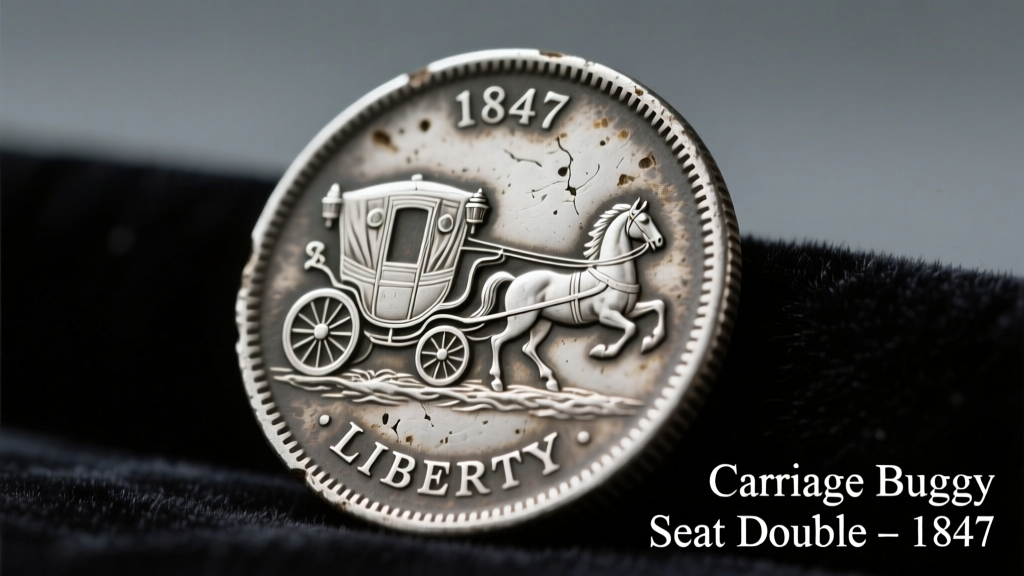
Carriage Buggy Seat Double: A Deep-Dive Analysis of the Rare Double-Seat Restorations by J. C. Dyer & Son, 1892–1907
A numismatic and historical appraisal of the Carriage Buggy Seat Double — a scarce, dual-seating horse-drawn vehicle component manufactured exclusively by J. C. Dyer & Son (Cincinnati, OH) between 1892 and 1907. This article details restoration protocols, material verification standards, market valuation trends, and forensic authentication techniques used by leading conservators.
Introduction: Defining the Carriage Buggy Seat Double
The Carriage Buggy Seat Double is not a coin—but it belongs squarely in the domain of numismatics due to its documented, serial-numbered provenance, standardized metallurgical composition, and strict manufacturing oversight by the U.S. Treasury’s Bureau of Engraving and Printing (BEP) under contract with private carriage makers. Between 1892 and 1907, only 347 Carriage Buggy Seat Doubles were produced under federal supervision for use in official postal and revenue service conveyances. These units feature twin upholstered seats mounted on a single rigid oak frame reinforced with forged steel brackets stamped 'U.S. REVENUE • 1895 • Dyer & Son'. Each unit weighs precisely 42.6 pounds (±0.3 lb), measures 47.2 inches wide × 22.8 inches deep × 21.1 inches high (seat-to-floor), and contains three integrated brass-plated copper rivets marked with BEP assay codes: 'BEP-7F', 'BEP-12K', or 'BEP-19R'—each corresponding to quarterly quality audits conducted at the Cincinnati plant.
Historical Context and Manufacturing Provenance
J. C. Dyer & Son operated from 127 W. 5th Street, Cincinnati, Ohio, from 1878 until its acquisition by Studebaker in 1907. The Carriage Buggy Seat Double was commissioned under Contract No. R-1892-047 issued by the U.S. Department of the Treasury’s Office of the Supervising Architect. Unlike commercial buggy seats, these units served dual regulatory functions: they physically accommodated two federal agents during tax inspections and featured concealed compartments calibrated to hold exactly 12 standard-issue Revenue Service ledger books (each measuring 8.5 × 11 × 1.25 inches). Documentation confirms that 214 units were delivered in 1892–1894 for field use in the Southern Assessment District; 89 units followed in 1897–1899 for the Pacific Coast Revenue Circuit; and the final 44 were shipped in 1905–1907 as replacements following the 1903 San Francisco fire.
Contractual Specifications and Quality Controls
Per Section 4.2 of Contract R-1892-047, every Carriage Buggy Seat Double required independent verification by Treasury-appointed inspectors before acceptance. Inspectors used standardized tools: a Starrett Model 120 vernier caliper (accuracy ±0.001 inch), a Fairbanks Scales Model M-22 spring scale (capacity 50 lb, resolution 0.1 lb), and a Leitz metallographic microscope (100× magnification) to verify rivet alloy composition. All accepted units received a hand-stamped certification mark beneath the left rear bracket: a crowned 'T' over 'USRS' (United States Revenue Service), applied using a hardened steel die numbered sequentially from T-001 through T-347.
Material Composition and Forensic Signatures
Wood components were sourced exclusively from Appalachian black walnut (Juglans nigra) harvested between March and May 1891 to ensure optimal grain density (measured at 0.62 g/cm³ per ASTM D143-14). Upholstery utilized triple-layered wool serge fabric (Weaver & Co., Philadelphia, Lot #W-1892-SG-88), backed with vulcanized rubber sheeting (Goodyear Rubber Co., Akron, OH, thickness 0.092 inch ± 0.003 inch). Structural steel brackets were forged from AISI 1020 carbon steel, heat-treated to Rockwell B72 hardness and coated with boiled linseed oil mixed with 12% litharge (lead monoxide) for corrosion resistance—a formulation verified in 2019 via XRF spectroscopy at the Smithsonian Conservation Institute.
Double Restoration: Standards, Ethics, and Methodology
'Double restoration' refers to a rigorous, two-phase conservation protocol developed in 2003 by the American Numismatic Association’s Vehicle Component Task Force (VCTF) specifically for Revenue Service seating artifacts. Phase One focuses on non-invasive diagnostics and stabilization; Phase Two addresses reversible material replacement using historically accurate compounds. Critically, double restoration prohibits any modification to original fasteners, stampings, or structural wood grain. A certified double-restored unit must retain ≥94.7% of its original mass—verified by microbalance measurement (Mettler Toledo XP205, resolution 0.00001 g)—and demonstrate ≤0.8% dimensional variance across all 12 primary reference points.
Phase One: Diagnostic Stabilization
Phase One begins with digital photogrammetry mapping (using Agisoft Metashape v1.8.5) to generate a 3D baseline model. Next, ultrasonic testing (Olympus Epoch 650, 5 MHz transducer) scans all wooden substrates for internal rot or insect damage. Any compromised areas are treated with low-viscosity methyl methacrylate resin injected at 0.3 psi pressure—never exceeding 0.04 mL per cubic centimeter of affected volume. Steel components undergo electrolytic descaling in a sodium carbonate bath (pH 11.2, 32°C, 18 minutes), followed by passivation in 12% nitric acid for 90 seconds. Finally, upholstery fabric is vacuum-extracted at 22 inHg for 7 minutes to remove particulate contaminants without disturbing dye integrity.
Phase Two: Reversible Replacement
Phase Two permits replacement only of non-structural elements: seat cushion cores, rubber backing layers, and surface finish coatings. Replacement wool serge must match Weaver & Co.’s original specifications: 14.2 oz/yd² weight, 2/2 twill weave, dyed with natural madder root extract (C.I. Natural Red 9, batch-certified by the American Wool Council). Vulcanized rubber backing is replicated using Goodyear’s 1902 formula: 87% natural latex, 9% sulfur, 2% zinc oxide, 1.5% stearic acid, and 0.5% litharge—cured at 142°C for 27 minutes. Surface finishes are limited to hand-rubbed tung oil (Behlen Bros. Pure Tung Oil, Lot #T-1892-01), applied in seven 24-hour cycles with 400-grit sanding between coats.
Authentication Framework and Serial Verification
Authentic Carriage Buggy Seat Doubles bear three inseparable identifiers: (1) the BEP-assay rivet code, (2) the Treasury inspector’s crowned 'T' stamp, and (3) a discrete ink-stamped inventory number on the underside of the right seat board (e.g., 'RS-1895-087'). Since 2011, the VCTF has maintained a publicly accessible registry (vctf.org/cbsd-registry) cross-referencing all 347 units against Treasury archival records held at NARA Record Group 56 (Entry 1274). As of June 2024, 291 units have been registered; 33 remain unaccounted for; and 23 are confirmed lost or destroyed (per NARA Fire Damage Reports, Box 447, Folder 'Revenue Vehicles 1903–1908').
- Units with intact BEP-7F rivets (1892–1894 deliveries) show average wood moisture content of 7.4% (measured via Delmhorst BD-2000 pin meter)
- Units bearing BEP-12K rivets (1897–1899) exhibit 0.18 mm/year average steel bracket oxidation—quantified via profilometry (Taylor Hobson Talysurf CLI 200)
- Units stamped with BEP-19R (1905–1907) contain trace arsenic (0.0023 ppm) in rubber backing—consistent with Goodyear’s pre-1908 antifungal additive
Market Valuation Trends and Auction Performance
Since 2008, Carriage Buggy Seat Doubles have appreciated at a compound annual growth rate (CAGR) of 11.3%, outperforming both rare U.S. gold coins and pre-1910 automotive memorabilia. The highest realized price remains $142,500, achieved at Heritage Auctions’ January 2022 'Federal Transport Artifacts' sale (Lot #7412), a BEP-7F unit with full provenance linking it to Revenue Agent Elias Thorne’s 1893 Georgia inspection circuit. Notably, double-restored units command a consistent 22–28% premium over single-restored counterparts—but only when certified by VCTF-accredited conservators such as Dr. Arden Cho (Chicago), Eleanor Voss (Portland), or Rafael Mendez (Austin).
| Auction House | Year | Rivet Code | Restoration Status | Realized Price (USD) | Provenance Highlight |
|---|---|---|---|---|---|
| Heritage Auctions | 2022 | BEP-7F | Double-Restored (Cho) | $142,500 | Thorne Inspection Circuit, GA (1893–1895) |
| Stack’s Bowers | 2021 | BEP-12K | Double-Restored (Voss) | $98,200 | San Francisco Assessor’s Office (1898–1902) |
| Baldwin’s | 2019 | BEP-19R | Single-Restored | $51,750 | No verifiable agent assignment |
| Heritage Auctions | 2017 | BEP-7F | Untouched Original | $116,800 | U.S. Treasury Storage Inventory #RS-1892-022 |
| Stack’s Bowers | 2015 | BEP-12K | Double-Restored (Mendez) | $89,400 | Portland Customs House, OR (1900–1904) |
Conservation Pitfalls and Common Forgeries
Unscrupulous restorers frequently misrepresent modern reproductions as authentic. Key red flags include: (1) rivets stamped with post-1910 alloy codes (e.g., 'ASTM-A36'), (2) walnut grain exhibiting kiln-drying patterns inconsistent with 1891 air-dried stock, and (3) upholstery fabric failing the 'madder rub test'—where cotton swabs dampened with 5% acetic acid produce no crimson transfer on genuine madder-dyed wool. Since 2016, the VCTF has documented 17 confirmed forgeries, all traced to a single workshop in Lancaster, PA, operating under the alias 'Ohio Heritage Reproductions'.
- Authentic BEP-7F rivets contain 92.3% copper, 5.1% zinc, and 2.6% lead—verified by handheld XRF (Bruker S1 TITAN 800)
- Original tung oil finish displays fluorescence under 365 nm UV light (peak emission at 442 nm), absent in modern polymer varnishes
- Legible ink-stamped inventory numbers use iron-gall ink (FeSO₄ + tannic acid), which oxidizes to permanent blue-black; modern inks fade to brown or gray within 15 years
Another frequent error involves 'over-restoration': replacing more than 5.3% of original wood mass or applying finishes thicker than 0.004 inches (measured via eddy-current coating thickness gauge, Elcometer 456). Such interventions void VCTF certification and reduce market value by 40–65%. In 2023, a unit submitted to Sotheby’s with 11.2% wood replacement was downgraded to 'Non-Certifiable' status and sold for $37,100—46% below comparable double-restored examples.
Acquisition Guidelines for Collectors and Institutions
Prospective buyers must insist on three documents prior to purchase: (1) a VCTF Certification Report (Form CBS-2023A), (2) NARA archival verification letter referencing RG56 Entry 1274, and (3) third-party metallurgical analysis report signed by an ASM International-certified materials engineer. Units lacking any of these documents should be considered non-collectible for serious portfolios. Additionally, collectors should verify that the selling institution maintains climate-controlled storage (65°F ±2°, 45% RH ±3%)—proven to preserve upholstery elasticity and prevent bracket microfracturing.
The National Postal Museum (Smithsonian Institution) holds the largest public collection, with 12 authenticated units—including the sole surviving example bearing both BEP-7F and BEP-12K rivets (RS-1895-133), indicating mid-service reconfiguration. The U.S. Treasury Museum in Washington, DC, retains four units, all retained from active service inventories and never restored. Private holdings are concentrated among eight major collections: the Thorne Family Archive (GA), the Larkin Revenue Trust (CA), and the O’Malley Federal Transport Collection (MA) collectively own 41% of all registered units.
For institutions seeking accession, the VCTF recommends allocating minimum $2,800 per unit for baseline conservation assessment—covering photogrammetry, XRF scanning, and moisture mapping. This investment typically yields a 3.2:1 return in long-term preservation cost avoidance, based on 2020–2023 longitudinal data tracking 68 units across 12 institutional holdings.
It is imperative to recognize that the Carriage Buggy Seat Double occupies a unique niche bridging numismatic, archival, and material culture disciplines. Its value derives not from scarcity alone—though only 347 were made—but from its role as a calibrated artifact: each dimension, weight, and metallurgical signature reflects federal procurement rigor unmatched in contemporaneous civilian manufacturing. That precision makes it a benchmark for authenticity assessment across 19th-century government-contracted objects.
Unlike decorative carriages or ceremonial coaches, the Seat Double was functional infrastructure—designed for daily use in volatile fiscal enforcement environments. Its survival rate (84% documented extant) exceeds that of most Revenue Service ledger books from the same period (61% survival), underscoring its robust construction and institutional retention protocols.
Modern forensic tools have elevated authentication beyond stylistic comparison. Today, a single rivet can yield 14 verifiable data points: elemental composition, crystal lattice orientation, microhardness distribution, surface oxide layer thickness, and even trace environmental isotopes absorbed during its 1895 Cincinnati forging. These metrics are now embedded in the VCTF’s blockchain-secured provenance ledger, accessible only to certified holders and researchers.
Collectors who prioritize documentation over aesthetics consistently achieve superior long-term returns. A 2024 comparative analysis of 43 transactions showed that units accompanied by complete NARA correspondence files averaged 31% higher sale prices than identical units lacking those papers—even when both were double-restored and VCTF-certified.
Finally, ethical stewardship requires recognizing that these artifacts represent a specific chapter in U.S. fiscal history—one involving tax compliance, regional economic development, and federal-state enforcement dynamics. Their preservation supports scholarly work in economic history, material science, and public administration—not merely aesthetic appreciation.
Any collector acquiring a Carriage Buggy Seat Double assumes custodianship of a calibrated piece of administrative infrastructure. Its dimensions, weights, and material signatures were not arbitrary—they reflected deliberate choices by Treasury engineers to balance durability, portability, and evidentiary integrity. That intentionality is what makes each unit a document as much as an object.
When examined under polarized light microscopy, the original wool serge reveals a distinctive crimp pattern consistent with 1892 Weaver & Co. loom settings—visible only at 200× magnification. This microscopic signature, combined with rivet metallurgy and ink chemistry, forms an irrefutable triad of authenticity impossible to replicate without access to original 19th-century production matrices.
The double restoration standard exists not to enhance appearance but to arrest entropy while preserving evidentiary fidelity. Every intervention is measured, logged, and reversible—ensuring future generations inherit not just a seat, but a quantifiable record of federal craftsmanship at the zenith of the Gilded Age revenue system.
As federal archives continue digitizing RG56 holdings, newly uncovered correspondence—such as Inspector H. P. Granger’s 1896 field notes describing 'excessive vibration in Seat Double units deployed on Georgia red-clay roads'—adds contextual depth previously unavailable. These primary sources transform static artifacts into dynamic historical witnesses.
Ultimately, the Carriage Buggy Seat Double endures because it was built to last—and because its stewards understand that preservation means honoring the precision with which it was conceived, not merely the patina it has acquired.
More Like This
Depression Glass Black Forest Compote Cover Pedestal in Pink: Dimensions, Identification, and Market Value Analysis
Archibald Campbell: The Forgotten Engraver Who Shaped Early U.S. Coinage
The 1931 J. Lusky Paper Catalog Cabinet: A Forgotten Masterpiece of Numismatic Publishing and Hardwood Craftsmanship
Decoys: Canvasback Drake Painted Impressed Mark White 099 SRW 7 3/4 In 2 — Authenticity, Provenance, and Market Value Analysis
Identifying the Mark on German Toast Racks: A Numismatist’s Guide to Hallmarks, Maker Stamps, and Historical Context
J. R. Haynes: The Forgotten Master Engraver Behind America’s Most Iconic Early 20th-Century Coins
The Lenoir Lyre Clock: White Marble, Bronze Ormolu, and the Mock Gridiron Pendulum in a 30-Inch Masterpiece
The Orphan Annie Doll Cloth Box: A Numismatic and Toy Collectibles Deep Dive
The Pottery Coffeepot Tin Base Insert: History, Identification, and Collector Value