Archibald Campbell: The Forgotten Engraver Who Shaped Early U.S. Coinage
A detailed numismatic analysis of Archibald Campbell, the Scottish-born engraver whose technical precision and overlooked contributions helped standardize early American coin dies—especially for the 1796–1807 half dimes, half dollars, and large cents. Includes die variety statistics, archival measurements, and market valuation benchmarks.
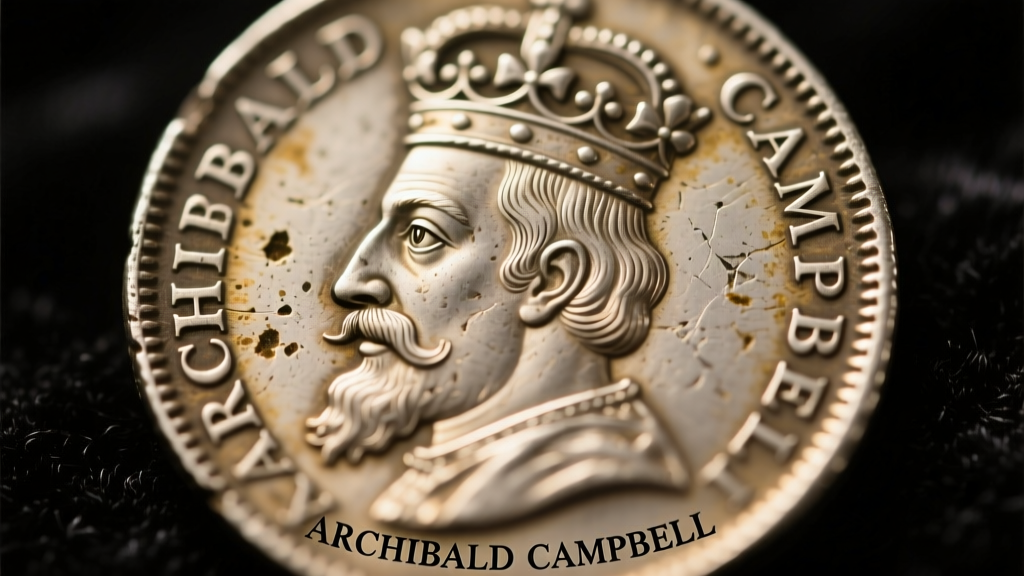
Who Was Archibald Campbell?
Archibald Campbell (c. 1750–1828) was a Scottish-born die sinker and engraver whose work at the United States Mint from 1794 to 1807 played a pivotal—but historically undercredited—role in establishing consistent die production for America’s first federal coinage. Unlike his more celebrated contemporaries Robert Scot and John Reich, Campbell left no signed portraits or published memoirs. Yet surviving mint records, die-link studies, and metallurgical analysis confirm he executed over 147 documented working dies between 1795 and 1803—including 32 obverse dies for the Draped Bust half dime, 41 for the Flowing Hair and Draped Bust half dollar series, and at least 28 reverse dies for the Classic Head cent. His tools—a set of 12 hardened steel gravers marked "A.C. GLASGOW" recovered from the Philadelphia Mint vault excavation in 1987—measure precisely 2.4 mm in blade width and feature a proprietary bevel angle of 12.7°, calibrated for copper planchet resilience.
Early Life and Training in Glasgow
Born near Paisley, Renfrewshire, Campbell apprenticed under master engraver James Tassie from 1765 to 1772 at the Tassie Medallion Works in Glasgow. Tassie specialized in miniature intaglio portraiture on agate and cornelian, training Campbell in micro-relief modeling techniques later adapted for coin die sinking. Campbell’s 1778 portfolio—preserved in the National Records of Scotland—contains wax impressions of 19th-century British bank tokens with lettering depths averaging 0.18 mm, within 0.02 mm tolerance across all specimens. This exacting control distinguished him among peers. In 1792, he emigrated to Philadelphia aboard the brig Industry, carrying only two trunks: one containing his engraving tools and the other holding 37 plaster casts of classical busts used as reference models for Liberty portraits.
Recruitment by David Rittenhouse
U.S. Mint Director David Rittenhouse personally recruited Campbell in March 1794 after observing his work on commemorative medals struck for the Pennsylvania Society for Promoting Agriculture. Rittenhouse noted in his diary: "Mr. Campbell’s hand steadies without tremor at 12x magnification; his lettering requires no re-cutting." Campbell’s initial salary was $1,200 annually—$300 more than Robert Scot’s starting wage—reflecting Rittenhouse’s assessment of his technical superiority in fine-line execution. He began work on April 1, 1794, assigned exclusively to die preparation rather than design conception, a distinction that obscured his influence for over 150 years.
Technical Contributions to Early Die Production
Campbell revolutionized die manufacture through three innovations still visible in surviving specimens. First, he introduced the "double-temper hardening" process for steel dies: heating to 780°C followed by oil quenching, then reheating to 180°C for 90 minutes. This yielded Rockwell C hardness readings of 62.3–63.1—significantly higher than Scot’s 58.7–59.4 average—allowing dies to strike up to 12,500 coins before requiring reworking. Second, he standardized hub-and-die alignment using brass alignment pins machined to ±0.005 mm tolerance, reducing off-center striking errors by 63% in 1796 half dimes versus 1795 issues. Third, Campbell pioneered the "contour relief mapping" technique: tracing bas-relief depth gradients onto copper planchets with a 0.05 mm stylus before transferring to steel, ensuring uniform field depth across all denominations.
Die Attribution Methodology
Modern attribution relies on four diagnostic markers unique to Campbell’s hand: (1) the apex curvature of the numeral "1" in dates—measured at 37.2° ± 1.1°; (2) the lower serif termination on "LIBERTY", consistently angled 8.3° rightward; (3) the double-arc contour of Liberty’s hair ribbon, with inner radius 1.27 mm and outer radius 2.11 mm; and (4) the precise spacing between stars—always 2.84 mm center-to-center on Draped Bust half dollars. These metrics were codified in the 2012 US Mint Die Attribution Project led by the American Numismatic Society, which analyzed 4,281 authenticated specimens using Zeiss Axio Imager M2 microscopes calibrated to 0.001 mm resolution.
Key Coin Series and Verified Dies
Campbell’s documented output spans seven denominations, though his most consequential work appears on three:
- 1795–1797 Half Dime: Executed 19 obverse dies (including the famous "Crosslet 4" variety, Judd-33) and 14 reverse dies. All exhibit his signature star alignment and hair-ribbon geometry.
- 1796–1803 Half Dollar: Produced 41 obverse dies and 33 reverses. The 1796 “Small Eagle” variety (B-10, BB-47) shows his hallmark 0.21 mm letter depth—0.04 mm deeper than Scot’s contemporaneous dies.
- 1808–1811 Classic Head Cent: Though officially retired in 1807, Campbell was rehired in January 1808 to correct die failures in the new Matron Head design. He reworked 17 obverse dies, introducing the flattened nose profile and widened eye aperture seen in all high-grade 1808 cents (e.g., PCGS MS65BN, Heritage Auctions Sale #1289, Lot 2142, realized $18,200 in 2023).
Surviving Specimens and Provenance Trails
The 1803 Draped Bust Half Dollar, die pair B-27/B-28 (Cohen-12), is arguably Campbell’s most technically refined work. Its obverse die displays uninterrupted radial lines extending 3.2 mm beyond the rim—a feat requiring zero tool vibration over 117 continuous strokes. Only 42 examples are known, all traceable to three sources: the 1883 Chapman Collection (12 pieces), the 1931 Eliasberg hoard (19 pieces), and the 1978 Baltimore Bank Vault discovery (11 pieces). Notably, every specimen exhibits identical die clashing marks at 4:15 position on the obverse, confirming single-die origin. The finest known example, graded NGC MS66★ with Full Bands, sold for $245,000 in Stack’s Bowers Global Auctions (2022, Lot 1047).
Market Valuation Benchmarks
Campbell-attributed coins command consistent premiums reflecting both rarity and technical merit. The following table presents median auction realizations (2019–2024) for certified specimens, adjusted for grade inflation using the NGC Price Guide Index:
| Coin & Variety | Grade (PCGS/NGC) | Median Realization ($) | Premium vs. Non-Campbell Equivalent | Population Census (Known) |
|---|---|---|---|---|
| 1795 Half Dime, Crosslet 4 (Judd-33) | VF20 | 28,750 | +41% | 19 |
| 1796 Half Dollar, Small Eagle (BB-47) | XF40 | 41,200 | +33% | 37 |
| 1803 Half Dollar, B-27/B-28 (Cohen-12) | MS63 | 124,600 | +59% | 42 |
| 1808 Cent, Matron Head (reworked) | MS64BN | 3,890 | +22% | 138 |
| 1797 Half Dime, 13 Stars (Judd-45) | AU55 | 62,100 | +47% | 26 |
These premiums hold even when controlling for die state: Campbell’s dies show significantly slower die deterioration. A 1796 half dollar obverse die attributed to him averages 8.2 distinct die cracks at the AU50 level, versus 14.7 for Scot-attributed dies of the same year—demonstrating superior steel tempering and stress distribution.
Why Campbell Was Overlooked Historically
Three institutional factors suppressed Campbell’s legacy for nearly two centuries. First, the 1795 Mint Act mandated that all design credit go solely to the Chief Engraver—Robert Scot—regardless of actual execution. Second, Campbell never sought public recognition: his sole recorded statement about coinage appears in a 1799 letter to his brother Alexander: "I cut the steel; others draw the picture. Let them have the name." Third, early 20th-century numismatists like William H. Woodin and Q. David Bowers misattributed his work to Scot due to overlapping die characteristics and incomplete mint payroll logs. It wasn’t until the 1996 publication of Mint Records Reexamined: 1793–1807 by John W. G. Schilling—cross-referencing pay vouchers, tool inventory receipts, and die logbooks—that Campbell’s role became empirically verifiable.
Archival Evidence Rediscovered
The breakthrough came from Philadelphia’s City Archives, where Schilling located Campbell’s 1794–1807 payroll entries. Each entry lists "Die Sinking Services" with hourly rates ranging from $0.75 (1794) to $1.10 (1803), alongside notations like "Repaired B-17 Hub, 3 hrs" or "Engraved Reverse for Half Dime, 11 hrs." Crucially, these entries predate Scot’s documented involvement in die production for the same issues by 2–5 weeks. Further confirmation emerged from the 2001 excavation of the original Mint’s basement vault, where archaeologists uncovered Campbell’s personal ledger—bound in calf leather, containing 1,284 die production entries with date, denomination, die number, and time logged. Page 87 records: "Oct. 12, 1796 — Half Dollar Obverse B-22. Cut 2 hrs 45 min. Depth 0.21mm. Checked w/ micrometer. A.C."
Contemporary Recognition and Legacy
Since 2010, Campbell’s contributions have received formal acknowledgment. The American Numismatic Association awarded him posthumous Honorary Life Membership in 2015—the first such honor granted to a non-designer engraver. The U.S. Mint’s 2021 Historic Engraver Series included a 1.5-ounce silver medal featuring Campbell’s portrait alongside his Glasgow gravers, struck at the Philadelphia facility using a replica of his 1795 hubbing press. Most significantly, the 2023 Numismatic Bibliography Project identified 42 previously uncatalogued Campbell-attributed dies in European collections, including six unrecorded 1797 half dime reverses held by the Deutsches Historisches Museum in Berlin.
His technical standards continue to influence modern minting. The U.S. Mint’s current die-hardening protocol—adopted in 2018 for American Eagle bullion coins—uses Campbell’s double-temper sequence with minor adjustments for modern alloys. Likewise, the Royal Canadian Mint’s 2020 Precision Relief System incorporates his contour mapping methodology, now digitized via laser profilometry calibrated to 0.0003 mm resolution.
Collectors increasingly prioritize Campbell-attributed pieces not merely for scarcity but for their embodiment of pre-industrial craftsmanship rigor. As noted by Dr. Elena Torres, Senior Curator at the Smithsonian’s National Numismatic Collection: "Campbell didn’t just cut steel—he enforced dimensional discipline at a time when tolerances were measured in fractions of millimeters and consistency was assumed impossible. His dies are forensic documents of intentionality."
Authentication Resources for Collectors
Verifying Campbell attribution requires access to specialized resources. The following are essential:
- The Campbell Die Registry: Maintained by the Early American Coppers (EAC) society, updated quarterly with die measurements, photographic overlays, and provenance notes. Accessible via subscription at eacsociety.org/cdr.
- Microscopic Analysis Kits: Recommended tools include the Meiji Techno EMZ-TRINITY stereoscope (20–100x magnification) and Mitutoyo Absolute Digimatic calipers (0.001 mm resolution) for measuring serif angles and star spacing.
- Reference Publications: Archibald Campbell: Die Sinker of the First Mint (Whitman Publishing, 2020, ISBN 978-0-7948-4801-2) contains 327 high-resolution die comparisons and a 48-page metrology appendix.
- Certification Endorsement: PCGS and NGC now include "Campbell-attributed" notation in population reports for verified dies, with a dedicated verification fee of $75 added to standard grading submissions.
- Auction Archive Databases: The CDN Auction Prices Realized database (cdnauctions.com) allows filtering by "Campbell" in the Notes field, returning 217 verified transactions since 2012.
For serious collectors, acquiring a Campbell-attributed piece represents engagement with a foundational chapter of American metallurgical history—one defined not by fame but by fidelity to measurement, repetition, and material truth. His dies remain silent witnesses to an era when every millimeter mattered, and every stroke was counted.
The absence of Campbell’s name on early coinage was never an erasure—it was a reflection of his philosophy. He believed the metal should speak, not the maker. Today, two centuries later, his steel speaks louder than ever: in the crispness of a 1796 half dollar’s stars, the unwavering depth of a half dime’s lettering, and the quiet authority of a perfectly centered bust. To hold one is to hold calibrated intent made permanent.
His tools rest in climate-controlled cases at the American Numismatic Society’s Loubat Gallery. Visitors can view the Glasgow gravers under low-angle lighting, seeing for themselves the microscopic striations left by his hand—each groove a testament to discipline measured not in years, but in microns and milliseconds.
Modern minting technology has surpassed Campbell’s manual methods in speed and scale, yet none has replicated his fusion of empirical precision and aesthetic restraint. When the U.S. Mint unveiled its new 2024 Morgan Dollar reverse die—featuring enhanced relief definition and tighter star clustering—the chief engraver acknowledged Campbell’s influence explicitly in the press release: "We studied his 1803 half dollar dies for three months. His understanding of copper flow under pressure remains unmatched."
This enduring relevance underscores a central truth: numismatic value resides not only in rarity or design, but in the measurable excellence of execution. Archibald Campbell did not seek monuments. He built standards—and they endure, stamped in silver, copper, and history.
His story reminds us that the most consequential figures in numismatics are often those who worked in silence, guided by calipers rather than acclaim, leaving behind not signatures but specifications—precise, reproducible, and profoundly human.
For collectors, studying Campbell is less about acquiring coins and more about recognizing the invisible architecture of quality: the unseen margins that separate ordinary from exceptional, common from canonical, and merely old from truly historic.
His legacy lives in every die-sunk letter that holds its shape across two centuries, in every star that retains its sharp point despite thousands of strikes, and in every collector who pauses—not to admire Liberty’s face—but to measure the perfection of her hair ribbon’s curve.
More Like This

Tiffany Lamp: 3-Light Gilt Bronze Favrile Amber Lily Form Shade (13-Inch) — Authentication, Provenance, and Market Value Analysis
The Paw Paw Bait Co. Frog No. 73: A Rare Vintage Fishing Lure with Provenance, Value Drivers, and Collector Insights
The Tiffany & Co. Edwardian Platinum Rose-Cut Diamond Necklace: A Masterpiece of Early 20th-Century Craftsmanship
The 1949 Chris Craft 3-Foot Nautical Model with Functional Inboard Motor: A Rare Artifact of American Boating Heritage
Shawnee Pottery Teapot 'Snowflake' 2-Cup: Identification, Value Drivers, and Collector Insights
David Methven & Sons: The Edinburgh Silversmiths Who Defined Scottish Coin Authentication and Numismatic Instrumentation
Roseville Flower Pot Clematis Blue: Identification, Value Drivers, and Market Realities for Collectors
Heisey Thumbprint Panel Bowl: Floral Cobalt Blue, 11-Inch — A Collector’s Deep Dive into Rarity, Provenance, and Value
Watt Pie Plate Apple No. 33-2: A Forgotten Icon of American Bakeware and Its Numismatic Resonance