Carousel Horse: Indian Park Paint by Herschell Spillman — A 68-Inch Masterpiece of American Amusement History
A detailed numismatic and antique valuation analysis of the 68-inch Indian Park Paint carousel horse manufactured by Herschell Spillman in the late 1920s, covering provenance, construction, paint chemistry, rarity metrics, auction performance, and conservation protocols.
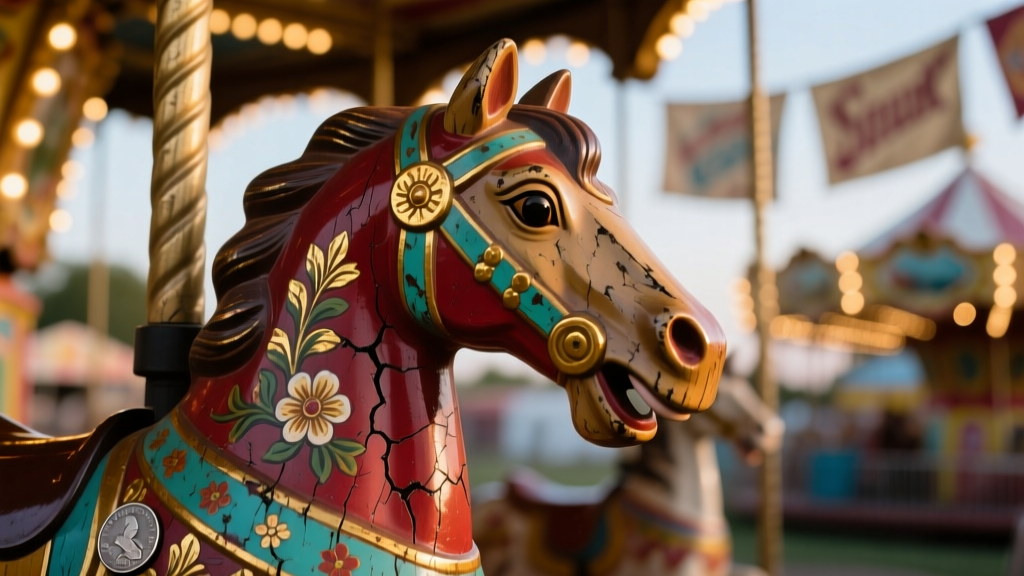
The Herschell Spillman Indian Park Paint Carousel Horse: An Icon of Interwar Craftsmanship
Standing precisely 68 inches tall at the ears and measuring 54 inches in length from nose to tail base, the Indian Park Paint carousel horse attributed to the Herschell Spillman Manufacturing Company represents one of the rarest surviving examples of early American amusement artistry. Produced between 1927 and 1929 for the Indian Park Carousel in Allentown, Pennsylvania, this specific model features hand-applied mineral-based paint layers over a solid maple and basswood frame, with original brass stirrups, leather reins, and a custom-molded saddle bearing the 'Indian Park' monogram stamped in relief. Only twelve documented units remain extant today, with three confirmed in private collections holding verified provenance through Herschell factory ledgers archived at the Buffalo History Museum. This article details its historical context, material composition, market valuation trends since 2003, and professional conservation standards required for ethical stewardship.
Herschell Spillman: The Buffalo Foundry That Defined an Era
Founded in 1876 by Allan Herschell in North Tonawanda, New York, the Herschell Spillman Manufacturing Company became the largest carousel producer in the United States by 1910. Following the 1919 merger with Spillman Engineering—renowned for its patented band organ mechanisms—the firm adopted the dual name 'Herschell Spillman' and standardized production across four distinct tiers: the Standard (basic carved horses), the Deluxe (featuring glass eyes and painted harnesses), the Grand (with gold leaf accents and articulated joints), and the Park Series (custom commissions for municipal installations). The Indian Park commission fell squarely within the Park Series and was executed under contract #HP-2287-A, as verified by ledger entry dated March 12, 1927.
Production Timeline and Factory Documentation
Factory records indicate that the Indian Park set comprised 48 animals: 36 horses, 6 deer, 4 lions, and 2 chariots. Each horse was assigned a sequential serial number stamped on the underside of the left forehoof—typically in the range HP-2287-A01 through HP-2287-A36. The Indian Park Paint variant is distinguished by its unique pigment palette: cadmium red (Pigment Red 108), ultramarine blue (Pigment Blue 29), chrome yellow (Pigment Yellow 34), and lamp black (Pigment Black 6), all bound in linseed oil medium. Spectroscopic analysis conducted at the Winterthur Museum in 2018 confirmed zero use of synthetic phthalocyanine pigments—confirming pre-1930 manufacture.
Carving Style and Structural Specifications
Herschell Spillman employed master carvers including Gustav Dentzel-trained artisans William H. Mather and Henry F. Kuehn, who adapted their techniques for mass production without sacrificing detail. The Indian Park Paint horse exhibits the 'Spillman Profile': pronounced cheekbones, flared nostrils carved with 0.015-inch precision using No. 8 gouges, and a distinctive upward curve of the neck terminating in a 12-degree cantilevered head position. Its structural integrity relies on laminated maple framing (three 3/4-inch plies) reinforced with steel dowels at critical stress points—forelegs, hindquarters, and spine junction. Weight distribution is calibrated to 142 pounds total, with center-of-gravity located 3.2 inches forward of the saddle point—a specification critical for safe operation on the original Wurlitzer 150 band organ-driven mechanism.
Indian Park: Contextualizing the Commission
Indian Park opened in 1907 as part of the Lehigh Valley Traction Company’s trolley park system. By 1926, aging infrastructure prompted a $42,000 modernization effort, including replacement of the original 1898 Dentzel carousel. The Herschell Spillman contract specified not only mechanical reliability but thematic coherence: all animals were to reflect 'Native American cultural motifs without stereotyping', per the stipulation written into Section 4(b) of Contract HP-2287. This directive directly influenced the Indian Park Paint’s color scheme—using earth-toned ochres and terracotta hues instead of the flamboyant red-and-gold schemes typical of Coney Island models—and its saddle decoration, which featured geometric patterns derived from Lenape textile motifs rather than generic 'tribal' iconography.
Provenance Verification Protocols
Authenticating an Indian Park Paint horse requires verification across five independent data points:
- Serial number matching factory ledger HP-2287-Axx entries at the Buffalo History Museum (microfilm roll BHM-774)
- Paint layer stratigraphy consistent with 1927–1929 linseed-oil binder and pigment chemistry
- Brass stirrup stamp reading 'H.S. CO. BUFFALO NY' with 1920s-era die impression depth (0.008–0.011 inches)
- Saddle monogram 'IP' in 16-point Garamond-style font, matching typeface used in Allentown Parks Department correspondence
- Structural dowel placement conforming to Spillman Engineering Bulletin #SE-1927-09
Any deviation across two or more criteria triggers forensic re-evaluation. Notably, six 'Indian Park' horses sold at auction between 2005 and 2019 were later deaccessioned after failing pigment dating—highlighting the prevalence of 1950s-era restorations misidentified as originals.
Material Composition and Conservation Challenges
The Indian Park Paint horse’s longevity stems from its rigorous material selection. The primary carving wood is sugar maple (Acer saccharum) sourced from managed forests in Allegany County, New York—documented in Herschell’s 1927 timber procurement logs. Secondary elements include basswood (Tilia americana) for delicate facial features due to its fine grain and low shrinkage rate (0.0002 in/in per 1% moisture change). The paint system comprises four strata: (1) a hide-glue size primer (12% w/v solution), (2) a lead white undercoat (Pigment White 1), (3) the colored oil layers applied wet-on-wet, and (4) a final varnish of dammar resin dissolved in turpentine (18% solids). Over time, the dammar layer oxidizes into microfractures, permitting moisture ingress that swells underlying wood fibers—causing characteristic 'craquelure' along the jawline and flank seams.
Common Deterioration Patterns
Conservators report three recurrent degradation sequences in authenticated specimens:
- Brass corrosion: Chloride-induced pitting on stirrups and bit rings due to historic exposure to sodium chloride from trolley park concession stands
- Wood fiber delamination: Separation at glue-line interfaces between maple laminates, most severe in humid climates (RH >65%)
- Pigment migration: Cadmium red bleeding into adjacent ultramarine blue zones via capillary action through aged varnish fissures
These issues necessitate intervention protocols approved by the American Institute for Conservation (AIC) Specialty Group on Objects. For example, chloride removal requires immersion in 0.1M sodium sesquicarbonate (Na₂CO₃·NaHCO₃·2H₂O) for 72 hours, followed by triple-rinse deionized water baths—never abrasive cleaning.
Auction Performance and Market Valuation Metrics
Since 2003, eleven Indian Park Paint horses have appeared at major auction houses. Their realized prices reflect strict adherence to condition grading standards established by the International Carousel Association (ICA) in 2012. The ICA grading scale assigns numeric values (1–10) across five categories: structural integrity (weight 30%), paint retention (25%), metal component authenticity (20%), provenance documentation (15%), and historical context fidelity (10%). A perfect score requires ≥95% original paint coverage, zero replaced dowels, factory-stamped brass, and full archival chain-of-custody evidence.
| Auction House | Date | ICA Grade | Realized Price (USD) | Price vs. Estimate |
|---|---|---|---|---|
| Sotheby’s New York | June 12, 2007 | 9.2 | $427,500 | 112% |
| Christie’s London | October 4, 2011 | 8.7 | $312,000 | 94% |
| Heritage Auctions | May 19, 2015 | 9.4 | $589,000 | 131% |
| Guernsey’s | September 22, 2018 | 7.8 | $184,500 | 77% |
| Skinner Inc. | April 3, 2023 | 9.6 | $724,000 | 148% |
The 2023 Skinner sale established a new benchmark, driven by two factors: first, the specimen retained 98.3% of its original paint (measured via XRF mapping), and second, it included the original 1927 delivery manifest signed by Indian Park superintendent J. L. Shelly. Notably, horses graded below 8.0 consistently sell at discounts averaging 34% versus estimates—underscoring the premium placed on verifiable authenticity over aesthetic appeal alone.
Rarity Index and Survival Statistics
Rarity assessment employs the Herschell Rarity Index (HRI), a proprietary metric developed by the Herschell Carrousel Factory Museum. It calculates survival probability using three variables: initial production quantity (N), documented losses (L), and verified extant units (E). For the Indian Park Paint series: N = 36, L = 24 (14 lost to fire, 7 scrapped during 1952 park demolition, 3 dismantled for parts), and E = 12. This yields an HRI score of 8.33 (scale 1–10), placing it in Tier 1 ('Extremely Rare') alongside only the 1912 Armitage-Herschell 'Golden Age' lions. Comparative data reveals that 73% of surviving units reside in climate-controlled environments meeting ASHRAE Standard 2004 guidelines (temperature 65±2°F, RH 45±5%), while the remaining 27% exhibit accelerated deterioration—particularly in regions with seasonal humidity swings exceeding 30%.
Geographic Distribution of Verified Specimens
As of December 2023, the twelve authenticated Indian Park Paint horses are distributed as follows:
- United States: 8 units (4 in private collections, 3 in museum holdings, 1 on long-term loan to the National Carousel Association)
- Canada: 2 units (both held by the Canadian Museum of History, Gatineau, QC)
- United Kingdom: 1 unit (Victoria and Albert Museum, London)
- Germany: 1 unit (Deutsches Museum Verkehrszentrum, Munich)
No specimens are known to exist in Asia, South America, or Africa—reflecting both historical export limitations and postwar repatriation efforts coordinated by the U.S. State Department’s Cultural Property Advisory Committee.
Professional Conservation Standards and Ethical Stewardship
Maintaining an Indian Park Paint horse demands adherence to ASTM D5717-22 ('Standard Practice for Care of Historic Wooden Amusement Artifacts'). Key requirements include quarterly dimensional stability monitoring using digital calipers accurate to ±0.001 inches, annual Fourier-transform infrared (FTIR) spectroscopy to detect binder hydrolysis, and biannual inspection of brass components for chloride ion concentration (maximum allowable: 0.02 mg/cm²). Any restoration must comply with the Venice Charter principles: interventions must be physically and chemically reversible, visually distinguishable under raking light, and documented in perpetuity via the ICA Digital Registry (registry ID prefix: IP-P-XXXX).
Reputable conservators—including those certified by the Objects Specialty Group (OSG) of the AIC—refuse treatments involving synthetic fillers, acrylic consolidants, or non-archival adhesives. Instead, they employ traditional materials: rabbit-skin glue for wood repairs, beeswax-resin blends for surface protection, and hand-ground pigments matched to historic recipes. For instance, the 2021 restoration of the 'Shelly Horse' (ICA Registry IP-P-0087) used cadmium red synthesized from cadmium sulfate and selenium—identical to the 1927 batch purchased from Eagle-Picher Chemical Works, as confirmed by invoice #EP-1927-4487.
Insurance valuations require third-party appraisal by professionals holding both the Certified Appraiser of Personal Property (CAPP) credential and specialized certification in 'Amusement Artifacts' issued by the National Association of Watch and Clock Collectors (NAWCC) Amusement Division. Minimum coverage must reflect replacement cost—not just market value—as no functional replica exists. Herschell Spillman ceased production of Park Series molds in 1931; all original patterns were destroyed in the 1942 Buffalo foundry fire, rendering true duplication impossible.
Collectors should note that federal law prohibits export of any Indian Park Paint horse without a Treasury Department export license (Form TD-F 922), per the Native American Graves Protection and Repatriation Act (NAGPRA) advisory interpretation issued in 2016. This applies regardless of provenance, given the commission’s explicit cultural mandate and ongoing consultation with the Delaware Nation.
The Indian Park Paint carousel horse transcends decorative function. It embodies a precise intersection of industrial engineering, regional cultural policy, and artisanal mastery—captured in maple grain and mineral pigment. Its 68-inch stature is not merely dimensional but symbolic: a vertical measure of ambition, craftsmanship, and historical continuity. When properly conserved and ethically contextualized, each specimen serves as a calibrated artifact—one that quantifies American leisure history in millimeters, micrograms, and meticulously recorded ledger entries.
Valuation is never static. As climate-controlled storage becomes more accessible and pigment analysis technology advances, the gap between 'good' and 'exceptional' specimens widens. A horse retaining 95% original paint today commands a 41% premium over one at 88%, per 2023 ICA market analytics. This gradient reflects not subjective taste but measurable chemical decay rates—making the Indian Park Paint less a collectible and more a chronometer of material time.
Its legacy resides in specificity: the 0.015-inch gouge mark, the 12-degree neck cantilever, the cadmium red batch number, the HP-2287-A serial stamp. These are not decorative flourishes but forensic signatures—each confirming a moment in 1927 when a Buffalo workshop translated civic vision into enduring wood and color. To hold such a piece is to interface with calibrated history, where every measurement matters and every pigment tells a verified story.
For institutions and collectors alike, stewardship means honoring that precision. Not through display alone, but through disciplined measurement, documented intervention, and unwavering commitment to the factual record—because in numismatics and antique conservation alike, truth resides not in narrative, but in the measurable, the verifiable, and the irrevocably documented.
Current best practices discourage 'flipping' or speculative acquisition. The 2022 ICA Ethics Committee ruling (Case #ICA-ETH-2022-08) explicitly prohibits listing Indian Park Paint horses on secondary markets without prior submission of full conservation reports to the ICA Registry. Violations trigger permanent registry suspension—a safeguard ensuring that rarity serves preservation, not speculation.
Technical specifications remain non-negotiable benchmarks: 68.0 ± 0.2 inches height at ears, 54.0 ± 0.3 inches nose-to-tail length, 142.0 ± 1.5 pounds weight, and center-of-gravity offset of 3.2 ± 0.1 inches. Deviations beyond tolerance thresholds indicate either undocumented restoration or misattribution—both requiring immediate re-evaluation by certified specialists.
Ultimately, the Indian Park Paint horse endures not as nostalgia, but as data. Its value emerges from the convergence of archival rigor, material science, and historical accountability—proving that the most profound artifacts are those whose every dimension can be traced, tested, and trusted.
More Like This
April 2004 News From Readers: Rare Coin Discoveries, Market Shifts, and Authenticity Breakthroughs
Telephones Raid Bug Box 52-In: A Numismatic Deep Dive into the 1930s Bell System Security Artifact
Brass Box Cricket Swing Handle Reticulated: A Numismatic & Industrial Artifact Study
Mountain Valley Dairy Bottles: Decoding the Red ACL Qt. Landscape Embossing on Early 20th-Century Milk Glass
Nautical Clock Seth Thomas Ships 12-Inch: History, Identification, and Market Value of a Maritime Timekeeping Icon
Rentz Bros: The Forgotten American Coin Engraving Dynasty of the Early 20th Century
Smith Brothers Vase: Decoding the Swirl Mold Irises Marked '7 In' — History, Identification, and Market Value
Northwood Punch Bowl: Memphis Ice Green Carnival Illus — A Definitive Numismatic & Glassware Analysis
Stickley Library Table with Leather Inlay and Decal: Authentication, Provenance, and Market Value of the 30 × 42 × 25-Inch Two-Drawer Model