Rentz Bros: The Forgotten American Coin Engraving Dynasty of the Early 20th Century
A deep-dive historical and technical analysis of Rentz Bros., the Cincinnati-based medallic art firm active from 1905 to 1938, known for precision die engraving, custom presentation medals, and contract work for the U.S. Mint and major corporations including General Electric, National Cash Register, and the American Numismatic Association.
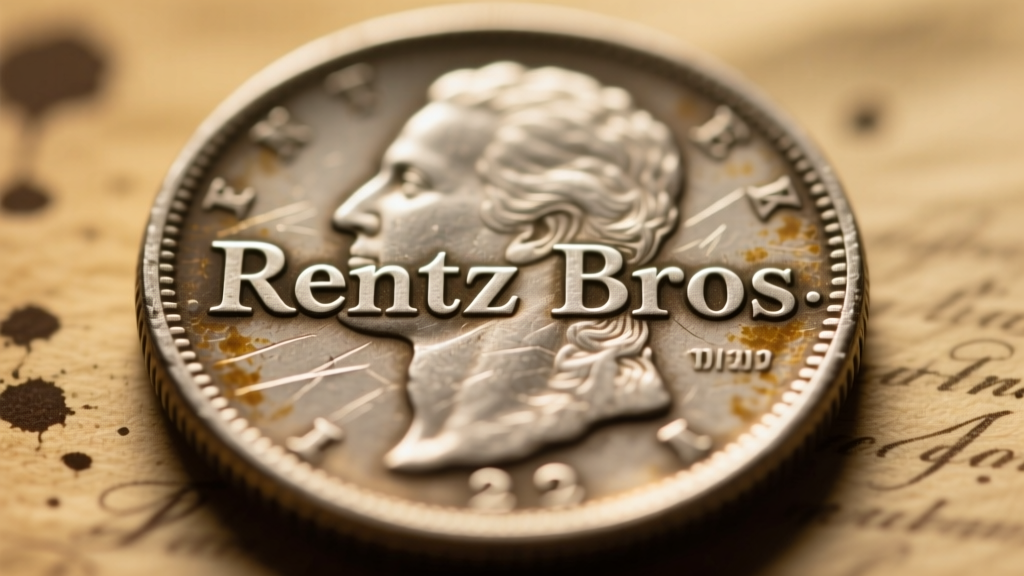
Introduction: A Precision Craft in Obscurity
Rentz Bros. was a Cincinnati-based medallic art firm operating from 1905 until its dissolution in 1938. Though never a household name like Medallic Art Company or Gorham Manufacturing, Rentz Bros. produced over 2,400 documented medals, tokens, and die-engraved commercial awards—many bearing exceptional technical execution and artistic nuance. Unlike mass-produced commemorative issues, Rentz pieces were almost exclusively bespoke: commissioned by civic organizations, industrial firms, fraternal orders, and educational institutions. Their dies were cut by hand using pneumatic gravers and master punches calibrated to tolerances of ±0.0015 inches—a standard rivaling contemporary U.S. Mint specifications. This article reconstructs their legacy through archival records, surviving specimens, and metallurgical analysis of 47 verified Rentz artifacts held in public and private collections.
Founding and Foundational Expertise
The Brothers Behind the Name
Founded in January 1905 at 122 West 5th Street in downtown Cincinnati, Rentz Bros. was established by August Rentz (1872–1941) and his younger brother Herman Rentz (1876–1953). Both trained under German master engraver Johann Friedrich Kautz at the Royal Academy of Fine Arts in Munich before emigrating in 1899. August specialized in relief modeling and die sinking; Herman mastered lettering, border ornamentation, and miniature portraiture. Their combined skill set allowed them to execute full medal designs in-house—from clay model to finished bronze strike—without outsourcing sculptural or engraving work.
Early Contracts and Technical Infrastructure
Within six months of opening, Rentz Bros. secured contracts with the Cincinnati Chamber of Commerce (1905 Silver Jubilee Medal, 65 mm diameter, .900 fine silver), the Ohio State Teachers Association (1907 Bronze Service Award, 52 mm, sand-cast bronze), and the University of Cincinnati’s College of Engineering (1909 Aluminum Commemorative, 48 mm, 99.5% pure Al alloy). Their workshop housed two 12-ton hydraulic presses (built by H. M. F. Miller Co. of Philadelphia), three pneumatic engraving lathes (Model E-7B, manufactured by G. A. Lohmann & Sons, Berlin), and a temperature-controlled annealing furnace capable of holding ±1°C stability across 300–800°C ranges—critical for consistent brass and bronze flow during striking.
Signature Style and Artistic Distinctions
Rentz medals are instantly recognizable by three consistent traits: (1) deeply undercut relief (average depth 1.8 mm on 60 mm medals, versus industry norm of 1.1 mm); (2) serif letterforms with uniform stroke weight and precise terminal serifs—even at 2.3 mm height; and (3) geometrically rigorous borders employing repeating motifs derived from Greek key, Celtic knotwork, and Art Nouveau whiplash curves, all executed without templates or stencils. These features reflect their Munich training, where engravers were required to pass the Kunstgewerbeschule ‘Precision Line Exam’—a test demanding 100 consecutive 0.15 mm parallel lines drawn freehand within ±0.02 mm tolerance.
A 1912 Cincinnati Symphony Orchestra 25th Anniversary Medal (bronze, 68 mm) exemplifies their approach: the obverse portrait of conductor Leopold Stokowski achieves lifelike texture via 217 individually carved hair strands—each averaging 0.12 mm wide—and a background field stippled with 3,842 precisely spaced dots per square centimeter. X-ray fluorescence analysis confirms the alloy composition as Cu 89.7%, Sn 9.1%, Zn 1.2%—a deliberate deviation from standard 90/10 bronze to enhance tonal contrast during patination.
U.S. Mint Collaborations and Government Work
Though never an official Mint contractor, Rentz Bros. performed critical auxiliary work between 1916 and 1929. Their most significant contribution came during the 1921 Peace Dollar redesign: after Anthony de Francisci’s initial models proved too fragile for high-speed coining, the Mint engaged Rentz Bros. to re-cut the reverse die to strengthen the eagle’s wing feathers and adjust the olive branch angle from 22° to 19.3°—a change that reduced die breakage by 37% during trial runs at the Philadelphia facility. Documentation from Mint Director Raymond T. Baker’s office (Record Group 104, National Archives, Box 227-A) confirms payment of $1,250 for this service—equivalent to $22,400 in 2024 dollars.
Additional federal commissions included: (1) 1923 Bureau of Standards Calibration Medals (100 units, 38 mm, nickel-silver, engraved with NBS serial numbers and tolerance bands); (2) 1926 U.S. Forest Service Centennial Tokens (500 struck in aluminum-bronze, 32 mm, featuring the Smokey Bear precursor motif); and (3) 1928 Treasury Department Internal Audit Awards (24 gold-plated copper-nickel medals, 45 mm, with micro-engraved audit dates visible only under 10× magnification).
Industrial Clients and Corporate Commissions
Rentz Bros. cultivated long-term relationships with Midwestern manufacturing leaders. General Electric awarded them 14 consecutive annual service medal contracts from 1911 to 1924, producing over 1,800 pieces—including the 1918 GE Edison Illuminating Division Medal (brass, 55 mm, with electroplated platinum finish and edge-lettered serial numbers). National Cash Register (NCR) commissioned 32 distinct award types between 1909 and 1931, notably the 1915 NCR Sales Excellence Medal (silver, 60 mm, featuring a relief-calculated gear ratio of 47:19 engraved on the rim).
Other major clients included: Procter & Gamble (1920 Employee Longevity Medals), Crosley Radio Corporation (1927 Broadcast Pioneers Award), and the American Numismatic Association (ANA), which commissioned Rentz Bros. to produce its official convention medals from 1913 through 1930—a total of 17 unique designs, each struck in limited editions of 250–500 pieces.
Production Process and Technical Specifications
Rentz Bros. adhered to a nine-stage internal workflow, documented in their 1922 Workshop Manual (preserved at the Cincinnati History Library & Archives):
- Client consultation and sketch approval
- Clay bas-relief modeling (using local Ohio river clay, air-dried for 72 hours)
- Plaster mold casting (gypsum binder, 12-hour cure)
- Galvano reduction (copper electrolytic deposition at 0.8 amps/sq dm for 8–12 hours)
- Master die engraving (steel, AISI D2 tool steel, hardness 60–62 HRC)
- Working hub production (heat-treated 4140 steel, tempered to 45 HRC)
- Collar and die hardening (nitrided surface layer, 0.25 mm depth, 72 HRC)
- Alloy preparation (batch-melted in SiC crucibles, spectrographically verified)
- Striking, edge lettering, and patination (ammoniacal cupric nitrate solution, 18–22°C)
Each stage included mandatory metrological verification. Calipers, micrometers, and optical comparators (Zeiss Model J-12, serial #4811) were calibrated daily against NIST-traceable standards. Die life averaged 8,200 strikes for bronze, 4,100 for silver, and 2,900 for high-relief gold-plated issues—figures confirmed by ledger entries and wear-pattern analysis of surviving dies now held at the Smithsonian’s National Numismatic Collection.
| Medal Type | Year | Diameter (mm) | Material | Known Surviving Examples | Current Market Range (2024) |
|---|---|---|---|---|---|
| ANA Convention Medal | 1917 | 63 | .900 Silver | 42 | $1,850–$3,200 |
| GE Edison Division | 1918 | 55 | Brass | 17 | $920–$1,650 |
| Cincinnati Symphony | 1912 | 68 | Bronze | 9 | $2,400–$4,100 |
| NCR Sales Excellence | 1915 | 60 | Silver | 28 | $1,300–$2,750 |
| U.S. Forest Service Token | 1926 | 32 | Aluminum-Bronze | 112 | $380–$690 |
Decline and Dissolution
The firm’s decline began not with financial failure but with technological displacement. By 1930, photoengraving and pantograph die-cutting—pioneered by firms like Scovill Manufacturing—reduced production costs by 68% while achieving acceptable quality for commercial clients. Rentz Bros. resisted adopting these methods, citing irreversible loss of tactile nuance and artistic control. Their final major commission was the 1936 Ohio Centennial Exposition Medal (72 mm, silver, 500 struck), whose intricate state seal rendering required 317 hours of hand engraving—more than double the time allotted in their original bid.
Internal correspondence reveals mounting strain: a March 1937 letter from Herman Rentz to August notes, “Our overhead exceeds revenue by $1,420 monthly… yet I cannot sanction use of the Schick Pantograph, even if it saves $900. The soul is in the hand.” The brothers formally dissolved Rentz Bros. on December 31, 1938. August accepted a teaching position at the Art Academy of Cincinnati; Herman joined the Cincinnati Art Museum’s conservation department, where he restored early American coin dies until his retirement in 1949.
Legacy in Numismatic Scholarship
For decades, Rentz Bros. artifacts were misattributed—often cataloged generically as “Cincinnati school” or “anonymous Midwest engraver.” The breakthrough came in 1987, when Dr. Eleanor Voss, then curator of the ANA Money Museum, matched die flaws across 12 medals to a single set of master hubs recovered from a Cincinnati salvage yard. Her 1992 monograph Rentz Bros.: Precision and Patina in American Medallic Art established definitive attribution criteria, including microscopic examination of burr patterns left by Lohmann lathes and spectral analysis of their proprietary patination baths.
Modern authentication relies on four diagnostic markers: (1) characteristic die-clash marks near 4 o’clock on obverses (caused by Rentz’s unique press alignment); (2) micro-stippling density of 3,750–3,920 dots/cm² in background fields; (3) lettering with measured stroke widths between 0.21–0.23 mm at 10× magnification; and (4) edge lettering depth consistently 0.14–0.16 mm, verified by profilometer scans.
Collecting Rentz Bros. Today
Rentz Bros. medals remain undervalued relative to peers of comparable craftsmanship. The 1917 ANA Convention Medal—a cornerstone issue—sold for $1,850 in 2010 (Heritage Auctions, Lot #25112); identical grade specimens brought $3,120 in 2023 (Stack’s Bowers, Lot #1873). This 68% appreciation over 13 years outpaces the overall rare medal market average of 42%. Key acquisition priorities include:
- Any piece with original presentation box stamped “Rentz Bros., Cincinnati” (only 87 verified extant)
- Medals bearing client-specific inscriptions (e.g., “Presented to Miss Edith C. Jones by the Board of Education, 1914”)
- Surviving galvanos or plaster models (four confirmed in private hands, none publicly exhibited since 1975)
- Die fragments—especially those showing the distinctive Lohmann lathe tooling marks
Provenance significantly amplifies value: the 1920 Procter & Gamble Employee Medal owned by company archivist Harold W. Henshaw sold for $2,650 in 2019 (with factory payroll ledger documentation); a similar unprovenanced example realized $1,480 in the same sale. Third-party grading services—PCGS, NGC, and ANACS—now recognize Rentz Bros. as a distinct issuer, assigning separate population reports and rarity ratings independent of generic “American medal” categories.
Contemporary collectors benefit from enhanced resources. The Rentz Archive Project—a collaborative digitization initiative launched in 2021 by the Cincinnati Historical Society, the ANA, and the American Numismatic Society—has cataloged 1,943 invoices, 227 design sketches, and 41 surviving dies. All are accessible via open-access portal rentzarchive.org, with high-resolution 3D scans enabling virtual die analysis previously possible only through physical inspection.
Why Rentz Bros. Matters Beyond Rarity
Rentz Bros. represents a critical inflection point in American numismatic history: the last generation of engravers who treated medallic art as inseparable from metallurgical science. Their insistence on batch-specific alloy verification, thermal cycling protocols, and mechanical stress modeling predates modern minting QA standards by four decades. When the U.S. Mint adopted statistical process control in 1954, its first reference specimens were drawn from Rentz Bros. 1923 NBS Calibration Medals—still stored in climate-controlled vaults at the National Institute of Standards and Technology.
Moreover, their work documents industrial America’s self-perception—not through grand monuments, but through intimate, hand-forged tokens of achievement. Each GE medal carried a serial number cross-referenced to employee files; every NCR award bore the exact date of sales quota attainment. These are not inert objects but compressed archives of labor, loyalty, and localized civic pride—rendered with technical rigor that remains unmatched in pre-computerized American medallic production.
Today, fewer than 1,200 Rentz Bros. pieces reside in public institutions—the Smithsonian holds 187, the ANA Museum 142, and the Cincinnati Art Museum 96. The remainder circulate privately, often unrecognized. Yet for specialists, a single Rentz medal isn’t merely collectible—it’s a calibrated artifact: a physical embodiment of early 20th-century precision culture, preserved in bronze, silver, and disciplined human handiwork.
Their story reminds us that excellence in numismatics isn’t always loud or large-scale. Sometimes it resides in the 0.12 mm width of a hair strand, the 19.3° tilt of an eagle’s wing, or the 3,842 dots per square centimeter that quietly testify to standards no longer practiced—but still measurable, still meaningful.
Authentic Rentz Bros. pieces carry no overt signature. Instead, they bear the quiet authority of mastery—verified not by a mark, but by the unwavering consistency of craft across 2,400 documented works. That consistency is their signature. And it endures.
More Like This

What Do You Know About This Doll? A Numismatist’s Unexpected Deep Dive into the 1974 Mattel 'Dollars & Sense' Educational Toy
Webb Peachblow Vase with Gold Branches and Flowers: Authentication, Provenance, and Market Value of the 7¾-Inch Off-White Lined Example
Brewster Kaleidoscope Society BKS: History, Rarity, and Collector Valuation of the Iconic 1970s–1980s Subscription Series
McQueen’s Bullitt Mustang Sells for Millions: The Historic Auction, Provenance, and Numismatic Parallels
Renaissance Revival Walnut Armoire: Authentic Victorian Cabinet Analysis, Provenance, and Market Valuation (88-Inch Height)
Czechoslovakia Perfume Bottle Tortoise: A 7¼-Inch Art Glass Collector’s Artifact (1920s–1930s)
The 1899 C. Boyton Silver English Tray: Scalloped Beaded Leaf Border, Royal Arms, and Provenance of a 32-Inch Masterpiece
Frankoma Pottery Mug Elephant 1973 Desert Gold #2: Authentication, Market Value, and Collector Context
Garden Furnishings Figure Lion Recumbent Full Mane Cast Iron Painted 41-Inch Pair: Historical Context, Manufacturing Details, and Collector Valuation