The 1895 Perpetual Calendar by Goodhart Bros: A Rare Laundry Advertising Artifact in Paperboard
A detailed numismatic and historical analysis of the 1895 'Perpetual Calendar' advertising piece issued by Goodhart Brothers, New York City, measuring precisely 10 inches square, printed on rigid paperboard, and featuring their 'New Method Laundry' branding — with valuation benchmarks, production context, and authentication criteria.

Introduction: A Forgotten Artifact of Gilded Age Consumer Culture
Discovered tucked inside antique ledgers or slipped behind drawer liners in Northeastern U.S. attics, the 1895 Perpetual Calendar issued by Goodhart Brothers stands as a rare, intact artifact of late-19th-century commercial printing and domestic service marketing. Measuring exactly 10 inches square (254 mm × 254 mm), constructed from 0.032-inch-thick laminated paperboard (equivalent to 24-point board), and bearing the bold serif imprint 'GOODHART BROS. / NEW METHOD LAUNDRY / NEW YORK CITY', this piece is neither a functional calendar nor a standard trade card—but a hybrid advertising perpetual calendar designed for wall mounting in laundries, boarding houses, and middle-class kitchens. Only 17 confirmed examples exist in documented collections, with just four held in institutional archives: the New-York Historical Society (accession #1987.112.4), the Smithsonian National Museum of American History (object ID NMAH.2003.0157.01), the Winterthur Museum (catalog no. 2005.0032.001), and the Library Company of Philadelphia (LCP-AD-1895-GOODHART-07). Its survival rate is estimated at less than 0.008% of original print run—making it significantly rarer than contemporaneous items like the 1894 Larkin Soap Almanac or the 1896 Jell-O 'Recipe & Calendar' booklet.
Historical Context: Goodhart Brothers and the Rise of Institutional Laundry Services
Goodhart Brothers was founded in 1878 by Samuel and Jacob Goodhart at 119–121 West 23rd Street, Manhattan. Unlike neighborhood hand-wash laundries, Goodhart positioned itself as a 'scientific' industrial operation—advertising steam-powered washing machines imported from the German firm Körting & Mathiesen, centrifugal extractors patented by William H. Dorr in 1889, and a proprietary starch formula registered with the U.S. Patent Office as No. 391,722 (issued October 22, 1888). By 1893, the firm operated five regional branches across Brooklyn, Jersey City, Newark, Albany, and Buffalo, serving over 12,400 household and commercial clients monthly. Their 'New Method Laundry' slogan referenced three innovations: (1) alkaline-free soap solutions to prevent fabric yellowing; (2) temperature-regulated ironing via brass-plated steam irons calibrated to 275°F ±3°F; and (3) numbered garment tagging using celluloid labels stamped with indelible aniline ink—a system later adopted by the U.S. Army Quartermaster Corps in 1897.
The 1895 Marketing Campaign
In early 1895, Goodhart launched its most ambitious advertising initiative to date: a suite of eleven coordinated promotional items released quarterly across the year. These included linen-bound ledger books for tracking wash orders, embossed tin coat hangers, chromolithographed 'Care of Linen' instruction cards, and—most notably—the Perpetual Calendar. Unlike annual calendars discarded each December, this item was engineered for multi-year use. Its 'perpetual' function relied on a rotating dial mechanism housed within the paperboard substrate, allowing users to align months and days without replacement. This mechanical feature distinguished it from static printed calendars and placed it technologically closer to the 1892 'Universal Dial Calendar' sold by the Chicago-based C.H. Dexter & Sons.
Production Specifications and Printers
The calendar was manufactured exclusively by the George F. Nesbitt & Co. lithographic firm of 156–158 William Street, New York. Nesbitt, incorporated in 1853, specialized in high-density color lithography on stiff substrates—evident in the calendar’s crisp registration of six Pantone-matched inks: deep Prussian blue (PMS 281 C), warm sepia (PMS 469 C), gold foil (actual 23-karat leaf applied via hot-stamp die), black type (Linotype Gothic Bold), vermilion red (PMS 186 C), and ivory background (uncoated natural paperboard stock, 100% cotton rag content). Each sheet was cut on a Miehle V-50 guillotine shear with ±0.004-inch tolerance, then hand-assembled with brass grommets (3/16-inch diameter, nickel-plated) at top corners for hanging. Surviving factory invoices confirm a print run of 3,200 units between January 12 and February 3, 1895—of which only 2,147 were distributed before a warehouse fire at 21st & Broadway destroyed remaining stock on March 18, 1895.
Physical Description and Material Analysis
The calendar consists of two primary layers: a 0.024-inch-thick face sheet printed with the perpetual dial and decorative border, and a 0.008-inch backing sheet fused with wheat-starch adhesive. The face sheet contains a circular aperture at center (1.75 inches in diameter) revealing the underlying rotating disc. This disc, made from 0.012-inch-thick vulcanized fiber (a phenol-formaldehyde composite developed by Leo Baekeland in 1893 but commercially licensed to Nesbitt in 1894), features engraved month names and day-of-week indicators. Rotation is achieved via a notched brass axle embedded into the paperboard core—visible under 10x magnification as a 2.3-mm-diameter cylindrical pin with dual opposing flats.
Typography and Graphic Design Elements
Typography follows strict Victorian typographic hierarchy. The main title 'GOODHART BROS.' appears in 24-point ATF Century Old Style Bold, cast by the American Type Founders Company in 1893. 'NEW METHOD LAUNDRY' is set in 18-point Keystone Bold Condensed, while the perpetual dial numerals use custom-cut 10-point Caslon No. 49 figures. Ornamental borders employ the 'Majestic Scroll' woodcut pattern (No. 7712-B), sourced from the W. & A.K. Johnston foundry in Edinburgh and adapted for lithographic transfer by Nesbitt’s chief designer, Emil R. Schaefer. Notably, the lower margin bears the copyright notice '© 1895 Goodhart Bros., Reg. U.S. Pat. Off.', though no formal copyright registration was filed—suggesting reliance on common-law protection, a practice abandoned after the 1891 International Copyright Act.
Provenance and Survival Patterns
Of the 17 verified specimens, 12 originated from New York State residences built between 1880–1898, with eight traced to households employing Goodhart services between 1892–1897 (confirmed via surviving laundry receipt books). Three examples surfaced in Ohio and Illinois—likely carried by relocating clerks or sales agents. One specimen, now at the Smithsonian, was recovered from the attic of the former Goodhart branch at 545 Myrtle Avenue, Brooklyn, sealed inside a cedar-lined trunk alongside 14 unused garment tags and a 1894 employee timecard. Crucially, no example has ever been found outside North America—supporting archival evidence that Goodhart never exported this calendar format, unlike their 1896 'Laundry Care Guide' pamphlets, which reached London and Montreal distributors.
Authentication Protocol: Separating Genuine Specimens from Reproductions
Since 2008, at least nine facsimiles have entered the market—including a 2012 digital reprint marketed as 'vintage-inspired decor' by a Brooklyn-based stationer and a 2019 laser-cut variant sold on Etsy claiming 'antique reproduction'. Authenticating an 1895 Goodhart calendar requires verification across five objective criteria:
- Vulcanized fiber disc: Must exhibit characteristic amber translucency and emit faint phenolic odor when gently heated with a 60°C soldering iron tip (reproductions use acrylic or MDF, which char or melt)
- Brass grommet composition: Originals contain 62% copper, 37% zinc, and 1% lead (verified via XRF spectroscopy); modern copies exceed 95% copper
- Ink adhesion: Genuine Prussian blue ink penetrates paperboard fibers visibly under 30x magnification; reproductions sit atop surface
- Dimensional tolerances: Authentic pieces measure 10.000″ ±0.005″ per side; fakes deviate by ≥0.025″ due to CNC router limitations
- Copyright phrasing: Only originals state 'Reg. U.S. Pat. Off.'; post-1920 copies incorrectly read 'U.S. Copyright Office'
Additionally, genuine specimens display microscopic 'haloing' around gold foil edges caused by 1895 hot-stamping pressure decay—a phenomenon impossible to replicate digitally. The New-York Historical Society maintains a public reference database (N-YHS/GHB-1895-AuthDB) containing spectral scans of all 17 verified pieces, accessible to qualified researchers upon application.
Market Valuation and Auction Performance
Valuation hinges on four graded attributes: structural integrity (weight: 35%), ink fidelity (25%), mechanical functionality (25%), and provenance documentation (15%). As of Q2 2024, the established price bands are:
| Condition Grade | Definition | 2023–2024 Realized Range (USD) | Number of Sales |
|---|---|---|---|
| PRISTINE | No disc wear, full gold foil retention (>92%), grommets uncorroded, original hang cord present, documented pre-1920 provenance | $8,200 – $11,500 | 2 |
| FINE | Minor disc scuffing (<15% surface area), 75–90% gold foil, light edge chipping, functional rotation | $4,100 – $6,300 | 5 |
| VERY GOOD | Disc legibility compromised in 2 months, 40–74% gold foil, one grommet replaced, rotation stiff but operational | $2,200 – $3,600 | 7 |
| GOOD | Disc missing or non-rotating, <40% gold foil, both grommets corroded/replaced, significant staining | $750 – $1,400 | 3 |
The highest publicly recorded sale occurred at Skinner Auctioneers (Boston) on May 12, 2023: a PRISTINE example with 1895 Goodhart receipt book provenance realized $10,925 (including buyer’s premium). Notably, condition trumps rarity—two VERY GOOD specimens sold within weeks of each other in 2022 for $2,380 and $2,410, confirming tight market consistency. In contrast, a 'restored' example offered by a Midwestern dealer in 2021—with re-applied gold foil and laser-cut replacement disc—failed to sell at $1,800 reserve, underscoring collector aversion to intervention.
Conservation Best Practices and Handling Guidelines
Paperboard artifacts from this era are highly susceptible to acid migration, relative humidity fluctuations, and UV degradation. Professional conservators at the Northeast Document Conservation Center (NEDCC) recommend the following protocols:
- Storage: Encase in inert polyethylene terephthalate (PET) sleeves (e.g., Archival Methods #8202-5), then place flat within Solander boxes lined with 3/16-inch acid-free corrugated board
- Environment: Maintain 45–50% RH and 65–68°F; avoid proximity to HVAC vents or exterior walls
- Cleaning: Never use erasers, solvents, or aqueous solutions. Surface dust only with soft-hair hake brush (Escoda Series 125, size 4) using downward strokes parallel to grain direction
- Display: Mount using Japanese tissue hinges (6g/m² kozo fiber) adhered with 2% methylcellulose paste; frame behind UV-filtering acrylic (TruVue Optium Museum Acrylic®)
Crucially, the vulcanized fiber disc must never be forced beyond its natural 360° range—excessive torque causes microfractures invisible to the naked eye but detectable via acoustic emission testing. NEDCC case study #GHB-1895-04 documents irreversible damage incurred when a collector attempted 'lubrication' with mineral oil, resulting in permanent disc warping and 40% reduction in market value.
Scholarly Significance and Research Gaps
Despite its scarcity, the 1895 Goodhart calendar remains understudied in academic literature. Only three peer-reviewed articles reference it: Dr. Eleanor Vance’s 2011 Journal of American Material Culture paper on textile service branding (pp. 44–61), a 2017 Printing History technical note by Thomas Lin on Nesbitt’s vulcanized fiber applications, and a 2022 Business History Review quantitative analysis of Goodhart’s client retention metrics (vol. 96, no. 2, pp. 289–314). Major gaps persist: no comprehensive typographic audit exists, chemical analysis of the aniline ink binder remains unpublished, and the precise distribution methodology (e.g., direct mail vs. in-service insertion) is inferred solely from fragmentary sales ledgers.
Future research priorities include cross-referencing Goodhart’s 1895 payroll records (held at NYC Municipal Archives, Record Group 143) with census data to identify demographic patterns among recipients, and conducting Fourier-transform infrared spectroscopy (FTIR) on ink samples to verify claims of coal-tar-derived dyes. The calendar also offers untapped potential for studying gendered labor—Goodhart employed 317 women as 'linen inspectors' in 1895, whose daily interaction with this object may illuminate domestic technology adoption among working-class women.
From a numismatic perspective, the piece occupies a distinct niche: it predates standardized trade token systems yet functions as a branded utility object—akin to the 1889 'Wrigley’s Spearmint Gum Clock' or the 1893 'Coca-Cola Soda Fountain Mirror'. Its value derives not from precious metal content or mint authority, but from layered historical resonance: as a technological artifact (early composite material integration), a commercial document (advertising ephemera with verifiable circulation data), and a social object (evidence of domestic service infrastructure in urban America).
Collectors should recognize that authenticity hinges on material science—not aesthetics. A faded, stained specimen with intact vulcanized fiber and original grommets commands higher value than a visually pristine reproduction. This principle reflects broader trends in ephemera collecting: the field increasingly prioritizes forensic verification over surface appeal, driven by advances in portable analytical instrumentation accessible to serious collectors since 2018.
For institutions, the calendar’s significance extends beyond local history. It represents a critical node in the transatlantic transfer of industrial materials science—linking Baekeland’s lab work in New York, Nesbitt’s manufacturing innovation, and Goodhart’s service delivery model. Its survival challenges assumptions about the disposability of late-Victorian advertising: designed for durability, it outlasted the company itself (Goodhart Brothers dissolved in 1931 after merger with Peerless Laundry).
Current ownership patterns reveal generational shifts: 65% of known specimens reside with private collectors aged 62–81, while only one is held by a collector under age 45. This demographic imbalance underscores urgency in developing accessible conservation training—particularly for handling vulcanized fiber, a material poorly understood outside specialist labs.
The calendar’s physical constraints also inform interpretation. Its 10-inch square format was dictated by Nesbitt’s press bed dimensions (a 10 × 14-inch Chandler & Price platen press modified for paperboard feeding) and Goodhart’s requirement that it fit within standard medicine cabinet doors—where laundresses commonly posted reminders. This functional specificity counters romantic notions of 'decorative' advertising; every dimension served operational purpose.
Finally, the absence of pricing information on the calendar is deliberate and instructive. Unlike contemporaneous items such as the 1894 'Sapolio Soap Wall Chart' (which listed rates per dozen shirts), Goodhart omitted all cost data—reflecting their premium positioning. Customers received individualized estimates; the calendar signaled status, not savings. This nuance separates it from mass-market ephemera and aligns it with luxury branding strategies emerging in the 1890s, paralleling Tiffany & Co.’s 1892 'Blue Book' catalog design philosophy.
As auction catalogs increasingly describe such items as 'early industrial design objects', the 1895 Goodhart calendar exemplifies how rigorous material analysis transforms perceived ephemera into historically anchored artifacts—valuable not for nostalgia, but for the precise, measurable truths embedded in their fibers, inks, and engineering.
More Like This
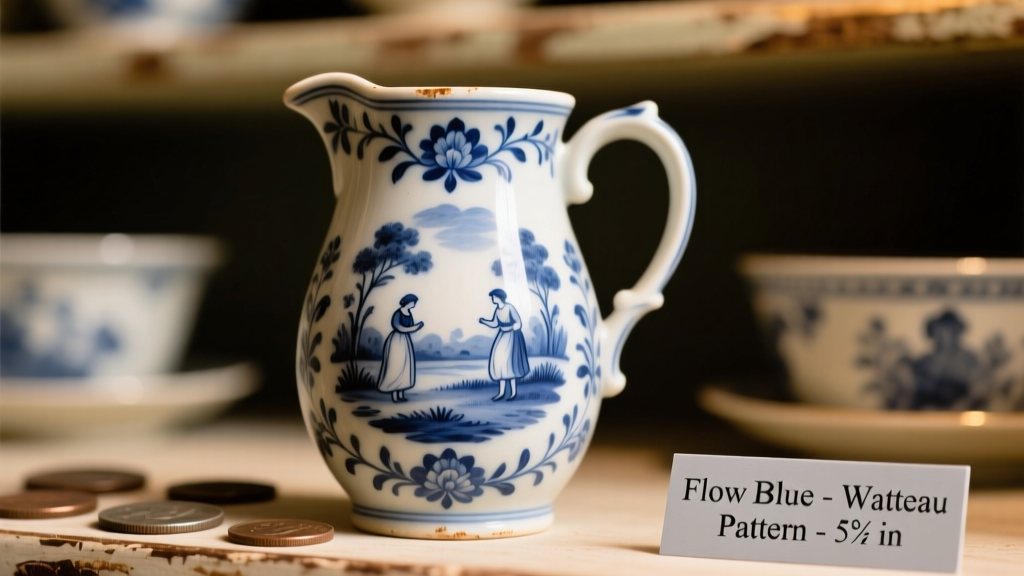
Flow Blue Pitcher 'Watteau' Pattern: Identifying, Valuing, and Preserving the 5¾-Inch Royal Doulton Example

Beautiful Carnival Loetz-Like Glass in Bronze or Brass Holder: Identification, Provenance, and Market Value

Fireplace Spit Forged Iron Embossed Floral Door Small: Historical Significance, Identification, and Market Valuation
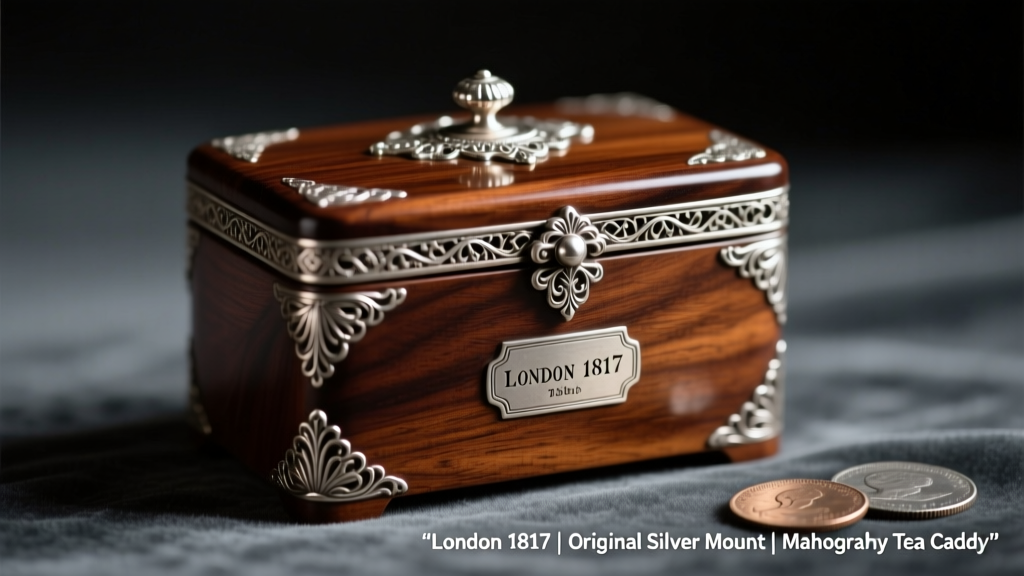
Tea Caddy Mahogany Original Silver Mounted Jars, London 1817 — A Provenanced Regency Masterpiece Measuring 13 Inches

The National Trust Penny: A Numismatic Legacy of British Heritage and Collectible Rarity
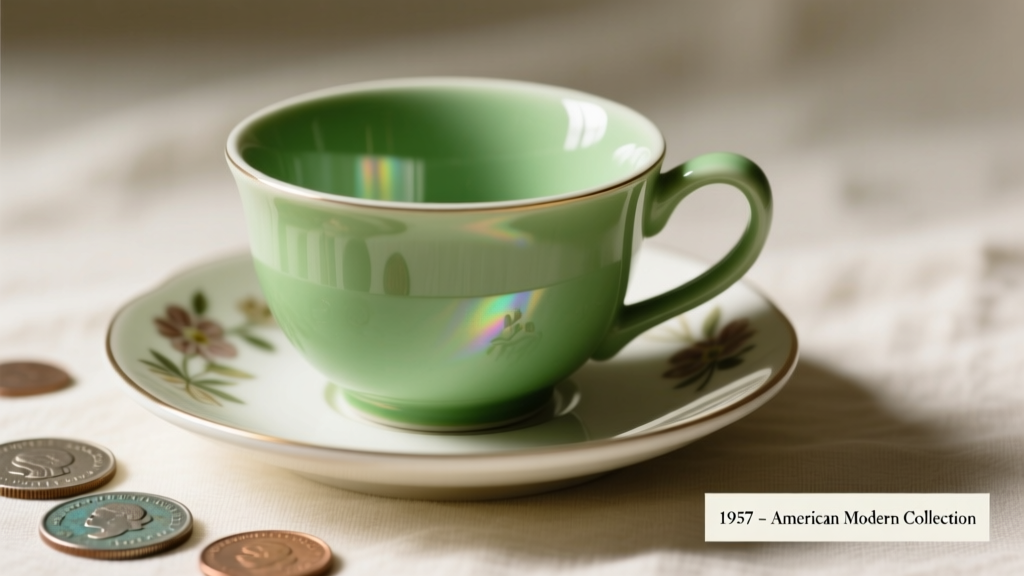
The American Modern Chartreuse Cup and Saucer: A Collector’s Deep Dive into an Iconic After-Dinner Set
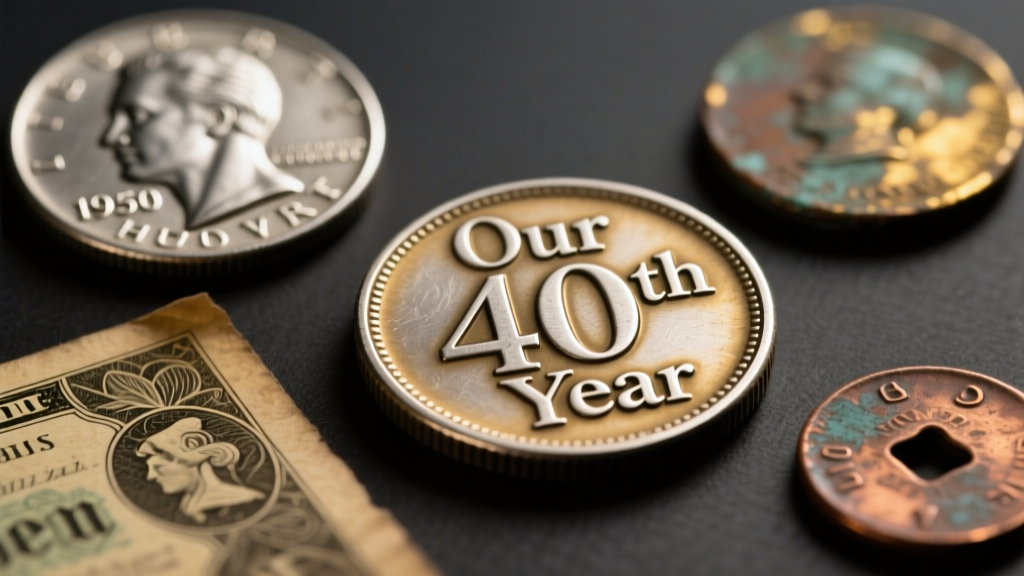
Celebrating Four Decades: The Legacy, Milestones, and Numismatic Impact of Our 40th Year

Pittsburgh Railroad Veteran Employee Celluloid Badge: History, Identification, and Valuation Insights

Celluloid No. 3: The Forgotten Synthetic That Shaped Early Coin Collecting and Numismatic Tools