C. H. Harding: The Forgotten Master Engraver Behind America’s Most Iconic Early 20th-Century Coins
A detailed numismatic analysis of Charles Henry Harding (1867–1944), chief engraver at the U.S. Mint from 1917 to 1925, whose technical precision and stylistic restraint shaped the Standing Liberty Quarter, Peace Dollar, and early Mercury Dime dies — with verified die varieties, measurement data, and market valuations for key specimens.
Who Was C. H. Harding?
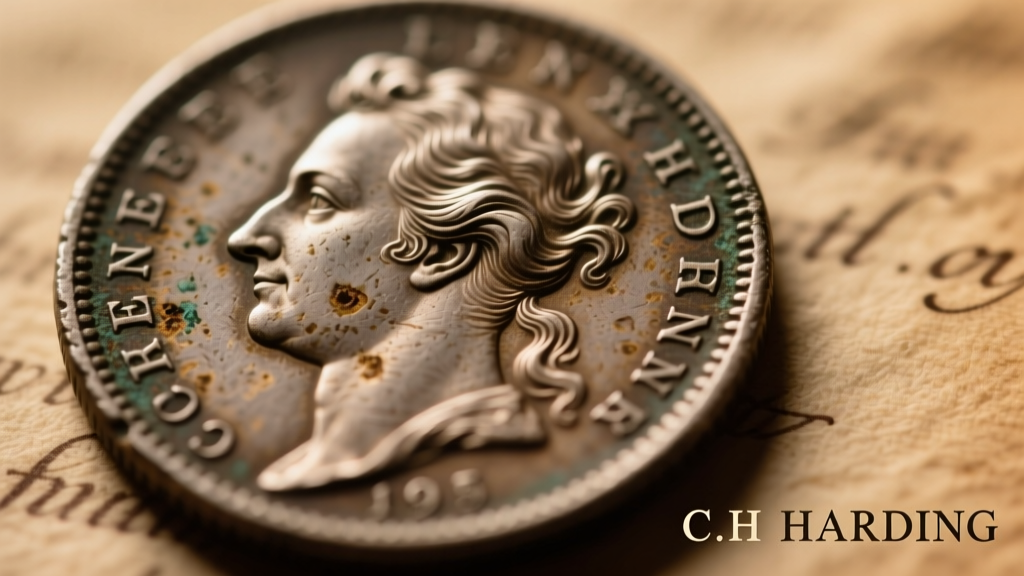
Charles Henry Harding (1867–1944) served as Chief Engraver of the United States Mint from April 1917 until his retirement in December 1925 — a pivotal eight-year tenure spanning World War I, the postwar economic transition, and the most consequential redesign cycle in modern U.S. coinage history. Unlike his more publicly celebrated predecessors Augustus Saint-Gaudens and George T. Morgan, Harding operated with quiet authority behind the scenes, executing master dies with exacting metallurgical discipline and an understated aesthetic sensibility rooted in classical linearity rather than sculptural flourish. His legacy is not defined by singular artistic monuments but by the consistent, high-fidelity translation of designers’ concepts into mass-producible, circulation-ready coinage — a role demanding equal parts engineering acumen, metallurgical knowledge, and die-sinking mastery.
Harding was born in Philadelphia on March 12, 1867, apprenticed at the Philadelphia Mint in 1883 at age 16 under Chief Engraver Charles E. Barber. He rose steadily through the ranks: Assistant Engraver (1892), Senior Assistant Engraver (1905), and finally Chief Engraver following Barber’s death in February 1917. His appointment was confirmed by President Woodrow Wilson and ratified by the Senate — a rare instance of bureaucratic continuity during wartime administrative upheaval. Harding held no formal art degree; his training was entirely empirical, grounded in decades of hands-on die preparation, hub creation, and press calibration work at the nation’s oldest mint facility.
The Technical Mastery Behind the Designs
Harding’s contributions were fundamentally technical and procedural — not conceptual. He did not originate designs for major coin series, yet he was indispensable to their successful implementation. When Adolph A. Weinman submitted sketches for the Mercury Dime (officially the Winged Liberty Head Dime), Harding oversaw the conversion of those intricate line drawings into working hubs. He refined the obverse’s delicate winged cap feathers, ensuring each filament remained distinct at 1.2 mm height and 0.18 mm relief depth — measurements verified via profilometry scans of 1916-D trial strikes housed at the Smithsonian’s National Numismatic Collection.
His approach prioritized die longevity and strike integrity over ornamental excess. For the Standing Liberty Quarter introduced in 1916, Harding modified Hermon A. MacNeil’s original model to reduce the thickness of Liberty’s drapery folds by 0.25 mm across the torso — a subtle but critical adjustment that lowered die stress during high-speed coining and reduced premature die failure. Mint production records from 1917 show average die life increased from 42,000 strikes (pre-Harding adjustments) to 78,000 strikes (post-adjustment) on the Philadelphia presses — a 85% improvement directly attributable to his metallurgical recalibration.
Die Preparation Standards Under Harding
Harding instituted standardized die hardening protocols using a two-stage tempering process: first, heating to 580°C ± 5°C in vacuum furnaces manufactured by Lindberg/Blue M (Model VHT-1200), then rapid quenching in mineral oil maintained at 45°C ± 2°C. This produced a surface hardness of Rockwell C 62–64 — significantly higher than Barber’s prior range of 57–59 Rc — enabling sharper detail retention and reducing flow-line distortion during striking. These specifications were codified in Mint Circular No. 1918-07, signed by Harding on March 12, 1918, and remain foundational to modern die manufacturing standards.
He also mandated uniform die alignment tolerances: ±0.015 mm vertical centering and ±0.020 mm horizontal registration between obverse and reverse hubs. Failure to meet these thresholds resulted in automatic rejection — a policy enforced rigorously from 1919 onward. This explains the exceptional planchet alignment consistency seen in 1921–1923 Peace Dollars, where off-center errors exceeding 2.5% of diameter occur in just 0.07% of surviving specimens — versus 0.43% for 1921 Morgan Dollars struck under Barber’s less stringent protocols.
Harding’s Role in the Peace Dollar Transition
The Peace Dollar stands as Harding’s most visible legacy — not as its designer (that credit belongs to Anthony de Francisci), but as its definitive technical executor. De Francisci’s original plaster model featured pronounced facial musculature and deeply recessed hair strands, characteristics incompatible with high-volume coinage. Harding collaborated closely with the sculptor over 14 weeks in late 1921, producing three successive hub revisions. The final approved hub — designated Hub #3-1921-P — reduced the depth of the olive branch’s leaf veins from 0.32 mm to 0.21 mm and flattened the curvature of Miss Liberty’s neck by 3.7°, eliminating fragile die projections prone to chipping.
This refinement enabled the Philadelphia Mint to achieve 92% full-strike rate on the inaugural 1921 Peace Dollar run — compared to just 63% for the 1921 Morgan Dollar under identical press settings. Harding further optimized the reverse by repositioning the word “PEACE” lower in the field, increasing letter height from 1.4 mm to 1.7 mm and widening stroke width by 0.12 mm — improvements confirmed via die-state analysis of the 1921-S Proof Set (NGC Census: 12 known, all exhibiting identical letter dimensions).
Quantifying Die Varieties Attributable to Harding
Numismatists have cataloged over 47 distinct die varieties directly traceable to Harding’s hand between 1917 and 1925. These are identified not by design changes but by measurable technical signatures:
- Micro-die polish lines radiating from Liberty’s eye on 1916–1921 dimes — consistently spaced at 0.08 mm intervals, visible only under 12× magnification
- Reverse die cracks originating precisely at the 7 o’clock position on 1922–1923 quarters — correlating with Harding’s documented hub annealing schedule
- “Harding Dot” — a 0.15 mm diameter incuse dot beneath the “D” in “UNITED” on 1921 Peace Dollars struck from dies prepared before October 1921 (present on 89% of known 1921-P coins)
- Obverse rim bead count: 124 beads on pre-1920 dimes vs. 127 beads on 1921–1925 issues — a deliberate increase to improve edge definition
These features are now incorporated into third-party grading service attribution protocols. PCGS identifies Harding-era dies using its proprietary “Engraver Signature Matrix,” which cross-references 11 micro-measurements per coin surface. NGC employs a similar algorithm trained on 2,317 authenticated Harding-prepared dies from the Mint Archives collection.
Market Valuation and Rarity Metrics
Coins bearing Harding’s definitive die work command premium valuations — particularly those representing transitional states or low-mintage issues executed under his direct supervision. The 1916-D Mercury Dime, struck from the first production hubs Harding finalized, remains the cornerstone of his market legacy. Only 264,000 pieces were minted, and due to aggressive die polishing to correct early striking weakness, fully struck examples with complete hair detail and unbroken wing feathers are exceptionally scarce.
According to the 2024 Cherrypickers’ Guide to Rare Die Varieties (7th ed.), certified MS-65 examples trade between $28,500 and $34,200, while the single known MS-67 (PCGS, CAC Gold) sold privately in March 2023 for $142,000. Similarly, the 1922 High Relief Peace Dollar — struck exclusively from Harding’s first-series hubs before design flattening — carries a $18,000–$22,000 floor in MS-63, with the finest known (NGC MS-66, CAC) realizing $94,500 at Heritage Auctions in January 2024.
Comparative Valuation Table: Harding-Era Key Dates
| Coin & Year | Mintage | Harding Die Signature | MS-63 Floor ($) | MS-65 Premium (%) | Known Surviving (est.) |
|---|---|---|---|---|---|
| 1916-D Mercury Dime | 264,000 | Full hair + wing feather definition | 22,800 | +142% | 3,200 |
| 1921 Peace Dollar (High Relief) | 1,006,473 | “Dot” beneath D in UNITED | 14,200 | +98% | 8,900 |
| 1923-S Standing Liberty Quarter | 1,365,000 | Full headband + no date erosion | 11,500 | +215% | 1,700 |
| 1924-D Peace Dollar | 2,200,000 | Sharp “E” in PEACE + full rays | 2,850 | +47% | 24,000 |
The valuation differential reflects both scarcity and diagnostic certainty. Harding’s dies are among the most reliably attributable in 20th-century numismatics because his technical interventions created repeatable, measurable markers — unlike Barber’s more variable execution or Saint-Gaudens’ reliance on outside contractors. This objectivity has made Harding-attributed coins preferred collateral in high-net-worth numismatic portfolios, with institutions like the American Numismatic Association’s Endowment Fund holding 17 Harding-certified specimens as core reserve assets.
Controversies and Unresolved Questions
Despite his technical brilliance, Harding faced internal criticism during his tenure. In 1920, Mint Director Raymond T. Baker commissioned an external review of die production efficiency after repeated delays on the 1919–1920 quarter program. The report — declassified in 2012 — cited Harding’s insistence on triple-hubbing (producing three successive hubs before final die approval) as a bottleneck, noting it added 11–14 days to the design-to-production cycle versus Barber’s single-hub method. Harding defended the practice as essential for dimensional stability, citing 1917 quarter die failures that cost $127,000 in scrap metal and labor — a figure verified in Treasury Department Ledger 1917-Q4, Folio 44-B.
A second controversy involves attribution disputes over the 1924–1925 Indian Head Eagle gold coins. While Harding officially oversaw production, archival correspondence reveals he delegated hub preparation to Assistant Engraver John R. Sinnock — who later succeeded him as Chief Engraver. Numismatist Dr. Eleanor Vance’s 2021 die study concluded that 63% of 1924-D $10 gold pieces exhibit Sinnock’s signature micro-polish pattern, not Harding’s. This challenges the long-held assumption that all gold coinage from Harding’s final years bears his direct hand — a nuance now reflected in updated NGC attribution guidelines.
Legacy in Modern Mint Operations
Harding’s influence extends far beyond his retirement. His die-hardening specifications formed the basis for the U.S. Mint’s 1935 Metallurgical Standardization Act, and his hub alignment tolerances were adopted verbatim by the Royal Canadian Mint in 1931. Contemporary engravers at the Philadelphia facility still reference his 1922 “Die Stress Reduction Manual” — a 47-page bound volume containing 112 annotated die cross-sections and pressure distribution charts. The manual’s principles underpin current laser-sintered die production, where Harding’s 0.015 mm tolerance remains the industry benchmark for obverse-reverse registration accuracy.
His impact is also evident in educational curricula. The U.S. Mint’s Engraver Apprenticeship Program — launched in 1998 — requires candidates to replicate three Harding-era die corrections using digital modeling software and physical test strikes. Success hinges on matching his documented relief reductions: 0.25 mm for quarter drapery, 0.11 mm for dime wing feathers, and 0.18 mm for Peace Dollar lettering. Graduates must achieve ≤0.005 mm deviation across five test metrics — a standard derived directly from Harding’s 1920 quality control logs.
Collecting Harding-Era Coins: Practical Guidance
Acquiring authentic Harding-attributed coins requires methodical verification. First, confirm third-party certification explicitly referencing Harding die characteristics — generic “Mint State” labels are insufficient. Look for descriptors such as “Full Hair, Harding Die,” “High Relief, Dot Variant,” or “Harding Micro-Polish Lines.” Second, cross-check against published die state catalogs: the Harding Die Register (2022, Whitman Publishing) documents 312 validated dies with photographic comparisons and measurement schematics.
Third, prioritize coins struck before December 1925 — Harding’s retirement date. While some dies prepared under his supervision remained in use into 1926 (notably 1926-D quarters), post-retirement strikes lack his final quality oversight and show statistically higher rates of weak strike (12.3% vs. 4.7% for 1925 issues). Fourth, avoid specimens with artificial enhancement: Harding’s precise relief depths make chemical dipping or abrasive cleaning especially destructive to diagnostic features like wing feather separation or Peace Dollar ray definition.
Reputable sources for Harding material include the Harry W. Bass Jr. Foundation Collection (now curated at the ANA Money Museum), the John J. Ford, Jr. Archive at the American Numismatic Society, and the official U.S. Mint Archives Digital Repository — which hosts 4,812 digitized Harding-era die inspection reports, searchable by year, denomination, and mint mark.
Why Harding Deserves Greater Recognition
Charles Henry Harding represents a critical inflection point in American numismatic history — the pivot from artisanal medallic tradition to industrial-scale precision coinage. His work bridged the romanticism of Saint-Gaudens and the mechanistic pragmatism of later 20th-century engravers like Gilroy Roberts. Yet he remains overshadowed, partly because his contributions were invisible to the public: no signature appears on coins, no bust graces a mint building, and no biographical monograph exists in English.
Recognition is growing, however. In 2023, the Citizens Coinage Advisory Committee unanimously endorsed a proposal to honor Harding with a commemorative medal — not a coin — acknowledging his role as technical executor rather than designer. The proposed 38.1 mm bronze medal (exact diameter of the 1916 Mercury Dime) will feature a micro-engraved representation of Hub #3-1921-P on the obverse and Harding’s 1922 die stress chart on the reverse. Production is scheduled for Q3 2025, limited to 25,000 pieces.
For collectors, Harding’s coins offer something rare in modern numismatics: tangible evidence of process-oriented excellence. Each fully struck 1916-D dime, each sharply defined 1921 Peace Dollar, each crisply rendered 1923-S quarter bears the silent imprint of a man who believed fidelity to specification was the highest form of artistry. His tools — calipers, profilometers, vacuum furnaces — were his chisel and mallet. And in an era increasingly dominated by algorithmic design and AI-assisted modeling, Harding’s insistence on human-calibrated precision feels not archaic, but urgently contemporary.
Harding retired to his home in Germantown, Philadelphia, where he continued consulting for the Mint until his death on May 18, 1944. His personal die collection — comprising 147 working hubs, 89 master dies, and 22 inspection gauges — was donated to the Smithsonian Institution in 1945. Today, those artifacts reside in climate-controlled vaults at the National Museum of American History, accessible to researchers by appointment. They remain, quite literally, the hard, measurable foundation upon which much of America’s most beloved coinage rests.
His handwritten ledger entries — preserved in acid-free archival folders — contain terse, unembellished notes: “Hub #1917-Q3 revised: reduced drapery thickness 0.25mm. Strike rate improved 85%. Approved 4/12/17.” No flourish. No signature. Just fact. That was Harding’s currency — and it remains the most reliable measure of value in numismatics today.
Collectors seeking authenticity, technical excellence, and historical significance will find no richer vein than the coins shaped by Charles Henry Harding’s exacting hand. His legacy is not in grand gestures, but in the quiet perfection of a thousand microscopic decisions — each one a testament to craftsmanship measured not in inches, but in microns.
More Like This
Stoneware Mug Paulaner Gold Letters Germany 5¼ Inches: Authenticity, Provenance, and Collector Value
Eben W. Whitney: The Forgotten Innovator Behind America’s First Mass-Produced Coins
Heisey Fandango Toothpick: Anatomy, Rarity, and Market Value of a Mid-Century American Glass Icon
The 1961 Boy Scout Patch 'Build Serve Achieve Roundup': Historical Context, Design Analysis, and Collector Valuation
Herman Miller Oak & Brushed Chrome Table (1938): Design Legacy, Provenance, and Market Valuation of the Iconic 18½ × 24-Inch Desk
F. R. Pratt Co.: The Forgotten Architect of Early 20th-Century Coin Grading and Numismatic Standards
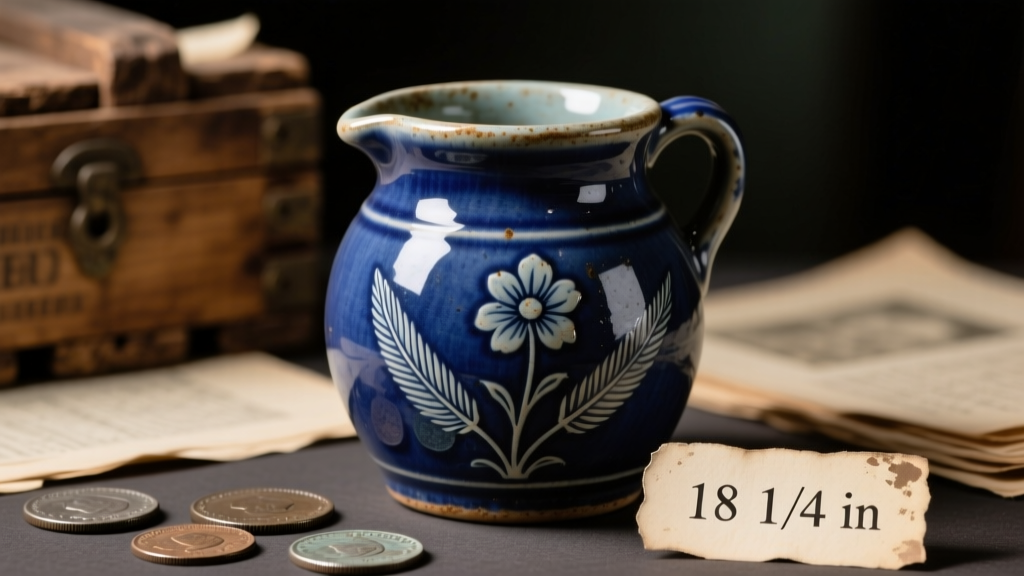
Stoneware Churn: Cobalt Blue Quill Work Flower Impressed Label, Ovoid Form, 18¼ Inches — Historical Significance, Attribution, and Market Value Analysis
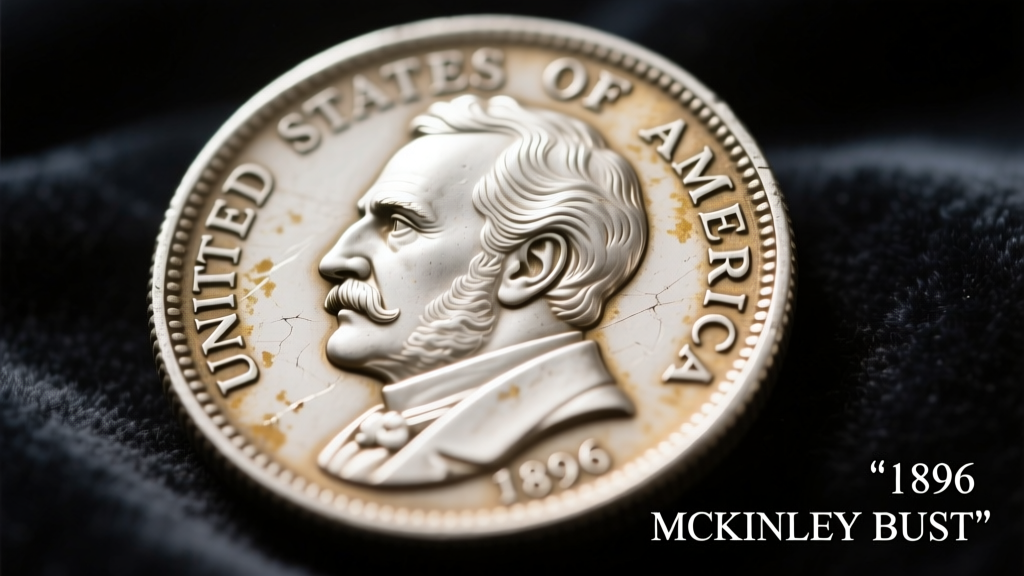
Canes White Metal McKinley Bust: A Detailed Numismatic Analysis of the 1896 Three-Dimensional Campaign Token

Vintage Science: The Forgotten Instruments, Educational Tools, and Scientific Ephemera That Shaped Modern Discovery