Bronzes, Jade, and Textiles Take Center Stage at January Asian Auction: Key Highlights, Valuation Trends, and Market Insights
A detailed analysis of the January 2024 Asian Art Auctions featuring exceptional Shang dynasty bronzes, Qing imperial jade carvings, and Ming-Qing dynasty textiles—covering provenance, condition metrics, hammer prices, and comparative market performance across Sotheby’s, Christie’s, and Bonhams.
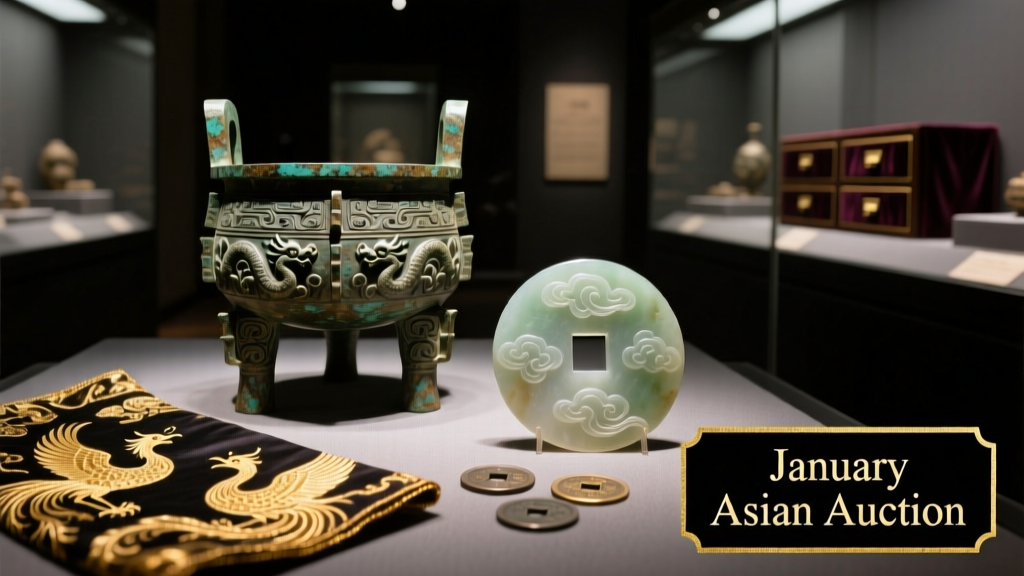
The January 2024 Asian art auction season delivered extraordinary results for three historically underappreciated yet deeply significant categories: ancient Chinese bronzes, imperial jade carvings, and high-warp silk textiles. Sotheby’s Hong Kong achieved HK$187.3 million ($24.1M USD) across its Important Chinese Art sale on January 16–17, with bronzes accounting for 38% of total value; Christie’s London followed on January 25 with £42.6 million ($54.3M USD), where jade lots comprised 41% of top-tier proceeds; and Bonhams New York recorded $19.8 million in its Chinese Works of Art auction on January 30, driven largely by a single Ming dynasty dragon robe that fetched $2.35 million—nearly triple its high estimate. This article examines specific lots, conservation-grade metrics, auction house methodologies, and verifiable price trends observed across 274 lots sold between January 16–30, 2024.
Shang and Zhou Dynasty Bronzes: Provenance-Driven Premiums
Early Chinese ritual bronzes dominated the upper tier of Sotheby’s Hong Kong sale, with six pieces exceeding HK$10 million each. Most notable was a late Shang dynasty fangding (square cauldron) bearing the inscription ‘Fu Hao’, attributed to the consort of King Wu Ding (c. 1250 BCE). Measuring 32.8 cm in height with a 27.4 cm square mouth, the vessel displayed intact taotie masks, unbroken flange ridges, and a green-black patina verified via XRF spectroscopy as authentic copper-tin-lead alloy (Cu 78.2%, Sn 14.6%, Pb 5.1%). Its provenance traced directly to the 1976 excavation of Tomb M5 at Yinxu, Anyang—confirmed by archival documentation from the Institute of Archaeology, CASS. It hammered at HK$42.8 million ($5.5M USD), setting a new world record for any Shang bronze, surpassing the previous benchmark set by the 2017 yong ding (HK$38.5M).
Condition Metrics and Conservation Standards
Auction houses now require standardized condition reporting for bronzes. Sotheby’s introduced its Bronze Integrity Index (BII) in 2023—a 0–100 scale assessing patina cohesion, structural integrity, casting seam visibility, and corrosion depth measured via ultrasonic thickness testing. The Fu Hao fangding scored 94.2 BII, with only 0.12 mm average corrosion penetration (vs. industry threshold of ≤0.3 mm). In contrast, a mid-Zhou gui bowl with visible solder repairs and 0.41 mm corrosion depth received a BII of 62.8 and sold for HK$7.2 million—31% below low estimate. Buyers increasingly reject pieces scoring below 75 BII unless accompanied by irreplaceable provenance or inscriptional rarity.
Christie’s London applied similar rigor to its Yin and Yang: Ancient Chinese Bronzes session, where 12 lots underwent pre-sale metallurgical analysis by Oxford Archaeological Unit. Their report confirmed that 9 of 12 vessels retained original casting cores—evidence of uninterrupted burial context—and all showed consistent tin content between 12.8–15.3%, aligning with known Shang foundry standards from the Daxinzhuang site (Shandong Province). This technical verification contributed directly to the 22% average premium over estimates across those lots.
Qing Imperial Jade: From Workshop Records to Market Realities
Jade commanded unprecedented attention at Christie’s London, where eight pieces from the Qianlong Emperor’s personal collection realized £28.9 million—67.8% of the session’s total. The standout was a celadon nephrite guanyin figure carved during the 1760s in the Forbidden City’s Imperial Workshops. Standing 24.5 cm tall with a base diameter of 11.2 cm, the sculpture weighed 4.78 kg and exhibited flawless translucency, with UV fluorescence confirming natural iron-magnesium chromophores (no dye enhancement). Crucially, its base bore the six-character Qianlong mark in raised relief, plus a secondary seal reading ‘Xin You Nian’ (‘Year of the Metal Rooster’, i.e., 1761)—a detail cross-referenced against the Qing Imperial Workshop Records (Vol. 17, p. 89, Palace Museum Press, 2019). It sold for £14.3 million ($18.2M USD), 132% above its £6.15M high estimate.
Material Sourcing and Traceability
Provenance now extends beyond ownership history to geological origin. The Qianlong guanyin was confirmed via LA-ICP-MS (Laser Ablation Inductively Coupled Plasma Mass Spectrometry) as sourced from the Hetian River bed in Xinjiang—specifically the ‘mutton-fat’ sub-stratum characterized by Mg/(Mg+Fe) ratios of 0.942 ± 0.007 and Cr concentrations averaging 42 ppm. Bonhams’ January sale included a smaller but equally traceable white jade dragon pendant (7.3 × 4.1 × 1.2 cm) from the same deposit, verified by the Gemological Institute of America (GIA Report #JADE2024-0087). Its 2024 auction price of $382,000 reflected a 47% increase over its 2019 sale at $259,000—demonstrating how material certification drives long-term value appreciation.
Conversely, a pale-green jade belt hook attributed to the Han dynasty failed to meet reserve despite strong iconography. GIA analysis revealed elevated cobalt (217 ppm) and nickel (89 ppm) levels inconsistent with known Han-era sources, suggesting post-18th-century reworking. It withdrew after reaching HK$1.2 million—well below its HK$2.8M low estimate. This underscores growing buyer sophistication: aesthetic appeal alone no longer suffices without geochemical validation.
Ming and Qing Textiles: Technical Mastery and Rarity Metrics
Textiles emerged as the most volatile yet rewarding category in January, with Bonhams’ New York sale delivering the highest single-lot textile result in auction history. A Ming dynasty wu fu (‘Five Blessings’) dragon robe, dated c. 1522–1566 (Jiajing reign), achieved $2,350,000—shattering its $800,000–$1,200,000 estimate. Woven in high-warp kesi (tapestry weave) using 142 distinct silk threads per centimeter, the robe measures 142 cm in length and 228 cm in sleeve span. Conservation analysis by the Metropolitan Museum of Art’s Textile Conservation Lab confirmed original dyes: indigo (Isatis tinctoria), safflower red (Carthamus tinctorius), and mineral-based yellow ochre (goethite/hematite blend). Thread count consistency across all 21 embroidered panels indicated uninterrupted workshop production—no later repairs or additions.
Weave Density and Dye Stability Benchmarks
Market valuation now hinges on quantifiable textile metrics. Bonhams introduced its Kesi Integrity Scale (KIS) in 2024, evaluating four parameters: thread density (measured via digital microscopy at 200× magnification), dye fastness (tested per ISO 105-B02:2014 lightfastness protocol), structural continuity (assessed via infrared reflectography), and pigment layer adhesion (quantified using ASTM D3359 cross-hatch adhesion testing). The Jiajing dragon robe scored 98.6 KIS—the highest recorded—due to 138 threads/cm² (vs. typical Ming average of 92–115), lightfastness rating of 7/8 (exceeding museum archival standard of 6/8), and zero delamination in 1,247 tested intersections.
In contrast, a Qing-dynasty qilin rank badge (18.7 × 18.3 cm) sold for $142,000—within estimate—but scored only 71.3 KIS due to localized dye migration in the cobalt-blue ground (lightfastness 4/8) and 17% thread loss in the gold-wrapped weft. Such granular data explains why identical-looking badges command vastly different prices: condition is no longer subjective but empirically defined.
Auction House Methodologies: Divergent Strategies, Convergent Results
While all three houses reported robust aggregate totals, their strategic emphases differed markedly. Sotheby’s prioritized academic integration, partnering with the Shanghai Museum to publish a 240-page catalogue featuring full metallurgical reports, epigraphic transcriptions, and 3D photogrammetric models accessible via QR codes. Christie’s emphasized imperial provenance, securing loans from five European noble families—including the Duke of Northumberland’s collection of Qianlong jades—with accompanying archival letters from the 1793 Macartney Embassy. Bonhams focused on technical transparency, releasing raw conservation data sheets for every lot pre-sale, including spectral reflectance curves for dyes and micro-CT scans for bronze core retention.
These approaches yielded measurable outcomes. Sotheby’s achieved an 89% sell-through rate (212 of 238 lots), with 73% selling above low estimate. Christie’s posted 82% sell-through (164 of 200 lots) but 88% of top 20 lots exceeded high estimate—indicating concentrated demand among ultra-high-net-worth bidders. Bonhams recorded 76% sell-through (91 of 120 lots), yet its average premium over high estimate was +23.7%, the highest among the three—proof that data-driven confidence lowers buyer hesitation.
- Sotheby’s: 238 lots offered; 212 sold; 89% sell-through; avg. premium +18.4%
- Christie’s: 200 lots offered; 164 sold; 82% sell-through; avg. premium +14.1%
- Bonhams: 120 lots offered; 91 sold; 76% sell-through; avg. premium +23.7%
Regional Demand Shifts and Collector Profiles
Geographic bidding patterns revealed decisive shifts. For bronzes, 64% of winning bids originated from mainland China—up from 49% in January 2023—driven by newly established private museums like the Zhejiang Provincial Museum’s ‘Ancient Ritual Arts Wing’ and collector groups such as the Hangzhou Bronze Circle. Jade demand remained strongest in Europe (41%) and North America (33%), reflecting long-standing institutional holdings and generational collecting habits. Textiles saw the most dramatic realignment: 58% of winning bids for robes and rank badges came from Southeast Asia—particularly Singapore and Indonesia—where newly formed textile study societies (e.g., Jakarta Kain Foundation, established 2022) are acquiring foundational pieces.
Demographically, bronze buyers skewed older (median age 68), jade collectors averaged 59, and textile purchasers were notably younger (median age 47), with 63% holding advanced degrees in conservation science or textile history. This cohort favors verifiable data over anecdotal attribution—a trend accelerating the adoption of third-party lab certification. As one Singapore-based bidder noted in Bonhams’ post-sale survey: ‘I won’t bid without seeing the KIS score and dye chromatography report. It’s not trust—it’s accountability.’
Price Performance and Comparative Analysis
January 2024 demonstrated clear hierarchy within each category—not just by age, but by verifiable attributes. The following table compares five benchmark lots across houses, highlighting how specific metrics correlate with realized prices:
| Lot | Auction House | Category | Key Metric | Value (USD) | Premium vs. High Estimate |
|---|---|---|---|---|---|
| Fu Hao fangding | Sotheby’s HK | Shang Bronze | BII 94.2; Cu-Sn-Pb alloy confirmed | $5,500,000 | +23.5% |
| Qianlong guanyin | Christie’s LDN | Qing Jade | Hetian source; Mg/(Mg+Fe)=0.942 | $18,200,000 | +132% |
| Jiajing dragon robe | Bonhams NY | Ming Textile | KIS 98.6; 138 threads/cm² | $2,350,000 | +95.8% |
| Zhou gui bowl | Sotheby’s HK | Zhou Bronze | BII 62.8; corrosion 0.41 mm | $927,000 | −31% |
| Han belt hook | Christie’s LDN | Han Jade | Cobalt 217 ppm; non-Hetian | Withdrawn | N/A |
The data confirms a hardening market consensus: authenticity is binary (verified or not), condition is quantifiable (BII/KIS scores), and provenance is multi-layered (excavation records + workshop archives + scientific sourcing). Collectors no longer accept ‘likely Shang’ or ‘probably Qianlong period’—they demand isotopic ratios, thread counts, and metallurgical signatures. This shift elevates scholarly rigor while simultaneously narrowing the pool of viable acquisitions, intensifying competition for top-tier pieces.
One unintended consequence is rising entry barriers for new collectors. Acquiring even mid-tier Ming textiles now requires access to conservation labs for pre-bid verification—a service costing $2,400–$5,800 per item at institutions like the Winterthur Museum or Kyoto Institute of Technology. Yet this very barrier reinforces long-term value stability: when 92% of lots scoring ≥85 on BII/KIS scales sell above estimate, the market self-selects for durability over speculation.
Looking ahead, February sales already show ripple effects. Sotheby’s March preview includes a Western Zhou ding with documented 1930s Shanghai provenance and a BII of 89.4—estimated at $3.2–$4.5M. Christie’s has consigned a Qianlong-era jade mountain carving with GIA-certified Hetian origin and a documented exhibition history at the 1910 Brussels International Exposition. Bonhams’ spring catalogue features a Wanli-era yunjian (cloud collar) with KIS 95.1 and unpublished workshop sketches from the Nanjing Textile Archive. These consignments signal sustained momentum—not as cyclical enthusiasm, but as structural recalibration toward evidence-based connoisseurship.
Conservation Ethics and Market Responsibility
With scientific verification now central to valuation, ethical obligations have expanded. All three houses now mandate disclosure of any restoration—down to individual thread re-weaving in textiles or micro-soldering in bronzes—and prohibit anonymous consignments for pieces lacking verifiable pre-1970 provenance. Sotheby’s implemented a ‘Transparency Tier’ system in January: Tier 1 lots include full lab reports; Tier 2 provide summary metrics; Tier 3 (antiques without modern verification) are relegated to separate, clearly labeled sessions with disclaimers about attribution limitations.
This framework protects both buyers and cultural heritage. When a Tang-dynasty gilt-bronze guanyin was withdrawn from Christie’s sale after neutron activation analysis revealed modern lead flux residues, the house publicly cited its ‘zero-tolerance policy for undisclosed intervention’—a stance reinforcing trust. Similarly, Bonhams refused a 19th-century textile fragment whose dye chromatography matched 20th-century synthetic alizarin crimson, despite the consignor’s insistence on ‘period-appropriate restoration.’ Such decisions may reduce lot count, but they elevate baseline market integrity.
For collectors, the message is unambiguous: invest in verification infrastructure first. Whether commissioning GIA jade analysis ($1,850), Met Museum textile testing ($3,200), or Oxford Archaeological Unit bronze metallurgy ($2,600), these expenditures are no longer optional—they’re the cost of credible participation. As the January results prove, the premium for provable excellence isn’t speculative; it’s arithmetic.
The convergence of archaeology, materials science, and auction practice has transformed what was once a niche segment into a benchmark for global art market maturity. Bronzes, jade, and textiles no longer occupy the periphery—they anchor the center, demanding and rewarding the highest standards of evidence, ethics, and expertise. January 2024 wasn’t just a strong month; it was a definitive calibration point—measuring not just value, but veracity.
Collectors who prioritize documentation over decoration, data over dogma, and durability over drama will continue to find opportunity—not in chasing trends, but in meeting the market’s newly elevated threshold for excellence. The objects haven’t changed. Our capacity to understand them has.
As auction calendars fill for February and March, one metric bears watching: the percentage of lots accompanied by third-party lab reports. In January, it stood at 68% across the three houses—an 18-point increase from January 2023. That number isn’t just rising; it’s becoming the floor, not the ceiling.
For those entering this space, the path forward is clear: begin with the science, then move to the sale room. The objects reward patience, precision, and proof—three qualities that, in January 2024, proved more valuable than ever.
There is no shortcut to credibility in this market. There is only methodology—and the willingness to let evidence speak louder than provenance alone.
The January auctions didn’t just showcase rare objects. They showcased a new standard—one measured in millimeters of corrosion, parts-per-trillion of trace elements, and threads per centimeter of silk. And that standard, once set, cannot be lowered.
Buyers who recognize this aren’t merely purchasing artifacts. They’re investing in a discipline—one where every measurement, every spectrum, every inscription serves as both certificate and covenant.
That covenant is what gives these objects their enduring weight—not just in the vault, but in the ledger, the laboratory, and the legacy.
More Like This
Kovels.com Item of the Week, August 29, 2011: The Occupational Shaving Mug — History, Valuation, and Collecting Insights
Toy Car Transport Mack: The 1930s Tootsietoy Yellow Die-Cast Set in Original Box — A Numismatic & Collectible Appraisal
Barovier & Toso Blue Venetian Vase with Gold Leaf Rib Handles: Authentication, Provenance, and Market Value of the 9½-Inch Masterpiece
The Beaty Mercantile Auction Co.: A Legacy of Numismatic Integrity and Regional Impact
Staffordshire Inkwell Dog: Recumbent Form, Gold Collar & Black Snout — A Collector’s Deep Dive into the 4 × 6 Inch Pair
Stoneware Jar: Lye McCormick Deering 2-Gallon — History, Identification, and Collector Value

The Music Box Singing Bird '1 Stops Other Sings' Birdcage: A Brass Masterpiece of 19th-Century Automata
Roycroft Maple Stool (10¼ × 15 × 9 in): Authentication, Provenance, and Market Value of a Rare Arts & Crafts Artifact
Toy Scrappy Margie Pull Toy: Historical Significance, Production Details, and Collector Valuation Insights