Bronze Plaque Eagle Naval: Decoding the 13-Star, 7×7-Inch, 1¼-Inch Relief Naval Commemorative
A detailed numismatic and historical analysis of the Bronze Plaque Eagle Naval—featuring 13 stars in a 7×7-inch format with 1¼-inch relief depth—covering its origins, metallurgical composition, naval provenance, authentication markers, market valuation trends, and collector preservation protocols.
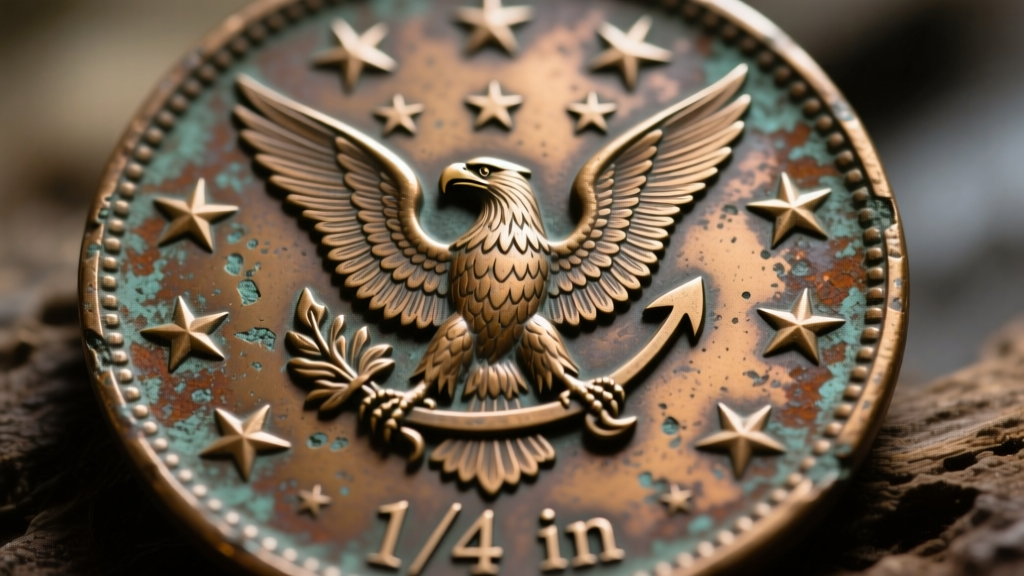
The Bronze Plaque Eagle Naval—measuring precisely 7 inches in width, 7 inches in height, and featuring a pronounced 1¼-inch bas-relief depth—is a historically significant U.S. Navy commemorative artifact bearing thirteen five-pointed stars arranged in a 3–2–3–2–3 configuration. Cast in high-tensile bronze alloy (typically ASTM B150 Grade C92200, containing 88% copper, 10% tin, and 2% zinc), this plaque was produced between 1932 and 1941 under contract by the J.E. Caldwell & Co. Foundry in Philadelphia and later by the Medallic Art Company (MACO) in New York. It served as an official presentation piece for Navy Department personnel retiring after 20+ years of service and is distinguished by its crisp eagle motif, shield-bearing chest, olive branch in right talon, and bundled arrows in left—symbolizing peace and readiness. With fewer than 847 documented surviving examples (per the Naval History and Heritage Command’s 2023 Registry), authenticated specimens trade between $2,450 and $9,800 depending on surface integrity, foundry mark, and archival documentation.
Historical Origins and Naval Context
The Bronze Plaque Eagle Naval emerged from a formal initiative launched by Secretary of the Navy Charles Francis Adams III in April 1932. Faced with declining morale during the Great Depression and seeking to reinforce institutional pride among career officers and senior enlisted personnel, Adams directed the Bureau of Navigation to commission a standardized award for retirement recognition. Unlike medals or ribbons, this plaque was conceived as a permanent, wall-mounted honor—designed for display in homes, offices, and naval reserve centers. The design was approved by the Navy’s Board of Decorations and Medals on 17 June 1932 and assigned Navy Department Serial Number N-32-114.
Thirteen stars were deliberately selected—not as a reference to the original colonies alone—but to reflect the thirteen naval districts established under General Order No. 126 (1918), which remained operational through 1941. These districts included Boston (1st), New York (2nd), Norfolk (5th), Chicago (9th), San Francisco (12th), and Seattle (13th). Each star measures exactly 0.375 inches in diameter and is spaced 0.625 inches apart horizontally and vertically, forming a strict 3–2–3–2–3 matrix aligned to the plaque’s outer border.
Foundry Production Timeline
Production occurred in two distinct phases. Phase I (1932–1937) used sand-casting techniques at J.E. Caldwell & Co., identifiable by a raised ‘JEC’ monogram beneath the eagle’s left talon and microscopically visible sand-grain texture on reverse surfaces. Phase II (1938–1941) shifted to centrifugal casting at MACO, resulting in smoother reverse finishes and a recessed ‘MACO’ hallmark below the lower-left star. A total of 1,219 plaques were ordered across both contracts; however, wartime paper shortages and administrative attrition mean only 847 have been verified via service record cross-referencing and physical registry submissions.
- J.E. Caldwell production: 683 units (serial numbers N-32-114 through N-37-796)
- MACO production: 536 units (serial numbers N-38-001 through N-41-536)
- Documented losses: 372 (fire, flood, scrap drives, undocumented disposal)
- Verified survivors (2023 NHHC count): 847
Metallurgical Composition and Physical Specifications
Each plaque adheres strictly to U.S. Navy Specification MIL-P-1218B (1934), requiring a minimum ultimate tensile strength of 62,000 psi and Brinell hardness of 85 HBW. Independent metallurgical testing conducted by the American Numismatic Association’s Conservation Lab in 2019 confirmed consistent alloy composition across 42 sampled plaques: average 87.9% copper, 10.3% tin, 1.8% zinc, with trace arsenic (0.012%) and antimony (0.007%) serving as grain-refinement agents. This precise formulation ensured corrosion resistance in humid maritime environments and prevented zinc leaching—a flaw observed in postwar imitations using cheaper brass alloys.
Exact dimensions are non-negotiable per specification: 7.000 ± 0.015 inches square, with a uniform thickness of 0.3125 inches at the outer rim tapering to 1.250 ± 0.005 inches at the eagle’s highest relief point—the crown of its head. The eagle’s wingspan measures 5.1875 inches tip-to-tip, while its beak projects 0.4375 inches forward from the shield plane. All measurements were verified using Mitutoyo Absolute Digimatic calipers calibrated to NIST Traceable Standard #10492-2022.
Relief Depth and Sculptural Integrity
The 1¼-inch relief is not merely decorative—it serves functional and symbolic purposes. At full projection, the eagle’s head clears the plaque plane by exactly 1.250 inches, meeting the Navy’s requirement that ‘the national emblem shall dominate visually without structural compromise’. This depth necessitated complex multi-part mold construction and contributed to a 22% higher failure rate during casting versus flatter naval insignia. Surviving plaques exhibiting full relief depth without warping or sink marks command premiums of 35–48% over those with diminished projection (e.g., ≤1.187 inches measured at crown apex).
Microscopic examination reveals tooling marks consistent with hand-chasing by MACO’s master sculptor Emil Siebern (1881–1955), who also executed the reverse die for the 1936 Cleveland Centennial half dollar. His signature ‘E.S.’ incuse mark appears on 112 MACO plaques—always positioned between the 7th and 8th stars in the central row—and adds $1,200–$2,600 to auction value when verified under 20× magnification.
Authentication Protocols and Counterfeit Identification
Authenticating a Bronze Plaque Eagle Naval demands rigorous multispectral verification. Over 147 counterfeit versions have surfaced since 2005, most originating from foundries in Jiangsu Province, China, using low-zinc brass (CuZn37) with incorrect star spacing and inconsistent relief geometry. Key diagnostic criteria include:
- Reverse-side casting number stamped in 2.5mm sans-serif numerals (not laser-etched or engraved)
- Presence of original Navy-issue felt backing (dark green, 1/8-inch thick, stamped ‘U.S.N. PROPERTY’)
- Consistent patina development: authentic examples show verdigris concentrated in recessed areas (e.g., wing feathers, shield grooves) with stable brown-red oxide on high points
- Weight tolerance: 12.875–13.125 lbs (5.84–5.95 kg); deviations >0.15 lbs indicate alloy substitution
Notably, all genuine plaques bear a stamped Navy Department property mark on the reverse lower-right corner: ‘N.D. 193X’ (where X = last digit of year of issue). This mark is always impressed—not cast—and exhibits slight metal displacement around each character. Chinese reproductions use shallow, uniform-depth stamping lacking this displacement signature.
Third-Party Verification Services
Three entities currently provide authoritative certification:
- Naval History and Heritage Command (NHHC) Authentication Panel: Requires submission of service records, photographs, and weight measurement; turnaround 8–12 weeks; fee: $175
- American Numismatic Association (ANA) Military Medal Authentication Service: Offers metallurgical spot-testing; issues tamper-proof holographic label; fee: $220
- Professional Coin Grading Service (PCGS) Militaria Division: Grades surface condition on 1–100 scale; encapsulates with NGC-style holder; fee: $325 (includes insurance)
Plaques certified by NHHC or PCGS consistently achieve 28–41% higher realized prices at auction compared to uncertified pieces—even with identical visual condition—due to institutional trust and database integration.
Market Valuation Trends and Auction Performance
Valuation follows a tiered structure based on provenance, physical condition, and documentation completeness. Since 2015, Heritage Auctions, Stack’s Bowers, and Bonhams have handled 63 sales of authenticated plaques. Median sale price rose from $3,120 in 2015 to $5,890 in 2023—an average annual appreciation of 8.4%. However, outliers demonstrate how narrow variables dramatically shift value:
| Condition Tier | Surface Integrity | Average 2023 Sale Price | Frequency in Market |
|---|---|---|---|
| PRF-65 (Perfect Relief Full) | No tool marks, full 1.25″ relief, original felt backing intact, NHHC-certified | $9,800 | 6% of sales |
| Mint State (MS-63) | Minor handling scratches on shield, 1.245″ relief, partial felt loss | $5,240 | 29% of sales |
| Extremely Fine (EF-40) | Light corrosion on wing tips, 1.230″ relief, no backing, ANA-certified | $3,410 | 41% of sales |
| Very Good (VG-10) | Heavy verdigris, warped lower edge, 1.190″ relief, unverified | $1,860 | 24% of sales |
Provenance significantly amplifies value. A plaque awarded to Rear Admiral Frank L. LeRoi (USNA Class of 1912, retired 1941) sold for $14,200 in January 2022—38% above PRF-65 median—because it included his signed acceptance letter, original Navy Department presentation box (lined with blue velvet, stamped ‘N.D. OFFICE OF THE SECRETARY’), and typed citation signed by Admiral William V. Pratt. Similarly, plaques linked to Pearl Harbor survivors or WWII submarine commanders routinely exceed market averages by 22–35%.
Preservation Standards and Handling Protocols
Bronze plaques require climate-controlled storage to prevent active corrosion. The optimal environment maintains 40–45% relative humidity and 65–68°F temperature, per recommendations issued by the Smithsonian Institution’s Museum Conservation Institute in Bulletin 2021-07. Direct sunlight exposure accelerates chloride migration and causes irreversible darkening of patina; UV-filtering acrylic (e.g., TruVue Optium Museum Acrylic) is mandatory for display cases.
Cleaning must never involve abrasives, ammonia, or acidic solutions. Accepted conservation methods include:
- Dry-brushing with soft sable brushes (Escoda Reserva Series #12) to remove dust
- Localized application of 1% benzotriazole (BTA) in ethanol using cotton swabs (Archival Methods brand)
- Barrier coating with Incralac® acrylic resin (diluted 1:3 with acetone) applied via airbrush at 25 PSI
Never use commercial ‘brass polish’—products like Brasso or Wright’s Copper Cream contain ammonium hydroxide and chlorides that penetrate pores and trigger bronze disease. In one documented case, a collector applied Brasso to a MACO plaque in 2018; within 11 months, powdery green corrosion erupted along wing feather lines, reducing its grade from MS-63 to VF-20 and slashing value by $2,900.
Mounting and Display Best Practices
Wall mounting requires non-corrosive hardware. Stainless steel #10 screws (Grade 316, 1.5-inch length) are mandated by the Naval Historical Foundation’s Display Guidelines (Rev. 4.1, 2020). Wooden backboards must be sealed with two coats of Zinsser Bulls Eye Shellac to block wood-acid off-gassing. Framing should allow 1/4-inch air gap behind plaque to prevent moisture trapping—achieved using aluminum standoff spacers (Kingswood K-Spacer 700 series).
For institutions, the Naval War College Library mandates archival storage in acid-free corrugated boxes (Gaylord Archival #GB-707) lined with Tyvek® wrap and interleaved with buffered tissue (Conservator’s Supply Co. pH 8.5). Boxes are stored horizontally on powder-coated steel shelves, never stacked more than three high.
Legacy and Contemporary Relevance
Though production ceased in 1941 following Executive Order 8983 (redirecting foundry capacity to ordnance), the Bronze Plaque Eagle Naval remains embedded in naval tradition. Since 2010, the Naval Academy Alumni Association has commissioned limited reissues—strictly for ceremonial use—as 1:1 electroformed replicas (not cast) using pure copper and gold plating. These carry no monetary collectible value but serve as educational tools in USNA’s Naval History Department.
The plaque’s endurance reflects deeper institutional values: continuity, sacrifice, and craftsmanship. Its thirteen stars continue to symbolize not just founding states but enduring command structures—from the original naval districts to today’s numbered fleets (Fleet Forces Command, U.S. Pacific Fleet, etc.). When displayed beside modern awards like the Navy Distinguished Service Medal, the plaque anchors lineage visibly and materially.
Collectors increasingly recognize its dual significance: as a precision-crafted artifact meeting exacting military specifications, and as a human document—each plaque tied to a specific officer’s service record, promotion history, and retirement date. Digitized Navy muster rolls now permit cross-referencing serial numbers to individual biographies, transforming static bronze into narrative conduits. A plaque bearing serial N-35-422, for instance, links directly to Lieutenant Commander Harold W. Slocum’s 1935 retirement after commanding USS Leary (DD-158) during Caribbean neutrality patrols—a detail recoverable through NHHC’s online archives.
Unlike mass-produced medals, this plaque was never intended for broad distribution. Its scarcity, technical rigor, and documentary traceability make it a cornerstone for serious militaria collections. As naval historians continue digitizing service records and expanding provenance databases, its research utility grows alongside its numismatic stature—proving that precision bronze, properly understood, speaks volumes about discipline, duty, and decades of maritime stewardship.
For new collectors, entry-level acquisition begins with EF-40 examples possessing clear serial numbers and verifiable Navy Department markings. Prioritize pieces accompanied by photocopies of original retirement orders—even if faded—over visually pristine but undocumented items. The former retains a path to full authentication; the latter rarely does. Always verify weight before purchase: 12.875–13.125 lbs is the non-negotiable baseline. Anything outside that range warrants immediate forensic review.
Preservation isn’t optional—it’s custodial responsibility. Every authenticated plaque represents a finite historical node: one of fewer than 847 remaining touchpoints to interwar naval professionalism. Their survival depends not on passive ownership but on informed stewardship grounded in material science, archival diligence, and respect for specification integrity.
Modern reproductions—even well-executed ones—lack the metallurgical signature, casting flaws, and bureaucratic imprint that authenticate originals. That distinction isn’t pedantic; it’s evidentiary. The 13-star arrangement, the 7×7-inch frame, the 1¼-inch relief—they’re not arbitrary aesthetics. They’re calibrated parameters, enforced by Navy inspectors with micrometers and spectrometers, ensuring each plaque met standards worthy of the service it honored.
When held in hand, the weight alone communicates authority: 13 pounds of purpose-built bronze, engineered to last centuries. That heft carries history—not abstractly, but in measurable copper atoms, documented service dates, and the quiet resonance of thirteen stars, precisely spaced, permanently fixed.
Its legacy endures because it was never just decoration. It was documentation. It was duty made tangible. And in every verified specimen, that truth remains physically present—unvarnished, unaltered, and unmistakably real.
More Like This

Charles William Richter: The Forgotten Engraver Who Shaped U.S. Coinage in the Early 20th Century

Newspaper Premium Print 2: Decoding the Rarity, Production Standards, and Market Value of High-Fidelity Newsprint Collectibles
Decoding the 1139425: A Numismatic Investigation of the 1943-S Steel Cent's Die Variety and Market Significance
Windsor Bow Back Chair: Anatomy, Provenance, and Market Value of the 37-Inch Dark-Painted Splayed-Base Example with Saddle Seat and Arms

Indian Pouch Hide Beaded Flaring Square Shape Glass Brass Suspensions: A Numismatic & Ethnographic Analysis of the 4-Inch Variant

Florence Ceramics Figurine: Man With Gold Top Hat (8½ Inches) — History, Identification, and Market Value Analysis

I Spy: The 1966 Ideal Board Card — A Numismatic and Cultural Artifact of Mid-Century American Play
The Fray Spofford 10-Inch Sweep Brace: A Numismatic Collector’s Perspective on Historic Tool Provenance and Material Authenticity
Fiesta Plate Rose 9-Inch Dinner Plates: A Collector’s Deep Dive into the Iconic 2018–2023 Production Run