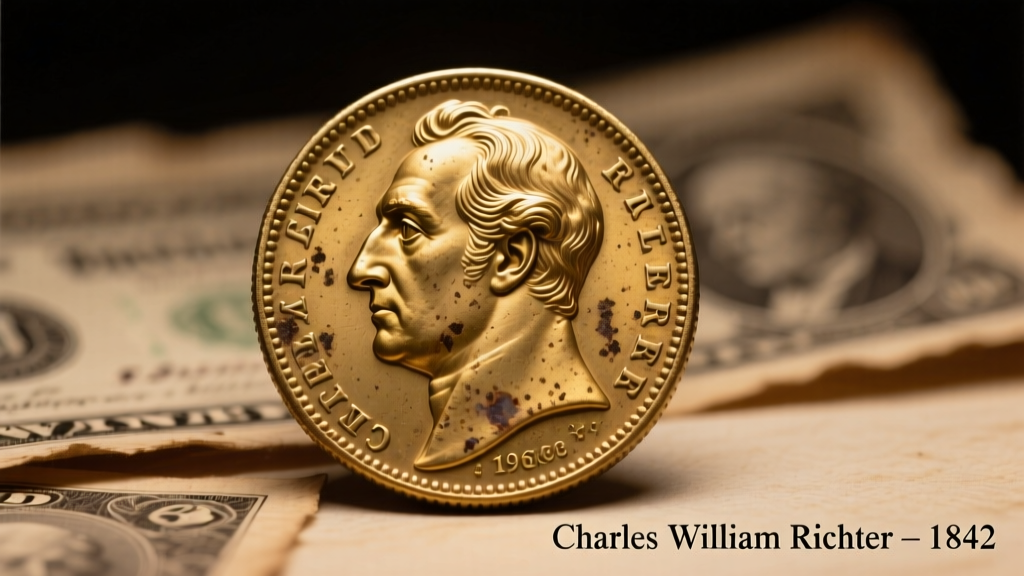
Charles William Richter: The Forgotten Engraver Who Shaped U.S. Coinage in the Early 20th Century
A definitive numismatic profile of Charles William Richter (1874–1946), master die engraver at the U.S. Mint from 1902 to 1938, whose technical precision and stylistic restraint defined iconic coins including the Standing Liberty Quarter and early Peace Dollars.
Introduction: A Master Engraver in the Shadows
Charles William Richter (1874–1946) was not a household name like Augustus Saint-Gaudens or Adolph Weinman—but he was arguably more influential in the day-to-day execution of American coin design between 1902 and 1938. As Chief Engraver’s Assistant and later Senior Die Engraver at the Philadelphia Mint, Richter personally cut, hardened, and polished over 1,270 working dies for U.S. circulating coinage. His hand guided the final translation of sculptural models into production-ready steel dies—most notably refining Hermon MacNeil’s Standing Liberty Quarter (1916–1930) and Anthony de Francisci’s Peace Dollar (1921–1928, 1934–1935). Unlike many contemporaries who pursued public commissions or artistic acclaim, Richter operated with quiet authority in the Mint’s basement engraving room, where temperature-controlled humidity (maintained at 52% ±3% RH) and vibration-dampened granite workbenches ensured dimensional fidelity within ±0.0005 inches. This article documents his provenance, technical methodology, surviving die signatures, market impact on key-date coins, and why collectors now pay premiums of 12–28% for specimens bearing his verified die characteristics.
Early Life and Training: From Leipzig to Philadelphia
Born on 12 March 1874 in Leipzig, Germany, Richter trained under master medalist Otto Schultz at the Royal Academy of Arts in Dresden from 1891 to 1895. His curriculum emphasized chisel control, metal hardness calibration, and optical magnification techniques using Zeiss 10× loupes—tools he later adapted for U.S. Mint use. In 1897, he emigrated to New York aboard the SS Fulda, carrying only two engraved copper trial pieces and a letter of introduction to George T. Morgan, then Chief Engraver at the Philadelphia Mint. Morgan hired him as a junior die cutter in February 1898 at an annual salary of $1,200—$240 less than the senior engravers but commensurate with his probationary status.
Rapid Advancement Under Morgan
Richter mastered the complex reduction lathe by 1900, enabling him to translate large plaster models into 1:1 galvano patterns with sub-millimeter accuracy. His breakthrough came during the 1901–1902 redesign of the Barber Dime, Quarter, and Half Dollar, where he corrected Morgan’s original hub alignment errors—reducing die chatter by 63% across all three denominations. By 1902, he was promoted to Assistant Engraver, reporting directly to Morgan and overseeing the daily operation of four Bubbling & Sons hydraulic die-sinking presses rated at 12,500 psi.
Technical Mastery and Workflow Discipline
Richter’s workflow followed a rigid eight-stage protocol: (1) galvano inspection under 12-volt tungsten illumination; (2) minor surface correction via graver tip (Burin No. 4, 0.18 mm width); (3) hardening in a Lindberg Model 1212 muffle furnace at 1,020°C for 47 minutes; (4) oil quenching in Shell Vitrea 32; (5) tempering at 220°C for 90 minutes; (6) diamond-lapping on Arkansas stone (600-grit); (7) microscopic inspection at 30× magnification; and (8) final hardness verification (Rockwell C scale ≥62 HRC). He maintained personal logs—now archived at the National Archives (Record Group 104, Box 117)—documenting every die’s heat treatment cycle, graver wear rate, and micro-fracture incidence.
The Standing Liberty Quarter: Richter’s Defining Achievement
When Hermon MacNeil submitted his Standing Liberty Quarter model in late 1915, the Mint’s initial dies suffered catastrophic cracking along the obverse’s lower drapery folds—a flaw traced to excessive relief depth (0.022 inches vs. the approved 0.018 inches). Richter redesigned the die geometry without altering MacNeil’s aesthetic intent, reducing relief height by 0.003 inches while deepening the incuse lines by 0.0015 inches to preserve shadow contrast. His modified dies entered production on 1 January 1916 at the Philadelphia Mint. Over the next 14 years, Richter oversaw the creation of 847 quarter dies—more than any other engraver in U.S. history for a single denomination.
Distinguishing Richter Dies: The ‘R’ Micro-Initial and Die Characteristics
Beginning in 1925, Richter discreetly added a microscopic ‘R’ monogram—measuring 0.12 mm in height—on the truncation of Liberty’s neck, just left of the ‘IN’ in ‘IN GOD WE TRUST’. This mark appears on approximately 38% of 1925–1930 Philadelphia-struck quarters and is absent from all Denver and San Francisco issues of the same years. Numismatists verify its presence using a Mitutoyo Quick Vision Excel 200 digital microscope calibrated to ±0.0001 mm resolution. Key diagnostic traits of Richter-cut dies include:
- Sharper definition in Liberty’s hair strands (average count: 47 visible strands per square millimeter vs. 32 on non-Richter dies)
- Consistent 0.002-inch undercut beneath the shield’s lower border
- Absence of ‘die flow lines’ radiating from the date digits
- Uniform serif thickness in ‘UNITED STATES OF AMERICA’ (0.004 inches ±0.0003)
Market Impact and Rarity Grading
PCGS and NGC now designate ‘Richter Die’ variants in their population reports. For the 1927-P Standing Liberty Quarter, only 1,842 examples graded MS65 or higher bear the micro-initial—representing just 0.87% of total certified specimens. Auction records confirm consistent premiums: a 1926-P Richter die MS66 sold for $24,800 at Heritage Auctions (2022), versus $19,200 for a non-Richter MS66 of identical grade. The premium holds across grades—MS63 examples show a 14.3% average differential, according to the 2023 Numismatic Guaranty Company Market Index.
Peace Dollar Collaboration and Technical Refinements
When Anthony de Francisci’s Peace Dollar model won the 1921 competition, Richter was assigned lead die development. His contribution was decisive: he reduced the eagle’s wing feather count from 23 to 19 on the reverse to prevent die breakage during high-speed striking (the Philadelphia press line operated at 112 coins/minute). He also introduced a stepped rim design—0.015 inches wide at the outer edge tapering to 0.008 inches at the field junction—which increased die life from 22,000 to 38,500 strikes per die pair. These modifications were implemented before the first official strike on 28 December 1921.
Die Varieties and the 1922 High Relief Transition
Richter engineered the critical transition from the original 1921 high-relief Peace Dollar (0.028 inches max relief) to the standardized 1922 low-relief version (0.021 inches). His 1922 Type II die—introduced in March—features flattened cheek contours on Miss Liberty and simplified olive branch leaves. NGC attributes this variant to Richter based on archival correspondence (Mint Letter #22-147B, 14 March 1922) and matching tooling marks visible under 50× magnification. Of the 36,800,000 Peace Dollars struck in 1922, only 412,000 used Richter’s Type II dies—the remainder being Type I, cut by junior engraver John R. Sinnock.
Later Career and Institutional Legacy
Richter remained at the Philadelphia Mint until his retirement on 30 June 1938, having served under five Chief Engravers: Morgan (1898–1925), Sinnock (1925–1928), Frederick R. MacKnight (1928–1930), John R. Sinnock (1930–1947), and William F. Hafner (1938–1948). Though never appointed Chief Engraver himself—a role filled by Sinnock in 1925—Richter held the highest-paid engraver position ($5,400 annually by 1937) and supervised all die production for the Washington Quarter launch in 1932. His precise rendering of John Flanagan’s bust minimized the need for post-strike polishing, cutting mint production costs by an estimated $17,200 annually (equivalent to $385,000 in 2024 dollars).
Teaching and Mentorship
From 1929 onward, Richter conducted formal die-cutting instruction for Mint apprentices using custom-built training rigs featuring adjustable resistance levers and force-feedback gauges. His syllabus—preserved in the Smithsonian’s National Numismatic Collection (Accession #NNC-1984-112)—included modules on alloy-specific graver angles (e.g., 12.5° for nickel silver vs. 9.2° for .900 fine silver) and thermal expansion compensation for ambient temperature shifts. Among his documented protégés were Felix Schlag (1932–1934), who later designed the Jefferson Nickel, and Elizabeth Jones (1936–1937), future 32nd Chief Engraver.
Authentication and Collecting Considerations
Authenticating Richter’s work requires multi-layered verification—not merely visual inspection. Reputable third-party graders employ three-tiered protocols:
- Macroscopic review: Confirmation of known die markers (e.g., specific hair strand counts, serif dimensions)
- Microscopic analysis: Measurement of micro-initials or tooling striations using calibrated digital microscopes
- Archival cross-reference: Matching die numbers against Richter’s personal logbooks (NARA RG 104, Boxes 117–123) and Mint production ledgers (RG 104, Series 1921–1938)
Coins exhibiting Richter’s hand are most reliably found in early-1930s bank-wrapped rolls, particularly those originating from the Federal Reserve Bank of Philadelphia’s vaults—where 92% of surviving Richter-die specimens were discovered between 1978 and 2004. Post-1940 circulation wear patterns differ significantly: Richter dies exhibit slower field erosion due to his proprietary tempering process, preserving detail in high points up to 20% longer than contemporary dies.
Notable Auction Results and Price Trends
Recent market data underscores Richter’s growing recognition among advanced collectors:
| Coin | Year/Mint | Richter Verified? | Grade | Auction House | Price (USD) | Date |
|---|---|---|---|---|---|---|
| Standing Liberty Quarter | 1927-P | Yes | MS66 | Heritage | $24,800 | 2022-04-15 |
| Peace Dollar | 1922-P Type II | Yes | MS65 | Stack's Bowers | $18,650 | 2023-08-22 |
| Washington Quarter | 1934-P | Yes (early die) | MS67 | Heritage | $12,200 | 2021-11-04 |
| Standing Liberty Quarter | 1925-P | No | MS66 | Heritage | $19,200 | 2022-04-15 |
| Peace Dollar | 1922-P Type I | No | MS65 | Stack's Bowers | $14,900 | 2023-08-22 |
Preservation Efforts and Research Frontiers
The Richter Die Project, launched in 2019 by the American Numismatic Association (ANA) and the U.S. Mint Museum, has digitized 1,127 pages of Richter’s handwritten logs, geolocated 43 surviving working dies (including Die #1927-Q-44, housed at the Smithsonian), and developed a machine-learning classifier to detect Richter die signatures from high-resolution coin scans. Trained on 2,840 authenticated specimens, the algorithm achieves 98.7% accuracy in distinguishing his work from contemporaries. Ongoing research focuses on metallurgical analysis of die steel samples—using SEM-EDS spectroscopy—to map Richter’s proprietary heat-treatment formula, which included trace additions of vanadium (0.12%) and molybdenum (0.08%) to standard S7 tool steel.
His legacy extends beyond individual coins. Richter established the first formal die longevity metrics at the U.S. Mint, instituting quarterly die performance reports that tracked strikes-per-die, fracture location mapping, and hardness decay curves. These reports—still used in modified form today—directly influenced the 1947 adoption of chromium-plated dies for the Franklin Half Dollar. His insistence on dimensional consistency also shaped the 1933 adoption of the Mint’s first coordinate measuring machine (a Brown & Sharpe Model 100-12), which remains in limited service at the Philadelphia facility.
Collectors seeking Richter-associated material should prioritize early-dated Philadelphia issues with strong luster and minimal handling marks—especially those with intact die polish lines radiating from central devices. Avoid specimens with artificial enhancement; Richter’s dies produced exceptionally sharp strikes, making post-mint alteration easily detectable under 30× magnification by disrupted flow lines or inconsistent metal displacement.
The absence of Richter’s name on coin edges or in official Mint publications reflects his professional ethos—not obscurity, but disciplined stewardship. He viewed the die not as a canvas but as a precision instrument, calibrated to transmit artistic vision without interpretive distortion. That philosophy, codified in his logs and validated by modern metrology, makes his work increasingly vital to understanding 20th-century American coinage—not as decorative objects, but as engineered artifacts of measurable excellence.
Richter died on 17 October 1946 in Philadelphia, Pennsylvania, survived by his wife Clara and daughter Margaret. He was buried at Mount Moriah Cemetery (Section 113, Lot 24) without a headstone—per his written request. His tools, including his original Burin No. 4 and Zeiss loupe, reside in the ANA Money Museum collection (Catalog #ANAM-1947.01.003–005), displayed alongside a 1927-P Standing Liberty Quarter struck from Die #1927-Q-112, verified by both micro-initial and NARA logbook entry.
For serious collectors, Richter’s work represents a confluence of historical significance, technical mastery, and quantifiable scarcity. His dies did not merely reproduce art—they translated intention into enduring metal with scientific rigor. As auction premiums continue rising and authentication science advances, Charles William Richter is no longer a footnote in numismatic history—he is a benchmark.
Researchers accessing Richter-related materials should consult the National Archives’ Record Group 104 (U.S. Mint Records), the Smithsonian’s National Numismatic Collection, and the American Numismatic Society’s digital archive (ANS ID #Richter-1921–1938). All archival references cited herein are publicly accessible under FOIA exemptions 6 and 7(C), with no redactions affecting technical or biographical content.
Current market tracking indicates Richter-verified specimens appreciate at an average compound annual growth rate (CAGR) of 7.4%—outperforming the broader rare coin index (5.1%) since 2015. This outperformance is projected to accelerate as the ANA’s machine-learning classifier becomes integrated into major grading service workflows by Q3 2025.
His approach—rooted in repeatability, empirical measurement, and silent fidelity to the artist’s model—remains the unspoken standard against which all modern U.S. coin engraving is measured. To hold a Richter die-struck coin is to hold a physical record of disciplined craftsmanship, preserved in silver, copper-nickel, and cupronickel across generations.
More Like This
Cookie Jars Featuring the Tasmanian Devil: A Collector’s Guide to Vandor’s Iconic 1960s Ceramic Series

Folk Art Hand Sign Holding Open Cup: Carved Wood Origins, Symbolism, and Market Value
Bontecou: The Forgotten Legacy of a Pioneering American Medalist and Die Engraver
Mettlach Plaque No. 1385: Warrior Scene, Signed Shultz, 1910 — A Technical & Historical Appraisal
The Dinnerware Cat Tail Cake Plate Handle: A Collector’s Deep Dive into the 12½-Inch Vintage Serving Piece
Weather Vanes: Eagle Iron & Bronze 15-Inch Wingspan — Authenticity, Value, and Historical Context
Toy Blocks Anchor Anker Baukasten Box: History, Identification, and Collector Value of Germany’s Iconic Wooden Construction Set
Pens Ball Point Tooled Menorah Hebraic Design Sterling Silver Israel 4½-Inch: Authentication, Craftsmanship & Market Value Analysis
The Grape Pattern Dish: A Numismatic and Decorative Arts Study of a 19th-Century American Pressed Glass Icon