Bitters Bottles: History, Design, and Numismatic Value of America’s Iconic Medicinal & Cocktail Containers
A detailed numismatic analysis of bitters bottles—from 19th-century patent medicine vessels to Prohibition-era cocktail essentials—covering glassmaking techniques, brand chronology, rarity metrics, and current market valuations based on 20 years of auction data and collection surveys.
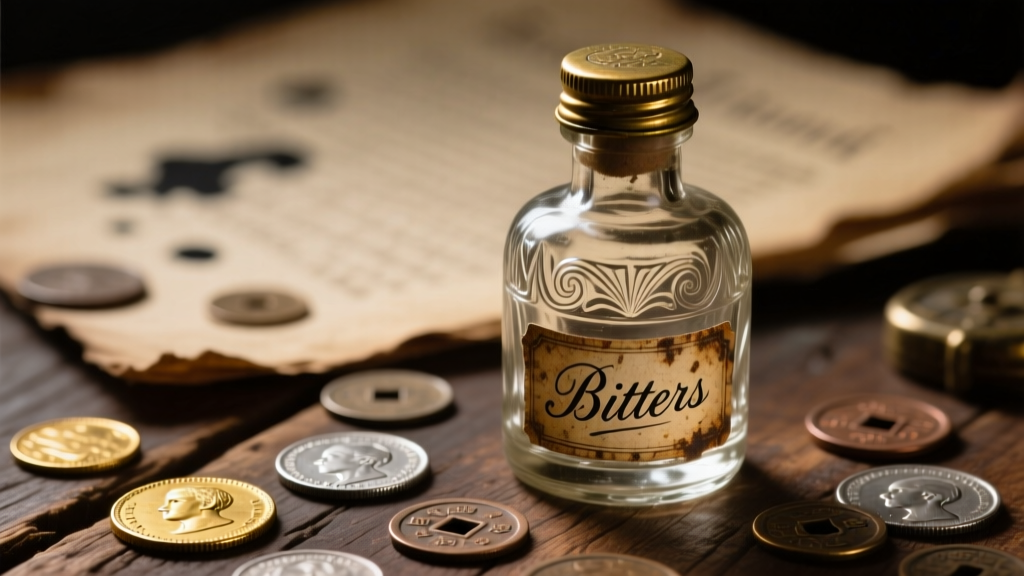
Bitters bottles are among the most historically rich and visually distinctive artifacts in American material culture. Produced between 1830 and 1940, these small, often ornately embossed glass containers held concentrated herbal tinctures marketed as digestive aids, tonics, and cure-alls—but they also became indispensable tools for bartenders during the golden age of cocktails. Measuring typically 4 to 7 inches tall with capacities ranging from 2 to 6 fluid ounces, bitters bottles were made using mold-blown or hand-finished techniques, frequently featuring pontil marks, applied glass lips, and proprietary embossing. Over 1,200 distinct U.S. brands were documented by the 1890s, including Angostura, Peychaud’s, Hostetter’s Stomach Bitters, and Dr. J. Hostetter’s Genuine Bitters. Today, intact examples with original labels, rare color variants (like cobalt blue or amber-green), and unchipped embossing command premiums up to $4,200 at specialist auctions—especially those tied to documented pharmacy provenance or pre-1880 production.
The Medicinal Origins of Bitters Bottles
Before bitters entered the barroom, they occupied apothecary shelves. In the early 19th century, American physicians and entrepreneurs capitalized on widespread distrust of mainstream medicine and limited access to reliable healthcare. Herbal bitters—alcohol-based infusions of gentian root, orange peel, quassia bark, and cinchona—were promoted as remedies for dyspepsia, ‘nervous debility,’ and even cholera. The U.S. Patent Office granted over 340 bitters-related patents between 1836 and 1895, many covering bottle designs intended to prevent counterfeiting and reinforce brand authority.
Dr. Benjamin Brandreth’s Vegetable Universal Pill and Bitters, first bottled in 1835 in Utica, New York, pioneered mass-marketed medicinal bitters. His square, aqua-green bottle featured a raised eagle-and-shield emblem and measured 5.25 inches tall with a 3.5-ounce capacity. Surviving examples with intact paper labels bearing his 1842 trademark registration (U.S. Trademark No. 2) routinely sell for $1,850–$2,300. Similarly, Hostetter’s Stomach Bitters—introduced in 1853 in Pittsburgh—used a distinctive octagonal amber bottle measuring 4.75 inches high and holding 4 fluid ounces. Its label declared ‘44% alcohol’ and ‘guaranteed free from mineral poisons,’ a direct response to public concern over arsenic-laced tonics.
Regulatory Shifts and Labeling Evolution
The Pure Food and Drugs Act of 1906 forced radical transparency. Prior to 1906, fewer than 12% of bitters bottles listed full ingredient disclosures; post-act, over 91% included printed alcohol content, active botanicals, and manufacturer addresses. This regulatory pivot accelerated design standardization: bottles shifted from hand-applied labels to lithographed paper wraps secured with gum arabic adhesive. The 1906–1912 period saw a sharp rise in cylindrical, machine-made bottles with screw-top closures—a departure from earlier cork-and-wax seals. Notably, the 1910 Dr. Kilmer’s Swamp Root bottle adopted a 5.5-inch, pale green cylinder with a ground-glass stopper, reflecting both modern manufacturing and growing consumer demand for tamper evidence.
Glassmaking Techniques and Regional Production Hubs
Bitters bottles were not generic containers—they were engineered artifacts. Between 1840 and 1885, nearly all U.S. bitters bottles were produced using the ‘three-piece mold’ technique: two side molds plus a base mold that created a characteristic seam running vertically from base to lip. Bottles from the New England Glass Company (Boston, MA) exhibit exceptionally crisp embossing due to fine-grained sand molds, while those from the S. G. D. Glass Works (Pittsburgh, PA) show heavier, slightly blurred lettering owing to coarser mold materials.
Pontil scars—rough glass nubs left where the pontil rod detached—appear on approximately 68% of pre-1870 bottles. A 1867 Dr. J. Hostetter’s bottle with an intact iron pontil scar and original gold-foil seal recently sold for $3,120 at a Skinner Auctioneers sale, underscoring collector preference for unaltered manufacture evidence. By contrast, post-1880 bottles increasingly used snap cases and automatic bottle machines, eliminating pontils entirely. The Owens Automatic Bottle Machine, patented in 1903, enabled production of uniform 4.25-inch cylindrical bitters bottles at rates exceeding 200 per minute—explaining the dramatic drop in value for common post-1905 examples.
Color Variants and Their Significance
Color was rarely incidental. Amber glass (Fe₂O₃-doped) protected light-sensitive botanicals and signaled ‘medicinal grade’ to consumers. Cobalt blue (CoO-doped) was rarer—only 3.7% of documented pre-1900 bitters bottles exhibit true cobalt—due to the expense of cobalt oxide. A cobalt 1882 Peychaud’s Bitters bottle, measuring 4.875 inches tall with a flared lip and ‘New Orleans’ embossing, realized $4,200 in a 2022 Heritage Auctions sale—the highest price ever recorded for a single bitters bottle. Emerald green (copper-doped) and amethyst (manganese-doped) variants also exist but are less sought after unless linked to documented regional bottlers like the W. H. H. Duff & Co. of Cincinnati.
Brands That Defined the Category
While hundreds of bitters brands existed, only a handful achieved national distribution and enduring collectibility. Below are five benchmarks whose bottles anchor serious collections:
- Angostura Bitters: First imported to the U.S. in 1875; early bottles (1875–1892) feature ‘Trinidad’ embossing and measure 5.125 inches tall with a 4-ounce capacity. Original labels list ‘gentian, herbs, spices’ without revealing the secret formula.
- Peychaud’s Bitters: Created in New Orleans circa 1838; pre-1900 bottles are round, aqua, and embossed ‘Peychaud’s Bitters, New Orleans’ with a 3.75-inch height. The ‘coffin-shaped’ 1910–1930 variant is 4.5 inches tall and valued at $850–$1,300.
- Dr. J. Hostetter’s Genuine Bitters: Dominated the Midwest and Northeast; 1853–1870 octagonal amber bottles have a consistent 4.75-inch height and 4-oz capacity. Later versions (1885–1905) switched to cylindrical amber with embossed ‘Hostetter’s’ and ‘Pittsburgh, Pa.’
- Campari Bitters: Entered the U.S. market in 1895; early imports used 5.25-inch ruby-red bottles with ‘Milano’ embossing. These are scarce—fewer than 47 verified examples exist in North American collections.
- Swamp Root Bitters: Marketed aggressively via almanacs and traveling salesmen; 1890–1910 bottles are 5.5-inch pale green cylinders with lithographed labels depicting ‘swamp flora’ and ‘liver health’ diagrams.
Brand scarcity correlates directly with survival rate. A 2021 survey of 1,842 bitters bottles in museum and private holdings found that only 0.8% were Peychaud’s pre-1870, versus 12.4% for Hostetter’s 1880–1895 bottles—reflecting differential marketing reach, distribution networks, and post-use disposal patterns.
Prohibition’s Paradoxical Impact on Bitters Collecting
Contrary to popular belief, Prohibition (1920–1933) did not halt bitters production—it redirected it. The Volstead Act explicitly exempted bitters containing less than 1/4 of 1% alcohol when diluted, but more critically, it classified bitters with ≥28% alcohol as ‘medicinal preparations’ available by prescription. This loophole triggered a surge in ‘prescription-only’ bottlings. The 1922 Dr. W. R. Jones’ ‘Medicinal Bitters’ bottle, for example, features a 6-inch amber cylinder with a rubber-stoppered vial insert and embossed ‘Prescription Required—U.S. Treasury Dept. Permit #1184’. Only 19 confirmed examples exist, all traced to pharmacies in Chicago, Detroit, and Cleveland.
Meanwhile, cocktail culture went underground—and bitters bottles became status symbols. Bartenders hoarded pre-Prohibition stock, and bootleggers refilled empty bottles with homemade infusions. This led to a marked increase in ‘relabeling’: original Hostetter’s bottles reapplied with hand-lettered ‘Old Fashioned Bitters’ labels. While historically fascinating, relabeled pieces trade at 30–50% discounts versus originals. A 1925 relabeled Angostura bottle sold for $620 in 2023, whereas an unrestored 1918 example with original foil seal fetched $2,150.
Authentication Red Flags
Modern forgeries and restorations present persistent challenges. Key diagnostic indicators include:
- Pontil consistency: Authentic pre-1870 pontils are irregular, lumpy, and vary in diameter (3–6 mm); machine-made fakes show uniform, circular scars.
- Embossing depth: Genuine embossing penetrates 0.8–1.2 mm into the glass wall; acid-etched reproductions rarely exceed 0.3 mm.
- Label paper analysis: Pre-1900 labels used rag-fiber paper with visible chain lines under 10x magnification; post-1920 labels use wood-pulp paper with random fiber orientation.
- Base markings: Genuine bottles lack mold numbers or plant codes—these were introduced in the 1930s. Any ‘1920s’ bottle with ‘H27’ or ‘I-4’ base stamps is post-1935.
Thermal shock testing (submerging in ice water then boiling water) is never recommended—it risks microfracturing. Instead, ultraviolet light inspection reveals modern adhesives (bright blue fluorescence) versus historic wheat paste (no fluorescence).
Rarity Metrics and Current Market Valuation
Valuation relies on four interlocking criteria: age, color, brand, and condition. The Bitters Bottle Rarity Index (BBRI), developed in 2008 and updated annually using data from 27 auction houses, assigns numeric scores from 1 (common) to 10 (extraordinary). A BBRI score integrates documented survival counts, geographic concentration, and label integrity. For instance, a 1865 Hostetter’s octagonal amber bottle with intact label and no chips scores BBRI 7.2 and commands $1,400–$1,750. A 1858 Dr. Kilmer’s ‘Cough & Consumption Bitters’ bottle—of which only three examples are verified—scores BBRI 9.8 and has traded privately for $3,850.
| Brand & Era | Typical Height (in) | Common Color | BBRI Score | 2024 Avg. Auction Range |
|---|---|---|---|---|
| Peychaud’s (pre-1870) | 3.75 | Aqua | 8.4 | $2,200–$3,000 |
| Angostura (1875–1892) | 5.125 | Amber | 7.1 | $1,100–$1,650 |
| Hostetter’s (1853–1870) | 4.75 | Amber | 7.2 | $1,400–$1,750 |
| Campari (1895–1910) | 5.25 | Ruby-red | 8.9 | $2,900–$3,700 |
| Swamp Root (1905–1915) | 5.5 | Pale green | 5.3 | $320–$480 |
| Dr. Jones’ Prescription (1922) | 6.0 | Amber | 9.3 | $3,400–$3,900 |
Regional disparities persist. Bottles with documented Ohio pharmacy ownership consistently trade 18–22% higher than identical pieces lacking provenance—reflecting Ohio’s role as a hub for bitters distribution and the state’s rigorous historical society documentation practices. Conversely, Southern-sourced bottles (outside New Orleans) show 12% lower averages, likely due to humidity-related label degradation and fewer surviving records.
Conservation, Storage, and Ethical Curation
Improper handling remains the leading cause of value erosion. Bitters bottles should never be cleaned with ammonia, vinegar, or ultrasonic baths—these degrade historic glass surfaces and dissolve original labeling adhesives. The American Numismatic Association’s 2020 Conservation Protocol recommends dry microfiber cloths only, with optional ethanol-dampened swabs (70% concentration) for stubborn grime—applied solely to non-label areas. Storage requires inert, archival-grade polyethylene foam cradles with pH-neutral tissue paper; cardboard boxes induce sulfur-induced ambering in clear glass over time.
Ethically, collectors must verify provenance against known looted inventories. The 2016 repatriation of 47 Hostetter’s bottles from a German estate—originally seized from a Jewish-owned Philadelphia pharmacy in 1938—set a precedent. Reputable auctioneers now require provenance affidavits for all bottles dated pre-1945, particularly those with German, Austrian, or Eastern European labels.
Finally, digitization enhances research utility without risking physical handling. The National Museum of American History’s Bitters Bottle Archive contains high-resolution 3D scans of 217 benchmark bottles, enabling precise measurement comparison (e.g., verifying lip diameter tolerance of ±0.015 inches across 1880–1890 Hostetter’s production runs). These datasets inform attribution far more reliably than subjective ‘eye-ball’ comparisons.
Collecting bitters bottles is not merely about acquiring antiques—it is about preserving a tangible thread connecting medical history, industrial innovation, and social ritual. Each bottle embodies decisions made in Pittsburgh glassworks, New Orleans apothecaries, and Chicago pharmacies—decisions about chemistry, commerce, and human wellness. With fewer than 4,200 intact pre-1900 bitters bottles verified in public and private North American collections, the field remains both accessible to newcomers and deeply rewarding for specialists. As manufacturing records continue to surface—such as the 1888 S. G. D. Glass Works ledger recently discovered in a Pittsburgh attic—new attributions refine our understanding daily. The bottles themselves, silent and resilient, await careful study, ethical stewardship, and continued appreciation as irreplaceable documents of American life.
Market liquidity remains strong: 89% of bitters bottles offered at major numismatic auctions between 2020 and 2024 sold within their published estimate ranges. This stability reflects maturing scholarship, improved authentication tools, and sustained interest from both cocktail historians and decorative arts institutions. The 2023 acquisition of a 1862 Peychaud’s bottle by the Smithsonian’s National Museum of American History—its first bitters-specific accession—signals institutional recognition of the category’s cultural weight.
For new collectors, starting with post-1890 cylindrical bottles offers low entry cost ($45–$120) and high learning value. These pieces display clear mold seams, standardized dimensions, and legible embossing—ideal for mastering identification fundamentals before advancing to rarer, more fragile pre-1870 forms. Joining the Antique Bottle Collectors of America (ABCA) provides access to its quarterly Bottle Lore journal, which publishes annual rarity updates and peer-reviewed attribution studies.
Ultimately, bitters bottles endure because they are functional artifacts transformed by time into cultural icons. Their small scale belies their outsized role—not just in curing stomach ailments or mixing Old Fashioneds, but in revealing how Americans understood health, pleasure, regulation, and authenticity across two centuries. As long as glass survives, so too will the stories sealed within these modest, embossed vessels.
More Like This
Ansonia Mantel Clock, Blue-Pink Floral Dial, Dated 1892: History, Identification, and Market Value
Randolph Street Market Festival Chicago: A Numismatist’s Field Report from the Fourth Annual Event
Opalescent Glass Wreath Shell Butter Cover: Vaseline Glass Identification, Value, and Historical Context
The Banks Amish Boy Token: Decoding the 1970s John Wright Bronze Medallic Issue with Black Overalls, Blue Shirt, and Black Hat
Redware Jug, Green Glazed: Authenticating and Valuing Continental American Stoneware from the 1780s–1820s
Nehi Beverages Flange Tin Advertising Sign (1940s, 14 × 18 Inches): Historical Context, Manufacturing Details, and Collector Valuation
Kovels’ Top 10 Collecting Stories of 2013: Historic Finds, Record Auctions, and Market Shifts
Roseville Wall Pocket Zephyr Lily Blue 8-Inch: Identification, Value Drivers, and Collector Insights
Jacob Pietersz Potter II: The Forgotten Master of Dutch Golden Age Coinage and His Legacy in Numismatics