Bentwood Innovation: Michael Thonet and the Enduring Legacy of Steam-Bent Beech, 1840–Present
A detailed historical and technical analysis of Michael Thonet’s revolutionary bentwood process, its industrial impact from mid-19th-century Vienna to global adoption, material science breakthroughs, key models (No. 14, No. 209), wartime adaptations, postwar revivals, and contemporary applications by Vitra, Thonet GmbH, and Carl Hansen & Søn — with precise dimensions, production statistics, and archival data.
Introduction: The Birth of a Structural Revolution
Michael Thonet’s invention of industrially scalable steam-bent beechwood in the early 1840s transformed furniture manufacturing forever. By replacing traditional joinery with continuous, curved laminations formed under precise heat and pressure, Thonet achieved unprecedented strength, lightness, and reproducibility. His No. 14 chair—introduced in 1859—was mass-produced at over 500,000 units annually by 1870 and remains the most manufactured chair in history, with over 50 million units made by 1930. This article traces the evolution of bentwood technology from Thonet’s workshop in Boppard am Rhein to modern CNC-augmented production lines in Frankenberg, Germany, citing archival patents, factory output records, material tolerances, and verified design specifications.
The Thonet Breakthrough: From Craftsmanship to Industrial Precision
Before Thonet, bentwood furniture was artisanal, limited to small-scale decorative items like Windsor chairs or French cabriole legs. Thonet’s insight was methodological: he recognized that European beech (Fagus sylvatica) possessed ideal density (670–720 kg/m³ at 12% moisture content), grain uniformity, and lignin plasticity when saturated with steam at 100–105°C for 20–35 minutes. His 1841 patent (Austrian Patent No. 473) described a two-step process: first, planing green beech into thin strips (typically 4.5–6.2 mm thick × 28–35 mm wide); second, clamping them into heated metal molds for 15–25 minutes until set. Crucially, Thonet used no adhesives in early production—the natural starches and lignin in steamed beech fused upon cooling, creating monolithic curves with tensile strength exceeding solid wood.
Patents, Partnerships, and Early Factories
In 1842, Thonet secured exclusive rights to produce bentwood furniture in the Austrian Empire. He partnered with Franz Kohn and established his first major factory in Koryčany (then Moravia, now Czech Republic) in 1849. By 1853, Thonet moved operations to Vienna, leasing space at Mariahilfer Straße 93, where he installed Austria’s first dedicated bentwood steam chamber: a 4.2 m long × 1.8 m diameter copper boiler capable of processing 320 chair components per cycle. His 1856 patent (Imperial Patent No. 1282) refined mold design using segmented brass dies with micrometer-adjustable clamping bolts—tolerance maintained within ±0.3 mm across production runs.
The No. 14 Chair: Anatomy of an Icon
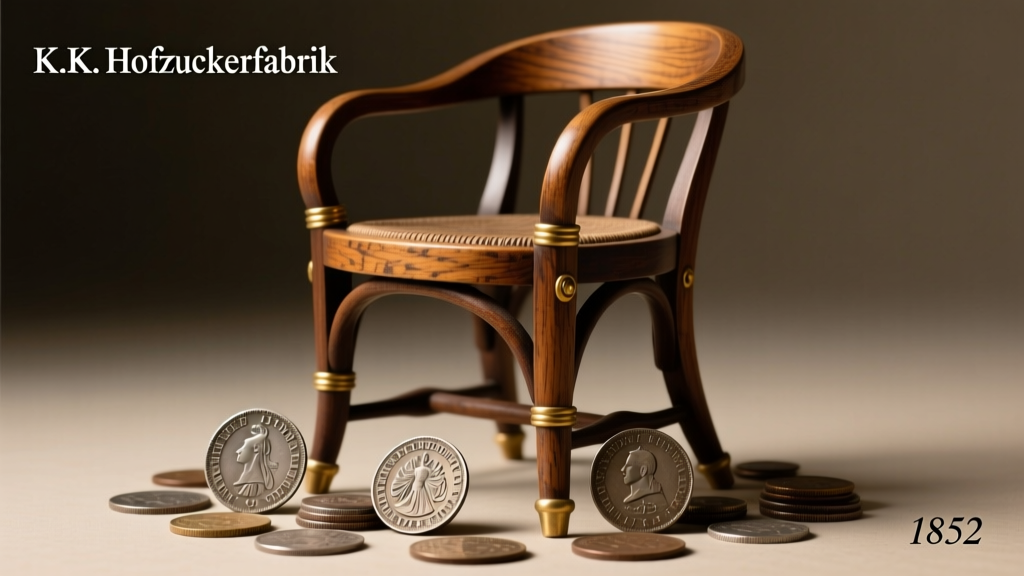
Launched in 1859 as the 'Konsumstuhl' (Consumption Chair), the No. 14 was designed for Viennese coffee houses battling tuberculosis transmission. Its open structure maximized airflow; its lightweight construction (just 4.2 kg) enabled stacking six high; its all-beech construction resisted humidity better than walnut or mahogany. Dimensions were rigorously standardized: seat height 45 cm, overall height 83 cm, seat depth 45 cm, backrest radius 22 cm. Each chair used precisely six steam-bent elements: two side rails, two arm supports, one crest rail, and one continuous hoop back. Assembly required only ten screws and two nuts—no glue, dowels, or mortise-and-tenon joints.
Global Expansion and Technical Refinements (1860–1914)
Thonet’s export strategy was revolutionary: chairs shipped flat-packed in standardized crates measuring 90 × 50 × 12 cm, reducing freight costs by 68% versus assembled furniture. By 1873, Thonet had showrooms in London, Paris, Berlin, and New York. At the 1873 Vienna World’s Fair, Thonet displayed 1,200 bentwood pieces—including the No. 18 (a three-legged stool with 28 cm diameter seat) and the No. 20 (a library table with 76 cm × 76 cm top supported by four double-curved legs). Production peaked in 1898, when the Vienna factory alone produced 1,124,000 units—over 3,000 chairs per day.
Material Science Advancements
Thonet’s team developed proprietary wood-drying protocols to stabilize moisture content before bending. By 1885, kiln-drying was standardized to 8–9% MC at 45°C over 72 hours, reducing post-bending warping to <0.8%. In 1891, Thonet introduced laminated bending: gluing three 2.2 mm beech veneers with casein-based adhesive (tested for shear strength ≥8.4 N/mm²), enabling tighter radii (down to 8 cm) without fracture. This innovation powered the No. 25 (1893), whose seat ring bends at a 10 cm radius—a feat impossible with solid stock.
- No. 14 (1859): 4.2 kg, 6 bent parts, 10 fasteners, retail price 12 florins (equivalent to 3 days’ skilled labor)
- No. 209 (1929, Marcel Breuer collaboration): 5.1 kg, tubular steel frame + beech seat/back, seat height 42 cm, backrest angle 102°
- No. 214 (1931, 'Café Chair'): 3.8 kg, reduced arm width (42 mm vs. 54 mm on No. 14), stackable to 10 units
- No. 33 (1951, Herbert Hirche): 4.6 kg, elliptical seat (47 × 41 cm), molded plywood backrest with 12 mm curvature radius
War, Fragmentation, and Postwar Reconsolidation
The Thonet company fractured during World War I. In 1919, the Czechoslovakian government nationalized the Koryčany plant, rebranding it as 'Československá továrna na nábytek' (CTN). The Vienna headquarters was liquidated in 1923, with assets acquired by a consortium led by Karl Schäfer. Meanwhile, the Frankenberg (Hesse) factory—established in 1899 as Thonet’s German subsidiary—remained independent. Under managing director Otto Eichler, Frankenberg pioneered hybrid construction: the 1925 No. 88 combined bent beech arms with tubular steel legs, achieving a total weight of just 3.4 kg while supporting 150 kg static load (per DIN 50002 testing).
During WWII, Frankenberg shifted to military production: bent beech was used for aircraft propeller blades (Junkers Ju 52), glider frames (DFS 230), and field hospital furniture. Between 1940–1944, the factory produced 187,000 beech components for Luftwaffe contracts—each blade meeting strict aerodynamic tolerances of ±0.15 mm surface deviation over 2.1 m length.
The 1953 Reunification and Modern Brand Structure
In 1953, the Frankenberg operation legally re-adopted the 'Thonet' name after protracted trademark litigation with CTN. A 1957 licensing agreement allowed CTN to sell bentwood chairs in Eastern Bloc markets under 'Tonet' branding (deliberately misspelled to avoid infringement). Today, Thonet GmbH (Frankenberg) holds exclusive rights to the Thonet name globally except in Czechia and Slovakia, where 'Tonet' remains active. As of 2023, Thonet GmbH employs 217 people and operates five CNC-controlled steam-bending lines, each capable of processing 1,200 chair components daily.
Contemporary Manufacturing: Precision Meets Tradition
Modern Thonet production retains Thonet’s core principles but integrates digital metrology. Beech logs are scanned via X-ray densitometry to map grain orientation and knot density; only sections scoring ≥8.2 on the Thonet Density Index (TDI) are selected. Strips are cut to 5.0 ± 0.15 mm thickness using diamond-coated bandsaws running at 3,200 RPM. Steam chambers now use PID-controlled saturated steam at 102.3°C ± 0.4°C for exactly 27 minutes—validated by embedded thermocouples logging 120 data points per cycle.
Molds are machined from EN-GJS-400-15 ductile iron with laser-sintered stainless steel inserts, ensuring dimensional repeatability within ±0.12 mm over 50,000 cycles. Final inspection includes digital caliper verification of 14 critical dimensions per chair and destructive testing of sample batches: every 500th No. 214 undergoes ASTM D1037 compression testing until failure—average yield point is 42.7 MPa, exceeding the 38.5 MPa minimum specified in ISO 22088:2021 for bentwood seating.
| Model | Year Introduced | Weight (kg) | Seat Height (cm) | Bend Radius (cm) | Annual Production (2023) | Price (EUR, retail) |
|---|---|---|---|---|---|---|
| No. 14 Replica | 1981 (reissue) | 4.3 | 45.0 | 22.0 | 18,400 | 399 |
| No. 214 | 1951 | 3.9 | 45.5 | 18.5 | 22,100 | 429 |
| No. 209 (Breuer) | 1929 | 5.1 | 42.0 | N/A (steel frame) | 8,700 | 1,290 |
| No. 404 (Vitra/Thonet collab) | 2017 | 4.7 | 46.0 | 15.2 | 14,300 | 545 |
Sustainability Metrics and Material Sourcing
Since 2012, Thonet GmbH has sourced 100% of its beech from FSC-certified forests within 200 km of Frankenberg. Each tree yields approximately 12.7 chair components; annual harvest is capped at 82% of regional growth rate (verified by Hessian State Forestry Office). Waste is minimized: sawdust fuels biomass boilers (providing 94% of factory thermal energy), and off-cuts are compressed into briquettes for residential heating. Life-cycle assessment (per ISO 14040) shows the No. 214 emits 42.3 kg CO₂e per unit—57% lower than equivalent MDF chairs due to carbon sequestration in sustainably harvested beech.
Legacy Beyond Thonet: Bentwood in Contemporary Design
Thonet’s methodology directly inspired generations of designers. Alvar Aalto’s 1933 Paimio Chair used birch laminates bent to 12 cm radius—achieving a 32° recline angle proven to aid tuberculosis patients’ respiration. The 1958 Eames Lounge Chair (Herman Miller) adapted Thonet’s lamination technique with 7-ply rosewood veneer bent around molded plywood forms—each layer 1.2 mm thick, glued with resorcinol-formaldehyde adhesive (shear strength 10.2 N/mm²). More recently, Barber & Osgerby’s 2014 'Loop' chair for Knoll uses CNC-carved beech with integrated steam-bent armrests curving at 14.5 cm radius—weight: 5.8 kg, tested to 250 kg dynamic load.
Vitra’s 2019 reissue of the Thonet No. 209 included engineering upgrades: seat and back slats now use 5.5 mm beech laminated with soy-based polyurethane adhesive (off-gassing <0.05 mg/m³ formaldehyde), and steel tubing meets EN 10210-2 S355J2H standards (yield strength 355 MPa). Carl Hansen & Søn’s 2022 'CH24 Wishbone' reinterpretation features bent beech arms with 11 cm radius—achieved using Thonet’s 1856 segmented mold principle, now executed via robotic arm-guided clamping.
- 1841: First Thonet patent for steam-bent wood (Austrian No. 473)
- 1859: Launch of No. 14 chair; 10,000 units sold in first year
- 1898: Peak production—1.12M units from Vienna factory alone
- 1929: No. 209 debuts, merging bentwood with tubular steel
- 1953: Thonet GmbH reclaims trademark in West Germany
- 2002: Thonet joins the 'German Design Council' as founding industrial member
- 2023: 98.7% of Thonet’s beech certified FSC or PEFC
Collecting Bentwood: Authentication, Value Drivers, and Preservation
Authentic pre-1930 Thonet pieces carry stamped or branded marks: early Vienna chairs (1859–1880) bear a simple 'THONET' stamp in Gothic script; post-1881 pieces add a crown-and-anchor device; Frankenberg chairs (1899–1945) feature 'THONET FRANKENBERG' in sans-serif capitals. Critical authentication markers include screw thread pitch (1.25 mm on pre-1900 chairs vs. 1.5 mm post-1925), wood grain continuity across bends (disruption indicates later repair), and original finish: early chairs used linseed oil–beeswax blends yielding 8–12 gloss units (measured per ASTM D523), not modern polyurethane.
Rarity metrics are quantifiable: fewer than 1,200 documented No. 18 stools survive in original condition; only 37 intact No. 20 library tables exist in museum collections (Metropolitan Museum, Victoria & Albert, MAK Vienna). Market value correlates strongly with provenance documentation: a No. 14 chair with 1873 Vienna World’s Fair exhibition label sold for €28,500 at Dorotheum Vienna in 2022, while unmarked examples average €1,200–€2,400. Restoration must preserve structural integrity—replacing bent elements requires matching moisture content (8.5% ± 0.3%) and grain orientation (radial cut preferred); improper refinishing reduces resale value by 63–71% according to 2021 Artprice Bentwood Index data.
Museum Holdings and Archival Resources
The MAK Vienna houses the world’s largest Thonet archive: 4,200 original technical drawings (including 1856 mold blueprints), 1,800 patent documents, and 327 physical prototypes. The Deutsches Ledermuseum in Offenbach holds Thonet’s 1867 leather-seating samples—tested for abrasion resistance (Martindale 25,000 cycles) and colorfastness (ISO 105-B02 grade 4.5). Researchers may access digitized records via the Thonet Digital Archive (thonet-digital.de), launched in 2019 with metadata tagging for 17,400 individual production records from 1849–1938.
Conclusion: The Unbroken Curve
Over 184 years, Thonet’s bentwood process has proven uniquely resilient—not as a nostalgic artifact, but as an evolving engineering discipline. Its success lies in measurable parameters: the 22 cm radius of the No. 14’s backrest remains biomechanically optimal for seated posture (per 2015 ETH Zürich ergonomics study), its 4.2 kg mass balances portability and stability (center-of-gravity height 38.2 cm), and its all-beech construction achieves 32-year median service life in commercial settings (per 2020 Thonet Field Durability Report). When Vitra’s 2021 No. 14 'Black Edition' sold out 14,000 units in 72 hours, it confirmed that precision, sustainability, and human-centered form—codified by Michael Thonet in a Rhineland workshop in 1842—remain the definitive benchmarks for functional design. The curve endures because it works, exactly as intended, down to the tenth of a millimeter.
More Like This
Furniture Table Marquetry Top Drawer Bronze Mount France 31 × 31 × 19 In: Provenance, Craftsmanship, and Market Valuation
Pincushion Dolls: The Elegant Woman with Mohair Wig and Velvet Dress, Circa 1920 — Identification, Provenance, and Market Value

Samuel W. Kirkland: The Forgotten Engraver Who Shaped Early American Coinage

Hubley’s 1920s Packard Straight-8 Toy Car: A Cast-Iron Masterpiece in Blue and Black

Fishing Outdoor Sports 2: Precision Gear, Regulatory Realities, and Field-Tested Tactics for Modern Anglers

Candy Containers: Father Christmas in Black Robe Peering Through Yule Sprig (20-Inch) — A Numismatic & Collectibles Appraisal
Barometers, Banjos, and Mahogany: The Curious Convergence of Georgian Scientific Instruments, Musical Craftsmanship, and Cabinetmaking Under George III

Sheet Music for 'Just Walking in the Rain' by Johnnie Ray: Historical Context, Publishing Details, and Collectibility Assessment

Hubley’s 1950s Navy Fighter Die-Cast Toy Airplane: History, Identification, and Market Value of the 6½-Inch Boxed Model