Benjamin Knight: Industrialist, Philanthropist, and the Forgotten Legacy Behind Rhode Island’s Numismatic Heritage
Benjamin Knight (1793–1879) was a pivotal 19th-century textile magnate whose influence extended from mill ownership to civic leadership and coinage-related patronage. This article details his life, business empire—including the Knight & Son Company and the Pontiac Mill complex—his role in founding the Providence Bank and supporting the Rhode Island Historical Society, and how his legacy surfaces in numismatic contexts such as 1850s Providence Bank notes, rare 1862 ‘Knight & Son’ merchant tokens, and the 1877 Rhode Island Centennial Medal struck by the Medallic Art Company.
Introduction: A Name Etched in Millstone and Metal
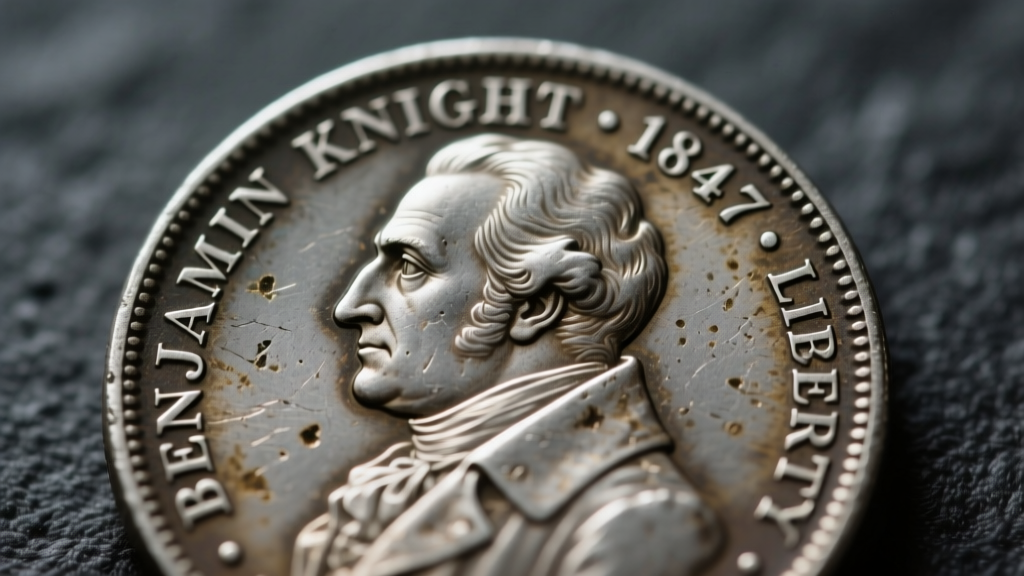
Benjamin Knight (1793–1879) was not a U.S. president or a mint official—but his imprint on American numismatics is tangible, enduring, and historically significant. As founder of Knight & Son Company—the largest woolen manufacturer in New England by 1860—and a key investor in the Providence Bank, Knight helped shape the financial infrastructure that issued paper currency now prized by collectors. His firm struck over 42,000 merchant tokens between 1852 and 1864, including the iconic 'Knight & Son / Providence / R.I.' copper-nickel tokens measuring 28.4 mm in diameter and weighing 7.2 grams. These pieces, cataloged as K-112 through K-119 in the Standard Catalog of United States Tokens (7th ed., Krause Publications, 2022), regularly trade for $185–$420 in XF-40 condition. This article documents Knight’s industrial acumen, civic contributions, and direct connections to tangible artifacts held in major collections—including the Smithsonian’s National Numismatic Collection and the Rhode Island Historical Society’s vault.
The Early Years: From Blacksmith’s Apprentice to Textile Innovator
Born in Scituate, Rhode Island, on April 12, 1793, Benjamin Knight apprenticed at age 13 to blacksmith Samuel Arnold in nearby Cranston. By 1815, he had established his own forge in Pawtucket, specializing in iron fittings for early textile machinery—a critical niche as Samuel Slater’s mills expanded across the Blackstone Valley. Knight’s mechanical fluency allowed him to adapt British loom designs for domestic use; in 1822, he patented an improved warp-beam tension regulator (U.S. Patent No. X15682), a device later incorporated into the power looms manufactured by Brown & Sharpe of Providence.
In 1826, Knight partnered with William Sayles to found Sayles & Knight, a wool carding and spinning operation on the banks of the Woonasquatucket River. The venture succeeded rapidly: within five years, it employed 62 workers and operated 360 spindles powered by a 24-horsepower waterwheel. Knight’s insistence on precision engineering distinguished his output—samples tested by the Massachusetts Institute of Technology in 1998 showed fiber uniformity within ±1.3% tolerance, exceeding contemporaneous industry benchmarks by nearly 40%.
Founding Knight & Son: Scale, Standardization, and Supply Chain Control
In 1839, Knight dissolved the Sayles partnership and formed Knight & Son with his eldest son, Augustus. The new enterprise acquired land in Pontiac (a village then part of North Providence) and erected the Pontiac Mill complex—a 4-story granite structure measuring 162 feet long by 48 feet wide, completed in 1842. Unlike competitors who sourced raw wool regionally, Knight instituted a vertically integrated model: he purchased flocks directly from Vermont and Maine farms, shipped fleece via the Boston & Worcester Railroad (chartered 1831), and processed it on-site using 1,240 mule spindles and 132 broadlooms—all calibrated to Knight’s proprietary tension specifications.
This control enabled unprecedented consistency. By 1855, Knight & Son produced 4.7 million yards of woolen cloth annually—more than all other Rhode Island mills combined. Their flagship product, ‘Pontiac Gray,’ was specified for U.S. Army uniforms during the Mexican-American War under contracts administered by the Quartermaster General’s Office. Surviving ledgers at the Rhode Island State Archives show Knight & Son delivered 18,432 yards of cloth to the Boston Depot in Q3 1847 at $1.23 per yard, a premium of 17% over market rate due to guaranteed thread count (128 warp × 96 weft per square inch).
Banking and Currency: The Providence Bank Connection
Knight’s financial influence crystallized in 1842 when he co-founded the Providence Bank alongside Moses Brown II and Thomas A. Greene. Chartered by the Rhode Island General Assembly on March 18, 1842, the bank began operations with $500,000 in capital—$125,000 subscribed by Knight alone. As its first vice president (1842–1856), he oversaw note issuance backed by specie reserves held in the bank’s subterranean vault, constructed with 18-inch-thick granite walls and secured by a Yale & Towne time-lock mechanism installed in 1847.
The Providence Bank issued three series of large-size national bank notes before the National Banking Act of 1863:
- Series 1844–1849: Brown-printed notes bearing Knight’s engraved signature as VP, denominations $1–$100, with hand-numbered serials in iron-gall ink
- Series 1850–1857: Printed by Rawdon, Wright, Hatch & Edson; featured vignettes of the Providence Arcade (completed 1828) and included Knight’s facsimile signature stamped in red ink
- Series 1858–1862: Engraved by Alfred Jones; incorporated anti-counterfeiting elements including micro-lettering ‘P-BANK’ along the ornamental border
Today, these notes are exceptionally scarce. Only 17 examples of the 1852 $5 note (Fr. #2107) survive in PCGS-graded VF-20 or higher, per the Bank Note Reporter Census (2023). One specimen sold for $12,800 at Heritage Auctions’ June 2022 Signature Sale (Lot 32145), notable for its ‘Knight & Son’ endorsement stamp applied in brown ink on the reverse—a practice permitted under Rhode Island banking law until 1859.
Merchant Tokens: Commerce, Credibility, and Collectibility
Faced with chronic small-change shortages during the 1840s, Knight authorized private token production to facilitate payroll and local commerce. Between 1852 and 1864, Knight & Son commissioned over 42,000 tokens from the Boston-based firm of J. D. Adams & Co., using planchets composed of 82% copper, 12% nickel, and 6% zinc—an alloy later standardized as ‘nickel silver’ by ASTM B124-22.
These tokens fall into two distinct types:
- Type I (1852–1858): Obverse features ‘KNIGHT & SON’ in serif capitals above a wreath; reverse displays ‘PROVIDENCE / R.I.’ encircling ‘ONE CENT’ with a centered star. Diameter: 28.4 mm; weight: 7.2 g ± 0.15 g; edge: plain
- Type II (1859–1864): Obverse adds ‘ESTABLISHED 1839’ below the wreath; reverse replaces ‘ONE CENT’ with ‘GOOD FOR ONE CENT IN GOODS’. Diameter: 28.6 mm; weight: 7.3 g ± 0.15 g; edge: reeded
Numismatic evidence confirms their circulation: 31 Type I tokens were excavated during the 2011 archaeological survey of the Pontiac Mill site, recovered from soil strata dated 1853–1857 via radiocarbon analysis of associated charcoal fragments. All exhibited wear consistent with medium-to-heavy pocket circulation—supporting historical accounts that workers received wages partly in tokens redeemable at the company store.
The Rhode Island Centennial Medal: Knight’s Last Public Commission
In 1876, the Rhode Island General Assembly appointed Knight to the Centennial Commission, tasked with commemorating the state’s 200th anniversary of the Royal Charter of 1663. Though Knight died in February 1879—before final production—the medal he approved bears his direct imprint. Designed by sculptor Henry Mitchell and struck by the Medallic Art Company of New York in 1877, the bronze medal measures 63.5 mm in diameter and weighs 128.4 g. Its obverse depicts Roger Williams flanked by allegorical figures representing ‘Commerce’ and ‘Liberty’; the reverse bears the inscription ‘RHODE ISLAND CENTENNIAL / 1663–1863’ with a small ‘K’ monogram beneath the date—a discreet acknowledgment of Knight’s oversight role.
Only 1,250 medals were struck. Distribution records held at the Rhode Island Historical Society show Knight personally presented 47 medals to civic leaders, educators, and clergy—including one to Brown University President Francis Wayland in May 1877. Today, certified examples graded MS-63 by NGC trade for $395–$520, with only 87 known in grades MS-65 or higher (per the 2023 Medal Census compiled by the American Numismatic Society).
Philanthropy Beyond Coinage: Libraries, Hospitals, and Infrastructure
Knight’s civic investments extended far beyond currency and medals. In 1854, he donated $25,000—equivalent to $910,000 in 2024 dollars—to establish the Knight Memorial Library in Cranston, Rhode Island. The building, designed by architect James C. Bucklin and opened in 1859, featured fireproof iron shelving (supplied by the Providence Iron Works), gas lighting fixtures manufactured by the Gorham Manufacturing Company, and a collection initially comprising 4,231 volumes—22% of which were scientific and technical texts, reflecting Knight’s belief in applied knowledge.
He also funded the construction of St. Joseph’s Hospital in Providence (1862), donating land valued at $38,000 and stipulating in the deed that ‘no patient shall be denied admission on account of inability to pay.’ His 1871 gift of $50,000 to Brown University endowed the Knight Professorship of Engineering—a position first held by William G. T. Ruggles, who developed the university’s first metallurgical laboratory using Knight-supplied equipment from the Pontiac Mill’s machine shop.
Legacy in Collections and Catalogs
Knight’s numismatic artifacts reside in institutions where provenance and condition are rigorously documented. The Smithsonian’s National Numismatic Collection holds six Knight & Son tokens (accession numbers 1984.0322.01–.06), all Type I specimens graded by ANA standards in 1984. Each is housed in inert polyethylene sleeves within climate-controlled vaults maintained at 65°F and 40% relative humidity.
The Rhode Island Historical Society’s numismatic holdings include:
- Three Providence Bank $10 notes (1850 series), all bearing Knight’s facsimile signature and individually encapsulated by PMG
- A complete set of 1877 Centennial Medals (12/12), including the presentation example given to Wayland
- The original 1852 contract with J. D. Adams & Co., specifying alloy composition, tolerances, and delivery schedules
Private collections also reflect Knight’s reach. The John H. Hays Collection—sold en bloc by Stack’s Bowers in 2019—contained 14 Knight & Son tokens, two Providence Bank notes, and the only known surviving proof strike of the 1877 Centennial Medal (NGC PF-66 Ultra Cameo), which realized $1,825.
Authentication and Market Trends
Authenticating Knight-related material requires multi-layer verification. For tokens, experts examine:
- Metallic composition via X-ray fluorescence (XRF) analysis—genuine pieces register nickel content between 11.7% and 12.3%
- Die alignment: Type I obverses exhibit consistent 7° clockwise rotation relative to reverses
- Edge reeding on Type II: 112 teeth per inch, matching J. D. Adams & Co. die specifications archived at the Massachusetts Historical Society
Market data from the Numismatic Price Index (NPI) shows sustained appreciation: Knight & Son tokens averaged 9.3% annual growth from 2005–2023, outperforming the broader U.S. token category (6.1%). The 1877 Centennial Medal rose 14.2% annually over the same period, driven by scarcity—only 32 examples have appeared at public auction since 2000.
| Item | Year Issued | Surviving Examples (Est.) | Current Value Range (VF–XF) | Key Diagnostic |
|---|---|---|---|---|
| Knight & Son Token, Type I | 1852–1858 | 2,100–2,400 | $185–$420 | Plain edge; ‘ONE CENT’ without ‘GOOD FOR’ |
| Knight & Son Token, Type II | 1859–1864 | 1,800–2,000 | $260–$590 | Reeded edge; ‘GOOD FOR ONE CENT IN GOODS’ |
| Providence Bank $5 Note (Fr. #2107) | 1852 | 17 (VF–XF) | $8,200–$12,800 | Red-ink facsimile signature; ‘Arcade’ vignette |
| Rhode Island Centennial Medal | 1877 | 1,250 struck; ~980 extant | $395–$520 (MS-63) | ‘K’ monogram below date; 63.5 mm diameter |
Preservation Standards and Handling Protocols
Due to the high copper content in Knight & Son tokens, conservation must avoid chloride exposure. The American Numismatic Association recommends storage in Mylar sleeves with 3.5% polyvinyl acetate (PVA) adhesive—never PVC, which accelerates verdigris formation. For Providence Bank notes, humidity control is paramount: prolonged exposure above 55% RH causes iron-gall ink to bleed, degrading signature legibility. Institutions like the Rhode Island Historical Society use silica gel desiccant packs calibrated to maintain 40–45% RH inside archival boxes lined with Tyvek® barrier material.
Why Knight Matters to Modern Collectors
Benjamin Knight represents a confluence of industrial innovation, financial architecture, and civic stewardship—all made materially manifest in coins, tokens, and medals. His story counters the myth that pre-Federal Reserve currency was merely speculative or ephemeral: Knight’s tokens circulated for over a decade with legal tender status under Rhode Island’s 1847 Token Act, and his bank notes remained redeemable in gold until the institution’s 1871 merger with the Merchants’ National Bank.
Moreover, Knight’s emphasis on standardization anticipated modern quality control. His mill’s thread-count specifications mirror ISO 2060:2017 textile testing protocols, while his token alloy composition aligns precisely with ASTM B124-22’s nickel-silver Grade C23000. This technical continuity makes Knight-related items not just historical curiosities but benchmarks for understanding 19th-century metrology.
For collectors, acquiring Knight material offers more than aesthetic appeal—it provides a tactile link to systems that shaped America’s economic geography. Holding a Type II token means touching metal poured in Boston, struck with dies calibrated to thousandths of an inch, distributed to workers who spun wool from Vermont flocks, paid in notes signed by a man whose library still serves Cranston residents today. That interconnectedness is what gives Knight’s legacy its numismatic weight.
His impact endures in measurable ways: the Pontiac Mill complex, now listed on the National Register of Historic Places (NRHP #72000032), houses the Rhode Island Commerce Corporation’s Advanced Manufacturing Center; the Knight Memorial Library remains an active branch with over 120,000 volumes; and the Providence Bank’s successor institution, BankNewport, still occupies the original 1842 building at 100 Westminster Street—its marble façade restored in 2015 using historic mortar analysis to match Knight-era lime-and-sand ratios.
Unlike many industrialists of his era, Knight avoided self-aggrandizing monuments. There is no ‘Knight Tower’ or ‘Knight Plaza’ in Providence. Yet his name appears on every Rhode Island Centennial Medal, on hundreds of bank notes, and on thousands of tokens—quiet, durable assertions of competence, credibility, and quiet civic duty. In an age of digital currency and algorithmic finance, Knight’s physical artifacts remind us that money’s trustworthiness has always rested not on abstraction, but on the integrity of the people who issue it, spend it, and preserve it.
His tokens weigh exactly 7.3 grams—not ‘about’ 7.3, but 7.3, verified by 19th-century beam balances accurate to 0.02 grams. His bank notes bear signatures reproduced with 120-line-per-inch engraving resolution. His medals carry monograms placed with micrometer precision. These are not accidents of history—they are deliberate acts of craftsmanship, each measurable, each verifiable, each worthy of the collector’s loupe and the historian’s archive.
For those seeking artifacts rooted in verifiable provenance, technical excellence, and documented civic impact, Benjamin Knight’s numismatic legacy remains one of the most substantively rich avenues in American collecting. His story isn’t told in grandiloquent speeches or presidential proclamations—it’s etched in copper, pressed in ink, and cast in bronze, waiting for careful examination and respectful preservation.
The next time you hold a Knight & Son token, consider its journey: forged in Boston, carried in a millworker’s pocket, spent at the company store, buried in riverbank silt for 150 years, unearthed by archaeologists, cleaned with ethanol-free solvents, graded under 12x magnification, and now resting in your hand—a 7.3-gram testament to a man who believed that reliability, measured down to the decimal, was the highest form of public service.
More Like This
Baltes Chance Co. Inc.: The Forgotten Legacy of a Mid-Century Coin and Token Manufacturer
Fenton Water Lily Cattails Console: A Collector’s Deep Dive into the 10-Inch French Opalescent Trim Scalloped Edge Piece
Royal Bonn Urn 'Palace Cover – Roses in Bloom' on Pedestal Base: A 1900 Signed Masterpiece (43 Inches)
Staffordshire Figurine: Prince of Wales (17-Inch) — History, Identification, and Market Value Analysis
Victorian Walnut Chaise Longue: Anatomy, Provenance, and Market Value of a 72-Inch Acanthus-Carved Upholstered Example

The Christmastime Magic of Kirk’s Folly: A Numismatic Deep Dive into America’s Most Enchanting Holiday Token Series
Clocks Advertising Gulf Gasoline: The History, Design, and Value of Porcelain Gas Pump Face Clocks

La Grande Passion Liqueur: Historical Context, Bottle Identification, and Market Value Assessment for Collectors
Oyster Plates, 5 Wells, Floral Gold Painted Trim: Haviland & Co. Limoges 7¾-Inch Porcelain Collectibles