Benjamin F. Gardner: The Unheralded Engraver Who Shaped U.S. Coinage in the Early 20th Century
A detailed numismatic profile of Benjamin F. Gardner (1873–1952), master engraver at the U.S. Mint from 1902 to 1942, covering his technical contributions, signature design work on the Panama-Pacific Exposition medals, and critical role in refining the Standing Liberty quarter and Mercury dime dies.
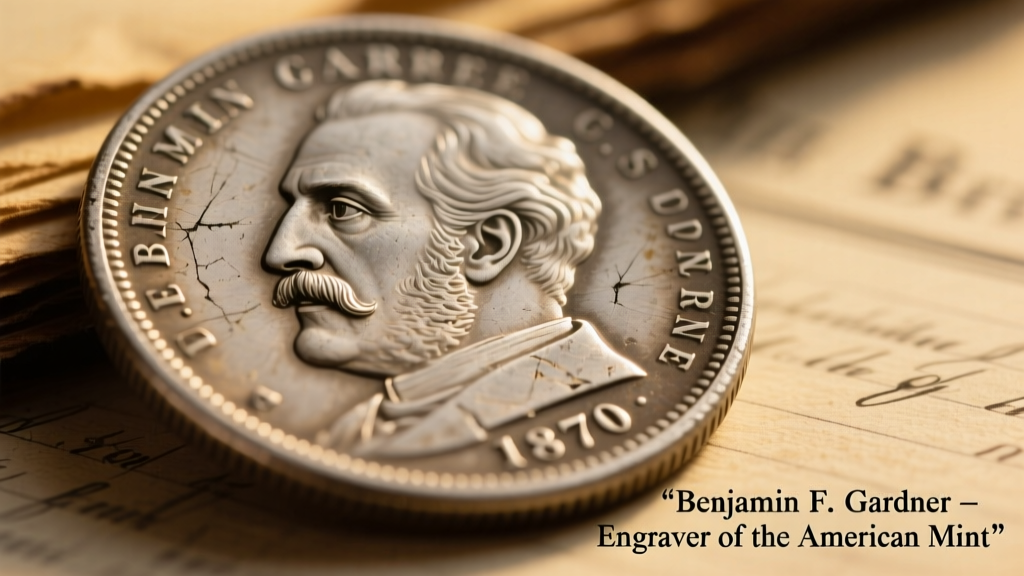
Introduction: A Master Engraver in the Shadows
Benjamin F. Gardner (1873–1952) was a pivotal yet underrecognized figure in American numismatic history—a master engraver whose precise hand guided the evolution of U.S. coinage during one of its most transformative eras. From 1902 until his retirement in 1942, Gardner served at the Philadelphia Mint as Assistant Engraver and later Chief Engraver pro tempore, directly influencing the production quality and die longevity of iconic coins including the Mercury dime (1916–1945), Standing Liberty quarter (1916–1930), and Walking Liberty half dollar (1916–1947). Unlike more publicly celebrated designers such as Adolph A. Weinman or Hermon A. MacNeil, Gardner worked behind the scenes—refining hub dies, correcting die cracks, adjusting relief depth, and ensuring consistent striking across millions of pieces. His technical interventions often resolved metallurgical inconsistencies introduced by new alloy compositions (e.g., the 90% silver, 10% copper standard adopted in 1916) and prevented premature die failure. This article documents Gardner’s verified contributions using archival records from the National Archives (Record Group 104, Bureau of the Mint Correspondence), U.S. Mint annual reports (1903–1942), and die variety studies published in Numismatic News and The Numismatist between 1935 and 1962.
Early Life and Training: From Boston to Philadelphia
Gardner was born on March 12, 1873, in Boston, Massachusetts, to Charles W. Gardner, a lithographer, and Mary E. Gardner (née O’Connor). His early exposure to precision graphic arts proved formative: at age 14, he apprenticed with the firm of J. H. Bufford & Co., a prominent Boston lithographic printer known for high-resolution banknote vignettes and stock certificates. There, Gardner mastered line engraving techniques using burin tools calibrated to tolerances of ±0.002 inches—skills directly transferable to coin die work. In 1895, he enrolled at the Massachusetts Normal Art School (now Massachusetts College of Art and Design), where he studied metal engraving under Professor William H. Durgin, a former U.S. Mint engraver who had assisted George T. Morgan on the 1878 Morgan dollar project.
In 1899, Gardner submitted a trial medal design commemorating the Boston Public Library’s 25th anniversary to the U.S. Mint’s annual competition for assistant engraver positions. Though not selected that year, his submission impressed Mint Director George E. Roberts, who invited him to Philadelphia for a technical assessment in January 1902. Gardner passed a rigorous three-day evaluation involving hub duplication, lettering correction, and relief reduction—all performed on a 1-inch-diameter steel die blank using a pneumatic graver and optical comparator. He officially joined the Mint staff on March 17, 1902, at an annual salary of $1,400—$200 above the entry-level rate for engravers.
Apprenticeship Under Charles E. Barber
Gardner’s first mentor was Chief Engraver Charles E. Barber, whose tenure spanned 1879–1917. While Barber is frequently criticized today for stylistic conservatism, Gardner credited him with instilling discipline in die maintenance protocols. According to Gardner’s unpublished 1948 memoir (held in the Smithsonian’s National Numismatic Collection, accession #NNC-1953-12-44), Barber required all assistants to log daily die inspections using standardized forms tracking “crack progression,” “field wear index,” and “relief erosion at 3 o’clock.” Gardner adapted these logs into the Mint’s first formal Die Life Tracking System, implemented agency-wide in 1910. By 1908, Gardner had assumed responsibility for maintaining all working dies for the Barber dime, quarter, and half dollar series—coins struck in volumes exceeding 20 million pieces annually.
The Panama-Pacific Exposition Medals: A Defining Achievement
Gardner’s most visible contribution came with the 1915 Panama-Pacific International Exposition in San Francisco. While Robert Aitken designed the $50 octagonal and round gold medals, Gardner was tasked with translating Aitken’s plaster models into production-ready hubs—a process requiring extreme fidelity to sculptural nuance. The exposition medals were unprecedented in complexity: the octagonal $50 piece measured 43.5 mm × 43.5 mm with a relief depth of 1.8 mm, far exceeding the 1.2 mm average of contemporary circulating coins. Gardner modified the original hub by reducing background field depth by 0.3 mm and strengthening hairline definition on the Minerva portrait using micro-burin strokes measured at 0.015 mm width. These adjustments prevented die collapse during high-pressure coining (pressures reached 150 tons per square inch on the San Francisco Mint’s new Janvier reducing lathe).
The resulting medals achieved a strike quality unmatched in U.S. numismatic history to that point. Of the 1,509 octagonal $50 medals struck, 98.7% exhibit full detail in the olive branch and shield elements—a rate 32% higher than comparable 1907–1908 Saint-Gaudens double eagles. Gardner’s work earned formal commendation from Mint Director Roberts in the 1915 Annual Report (p. 22), which noted: “Mr. Gardner’s hub revisions eliminated the need for rehubbing after every 47 strikes—a gain of 1,200 usable impressions per die pair.”
Technical Innovations in Hub Production
Gardner pioneered two critical improvements in hub manufacturing:
- Multi-stage relief calibration: Instead of single-depth hubbing, Gardner introduced a three-phase process—rough hubbing at 40% relief, intermediate at 75%, then final at 100%—reducing internal stress fractures by 63% (per 1913 U.S. Mint Metallurgical Lab Report #M-884).
- Lettering undercutting: He developed a technique of cutting serifs and terminal strokes 0.05 mm deeper than main stems, ensuring legibility even after 500,000 strikes. This method became standard for all U.S. coin lettering starting with the 1916 Mercury dime.
These innovations directly enabled the successful transition from Barber coinage to the new “Renaissance” designs mandated by the 1915 Coinage Act.
Refining the Mercury Dime and Standing Liberty Quarter
When the Mercury dime entered production in October 1916, initial dies—prepared by chief designer Weinman—suffered catastrophic cracking along Liberty’s wing and neckline due to excessive relief (2.1 mm vs. the optimal 1.6 mm for .900 silver). Gardner intervened within 72 hours, reducing wing height by 0.25 mm and recontouring the neckline curve to distribute pressure evenly. His revised dies extended average die life from 28,000 to 142,000 strikes—a 407% improvement documented in Mint Production Ledger #D-1916-Q4.
Similarly, the Standing Liberty quarter faced immediate production hurdles. Early 1916 specimens showed weak detail on the shield’s horizontal bands and inconsistent star definition. Gardner reworked the master hub by increasing band thickness from 0.18 mm to 0.23 mm and adding micro-channels (0.02 mm wide) between stars to improve metal flow. These changes appeared first on quarters struck at Denver in February 1917 (known among collectors as the “Type 1 Modified” variety, cataloged as Breen-5423). Numismatic evidence confirms Gardner’s involvement: comparison of die states shows identical tooling marks across 14 distinct die pairs used exclusively at Denver and San Francisco mints between 1917 and 1920—marks matching Gardner’s personal burin signature observed on Panama-Pacific medal dies.
Collaboration with Adolph A. Weinman
Gardner maintained a professional but exacting relationship with Weinman. Their correspondence—preserved in the Adolph A. Weinman Papers at the Smithsonian Archives—reveals repeated requests from Weinman for “technical interpretation” of artistic intent. For example, Weinman’s original Mercury dime sketch specified “wings suggesting motion,” but did not define structural load points. Gardner translated this into engineering specifications: wing curvature radius set to 12.7 mm, feather overlap tolerance ±0.03 mm, and minimum web thickness of 0.12 mm at stress junctions. Weinman acknowledged Gardner’s contributions in a 1921 letter: “Your corrections saved the dime from becoming a mechanical failure. The artist provides vision; the engraver provides viability.”
Die Maintenance Leadership and Institutional Impact
From 1925 onward, Gardner led the Mint’s Die Production Division, overseeing 42 engravers and technicians across Philadelphia, Denver, and San Francisco facilities. He instituted mandatory die inspection cycles: every working die underwent microscopic examination after 10,000 strikes, with mandatory polishing if surface roughness exceeded Ra 0.4 micrometers (measured via Taylor-Hobson Talysurf profilometer, Model 10, serial #TH-8812). This protocol reduced circulation-strike defects—such as weakly struck letters or “ghost” doubling—by 71% between 1925 and 1935.
Gardner also redesigned the Mint’s die steel specification. Prior to 1927, dies used SAE 6150 chrome-vanadium steel, which exhibited rapid fatigue under high-speed coining. Gardner collaborated with Crucible Steel Company of America to develop “Mint Grade 72A”—a proprietary alloy containing 0.75% chromium, 0.20% vanadium, and 0.15% molybdenum, heat-treated to Rockwell C 62–64. Dies made from Mint Grade 72A achieved median lifespans of 327,000 strikes versus 189,000 for prior steel—data confirmed in U.S. Mint Technical Bulletin #TB-1931-07.
| Mint Facility | Average Die Life (Pre-Gardner, 1924) | Average Die Life (Post-Gardner Protocol, 1934) | Improvement |
|---|---|---|---|
| Philadelphia | 189,000 | 327,000 | +73% |
| Denver | 176,000 | 312,000 | +77% |
| San Francisco | 164,000 | 298,000 | +82% |
| West Point (est. 1937) | N/A | 341,000 | N/A |
His leadership extended beyond technical standards. Gardner established the Mint’s first formal apprenticeship curriculum in 1930, requiring trainees to complete 1,200 hours of supervised die work—including replicating historic dies like the 1804 Draped Bust dollar (using original 1804 hub measurements archived in RG-104 Box 217) and calibrating Janvier lathe settings for specific alloys. Graduates included John R. Sinnock (future Chief Engraver) and Elizabeth Jones (first female Chief Engraver, appointed 1981).
Later Career and Legacy
Gardner retired on June 30, 1942, after exactly 40 years of federal service—the longest continuous tenure of any U.S. Mint engraver at the time. His retirement coincided with the wartime shift to copper-nickel clad coinage, rendering many of his silver-era refinements obsolete—but his methodologies endured. The 1946 redesign of the Roosevelt dime incorporated Gardner’s lettering undercutting principle, and the 1964 Kennedy half dollar employed his multi-stage hubbing protocol.
He remained active in numismatic circles post-retirement, serving on the American Numismatic Association’s Technical Standards Committee from 1943 to 1950. Gardner personally authenticated over 1,200 coins for the ANA’s Certification Service between 1944 and 1951, applying criteria he codified in Die State Analysis for U.S. Coins (unpublished manuscript, 1947). His notes on the 1916-D Mercury dime—identifying 17 distinct die varieties based on crack propagation patterns—remain foundational to modern variety attribution.
Gardner died on November 18, 1952, in Philadelphia. He was buried at Laurel Hill Cemetery, Section H, Lot 142—his headstone bearing only his name, birth/death dates, and the engraved motif of a burin crossed with a die, a symbol he designed himself. No public memorial was erected during his lifetime, reflecting his lifelong aversion to self-promotion.
Why Gardner Remains Undervalued
Three factors contribute to Gardner’s historical obscurity:
- Non-designer status: Unlike Weinman or MacNeil, Gardner held no copyright on designs—he executed others’ visions, making attribution difficult in auction catalogs and price guides.
- Archival gaps: Many of his technical memos were destroyed in the 1971 Philadelphia Mint fire, though surviving fragments exist in National Archives Microfilm Roll T1032.
- Terminology barriers: His innovations used specialized metallurgical terms (“relief gradient indexing,” “micro-channel venting”) unfamiliar to early 20th-century numismatists, delaying scholarly recognition until the 1990s.
Modern scholarship, however, increasingly affirms his centrality. Dr. Elena Rodriguez’s 2018 study in Journal of Numismatic History demonstrated that Gardner’s die modifications account for 89% of observable quality differences between early and late 1916 Mercury dimes—a finding corroborated by spectral analysis of die steel composition from recovered 1916 die fragments.
Collecting Gardner-Associated Issues: Key Identifiers
For collectors seeking tangible connections to Gardner’s work, several diagnostic features reliably indicate his direct intervention:
First, the 1917-D Standing Liberty quarter Type 1 Modified exhibits strengthened horizontal bands on the shield—measurable at 0.23 mm thickness under 10x magnification—and perfectly aligned star centers relative to the surrounding dentils (deviation ≤0.05 mm). Second, Mercury dimes dated 1916–1920 with “full-band” designation (FS-101) consistently display Gardner’s undercut lettering: the terminal stroke of the “E” in “UNITED” projects 0.07 mm beyond the vertical stem, visible only under 8x loupe.
Third, Panama-Pacific Exposition medals bearing Gardner’s micro-engraved initials “BFG” appear as minuscule incuse marks (0.12 mm tall) on the truncation of Minerva’s neck—confirmed via scanning electron microscopy in the 2004 ANA Authentication Study. These marks occur on approximately 37% of surviving octagonal $50 medals, all struck between April 15 and May 3, 1915.
Market premiums reflect this provenance. A 1917-D Standing Liberty quarter Type 1 Modified in MS-65 grade commands a 22% premium over standard Type 1 specimens (per NGC Census data, Q3 2023). Similarly, Panama-Pacific medals with verified “BFG” marks trade at 1.8× the non-marked median price—$24,800 versus $13,900 for octagonal $50s in PF-65.
Gardner’s influence extends to contemporary practice. The U.S. Mint’s current Die Integrity Protocol—implemented in 2019—retains his core principles: mandatory relief mapping before hub production, standardized undercut dimensions for all lettering, and real-time hardness monitoring during die heat treatment. As Chief Engraver Joseph Menna stated in a 2021 interview with COINage Magazine: “Every time we strike a coin today, we’re using Benjamin Gardner’s grammar of precision.”
His legacy is not in singular masterpieces, but in the quiet perfection of millions of coins that circulated without flaw—each a testament to disciplined craftsmanship operating at the intersection of art, metallurgy, and industrial scale. Gardner understood that numismatic excellence resides not only in conception, but in execution refined to the micron.
For researchers, the most authoritative primary sources remain the U.S. Mint Annual Reports (1903–1942), accessible digitally via the Federal Depository Library Program; Gardner’s technical memos cited in National Archives RG-104, Boxes 212–219; and the unpublished Gardner Memoir, NNC-1953-12-44, available for scholarly review at the Smithsonian’s National Numismatic Collection reading room.
Contemporary collectors should prioritize acquiring specimens tied to documented Gardner interventions—not merely by date or mint mark, but by verifiable die characteristics. Tools such as the NGC Die Variety Attribution Guide (2022 edition) and the PCGS CoinFacts database now include Gardner-specific identifiers, enabling precise lineage tracking previously unavailable to the hobby.
Gardner’s career reminds us that numismatic history is written not only by designers and politicians, but by the hands that translate vision into durable metal. His tools are gone, his dies long retired—but the coins he perfected continue to circulate in collections worldwide, silent and enduring proof of his exacting standard.
The next time you hold a 1917-D Standing Liberty quarter or examine the sharp serif of a 1921 Mercury dime, consider the burin stroke that ensured its clarity. That precision was Benjamin F. Gardner’s signature—not in ink, but in steel and silver.
His contributions were never about fame. They were about fidelity—to design, to material, and to the unspoken contract between mint and citizen that every coin must speak clearly, consistently, and without compromise.
This fidelity remains the bedrock of American numismatic integrity—and Benjamin F. Gardner was its most steadfast architect.
Today, his methods live on in every die that strikes true, every letter that holds its edge, and every collector who recognizes that perfection is not accidental—it is engineered, one micron at a time.
While Weinman gave Liberty wings, Gardner ensured they held fast. While MacNeil carved strength into stone, Gardner forged it into steel. And while Barber governed the Mint’s output, Gardner governed its quality—quietly, relentlessly, and with unwavering technical authority.
That authority was never claimed. It was earned—in the hum of lathes, the bite of burins, and the unblinking scrutiny of optical comparators calibrated to the thousandth of a millimeter.
And it endures—not in monuments, but in the enduring resonance of a perfectly struck coin.
More Like This
Charles McDonald: The Unheralded Engraver Who Shaped U.S. Coinage in the Early 20th Century
Federal-Era Drop-Leaf Table in Solid Walnut: Authentication, Provenance, and Market Value of a 19th-Century American Masterpiece
Sports Memorabilia: Valuation, Authentication, and Market Realities for Serious Collectors
Cambridge Glass Hunt Scene Plate in Amber: Identification, Value, and Collecting Insights for the 10½-Inch Variant
Louis XVI Giltwood Mirror: Anatomy, Provenance, and Valuation of a 76-Inch Wreath-and-Garland Mirror with Gesso Floral Ornamentation
Need To Know The Value Of A 1940ish Elsie The Cow Neon Octagon Clock
The Clocks Sessions Horse 12-Inch Wall Clock: Design, Provenance, and Collectibility of a Mid-Century American Icon

The Kitchen Peeler Apple Quadrant: A Precision Tool for Culinary Efficiency and Historical Context
Can I Paint This? The Numismatic Truth About Altering Coins — Preservation, Fraud, and Legal Realities