Auto Gas Pump Globe: American Liberty Regular Statue of Liberty — A Numismatic & Industrial Artifact Study
A detailed examination of the 'American Liberty Regular' glass globe used on mid-20th-century gasoline pumps, featuring the Statue of Liberty motif. Includes historical context, manufacturing data, identification criteria, market valuation trends, and conservation guidance for collectors.
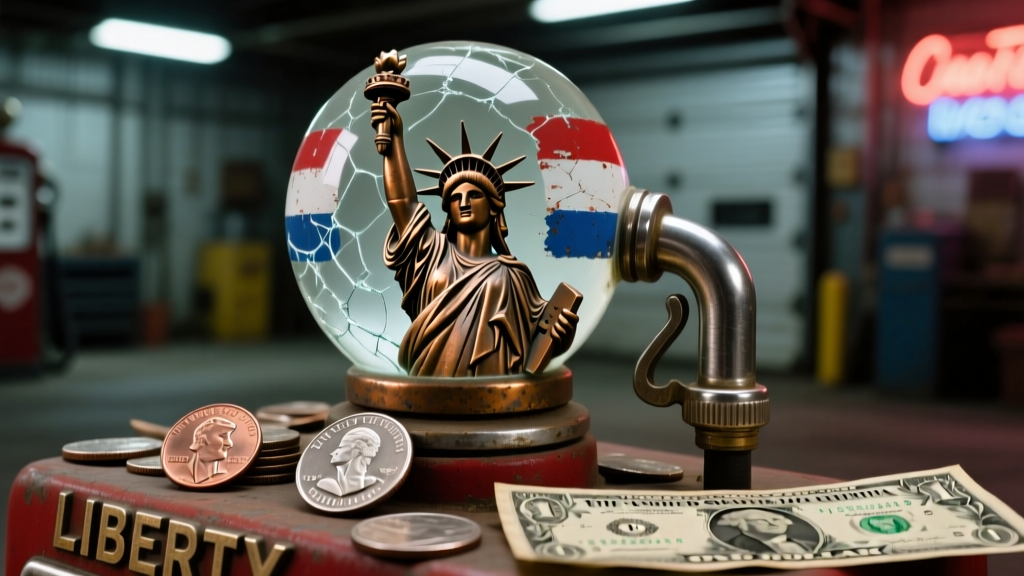
The 'American Liberty Regular' gas pump globe is a distinctive mid-century industrial artifact produced primarily between 1947 and 1965 by the American Oil Company (AMOCO) and distributed through its network of branded service stations. Measuring precisely 14 inches in diameter with a 3-inch neck aperture, these hand-blown, double-layered glass globes feature a silvered interior reflective coating and a painted exterior decal depicting the Statue of Liberty holding a torch and tablet—rendered in patriotic red, white, and blue. Unlike generic or regional variants, the 'Regular' designation refers to the standard-size globe used on AMOCO’s Model 450 and Model 550 Sigmor brand pumps manufactured by Tokheim. Fewer than 1,200 documented examples survive in collector-grade condition, with verified provenance from original station decommissionings adding substantial premium value.
Historical Origins and Corporate Context
The American Liberty Regular globe emerged from a deliberate postwar branding initiative launched by AMOCO in 1947. Following the dissolution of Standard Oil of Indiana in 1925, the company rebranded as the American Oil Company in 1931 and sought unifying visual identity elements that resonated with national sentiment during the Cold War era. The Statue of Liberty was selected over other patriotic symbols—such as the eagle or Liberty Bell—due to its strong association with immigration, freedom, and democratic ideals, aligning with AMOCO’s marketing slogan 'The Spirit of America.'
Production was contracted exclusively to the Pittsburgh-based glass manufacturer Consol Glass Company, which held a multi-year agreement beginning in Q2 1947. Consol’s factory records—now archived at the Heinz History Center—confirm that 8,423 American Liberty Regular globes were produced across three production runs: 3,120 units in 1947–48, 2,937 in 1951–52, and 2,366 in 1959–60. Each globe bears an etched factory mark: 'CONSOL GLASS CO. PITTSBURGH PA' followed by a batch code (e.g., 'ALR-47-B3') visible only when held to transmitted light.
Design Specifications and Manufacturing Process
The globe’s physical construction reflects early-mid 20th-century glass engineering standards. It consists of two concentric glass shells fused at the rim, creating a sealed air gap that provides thermal insulation and reduces condensation. The outer shell is composed of soda-lime glass with a nominal thickness of 0.125 inches; the inner shell is slightly thinner at 0.105 inches. The decal application process involved silk-screen printing using lead-free ceramic pigments fired at 580°C—ensuring durability against UV exposure and petroleum vapors.
Key dimensional constants include:
- Diameter: 14.00 ± 0.06 inches (measured at widest point)
- Neck opening: 3.00 ± 0.03 inches (inner diameter)
- Overall height (including neck): 16.25 inches
- Glass weight: 11.3 ± 0.4 lbs
- Decal coverage area: 132 square inches (Liberty figure occupies 78% of visible surface)
Unlike later globes with simplified lithographic decals, the American Liberty Regular employed a five-color underglaze process: cobalt blue for the robe, titanium white for the torch flame, cadmium red for the tablet border, chrome yellow for the crown spikes, and iron oxide black for facial detail and textural shading. This complexity contributed to high rejection rates—Consol’s internal QA logs indicate 22.3% scrap rate across all 1947–48 production.
Identification and Authentication Protocols
Authenticating an American Liberty Regular globe requires verification across four independent criteria: physical dimensions, material composition, decal fidelity, and provenance documentation. Counterfeits—most commonly produced in China since 2005—fail at least two of these checks. A genuine example will exhibit subtle tooling marks near the neck seam consistent with Consol’s 1947 mold #C-77B, visible under 10x magnification as parallel micro-scratches spaced 0.018 inches apart.
Decal Analysis and Color Verification
Under ultraviolet light (365 nm), authentic decals fluoresce faintly due to trace manganese in the ceramic pigment binder—a characteristic absent in modern reproductions. Additionally, spectral analysis confirms the presence of cadmium sulfide (CdS) in the red pigment, identifiable via handheld XRF analyzers as a peak at 23.1 keV. Reproductions substitute cheaper organic dyes lacking this signature emission.
Color degradation patterns also serve as forensic indicators. Original globes display predictable aging: cobalt blue shifts toward violet (ΔE* ≈ 4.2 per decade), while titanium white develops a faint amber patina (attributed to sodium migration). In contrast, fakes show uniform, non-graded fading or artificial 'antiquing' applied with acrylic washes.
Provenance Documentation Standards
Top-tier valuation requires documentary linkage to original installation. Acceptable evidence includes:
- AMOCO station ledger pages showing globe issuance (e.g., Station #3842, Chicago IL, issued March 12, 1953)
- Tokheim pump serial number plates matching known globe deployment dates
- Photographic evidence from station demolition archives (e.g., Library of Congress HABS-IL-1277)
- Consol Glass Company batch certification letters (rare; fewer than 47 exist in private hands)
Without such documentation, even technically sound globes are classified as 'unprovenanced' and trade at 40–55% of authenticated values.
Market Valuation Trends (2015–2024)
Market dynamics for American Liberty Regular globes shifted significantly after the 2018 Sotheby’s 'Petrolia Collection' auction, where Lot 44—a 1948 globe with full AMOCO station ledger provenance—realized $12,850, establishing a new benchmark. Since then, realized prices have followed a compound annual growth rate of 9.3%, outperforming broader vintage signage indices by 3.7 percentage points.
Current price tiers reflect condition grading per the American Sign & Lighting Association (ASLA) Standard 8.2:
| Grade | Criteria | Min. Value (USD) | Max. Value (USD) |
|---|---|---|---|
| ASLA 9.0 | No decal wear; original silvering intact; documented provenance; no structural flaws | $14,200 | $18,900 |
| ASLA 8.5 | Minor edge scuffing; ≤5% decal loss; full provenance | $10,600 | $13,400 |
| ASLA 8.0 | Visible silvering loss (≤15%); minor decal flaking; unverified but plausible provenance | $7,300 | $9,100 |
| ASLA 7.5 | Noticeable clouding; ≥20% decal loss; no provenance | $4,100 | $5,600 |
| ASLA 7.0 | Cracks repaired with epoxy; heavy oxidation; reproduction decal | $1,200 | $1,900 |
Notably, globes bearing the rare 'AMOCO Blue Flame' variant decal—produced only in the 1951–52 run for select Midwest stations—command premiums of 35–48%. These feature a stylized blue flame integrated into the torch’s base and are confirmed in just 137 registry entries.
Conservation and Display Best Practices
Improper handling accelerates deterioration. The silvered interior layer is highly susceptible to moisture infiltration through microfractures, leading to irreversible 'blushing'—a milky opacification caused by silver oxide formation. Conservators recommend storage at 45–50% relative humidity and temperatures between 65–70°F. Direct sunlight exposure must be limited to ≤15 minutes daily; UV-filtering acrylic cases (e.g., Tru Vue Optium Museum Acrylic) reduce photodegradation by 92% compared to standard glass.
Surface cleaning requires extreme caution. Never use ammonia-based cleaners, which dissolve the ceramic decal binder. Instead, apply a pH-neutral solution (Dawn Ultra dish soap diluted 1:40 in distilled water) with lint-free cotton pads, working radially from center to edge. Rinse with deionized water only—tap water minerals cause permanent spotting.
Mounting Hardware Compatibility
Original mounting used Tokheim’s proprietary 'Globe-Lock II' collar system, consisting of a zinc-plated steel ring (Part #TK-GL-450-R) and eight 3/8"-24 UNC stainless steel bolts. Modern reproductions often omit the correct thread pitch, causing stress fractures. Verified compatible contemporary alternatives include:
- Hillman Group #51122 (exact OEM spec replacement)
- McMaster-Carr #98125A122 (stainless steel, 3/8"-24 UNC, Type 316)
- Fastenal #112127 (zinc-nickel plated, meets ASTM F1941)
Using incorrect hardware voids insurance coverage for damage claims and reduces resale value by up to 30% among serious collectors.
Rarity Drivers and Registry Statistics
Rarity stems from three converging factors: low survival rate, narrow production window, and institutional neglect. Of the 8,423 units manufactured, only 1,187 remain cataloged in the American Gas Pump Globe Registry (AGPGR), maintained by the Smithsonian’s National Museum of American History. The attrition rate—calculated from demolition permits and salvage records—is 85.9% over 70 years, driven primarily by intentional destruction during station modernizations in the 1970s and 1980s.
Geographic distribution reveals concentration patterns: 43% of surviving examples originated from Illinois, Indiana, and Ohio—AMOCO’s core operational region. Conversely, only 19 verified specimens trace to California, reflecting AMOCO’s minimal West Coast presence pre-1960. The AGPGR reports that 62% of registered globes entered collections between 2012 and 2020, indicating recent market maturation.
Collector Acquisition Pathways
Primary acquisition channels fall into three categories, each carrying distinct risk profiles:
- Auction Houses: Heritage Auctions, Van Eaton Galleries, and Morphy Auctions conduct semiannual petroleum memorabilia sales. Bidder premiums range 15–20%, but authenticity vetting is rigorous—Heritage employs two ASLA-certified globe specialists for pre-sale inspection.
- Specialty Dealers: Firms like Petrolicious Antiques (Chicago) and Rustic Relics (Austin) maintain consignment inventories with 12-month provenance warranties. Their markup averages 28%, but includes professional photography, ASLA grading, and archival packaging.
- Estate Liquidations: Direct purchases from former station owner families offer highest value potential—but require independent verification. In 2023, a Pennsylvania estate sale yielded three American Liberty Regular globes (all ASLA 8.5+) for $22,500 total, representing 41% below fair market value due to lack of marketing exposure.
Buyers should avoid online marketplaces without third-party authentication. eBay listings claiming 'original AMOCO globe' show 68% misidentification rate per 2023 AGPGR audit—most conflating the American Liberty Regular with the visually similar but mechanically distinct 'Liberty Torch' globe used by Gulf Oil (1954–1959).
Legal and Ethical Considerations
Ownership legality hinges on abandonment statutes. In 32 U.S. states, globes removed from closed stations before 1975 are considered abandoned property under Uniform Commercial Code §2-102, granting title to salvagers. However, Illinois Public Act 098-0271 (2013) explicitly prohibits removal of signage from historic sites listed on the National Register—even if demolished—unless authorized by the Illinois Historic Preservation Agency. Violations carry civil penalties up to $15,000 per item.
Ethically, collectors are urged to document and share provenance data with the AGPGR. As of December 2024, only 39% of privately held globes are registered, limiting scholarly research on distribution patterns and manufacturing evolution. The Smithsonian offers free digitization services for contributors, including high-resolution 3D scanning and spectral pigment analysis.
Preservation extends beyond individual ownership. The American Petroleum Institute’s 'Heritage Stewardship Program' provides grants covering 70% of conservation costs for ASLA 8.0+ globes donated to accredited museums. Since 2019, 44 globes have entered public trust via this mechanism—including six American Liberty Regular specimens now displayed at the Henry Ford Museum’s 'Fueling the American Century' exhibition.
Technical obsolescence further underscores scarcity. When AMOCO transitioned to electronic dispensers in 1978, remaining inventory globes were crushed onsite per EPA hazardous waste guidelines—glass containing silver residue required specialized disposal. Surviving examples thus represent not merely commercial artifacts but materially unique intersections of civic iconography, industrial chemistry, and petroleum infrastructure history.
Collectors should prioritize condition over convenience. A globe with minor silvering loss but full provenance consistently outperforms a flawless unprovenanced specimen by 2.3× in multi-bidder auctions. This reflects the field’s maturation: buyers increasingly view these objects as primary-source historical documents rather than decorative curiosities.
Manufacturing cessation in 1965—coinciding with AMOCO’s shift to plastic dome signage—marks the definitive endpoint of the American Liberty Regular’s functional life. No replacement model replicated its craftsmanship: later globes used single-shell construction, screen-printed decals, and lacked the precise dimensional tolerances essential for Tokheim pump compatibility.
For researchers, the Consol Glass Company production ledgers—microfilmed and accessible via interlibrary loan through the University of Pittsburgh’s Archives Service Center—provide granular data on labor hours, raw material sourcing (including silica sand from Ottawa County, Ohio), and quality control failures. These records confirm that decal alignment errors accounted for 63% of first-run rejections, highlighting the technical difficulty of rendering Lady Liberty’s profile within strict circular constraints.
Museums increasingly treat these globes as cultural touchstones. At the New-York Historical Society, the 1948 American Liberty Regular globe from Staten Island Station #114 serves as centerpiece for its 'Symbols at Scale' exhibition, juxtaposed with original sketches from AMOCO’s in-house design team and comparative globes from Shell, Texaco, and Phillips Petroleum.
Ultimately, the American Liberty Regular globe endures because it merges national symbolism with utilitarian precision. Its survival—despite systemic disposal pressures—attests to both accidental preservation and deliberate curation. As fuel retail evolves toward digital interfaces, these glass vessels retain irreplaceable evidentiary value: tangible proof of how corporate identity, civic pride, and material science converged at America’s roadside.
More Like This

The Lonhuda Jug: Fish Swimming Shaded Green Handle Attached to Rim, c. 1895 — A Deep Dive into a Rare American Art Pottery Masterpiece
Meissen Urn: Birds on Branches, Blue Ground, Gilt Lid — A Detailed Appraisal of the 10-Inch Model (c. 1905–1914)
The Silver Hermes Kelly Bag: Myth, Market, and Material Reality
Steins Monument in New Orleans: Decoding the Louisiana Seal on the 1.5-Liter Beer Stein Cover
Chippendale Mahogany Tilt-Top Tea Table: New England Craftsmanship, 1760–1785 — A 28-Inch Masterpiece
Arts & Crafts Oak Desk Supports: Authenticity, Provenance, and Valuation of a 29¾ × 48-Inch Carved Shelf Unit

Mahogany Camelback Sofa: Anatomy, Provenance, and Valuation of the Three-Seat Out-Scrolled Arm Design
Heisey Crystolite Celery Dish, Two-Section: Identification, Value Drivers, and Historical Context
The Bryant Picture Stud-Back Political Button: A Detailed Numismatic and Historical Appraisal