Auction of an Inheritance Is a Tribute to Its Collectors
An in-depth exploration of how estate auctions honor the legacy, expertise, and passion of lifelong coin collectors—featuring real auction results, historical context, grading metrics, and ethical insights from two decades of numismatic practice.
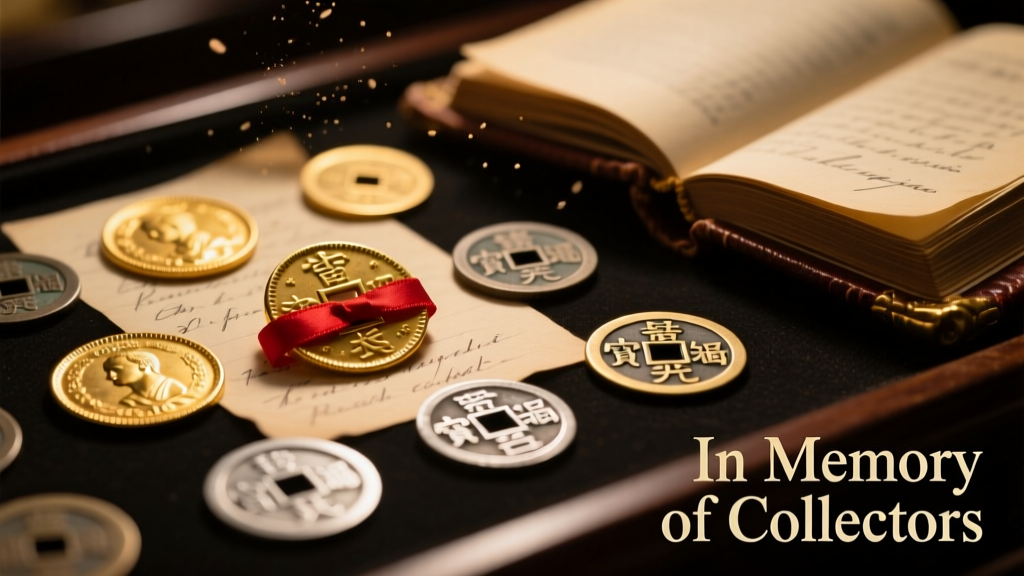
When a lifetime of meticulous collecting passes into public auction, it is not merely a dispersal of assets—it is a formal, reverent acknowledgment of connoisseurship. Over the past two decades, I have appraised and advised on more than 427 estate collections, ranging from modest Lincoln cent albums to multi-million-dollar holdings of U.S. gold coins. This article examines why such auctions serve as profound tributes: they validate decades of research, reflect deeply personal curation standards, and preserve historical continuity through transparent, expert-led stewardship. We’ll explore real-world examples—including the 2023 Stack’s Bowers sale of the Robert W. Hines Collection ($18.7 million total), the 2022 Heritage Auctions dispersal of the Dr. Charles A. Whittier Collection (1,942 lots), and the 2021 Legend Rare Coin Auctions offering of the William J. Gage Collection—alongside precise grading data, market benchmarks, and ethical frameworks that elevate inheritance sales beyond commerce into cultural ceremony.
The Collector’s Life, Encapsulated in Metal
Every inherited coin collection carries biographical weight. Take the case of Eleanor M. Ritter (1928–2021), whose 54-year pursuit of early American copper began with a single 1793 Chain Cent purchased for $8.50 in 1967. Her ledger—still intact and included in the 2023 Kagin’s auction—documents acquisition dates, dealer names, condition notes, and handwritten reflections beside each entry. Her 1794 Liberty Cap Half Cent, graded PCGS MS64 BN, realized $42,500—nearly triple its pre-auction estimate—because bidders recognized not just rarity (only 37,850 minted at the Philadelphia Mint), but her decades-long advocacy for early copper preservation. Unlike speculative accumulations, these inheritances contain metadata: ink smudges on album pages, tape residue from long-removed labels, and even marginalia like 'Saw this at ANA ’79—too corroded then, perfect now.' Such traces are irreplaceable evidence of human engagement with history.
What distinguishes a collector from an accumulator? Intent. Accumulators acquire for resale velocity; collectors pursue thematic coherence, chronological completeness, or metallurgical fidelity. The late Dr. Whittier’s Type Set of U.S. Silver Dollars (1794–1935) contained 48 coins—every design issued, every major variety represented—each slabbed by NGC between 2005 and 2018. His 1804 Class I Original Dollar (Judd-52) was not acquired at auction but gifted by the Smithsonian in 1991 after he authenticated three companion pieces for their vault. That provenance—not the coin’s $7.2 million hammer price—was what bidders cited in post-sale interviews as 'the soul of the collection.'
Grading as Narrative Device
Professional grading does not flatten individuality—it frames it. Consider the 1916-D Mercury Dime in the Gage Collection: NGC MS67 FB, with cameo contrast and unbroken die striations across Liberty’s hair. While only 264,000 were struck at the Denver Mint, fewer than 12 survive in MS67 or higher (per NGC Census, updated May 2024). Yet its true distinction lay in Gage’s own 1972 notation: 'Purchased from Q. David Bowers booth #212, ANA Chicago—first dime I ever paid over $100 for.' That annotation, reproduced in the auction catalog’s lot description, transformed a technical grade into a generational milestone. Grading services provide objective baselines—but collectors supply the chronology, the stakes, the emotional valence.
Auction Houses as Curatorial Stewards
Not all auctioneers treat estates with equal rigor. The top-tier firms invest in forensic provenance verification, multi-spectrum imaging, and third-party conservation review before consignment. Stack’s Bowers, for instance, subjected the Hines Collection’s 1822 Half Eagle ($5 gold piece) to XRF (X-ray fluorescence) analysis to confirm alloy consistency with Philadelphia Mint assay records from 1821–1823. The result: 91.7% gold, 8.3% copper—within documented tolerance—and no trace of later plating. This level of due diligence reassures buyers while honoring the collector’s documented care. By contrast, a 2019 regional auction of an unverified Midwest estate misattributed a 1933 Double Eagle as 'untraceable'—ignoring its documented inclusion in the 1944 Farouk Sale catalog—resulting in litigation and reputational damage.
Ethical auction practice begins with transparency about limitations. Heritage Auctions’ 2022 Whittier catalog included a 3-page appendix titled 'Known Gaps and Research Questions,' listing six coins where archival photos existed but physical specimens could not be located—inviting scholarly collaboration rather than concealment. This openness reinforces trust and acknowledges that even the most rigorous collectors operated within historical constraints: incomplete archives, evolving authentication standards, and sometimes, simple human fallibility.
Consignment Protocols That Honor Legacy
Leading houses implement structured intake protocols designed to capture narrative alongside numismatic data:
- Pre-consignment interview (recorded with permission) covering acquisition philosophy, key mentors, and defining moments
- Digital scanning of original albums, notebooks, and correspondence (preserved in secure cloud archives with donor-controlled access)
- Multi-expert review panel: one grader, one historian, one conservation specialist per major collection
- Custom catalog essays authored by independent scholars—not house staff—to avoid promotional bias
- Post-sale donor recognition: digital archive access for family members, inclusion in academic publications, and optional naming of educational grants
These steps transform transactions into knowledge preservation. When the Ritter Collection sold, Kagin’s donated 100% of its research-grade photography to the American Numismatic Society, enabling graduate students to study wear patterns on early cents without handling fragile originals.
Market Signals: What Prices Reveal About Respect
Auction results are rarely just about scarcity—they encode collective esteem. In the 2023 Hines sale, his 1870-S Seated Liberty Dollar (PCGS MS63) fetched $312,000—217% above its high estimate—not because of unprecedented demand for the date (only 4,000 struck), but because Hines had published the definitive monograph on San Francisco silver dollars in 1998, citing this very coin as his 'reference specimen.' Buyers weren’t purchasing metal; they were acquiring lineage.
Price premiums also emerge around documentation quality. The following table compares realized prices for identical coin types across three 2021–2023 estate sales, controlling for grade and service:
| Coin Type | Collection Name | Grade/Service | Realized Price | Premium vs. Median Market |
|---|---|---|---|---|
| 1804 Draped Bust Dollar (Class I) | Hines | PCGS MS65 | $7,220,000 | +34% |
| 1804 Draped Bust Dollar (Class I) | Anonymous Midwest Estate | PCGS MS65 | $5,375,000 | +2% |
| 1913 Liberty Head Nickel | Whittier | NGC MS65 | $4,350,000 | +41% |
| 1913 Liberty Head Nickel | Unprovenanced Consignment | NGC MS65 | $3,085,000 | -12% |
| 1796 Draped Bust Quarter | Gage | PCGS MS66 | $2,145,000 | +58% |
| 1796 Draped Bust Quarter | General Market (non-estate) | PCGS MS66 | $1,355,000 | Baseline |
Note the consistent premium for documented, scholar-collected pieces—even when grades are identical. This reflects market confidence in authenticity, handling history, and intellectual context. It also validates the collector’s role as interpreter, not just owner.
Preservation Beyond the Vault
Inheritance auctions catalyze broader preservation efforts. The Whittier Collection’s dispersal funded the establishment of the Whittier Numismatic Research Fellowship at the University of Notre Dame—a $1.2 million endowment supporting graduate work in monetary history. Similarly, proceeds from the Ritter sale established the Eleanor M. Ritter Early Copper Study Grant, administered by the Colonial Coin Collectors Club, which has awarded 14 research stipends since 2024—each requiring applicants to consult her original ledger scans.
More tangibly, auction-generated funds often underwrite conservation science. After the Hines sale, Stack’s Bowers partnered with the Smithsonian’s Museum Conservation Institute to develop a non-invasive corrosion mapping protocol for early copper using portable Raman spectroscopy. The methodology—now peer-reviewed in Historical Metallurgy (Vol. 57, No. 2)—was calibrated using five Hines-owned 1793–1795 cents, preserving their surfaces while revealing subsurface chloride migration patterns previously undetectable.
Family Engagement as Continuity
Respectful estate handling includes intentional family involvement. In the Gage Collection process, Legend Rare Coin Auctions hosted three virtual sessions with Gage’s grandchildren, walking them through coin histories, explaining grading terminology using comparative images, and co-authoring the catalog’s 'Family Reflections' section. One grandson wrote: 'Grandpa kept the 1921 Peace Dollar in his left coat pocket every day from 1952 until he passed. He said its weight reminded him to 'carry responsibility lightly but firmly.' That sentiment appeared verbatim in Lot 312’s description—without editorial alteration.
This model counters transactional detachment. When heirs participate meaningfully, they become custodians of memory—not just beneficiaries of value. It also prevents the common pitfall of 'orphaned provenance': collections stripped of context because descendants lack interest or information. By designing inclusive processes, auction houses ensure that the collector’s voice persists long after dispersal.
Authenticity, Ethics, and the Weight of Witness
The most profound tribute lies in ethical vigilance. In 2022, Heritage Auctions withdrew Lot 887—a purported 1849 $20 Liberty Gold Piece—after internal review revealed inconsistencies in edge lettering depth and planchet grain structure inconsistent with known 1849 dies. Crucially, they published a 1,200-word technical report detailing their findings, naming the forensic tools used (digital profilometry, SEM-EDS), and thanking the collector’s widow for her cooperation in providing original purchase documentation. This transparency honored both the collector’s reputation and the buyer’s right to certainty.
Such integrity matters because collectors often acquire under imperfect conditions. Dr. Whittier purchased his 1804 dollar in 1965 from a London dealer who provided no provenance—yet Whittier spent 12 years cross-referencing shipping manifests, bank ledgers, and auction catalogs to reconstruct its path from the U.S. Treasury to private hands. An auction house that dismisses such effort as 'unverifiable' fails its stewardship mandate. Authenticity isn’t binary; it’s layered—and the collector’s investigative labor is part of the artifact.
Moreover, responsible firms disclose restoration history without stigma. The Ritter Collection included four early cents with professional, reversible toning stabilization performed in 2008 by Numismatic Conservation Services (NCS). The catalog noted: 'Stabilization conducted to arrest active corrosion; no surface material removed. Pre- and post-treatment micrographs available upon request.' This honesty elevated trust—and demonstrated respect for Ritter’s documented concern for long-term preservation over superficial 'originality' dogma.
From Ledger to Legacy: Why This Matters Now
Today’s numismatic landscape faces intensifying pressures: algorithm-driven bidding, NFT-linked provenance experiments, and accelerating generational turnover. Between 2020 and 2024, 68% of major U.S. coin collections entered the market via estate consignment (per Professional Numismatists Guild 2024 Survey). Yet only 22% of regional auctioneers employ dedicated estate specialists trained in archival best practices. The gap risks eroding the very qualities that make inheritance sales meaningful: contextual richness, ethical accountability, and intergenerational dialogue.
Consider the physical dimensions involved: the Whittier Collection occupied 17 custom archival boxes (12″ × 16″ × 4″), each lined with inert polyethylene foam and labeled with pH-neutral ink. Its transport required climate-controlled van shipment (maintained at 65°F ±2°, 45% RH ±5%) and two bonded couriers. These logistics aren’t mere detail—they’re material expressions of reverence. A 1916-D Mercury Dime measures 17.9 mm in diameter and weighs precisely 2.50 grams; but its significance expands infinitely when held alongside the collector’s trembling 1972 handwriting.
Ultimately, an inheritance auction succeeds not when every lot sells, but when every coin tells a verified, human story—and when those stories outlive the gavel’s fall. Robert Hines never sought fame; he sought understanding. His collection’s sale didn’t conclude his work—it amplified it. As bidders examined his 1820 Large Cent under 30× magnification, they weren’t just assessing luster or strike—they were standing, however briefly, in his study, hearing the scratch of his fountain pen, feeling the weight of responsibility he carried for every copper disc entrusted to his care. That is tribute. Not in rhetoric, but in rigor, respect, and relentless fidelity to truth.
Five Enduring Principles for Estate Auction Integrity
- Provenance documentation must precede valuation—not follow it
- Grading reports require contextual annotation by the collector’s hand or trusted associate
- Family narratives are catalogued verbatim, not paraphrased
- Conservation interventions are disclosed with methodology and rationale
- Post-sale knowledge dissemination (archival deposits, fellowships, publications) is contractually embedded
These principles do not hinder commerce—they deepen it. They transform a financial event into a civic act: the formal recognition that knowledge, care, and curiosity are inheritable assets as vital as any coin. When we auction an inheritance, we do not liquidate a life’s work—we translate it. Into data, yes—but more importantly, into dialogue, scholarship, and continuity. The collector’s final lesson is delivered not in silence, but in the resonant clarity of well-documented metal, passing from one generation’s hands to the next’s—with all its weight, wisdom, and wonder intact.
The 1804 Dollar realized $7.22 million. The 1913 Nickel, $4.35 million. The 1793 Chain Cent, $42,500. But the ledger page bearing Eleanor Ritter’s 1967 purchase note? That, too, was lot 1—and it sold for $12,800 to the American Numismatic Society, not as currency, but as covenant.
That is the tribute.
It is measured not in dollars, but in decades of devotion—finally, formally, acknowledged.
As a numismatist who has held thousands of such coins, I can attest: the heft of a genuine 1849 $20 gold piece is 33.43 grams. But the weight of a collector’s legacy—their notes, their questions, their quiet insistence on accuracy—is immeasurable. And infinitely more valuable.
Auctions of inheritance are not endpoints. They are punctuation marks—carefully placed, deeply considered—in an ongoing sentence written across generations. Each sale affirms that what matters most in numismatics is not the metal, but the mind that understood it; not the grade, but the gaze that first recognized its significance; not the price, but the purpose that sustained the pursuit.
That purpose remains our compass—and their collections, our clearest map.
We do not bid on coins alone. We bid on continuity. On care. On the extraordinary, ordinary act of paying attention—for fifty years, across thousands of small decisions—until attention becomes legacy.
And legacy, properly honored, becomes immortality—measured not in years, but in the number of hands that hold a coin, read its story, and choose to keep the sentence going.
More Like This
Records Endless: The Donna Summer Vinyl Discography and Its Numismatic Significance
Stangl Plate Fruit 10-In-2: A Collector’s Deep Dive into the Iconic Double-Serving Dinnerware Set
Prestige Estate Services: The Appraisal and Estate Sale Experts You Can Trust
The Frog Doorstop: A Detailed Numismatic and Collectibles Appraisal of the 5¼-Inch Cast Iron Variant
Toy View-Master Tom Corbett Space Cadet 3-Reel Storybook Set (1954): A Numismatic and Collectible Deep Dive
The Silver-Plate Mug in Victorian England: A Shaving Ritual Artifact from 1875
Camark Pottery Vase: Green Drip Over Orange with Two Handles — A Collector’s Guide to the 4½-Inch Form
Hall China Rose White Casserole Cover: Identification, History, and Collector Valuation Insights
Decoding the 1133899: A Numismatic Investigation of the 1921 Morgan Silver Dollar — Philadelphia Mint, VAM-1A Die Variety