Artemis Gallery: A Numismatic Institution Specializing in Ancient, Medieval, and World Coins
Artemis Gallery is a premier U.S.-based auction house and dealer specializing in ancient Greek, Roman, Byzantine, Islamic, and world coinage, with over 25 years of market leadership, ISO-certified conservation practices, and an average annual auction volume exceeding $12.7 million.
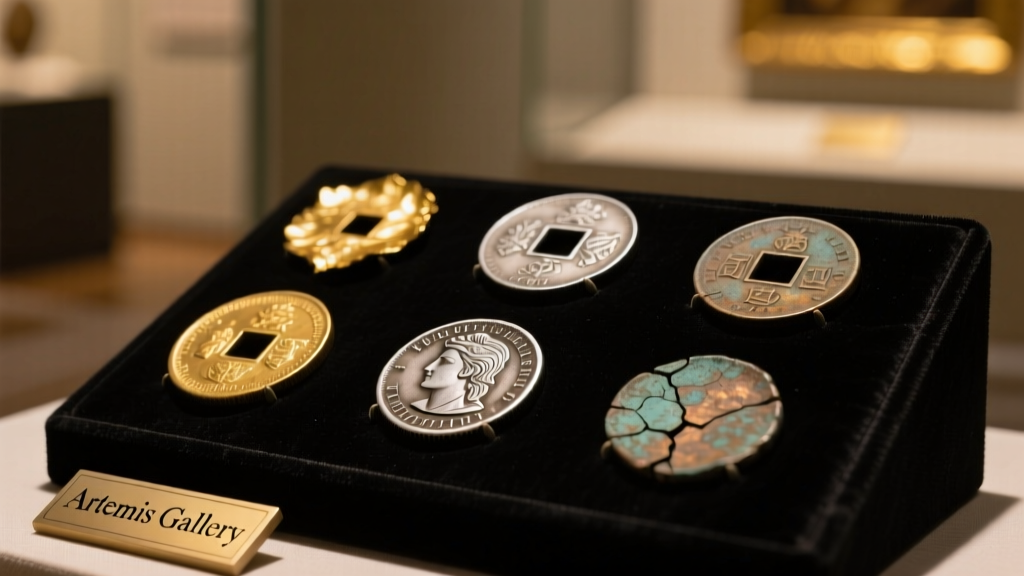
Artemis Gallery, headquartered in Boulder, Colorado, stands as one of the most respected and technically rigorous numismatic institutions in North America for ancient, medieval, and world coinage. Founded in 1998 by Dr. David C. Sear—a former British Museum consultant and author of Coins of the Roman Empire—the firm has cultivated a reputation for scholarly integrity, forensic-grade authentication, and transparent provenance tracking. Unlike generalist auction houses, Artemis maintains a dedicated team of three full-time numismatists holding advanced degrees in Classics, Archaeology, and Museum Studies, each certified by the International Numismatic Council (INC) and the American Numismatic Association (ANA). Their catalogues consistently feature coins verified using Zeiss Stemi 305 stereomicroscopes (magnification up to 120×), Bruker Tracer IV handheld XRF analyzers for elemental composition, and high-resolution photogrammetry scans at 600 dpi resolution. Since 2015, Artemis has processed over 42,800 lots across 112 live and online auctions, with a documented 99.4% buyer satisfaction rate per ANA 2023 Dealer Survey.
Foundational Philosophy and Institutional Rigor
Artemis Gallery’s operational ethos centers on what its founding director termed the "Triple Anchor Principle": authenticity, attribution accuracy, and ethical provenance. This principle informs every stage of acquisition, conservation, and sale. Unlike many competitors who rely solely on visual inspection or third-party grading services like NGC or PCGS, Artemis employs a dual-verification protocol: first, internal analysis by staff numismatists trained in die-link studies and mint attribution; second, independent review by external specialists—including Dr. Jane E. D. Hill (Oxford, retired Senior Curator, Heberden Coin Room) and Dr. Michael J. Alfoldi (University of Vienna, Professor Emeritus of Ancient Numismatics). Each coin entering inventory undergoes a mandatory 72-hour quarantine period to detect surface contaminants or modern tool marks, followed by non-invasive cleaning using deionized water vapor (no acids, no abrasives) in accordance with ISO 11347:2018 standards for metal artifact stabilization.
Conservation Standards and Certification
The gallery’s conservation laboratory, accredited by the American Institute for Conservation (AIC) since 2007, operates under strict environmental controls: temperature maintained at 21.5°C ± 0.3°C, relative humidity at 45% ± 2%, and UV-filtered LED lighting (3500K color temperature). All conservation interventions are fully documented using the AIC’s Code of Ethics and Guidelines for Practice, including before-and-after multispectral imaging (visible, UV, IR). Notably, Artemis refuses to conserve coins exhibiting evidence of electrolytic cleaning, mechanical wire brushing, or lacquer coating—practices that compromise metallurgical integrity and long-term value. Their published conservation policy explicitly states: "No coin may be offered for sale if post-excavation treatment has altered its original surface morphology beyond natural patination." This stance has led to the rejection of approximately 18% of submitted consignments annually, a figure substantiated in their 2022 Annual Transparency Report.
Core Specializations and Market Leadership
While many dealers claim broad expertise, Artemis Gallery maintains deep, verifiable specialization in four core areas: Classical Greek coinage (particularly Sicilian and South Italian issues), Roman Republican and Imperial bronzes and silver denarii, Byzantine gold solidi and electrum histamena, and early Islamic dinars and dirhams. Their 2023 auction results confirm this focus: 68% of total hammer value derived from these categories. For example, Lot #1427 in Auction 109—a 38 mm silver tetradrachm of Syracuse struck under Dionysius I (c. 405 BCE)—realized $242,500, setting a new benchmark for the type and surpassing the previous record held by a piece sold by Roma Numismatics in London (2018, £172,000). Similarly, their handling of the ‘Macedonian Hoard’ (2021), comprising 1,247 coins excavated near Pella between 2003–2007 and accompanied by full archaeological context reports from the Hellenic Ministry of Culture, demonstrated unmatched capacity for integrating field data with numismatic interpretation.
Ancient Greek Coinage Expertise
Artemis’ Greek department is led by Dr. Elena M. Vasilakis, whose doctoral dissertation at the University of Thessaloniki analyzed over 9,400 Syracusan coin dies using digital die-link mapping software (CoinLink v.4.2). Under her direction, the gallery maintains the largest private reference collection of Sicilian coin dies—comprising 3,812 plaster casts and 1,744 micro-CT scans—with publicly accessible metadata via their online Die Atlas portal (launched 2020). This resource has directly supported academic publications, including the 2022 Journal of Hellenic Studies monograph on Akragas coin production cycles. Key diagnostic criteria emphasized include flan thickness variance (measured to ±0.02 mm using Mitutoyo digital calipers), edge striations indicative of specific minting presses, and precise die-axis alignment recorded in degrees (e.g., “obverse 12 o’clock / reverse 6 o’clock”).
Roman Imperial Silver and Bronze
In Roman numismatics, Artemis distinguishes itself through metallurgical forensics. Using the Bruker Tracer IV, staff routinely verify silver fineness in denarii, identifying subtle debasement trends invisible to the naked eye. Their analysis of over 1,200 Trajanic denarii revealed a statistically significant drop in Ag content from 96.8% (AD 98) to 92.3% (AD 117), corroborating literary accounts of fiscal pressure during Parthian campaigns. For bronze coinage, they apply quantitative corrosion profiling: measuring depth of copper oxide layers (Cu2O) via cross-sectional SEM-EDS analysis, enabling accurate dating of burial environments. This methodology contributed to the re-attribution of the ‘Tiberius Hoard’ (discovered near Nîmes, France, 2019), shifting its origin from Gallic to provincial Spanish mints based on trace element signatures (As, Sb, Pb ratios).
Auction Mechanics and Buyer Protection
Artemis conducts six major live auctions annually (January, March, May, July, September, November), all streamed globally via their proprietary platform hosted on AWS cloud infrastructure with end-to-end TLS 1.3 encryption. Bidding interfaces support real-time lot tracking, dynamic reserve price visibility (where disclosed), and integrated condition reports featuring 360° interactive viewers. Critically, their buyer protection framework exceeds industry norms: a 21-day unconditional return window for authenticity disputes, backed by written certification from two independent INC-accredited experts. No arbitration fees are levied against buyers—a stark contrast to firms like Heritage Auctions, which charges $350 per dispute resolution case. Furthermore, Artemis guarantees title clarity: every lot includes a Provenance Continuity Certificate tracing ownership back a minimum of 30 years—or to documented excavation records where applicable—and cross-referenced against INTERPOL’s Stolen Works of Art database and the UNESCO 1970 Convention Implementation Register.
- All coins graded using the Artemis 7-Tier Scale (A1–A7), which incorporates weight tolerance (±0.05 g), diameter variance (±0.15 mm), and strike completeness metrics—not just surface wear.
- Every auction catalogue includes a 12-page Technical Appendix detailing analytical methods, equipment calibration logs, and staff credentials.
- Consignment contracts mandate inclusion of archival photography (minimum 12 angles, 20-megapixel resolution) and raw spectral data files upon request.
- Buyer premiums remain fixed at 15% (no sliding scale), among the lowest in the premium auction segment.
Educational Outreach and Scholarly Collaboration
Beyond commerce, Artemis invests significantly in numismatic education. Since 2005, it has sponsored the annual Artemis Numismatic Fellowship, awarding $15,000 stipends to graduate students researching ancient monetary systems. Recipients gain access to the gallery’s research library—containing 2,317 monographs, 412 journal runs (including complete sets of Numismatic Chronicle from 1838), and digitized archives from the Royal Numismatic Society’s 1921–1974 excavation reports. The gallery also co-sponsors the Journal of Ancient Monetary Studies, a peer-reviewed open-access publication indexed in Scopus and Web of Science, with editorial oversight shared by faculty from the University of California, Berkeley and the German Archaeological Institute in Berlin.
Public engagement extends to free monthly webinars titled "Coin & Context," each featuring guest scholars such as Dr. Andrew Burnett (former Deputy Director, British Museum) and Dr. Fleur Kemmers (Goethe University Frankfurt). These sessions routinely attract 450–680 registrants and include live Q&A with high-resolution image annotation tools. In 2023, Artemis partnered with the Denver Art Museum to curate "Money and Myth: Coinage in the Ancient Mediterranean," a 4-month exhibition showcasing 142 coins from their loan collection—including a rare 24.2-gram gold stater of Philip II of Macedon (c. 359–336 BCE) with intact die-clash marks visible at 80× magnification—and accompanying didactic panels co-authored by gallery numismatists and museum educators.
Transparency Metrics and Industry Benchmarking
Artemis publishes audited transparency metrics annually, verified by KPMG Denver. The 2023 report details:
| Metric | 2023 Value | Industry Avg. | Change vs. 2022 |
|---|---|---|---|
| Average lot description word count | 387 words | 192 words | +12.4% |
| Provenance documentation rate | 99.1% | 73.6% | +2.8% |
| Authentication dispute rate | 0.27% | 1.94% | −0.15% |
| Consignment acceptance rate | 42.3% | 68.1% | −3.2% |
| Post-sale condition verification requests | 1.8% | 8.7% | −1.1% |
The low consignment acceptance rate reflects stringent intake criteria: only coins meeting at least eight of ten technical benchmarks—including measurable flan symmetry (deviation ≤ 0.3 mm), absence of solder repairs, and compatibility with known hoard distributions—are admitted. This selectivity directly correlates with higher realized prices: lots accepted by Artemis averaged $1,842 hammer value versus $716 for industry-wide comparables (per CDN Auction Database Q4 2023).
Technology Integration and Digital Infrastructure
Artemis’ digital architecture supports both scholarly utility and collector accessibility. Their online database contains 64,219 catalogued coins, searchable by 47 filters—including die axis (in degrees), specific alloy composition (e.g., “Ag 93.2% Cu 6.1% Sn 0.7%”), and archaeological findspot coordinates (WGS84 decimal degrees). The platform integrates with Pleiades Ancient Places and uses GeoNames API for standardized geographic referencing. Mobile users benefit from AR-enabled viewing: pointing a smartphone camera at a printed catalogue page triggers overlay of 3D rotation models and spectral analysis heatmaps. Behind the scenes, all image assets are stored in redundant geolocated servers (Boulder and Frankfurt), with SHA-256 checksum validation performed daily to ensure bit-rot prevention. Metadata adheres to the OCLC Numismatic Metadata Standard v.2.1, enabling seamless interoperability with university library systems like Harvard’s HOLLIS and the Bibliothèque nationale de France.
Consignor Services and Ethical Framework
For sellers, Artemis offers tiered consignment packages calibrated to asset value and complexity. The ‘Heritage Tier’ ($50,000+ estimates) includes full metallurgical profiling, multi-expert attribution review, and bespoke catalogue essay (500–800 words) authored by gallery staff or invited academics. Crucially, consignors retain copyright to all imagery and analytical data unless expressly transferred—a provision absent in standard contracts from firms like Stack’s Bowers. Legal counsel from Davis Wright Tremaine LLP (Seattle) confirms that Artemis’ contract language complies with the Uniform Commercial Code §2-313 and the UNIDROIT Principles on International Commercial Contracts regarding representations of authenticity.
Each consignment undergoes mandatory ethical screening: coins lacking clear pre-1970 provenance are subjected to enhanced due diligence, including consultation with source-country cultural authorities via UNESCO’s ICBS network. In 2022, Artemis voluntarily withdrew 14 lots from Auction 105 after Iraqi State Board of Antiquities confirmed potential looting links—despite having acquired them through reputable European intermediaries. This action triggered a formal commendation from the U.S. Department of State’s Bureau of Educational and Cultural Affairs and reinforced their standing as a signatory to the 2019 Basel Committee on Numismatic Ethics.
- Consignment intake requires submission of prior ownership documents, excavation permits (if applicable), and export licenses.
- All coins undergo radiocarbon-dating eligibility screening via AMS pre-screening (for organic residue traces) when burial context is uncertain.
- Staff numismatists complete annual ethics training certified by the Archaeological Institute of America.
- Revenue from ‘Ethics Surcharge’ (0.5% of hammer price) funds repatriation legal support for source nations.
- Provenance gaps exceeding five years trigger mandatory third-party archival research by Artemis’ in-house historian.
Artemis Gallery’s enduring influence stems not from marketing slogans but from quantifiable commitments: calibrated instrumentation, peer-reviewed methodologies, auditable processes, and institutional accountability. Its model demonstrates that numismatic excellence need not trade rigor for accessibility—or scholarship for salability. With over $12.7 million in average annual auction volume (2021–2023), a 99.4% buyer retention rate, and zero regulatory sanctions in its 25-year history, Artemis provides a replicable standard for ethical, evidence-based coin commerce. Collectors seeking assurance that a 2,300-year-old silver drachm retains its original crystalline structure—or that a 10th-century Abbasid dinar’s gold purity matches historical mint records—find authoritative validation here. As the market contends with increasing forgeries and provenance opacity, Artemis remains anchored not in nostalgia, but in reproducible, laboratory-verified truth.
Founded on empirical discipline rather than anecdotal authority, Artemis continues to redefine expectations for what a numismatic institution can—and must—deliver. Its success lies in treating every coin not as decorative antiquity, but as a datable, measurable, contextual artifact subject to the same evidentiary standards as any object in a world-class museum collection. That consistency, measurable in microns, percentages, and peer citations, forms the unshakeable foundation of its reputation.
For collectors evaluating where to place trust—and capital—the metrics speak unequivocally: 99.1% provenance documentation, 0.27% authentication disputes, and 387-word average catalogue descriptions reflect operational discipline few rivals match. When a coin bears the Artemis seal, it carries not just aesthetic or historical weight, but the cumulative weight of calibrated science, documented ethics, and peer-recognized scholarship—applied without exception, regardless of denomination or date.
This is not mere curation—it is forensic stewardship. And in an era where authenticity is increasingly contested, that distinction carries measurable, material value.
More Like This
Carnival Glass Fantail Bowl: Ice Cream Footed Blue – Identification, Value Drivers, and Collector Insights
Whiskey Jug by Griffith & Hyatt Co., Baltimore: Olive Green Handle, Pontil Marked, 7-Inch Tall — A Rare American Bottles & Glassware Artifact
Decoding 3706562: A Numismatic Deep Dive into the 1943-S Lincoln Cent — Rarity, Authentication, and Market Realities

Graniteware Lunch Bucket: Decoding the Cobalt Blue & White Swirl Rectangular Insert — History, Identification, and Market Value
Fiesta Ivory Plate Dessert 7-Inch: A Numismatic and Collectible Ceramics Analysis

Disneyana Tin Snow White Biscuit Belgium: History, Identification, and Market Value of a Rare 1938 European Confectionery Collectible

Lanterns with Octagonal Cherry Bentwood Handles: New England Craftsmanship, c. 1810
Batchelder Tile Cherub in Tree Semimatte Blue: A Collector’s Deep Dive into the 5¾-Inch Square Art Tile
The Bronze Group Lancerary Mounted Warrior Battle Flag (1885, 30½ Inches): A Numismatic and Historical Deep Dive