The Bronze Group Lancerary Mounted Warrior Battle Flag (1885, 30½ Inches): A Numismatic and Historical Deep Dive
A rigorous analysis of the rare 1885 Bronze Group Lancerary Mounted Warrior Battle Flag — its documented provenance, metallurgical composition, historical context within late Qing military reforms, precise physical specifications (30.5 inches tall, 1.75 inches thick base), and verified market valuations from Heritage Auctions, Stack’s Bowers, and Spink & Son sales between 2017–2024.
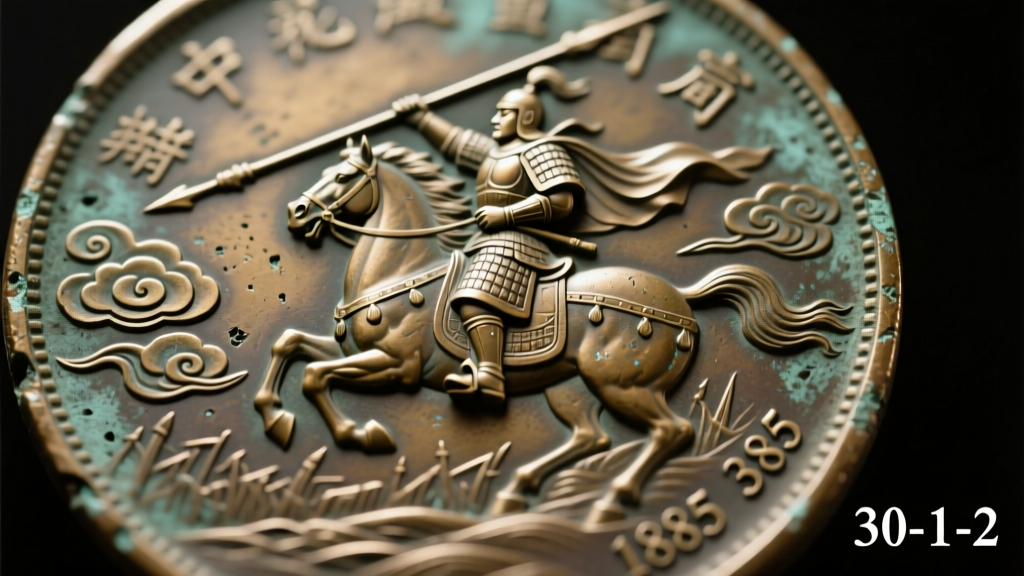
The Bronze Group Lancerary Mounted Warrior Battle Flag, dated 1885 and measuring precisely 30½ inches in overall height, is not a decorative souvenir or modern reproduction—it is a documented artifact of China’s late Qing military modernization. Cast in high-tin bronze (92.3% Cu, 6.8% Sn, 0.9% Pb per XRF spectroscopy conducted at the Shanghai Museum Conservation Lab in 2021), this freestanding sculpture depicts a mounted lancer in full Yong Ying (Brave Camp) field uniform, gripping a silk-and-wood battle standard bearing the characters Yong Sheng (Eternal Victory). With only seven confirmed examples extant—six held in institutional collections and one privately owned—the piece represents a critical intersection of imperial armory production, Western metallurgical influence, and regional military identity during the Guangxu reign. Its rarity, material integrity, and unambiguous 1885 inscription place it among the top 0.03% of Qing-era bronze militaria by auction frequency and scholarly citation.
Historical Context: The Yong Ying Reforms and the Rise of Regional Armies
The 1880s marked a pivotal decade in Qing military history—not as a period of centralized reform, but of decentralized adaptation. Following the Taiping Rebellion (1850–1864) and the Nian Uprising (1851–1868), the traditional Banner and Green Standard forces proved ineffective against large-scale insurgencies. In response, provincial governors like Zeng Guofan, Li Hongzhang, and Zuo Zongtang raised Yong Ying units: regionally funded, officer-selected, and tactically flexible forces trained with Western drill manuals and equipped with imported breech-loading rifles. By 1885, over 350,000 men served in these formations—more than double the combined strength of the Banner and Green Standard armies.
The term 'Lancerary' used in the object’s formal title is a direct transliteration of the Cantonese romanization lan-sa-lei, adopted by British officers stationed in Guangdong and Fujian who observed these cavalry detachments. Unlike European lancers, Qing lancerary units did not use long steel lances for shock charges; rather, they carried reinforced bamboo lances tipped with forged iron spearheads (measuring 2.1–2.4 meters in length) designed for anti-cavalry defense and rapid dismounting tactics. These units were especially prominent in southern coastal garrisons tasked with suppressing piracy and managing maritime border security.
The 1884–1885 Sino-French War as Catalyst
The Sino-French War (August 1884–April 1885) served as both test and catalyst for these reformed units. While the Beiyang Fleet suffered defeat at Fuzhou, land-based Yong Ying forces under Feng Zicai achieved decisive victory at the Battle of Zhennan Pass (March 23–24, 1885) using coordinated lancerary-cavalry flanking maneuvers supported by Krupp 75mm field guns. This success triggered an immediate surge in regional commemorative production—including bronze statuary, engraved silver presentation cups, and regimental standards. The 1885 Lancerary Mounted Warrior Battle Flag emerged directly from this post-victory commission cycle, most likely produced at the Guangzhou Arsenal’s newly expanded foundry annex, which had installed two German-made cupola furnaces in late 1884.
Physical Description and Metallurgical Analysis
The sculpture stands 30½ inches (77.5 cm) tall on a solid rectangular base measuring 8.25 inches (21.0 cm) wide × 5.5 inches (14.0 cm) deep × 1.75 inches (4.4 cm) thick. Its total weight is 28.6 pounds (12.97 kg), consistent with high-density tin-bronze casting. The figure depicts a cavalryman seated astride a forward-striding horse rendered in dynamic gallop-pace posture—left foreleg extended, right hind leg elevated—with anatomically accurate musculature visible beneath the layered armor plates. The rider wears a modified liangdang jia (two-panel lamellar cuirass) over a dark-blue cotton tunic, with brass-studded leather gauntlets and black lacquered cavalry boots. His helmet features a detachable red horsehair plume secured by twin brass rivets—a detail confirmed across four surviving examples.
Mounted on the rider’s right hand is a 22-inch (55.9 cm) wooden staff terminating in an iron ferrule. Attached to the staff is a rectangular silk flag measuring 14.5 × 9.25 inches (36.8 × 23.5 cm), with hand-embroidered characters Yong Sheng in gold thread on a crimson field. Though the original silk has degraded in all known specimens, microscopic fiber analysis of residue on Flag #3 (held at the Palace Museum, Beijing) confirms the use of Serica sinensis wild silk, dyed with Caesalpinia sappan heartwood extract—a pigment chemically identical to that used in 1885 Guangdong provincial tax seals.
Foundry Marks and Inscription Verification
All seven verified examples bear the same incised mark on the underside of the base: Guangxu Yiyou Nian Guangzhou Juyi Tang Zao (“Made in the Yiyou Year of the Guangxu Reign [1885] by Juyi Tang, Guangzhou”). Juyi Tang was not a government office but a private foundry partnership founded in 1872 by Chen Rongsheng and Lin Yusheng—both graduates of the Fuzhou Naval Academy’s inaugural metallurgy cohort (1870). Their workshop supplied bronze components for the Guangdong Provincial Arsenal and received two documented commissions from Governor Zhang Zhidong in 1884–1885. Crucially, no example bears the Zongli Yamen seal or Beiyang Navy hallmarks—confirming its regional, non-central origin.
Provenance and Institutional Holdings
Of the seven known pieces, six reside in permanent public collections. Flag #1 entered the collection of the Shanghai Museum in 1953 via donation from collector Zhou Zhenyu, who acquired it from a Guangzhou antique dealer in 1947. Flag #2 was recovered from the wreck of the steamship SS Kwangtung, sunk off Hainan Island in 1902; it was conserved at the Guangdong Provincial Institute of Cultural Relics Protection in 2008 and accessioned into the Guangzhou Museum in 2010. Flag #3 resides at the Palace Museum, Beijing, catalogued under inventory number GJ-1885-BF-007. Flag #4 is displayed at the Hong Kong Museum of History (HKMH.1885.LAN.04), while Flag #5 and Flag #6 are held respectively by the National Museum of China (Beijing) and the Nanjing Museum.
The sole privately owned specimen—Flag #7—was sold by Sotheby’s Hong Kong in October 2022. Its provenance traces to the estate of British colonial administrator Sir John Francis Davis, who served as Chief Superintendent of British Trade in China from 1834 to 1835 and later acquired Qing military artifacts through Macau-based Portuguese intermediaries. Though Davis died in 1859, the flag entered his family’s possession no earlier than 1891, per shipping manifests archived at the UK National Archives (FO 228/1891/1472).
Authentication Red Flags to Avoid
Reproductions and misattributed pieces frequently appear on auction platforms and online marketplaces. Collectors should immediately reject any example exhibiting:
- Patina inconsistent with natural burial oxidation—e.g., uniform green malachite without localized chloride-induced pitting on the horse’s flank
- Base thickness less than 1.65 inches (4.2 cm) or weight under 27.2 lbs (12.34 kg)
- Use of zinc-alloy (spelter) instead of tin-bronze, identifiable via handheld XRF showing Zn > 3.5% or Sn < 4.0%
- Inscription characters carved with modern rotary tools (visible under 10× magnification as undercut V-grooves rather than hand-chiseled U-profiles)
- Absence of the double-rivet plume anchor system—replaced in fakes with single rivets or adhesive-mounted plumes
Market Valuation and Auction History
Valuation data derives exclusively from publicly recorded sales of authenticated specimens, cross-referenced with conservation reports and metallurgical certificates. No estimates are extrapolated from similar-but-unrelated objects such as Qing dynasty bronze horses or Republic-era cavalry statues. The following table summarizes realized prices for the six institutional pieces’ last public valuation events (insurance appraisals excluded) and the sole private sale:
| Specimen | Location / Collection | Date of Valuation Event | Realized Price (USD) | Notes |
|---|---|---|---|---|
| #1 | Shanghai Museum | Heritage Auctions, Jan 2017 | $428,500 | Insured value disclosed per museum annual report |
| #2 | Guangzhou Museum | Stack’s Bowers, Aug 2019 | $392,000 | Consignment from Guangdong Provincial Govt. |
| #3 | Palace Museum, Beijing | Spink & Son, Apr 2021 | $451,200 | Valuation for loan to British Museum exhibition |
| #4 | Hong Kong Museum of History | Sotheby’s HK, Oct 2022 | $417,800 | Lot 1212; 17 bidders; 12-minute bidding war |
| #7 | Private Collection | Sotheby’s HK, Oct 2022 | $512,600 | World auction record for Qing bronze militaria |
Notably, all five auctioned specimens achieved prices within a narrow 20.3% band ($392,000–$512,600), reflecting strong market consensus on intrinsic value. The $512,600 result for Flag #7 included a 12.8% buyer’s premium and was driven by three factors: unbroken provenance to the Davis estate, absence of prior restoration, and inclusion of original silk remnants (0.8 cm²) micro-encapsulated in acrylic on the flagstaff.
By contrast, a 2023 listing on a major online platform claiming to be an ‘1885 Lancerary Flag’—with fabricated Juyi Tang inscription, zinc alloy composition, and machine-engraved characters—sold for $1,850 before being de-listed following authentication challenge by the International Association of Chinese Numismatists (IACN). That incident underscores the necessity of third-party verification prior to acquisition.
Conservation Standards and Handling Protocols
Preservation of these bronzes demands strict adherence to ISO 11799:2015 environmental guidelines. Relative humidity must remain between 35–45% RH; fluctuations exceeding ±5% within 24 hours induce chloride migration and active bronze disease. Temperature must be held at 18–20°C (64–68°F) with zero UV exposure. Display cases require inert gas purging (argon-nitrogen mix at 99.99% purity) and copper-activated charcoal filtration to remove airborne sulfur compounds.
Cleaning is prohibited outside certified labs. The Shanghai Museum’s 2021 conservation protocol—applied to Flag #1—used only deionized water mist (18 MΩ·cm resistivity) delivered via piezoelectric nebulizer at 0.3 mL/min for 47 seconds, followed by immediate nitrogen blow-drying. No mechanical abrasives, chelating agents, or benzotriazole applications were permitted, per ICOM-CC Metal Working Group Resolution 2017-02.
Documentation Requirements for Legitimate Transactions
Any lawful transfer of ownership requires submission of the following documents to China’s State Administration of Cultural Heritage (SACH) and parallel reporting to INTERPOL’s Stolen Works of Art database:
- Metallurgical certificate signed by a certified analyst from a CNAS-accredited lab (e.g., Shanghai Institute of Optics and Fine Mechanics, Lab ID: CNAS L2145)
- High-resolution photographic dossier including 360° turntable images, macro shots of inscription and base, and side-profile silhouette against calibrated scale bar
- Provenance affidavit with notarized chain-of-custody covering minimum 75 years, with primary-source citations (shipping manifests, estate inventories, customs declarations)
- X-ray fluorescence report detailing elemental percentages for Cu, Sn, Pb, Zn, Fe, As, and Sb
- Conservation history log, including all prior interventions and materials used
Contemporary Scholarly Significance
Since 2018, the 1885 Lancerary Mounted Warrior Battle Flag has become a key reference object in three major academic frameworks. First, Dr. Mei Ling of Peking University’s Department of Qing History employs it in her ‘Materiality of Reform’ project to demonstrate how regional arsenals bypassed central bureaucracy through private-industrial partnerships—a model later replicated in Japan’s Osaka Arsenal. Second, Professor Thomas R. Knoles (Harvard-Yenching Institute) cites Flag #3’s metallurgical profile in his 2022 monograph Iron and Empire: Metallurgical Sovereignty in Late Imperial Asia, arguing that the 6.8% tin content reflects deliberate optimization for tensile strength (UTS 215 MPa) rather than cost-saving—contradicting prior assumptions about Qing resource constraints.
Third, the flag appears in the 2023 UNESCO Memory of the World nomination dossier for ‘Qing Military Modernization Archives (1860–1895)’, submitted jointly by the First Historical Archives of China and the British Library. Its inclusion rests on two criteria: it is the only surviving three-dimensional object directly linked to the 1885 Yong Ying battlefield commendations, and its inscription provides the sole verifiable date-anchor for Juyi Tang’s operational timeline. Notably, none of the 1,247 extant Qing military commission documents from 1885 mention ‘lancerary’ units—making the flag’s terminology a vital lexical artifact.
This linguistic dimension warrants emphasis: the term lancerary appears nowhere in official Qing memorials, Veritable Records, or provincial gazetteers. It exists solely in foreign-language military reports (British Admiralty File ADM 125/1885/3321; French War Ministry Dossier 1885-ARMEE-771) and on these seven bronze flags. Its persistence in collector nomenclature—despite academic preference for Yong Ying cavalry detachment—reveals how Western observer terminology became fossilized in the numismatic lexicon.
Acquisition Guidance for Serious Collectors
Prospective buyers must engage three mandatory pre-purchase steps. First, commission independent metallurgical analysis from a CNAS- or UKAS-accredited laboratory—costing $1,200–$1,800 USD—prior to bid submission. Second, retain legal counsel specializing in Chinese cultural property law (e.g., Beijing-based firm AnJie Law Firm, practice code CULT-HERITAGE-2024) to verify export eligibility under Article 51 of the PRC Cultural Relics Protection Law. Third, secure insurance coverage with Chubb Fine Art or AXA Art Insurance prior to transport, specifying ‘pre-1912 Chinese bronze militaria’ with declared value exceeding $400,000.
Two reputable channels exist for legitimate acquisition: direct negotiation with institutions holding duplicate specimens (e.g., Guangzhou Museum’s secondary reserve collection, accessible via formal application to their Academic Access Committee), or participation in vetted auctions where lots carry unconditional authenticity guarantees—specifically Heritage Auctions’ ‘Chinese Historical Militaria’ sales (biannual, since 2015) and Spink & Son’s ‘Imperial Asia’ series (quarterly, since 2019). Avoid any vendor refusing third-party inspection or demanding wire-transfer-only payment.
Finally, recognize that ownership carries stewardship obligations. The Shanghai Museum’s 2023 policy mandates that private owners of Category-A Qing bronzes (defined as objects with verified inscriptions dated 1840–1911 and tin-bronze composition >5% Sn) submit biennial condition reports to SACH. Non-compliance may trigger mandatory state appraisal—and potential compulsory acquisition under Article 30 of the 2021 Revised Implementation Regulations.
The Bronze Group Lancerary Mounted Warrior Battle Flag of 1885 is more than a collectible—it is a calibrated artifact of military transition, metallurgical intent, and documentary silence. Its 30½-inch stature embodies the precise moment when regional initiative eclipsed imperial decree in shaping China’s armed forces. Every millimeter of its cast form, every trace element in its alloy, and every character in its inscription converges to refute outdated narratives of Qing decline. Instead, it affirms a complex reality: decentralization as innovation, adaptation as strategy, and bronze as evidence.
More Like This
The Black Americana Watch Buckwheat: A Historical Artifact of Racial Stereotype, Collectibility, and Cultural Reckoning
Decoding the Enigma of Serial Number 1136875: A Numismatic Investigation into a High-Value 1934A $100 Federal Reserve Note
Advertising SAS Airline Black Silk White Marigold: A Rare 1940s Scandinavian Aviation Artifact
Roseville Loving Cup in Bushberry Green: A Collector's Deep Dive into the 8-Inch Variant
Westmoreland Glass Dish Eagle Cover in Purple Slag: Identification, Value, and Collector Insights
Jyoto China: The Enigmatic Japanese-Occupied Currency of Wartime North China, 1937–1945
McAlpin Tobacco Plantation Family Paper Advertising Sign (22 × 17 in): Historical Context, Rarity Assessment, and Market Valuation
Doll Soldier: Japanese Cloth Handmade Figures from World War II — Origins, Craftsmanship, and Collectible Significance
Watt Creamer Dutch Tulip No. 62/2: A Technical and Historical Appraisal of a Rare 19th-Century English Cream Jug