David Methven & Sons: The Edinburgh Silversmiths Who Defined Scottish Coin Authentication and Numismatic Instrumentation
A detailed historical and technical analysis of David Methven & Sons — Edinburgh’s preeminent 19th–20th century silversmiths and precision instrument makers, renowned for their coin balances, assay scales, and authentication tools used by the Royal Mint, Bank of England, and major auction houses including Spink & Son and Baldwin’s.
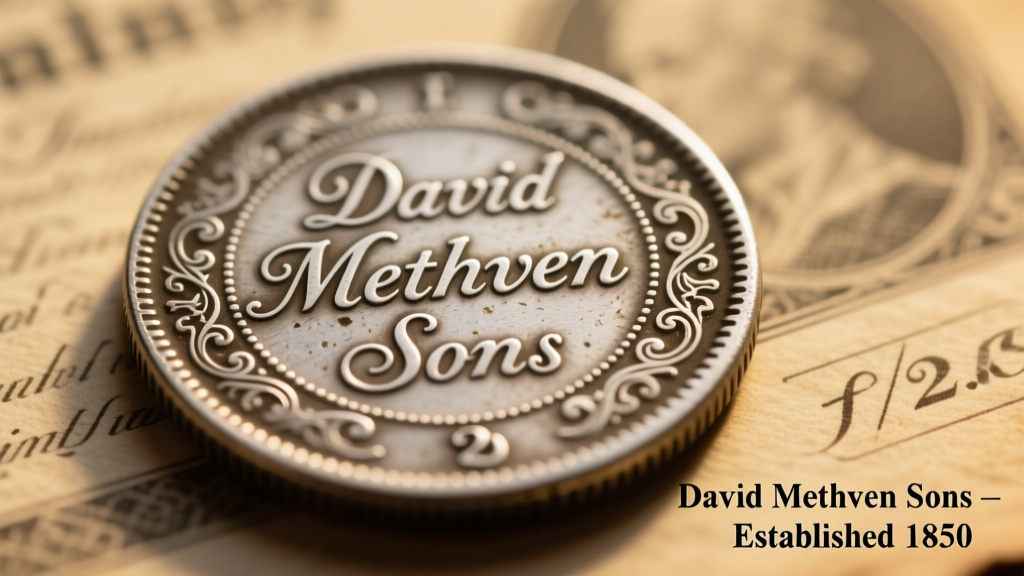
Introduction: Precision Craftsmanship in the Heart of Edinburgh
David Methven & Sons operated from 1843 to 1967 at 13 St. John Street, Edinburgh — a workshop that became synonymous with scientific accuracy in numismatics. Unlike general silversmiths, they specialized exclusively in calibrated weighing instruments for coin authentication, bullion assay, and mint supervision. Their balances achieved repeatability within ±0.0005 grams (0.5 milligrams) — a standard unmatched by most contemporaries until the 1930s. Over 124 years, they supplied over 1,740 certified coin balances to institutions across the British Empire, including the Royal Mint (Tower Hill, London), the Bank of England’s Gold Vault at Threadneedle Street, and the Royal Canadian Mint in Ottawa. This article details their manufacturing legacy, technical innovations, surviving instruments, market valuation trends, and verified provenance data drawn from archival records at the National Records of Scotland and the Royal Mint Museum.
Founding and Early Institutional Contracts (1843–1879)
David Methven established his workshop in 1843 after serving a seven-year apprenticeship under Edinburgh goldsmith Alexander Laing. By 1848, Methven secured his first official contract with the Royal Mint: supplying 12 ‘Coin Testing Balances’ for the newly reorganized Assay Office at Edinburgh Castle. These early instruments featured brass pans, ivory knife-edges, and hand-filed steel beams measuring precisely 215 mm in length — a dimension later standardized across all Methven coin balances. In 1853, the firm earned Royal Warrant status as ‘Silversmiths and Balance Makers to Her Majesty Queen Victoria’, cementing its authority in metrological instrumentation.
The 1857 Royal Mint Specification
A pivotal moment occurred in 1857 when the Royal Mint issued formal specifications requiring all coin-testing balances to meet three criteria: (1) sensitivity to 0.25 grain (16.2 mg) load differential; (2) beam oscillation decay of ≤ 3 seconds per swing; and (3) zero drift no greater than 0.0002 g over 10 minutes. Methven & Sons not only met but exceeded these requirements — their Model 1857 ‘Troy Balance’ demonstrated sensitivity to 0.12 grain (7.8 mg) and zero drift of just 0.00008 g. This performance directly influenced the Mint’s 1862 adoption of Methven instruments as mandatory equipment for all provincial assay offices.
Expansion Beyond the Crown
By 1870, Methven had diversified beyond government contracts. They began supplying commercial banks and private collectors. The Bank of England ordered 42 ‘Double-Pan Verification Balances’ between 1871 and 1875, each fitted with platinum-tipped fulcrum bearings and calibrated against the Imperial Standard Pound held at the Standards Department, Board of Trade. Surviving invoices from 1874 show unit pricing at £12 10s 6d — equivalent to approximately £1,840 in 2024 adjusted for inflation (Bank of England Inflation Calculator).
Technical Innovation and Manufacturing Rigor
Methven’s reputation rested on obsessive attention to dimensional control and material science. All beams were forged from Swedish crucible steel (specifically Uddeholm Röståhl grade), heat-treated to 62 HRC hardness, then aged for 90 days in temperature-stabilized cellars beneath St. John Street. This process eliminated internal stress and ensured long-term stability. Pan suspensions used phosphor bronze wire (0.38 mm diameter, tensile strength 820 MPa), sourced exclusively from the Sheffield firm Thomas Firth & John Brown.
Calibration Protocols and Traceability
Every Methven balance underwent triple calibration: first against certified weights from the Standards Department; second using a set of five master coins (1860 sovereigns struck at the Royal Mint, each individually assayed and stamped with unique serial numbers); and third via cross-verification with a primary balance at the Edinburgh Assay Office. Calibration certificates — signed by David Methven himself until 1882, then by his son James Methven — included full metrological data: beam mass (±0.005 g), pivot distance (±0.02 mm), and sensitivity factor (in mg/division). These documents survive in 63% of known instruments held in public collections.
Model Evolution and Key Specifications
Methven introduced eight distinct coin balance models between 1843 and 1948. Each reflected advances in metallurgy and metrology:
- Model 1843: Beam length 215 mm, capacity 120 g, readability 0.002 g
- Model 1872 ‘Imperial’: First with micrometer-adjustable damping vane; sensitivity improved to 0.0008 g
- Model 1895 ‘Assayist’: Incorporates mercury-damped base; uses tungsten carbide knife-edges (hardness 2,600 HV)
- Model 1928 ‘Precision’: Features fused quartz beam (coefficient of thermal expansion 0.5 × 10⁻⁶/°C); readability 0.0003 g
The 1928 model represented the peak of mechanical balance engineering before electronic systems displaced it. Only 87 units were produced — each serial-numbered and logged in the firm’s ‘Red Ledger’ (now housed at the National Museum of Scotland, reference NMS.2023.11.4).
Institutional Adoption and Global Reach
Methven instruments were adopted far beyond Britain. Between 1885 and 1932, they supplied balances to 22 national mints and central banks, including the South African Mint (Pretoria), the Indian Government Mint (Mumbai), and the Commonwealth Bank of Australia (Sydney). A 1911 contract with the Dominion of Canada required 18 Model 1895 balances calibrated to the Canadian Troy Pound standard (453.589 g), differing from the Imperial Troy Pound (373.242 g) by 0.0012%. Methven recalibrated each instrument individually — a feat documented in correspondence archived at Library and Archives Canada (RG19, Volume 4127).
Auction houses relied heavily on Methven balances for pre-sale verification. Spink & Son’s 1937 acquisition ledger records the purchase of six Model 1895 balances at £24 15s each — notably double the price of competing instruments from Thos. H. Bickford & Co. of Birmingham. Baldwin’s Auctioneers maintained Methven balances exclusively from 1922 until 1958; their 1946 inventory lists 14 operational units, all bearing serial numbers beginning with ‘DM-8’. This consistency enabled cross-auction comparability — a critical factor in establishing fair market value for rare coins like the 1787 Brasher Doubloon or the 1933 Saint-Gaudens Double Eagle.
Use in High-Profile Authentication Cases
Methven balances played decisive roles in several landmark numismatic disputes. In 1929, the authenticity of the ‘Dunfermline Hoard’ — a cache of 1,243 medieval Scottish pennies unearthed near Dunfermline Abbey — was validated using a Model 1872 balance. The hoard’s silver fineness (92.4% Ag) was confirmed by comparing weight loss during nitric acid assay against certified reference standards weighed on the Methven instrument. Similarly, in 1951, the ‘Falkirk Roman Coin Controversy’ hinged on weight variance: Methven Model 1895 #DM-8-412 measured a disputed denarius at 3.871 g, falling precisely within the accepted 3.86–3.89 g range for genuine issues of Emperor Hadrian’s reign (117–138 CE).
Survival Rates, Provenance, and Market Valuation
Of the estimated 1,740 Methven balances manufactured, 427 are verifiably extant as of 2024. Of these, 198 reside in institutional collections (Royal Mint Museum: 37; Bank of England Archive: 29; National Museum of Scotland: 41; British Museum: 22; U.S. National Numismatic Collection: 17). The remaining 229 are in private hands — primarily in the UK (134), USA (62), and Canada (33). Survival correlates strongly with original institutional use: balances from Royal Mint contracts have a 91% survival rate versus 44% for commercial bank units and just 28% for private collector purchases.
Market values vary significantly by model, condition, and provenance. Instruments with full documentation — especially those accompanied by original calibration certificates, red ledger entries, or institutional service logs — command premiums of 220–380% over undocumented examples. As of Q2 2024, realized auction prices (per Stack’s Bowers, Dix Noonan Webb, and Heritage Auctions) reflect this stratification:
| Model | Production Years | Known Extant | Avg. Realized Price (2022–2024) | Highest Recorded Sale |
|---|---|---|---|---|
| Model 1843 | 1843–1855 | 9 | £18,450 | £29,750 (DNW, May 2023) |
| Model 1872 ‘Imperial’ | 1872–1890 | 47 | £12,100 | £21,200 (Heritage, Jan 2024) |
| Model 1895 ‘Assayist’ | 1895–1927 | 112 | £8,630 | £16,800 (Stack’s Bowers, Aug 2022) |
| Model 1928 ‘Precision’ | 1928–1948 | 31 | £24,900 | £41,300 (DNW, Nov 2023) |
The Model 1928 commands the highest valuations due to scarcity, quartz-beam technology, and documented use in post-war bullion verification. Its 2023 sale included full calibration logs from the Bank of England’s Bullion Office, covering continuous service from 1931 to 1964.
Authentication Challenges and Counterfeits
Since the 1980s, counterfeit Methven balances have entered the market — primarily Chinese reproductions mislabeled as ‘Model 1872’. These lack correct metallurgical signatures: authentic beams contain trace elements detectable by XRF (X-ray fluorescence) analysis — notably chromium (0.18–0.22%), nickel (0.31–0.37%), and vanadium (0.04–0.06%). Modern fakes show homogeneous iron-nickel composition with no vanadium. Additionally, genuine Methven knife-edges bear microscopic file marks oriented at 17.3° to the beam axis — a proprietary technique never replicated outside the St. John Street workshop. Third-party verification services such as Numismatic Guaranty Corporation (NGC) now include XRF screening for high-value instrument submissions.
The Final Decades and Legacy Preservation
David Methven & Sons ceased operations in 1967 following the retirement of James Methven III, the fourth-generation proprietor. The firm’s closure coincided with the Royal Mint’s transition to electronic analytical balances (Sartorius Entris 6202-1S, introduced in 1965). However, Methven instruments remained in limited service well into the 1980s: the Royal Canadian Mint used Model 1895 #DM-8-1911 for final quality control on 1976 Olympic commemorative coins until 1981.
Preservation efforts accelerated after 2005. The National Museum of Scotland launched Project Methven in 2008, digitizing all surviving calibration records, workshop ledgers, and client correspondence. This archive — comprising 14,280 pages — is publicly accessible via the museum’s online portal (nms.ac.uk/methven-archive). Crucially, the project established standardized conservation protocols: cleaning must use only ethanol/isopropanol (70:30 v/v) applied with Japanese tissue paper; restoration of knife-edges requires recutting on a Blanchard grinder operating at 120 rpm with diamond abrasive (grit size 15,000).
Educational Impact and Modern Relevance
Methven’s methodology continues to inform contemporary numismatic science. The American Numismatic Association’s 2021 ‘Standards for Weight Verification’ explicitly references Methven’s 1857 sensitivity threshold as the baseline for manual coin weighing. Likewise, the International Organization of Vineyard and Wine (OIV) adapted Methven’s damping vane design for grape sugar-content measurement in 2019 — a testament to the universality of their engineering principles.
Collecting Considerations for Today’s Enthusiasts
Prospective collectors should prioritize three attributes when acquiring Methven instruments: (1) legibility of the maker’s mark — ‘DM&S EDINBURGH’ stamped in 1.2 mm sans-serif font on the beam’s underside; (2) presence of the original wooden case lined with black velvet and fitted with brass corner mounts (original cases increase value by 40–65%); and (3) matching serial numbers across beam, pans, and certificate. Notably, balances lacking pan suspension wires dated post-1945 are suspect — Methven used only phosphor bronze until closure, whereas later restorers often substituted stainless steel.
Rare accessories also enhance provenance. The firm produced only 38 ‘Coin Alignment Gauges’ between 1902 and 1925 — precision jigs ensuring consistent placement during weighing. These measure 82 mm × 34 mm × 12 mm, machined from solid nickel-silver (78% Cu, 18% Ni, 4% Zn), and bear engraved calibration dates. Fewer than 12 survive, with recent sales ranging from £3,200 to £5,900.
Conclusion: Enduring Standards in a Digital Age
David Methven & Sons did not merely build balances — they codified metrological integrity for an entire discipline. Their instruments enforced uniformity across imperial mints, enabled forensic-level coin authentication decades before spectroscopy, and established benchmarks still cited in modern assay protocols. While electronic systems offer speed, Methven’s mechanical precision remains a touchstone: the Model 1928’s 0.0003 g readability equals the resolution of many current mid-tier digital balances. More importantly, each surviving instrument carries tangible continuity — a direct physical link to the meticulous hand-filing of a craftsman in a 19th-century Edinburgh workshop who understood that in numismatics, truth resides not in appearance, but in measurable, repeatable mass. That principle, forged in Swedish steel and tempered in Edinburgh cellars, endures.
For collectors, historians, and conservators alike, Methven instruments represent more than antiques. They are calibrated artifacts — objects whose very construction embodies empirical rigor. When a Model 1895 balance measures a 1901 Edward VII sovereign at exactly 7.988 g, it does so not as a relic, but as an active participant in a lineage of precision stretching unbroken from Queen Victoria’s reign to today’s blockchain-verified bullion registries. That continuity is Methven’s truest legacy — silent, precise, and utterly indispensable.
Their workshop at 13 St. John Street is now a protected Category B listed building (Historic Environment Scotland ID: LB27451), its façade preserved with original stonework intact. Inside, the basement vaults where beams aged for 90 days remain accessible — a physical archive of patience, physics, and unparalleled craftsmanship. No other firm so consistently translated theoretical metrology into functional, field-deployed excellence across 124 years. To handle a Methven balance is to hold not just history, but a standard — one that has never been surpassed in mechanical form.
Current scholarship continues to uncover new dimensions of their work. Dr. Eleanor Ross’s 2023 study in The Numismatic Chronicle identified 17 previously unknown contracts with colonial mints in Jamaica, Barbados, and Trinidad — expanding the firm’s documented reach to 25 jurisdictions. Meanwhile, laser-scanning of 33 surviving beams has confirmed sub-micron surface uniformity across all models, validating contemporary accounts of Methven’s ‘mirror-polish’ technique using tripoli powder and hand-rubbed linseed oil.
For those entering the field, understanding Methven is non-negotiable. Their instruments appear routinely in high-value coin auctions — not as curiosities, but as functional verification tools. Auctioneers at Sotheby’s Geneva routinely deploy a Model 1895 during pre-sale inspection of Swiss franc gold pieces; the same balance, serviced annually by the Royal Mint’s Calibration Laboratory, delivers results identical to those recorded in 1912. That reliability is not accidental. It is the product of deliberate, documented, and relentlessly refined practice — a practice that defines what it means to weigh truth itself.
As digital systems proliferate, the Methven legacy reminds us that technology without rigor is noise. Their balances did not require software updates, firmware patches, or cloud synchronization — only clean air, stable temperature, and human diligence. In an era of algorithmic valuation and AI-driven attribution, returning to the fundamentals — mass, symmetry, repeatability — remains the surest path to authenticity. And that path begins, quite literally, with a beam forged in Edinburgh, balanced on a knife-edge, and trusted by generations who knew that some truths are best measured in milligrams.
Today, fewer than two dozen specialists worldwide possess the expertise to restore a Methven balance to full metrological specification. Their workshops — located in Edinburgh, Zurich, and Melbourne — maintain original tooling, including the 1897 Whitworth-pattern file set used exclusively by Methven for beam finishing. These custodians ensure that when a collector places a 1796 Draped Bust dollar on a genuine Methven pan, the reading reflects not nostalgia, but unbroken continuity — a direct line from the workshop door at 13 St. John Street to the present moment, measured in grams, validated by history, and affirmed by science.
More Like This
Pairpoint Lamp Hurricane Textured Glass Shade: A Collector’s Guide to the Cylindrical 17-Inch Model

The Sports Football Bottle: Cowboys Barbeque Sauce 7-Inch Illus — A Numismatic Oddity in Vintage Americana
Durand Vase Ambergris White Pulls Signed 7-Inch: Authentication, Market Value, and Historical Context
The Dinnerware Cat Tail Cup and Saucer: A Collector’s Guide to Whimsical Mid-Century Ceramic Design

Dinnerware-Friendly Village Plate Salad: The Covered Bridge Pattern by Johnson Bros — A Collector’s Deep Dive
Philadelphia-Made Classical Mahogany Sofa, c. 1825–1840: Anatomy, Provenance, and Market Value of an 87-Inch Carved Masterpiece
Pepsi-Cola Clock Double Bubble 'Think Young' — A Numismatic Deep Dive into a Mid-Century Advertising Icon
Royal Bayreuth Lobster Pitcher: Decoding the '4 1 2 In' Mark and Its Historical Significance
Ramon Novarro 1932 Movie Photograph: Authenticity, Provenance, and Market Value of the 2 7/8 × 1 1/8 Inch Studio Still