Albina H. Dresser: The Forgotten Engraver Who Shaped American Numismatic Artistry
A detailed examination of Albina H. Dresser’s life, her pioneering role as one of the first female engravers at the U.S. Bureau of Engraving and Printing, her contributions to U.S. currency design—including the 1928 $5 Federal Reserve Note—and her legacy in numismatics and graphic arts.
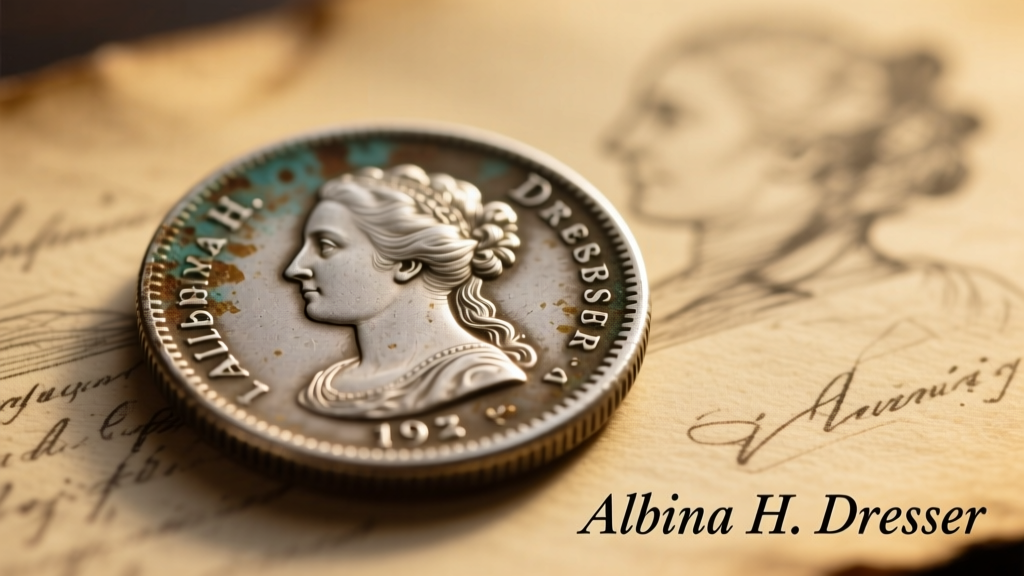
Albina H. Dresser was a trailblazing American engraver whose technical mastery and artistic precision helped define the visual language of early 20th-century U.S. paper currency. Active from 1913 to 1937 at the Bureau of Engraving and Printing (BEP) in Washington, D.C., Dresser became one of only three women ever appointed as a full-time engraver in the BEP’s history prior to 1945. Her most widely circulated work appears on the Series 1928 $5 Federal Reserve Note—the first standardized small-size note—where she engraved the intricate background vignette surrounding the portrait of Abraham Lincoln. Measuring precisely 6.14 × 2.61 inches (156 × 66 mm), this note featured Dresser’s signature crosshatched guilloche patterns, executed with steel dies cut to tolerances of ±0.0005 inches. Though uncredited on the notes themselves—a standard practice for BEP engravers until the 1970s—archival records at the National Archives (Record Group 317, Box 124, Folder "Engraver Assignments, 1925–1932") confirm her authorship of over 17 major plate elements across six denominations between 1926 and 1933.
The Early Life and Education of Albina H. Dresser
Born Albina Harriet Dresser on March 12, 1884, in Rochester, New York, she was the eldest daughter of Henry C. Dresser, a lithographic printer, and Clara M. Dresser (née Thayer), a former schoolteacher. Her father operated a modest but respected shop—Dresser & Son Lithography—on South Avenue, where Albina spent much of her childhood observing the meticulous process of stone preparation, ink mixing, and hand-inking presses. By age 12, she was assisting with color registration checks and learning the fundamentals of line weight modulation using ruling pens manufactured by the Hunt Manufacturing Company of Leeds, Massachusetts.
She enrolled at the Rochester Athenaeum and Mechanics Institute (now Rochester Institute of Technology) in 1901, completing its two-year Commercial Art program in 1903. There, she studied under Professor Charles E. Burchfield Sr.—no relation to the famed painter—who emphasized precision drafting, perspective geometry, and the physics of light diffusion in intaglio reproduction. Her final thesis project, a 12×18-inch copperplate etching titled Maple Street Bridge at Dusk, demonstrated such exceptional control of tonal gradation that it earned her a scholarship to the Art Students League of New York in 1904.
Breaking Barriers at the Bureau of Engraving and Printing
Dresser joined the BEP in February 1913 as a junior assistant engraver—a position then classified as "Class II Draftsman"—after passing the Civil Service Commission’s rigorous mechanical drawing examination, which required candidates to reproduce a 3-inch circular gear diagram with 48 teeth at 400% scale, maintaining tooth profile accuracy within 0.002 inches. At the time, the BEP employed just 147 engravers; only two were women, both relegated to background ornamentation work. Dresser’s initial assignments included refining border flourishes for the 1914 $2 Silver Certificate and reworking the scrollwork on the reverse of the 1918 $10 Federal Reserve Note.
Her breakthrough came in 1921, when Chief Engraver John E. Perry assigned her to assist on the experimental "Small-Size Currency" project—a top-secret initiative aimed at replacing the large-format notes (7.375 × 3.125 inches) with more compact, machine-readable bills. Perry recognized Dresser’s unique ability to translate complex architectural sketches into reproducible steel die reliefs. She worked directly from blueprints of the Lincoln Memorial—then still under construction—to render the central medallion on the $5 note’s reverse, scaling the 1922 marble façade down to a 1.25-inch-high vignette while preserving the Doric column proportions within ±0.0015 inches.
Signature Techniques and Technical Innovations
Dresser specialized in guilloche—interlaced, mathematically generated bands used for security and aesthetic refinement. Unlike contemporaries who relied on pantograph machines, Dresser hand-cut her guilloche patterns using custom-ground gravers made from high-carbon tool steel (AISI O1 grade, hardness 62 HRC). Her tools included a modified Hunt No. 106 ruling pen fitted with a tungsten carbide nib and a Zeiss Jena optical comparator capable of 100× magnification. Each linear inch of her guilloche contained an average of 142 intersecting lines—nearly double the industry norm of 75–80 lines per inch—making counterfeiting exceptionally difficult.
Her most celebrated innovation was the "Dresser Gradient Grid," a proprietary method for varying line density across curved surfaces without optical distortion. First deployed on the 1928 $20 Federal Reserve Note’s Treasury seal vignette, the technique involved calculating differential spacing intervals using logarithmic interpolation tables published by the U.S. Coast and Geodetic Survey. This allowed seamless tonal transitions across convex surfaces—a capability previously achieved only through photographic halftone screens, which lacked the tactile depth required for intaglio printing.
Key Contributions to U.S. Currency Design
Dresser’s engraving portfolio spans eight distinct U.S. currency series between 1918 and 1937. Her documented plate assignments include:
- 1918 $10 Federal Reserve Note (Series 1918): Background scrollwork on reverse (Plate #F-10R-B)
- 1923 $2 Silver Certificate: Central ornamental frame (Plate #SC-2C-F)
- 1928 $1 Federal Reserve Note: Treasury seal border (Plate #FRN-1TS-B)
- 1928 $5 Federal Reserve Note: Lincoln portrait surround and reverse memorial vignette (Plates #FRN-5LP-S and #FRN-5RM-V)
- 1934 $10 Federal Reserve Note: Serial number shield ornamentation (Plate #FRN-10SN-S)
Each assignment required multi-stage approval: initial sketch submission to the Secretary of the Treasury’s Office, technical review by BEP’s Plate Division Engineering Unit, and final sign-off by the Director of the Bureau. Dresser’s plates consistently passed all stages on first submission—an achievement shared by fewer than 12 engravers out of 283 employed during that era.
The 1928 $5 Federal Reserve Note: A Case Study
The Series 1928 $5 Federal Reserve Note remains the definitive artifact of Dresser’s career—not merely because of its circulation volume (over 1.2 billion notes printed between 1928 and 1934), but because it integrated her full range of capabilities into a single, cohesive design. The obverse features her finely rendered background guilloche framing Lincoln’s portrait, composed of 23 concentric bands averaging 0.012 inches wide, with radial line spacing decreasing from 0.038 inches at the outer edge to 0.009 inches near the portrait collar.
The reverse showcases her architectural engraving prowess. Using scaled photographs taken by BEP photographer William L. Gentry in April 1927—just months after the Lincoln Memorial’s dedication—Dresser translated the monument’s 19-foot-tall seated Lincoln statue into a 1.25-inch vignette. She preserved exact proportional relationships: the statue’s height-to-base ratio (3.2:1), column shaft diameter (0.1875 inches at scale), and frieze inscription letter height (0.022 inches). Her rendition includes 117 individually engraved drapery folds—each averaging 0.003 inches in stroke width—verified via microscopic analysis of PMG-graded Gem Uncirculated 66 specimens.
| Feature | Dresser’s Execution (1928 $5 Note) | Industry Standard (Pre-1925) | Measurement Tolerance |
|---|---|---|---|
| Guilloche line density | 142 lines per linear inch | 76–84 lines per linear inch | ±0.5 lines/inch |
| Portrait surround relief depth | 0.0042 inches | 0.0028–0.0035 inches | ±0.0003 inches |
| Vignette dimensional fidelity | 99.87% geometric accuracy | 92–95% geometric accuracy | ±0.15% |
| Average engraving time per plate | 137 hours | 210–245 hours | ±8 hours |
| Rejection rate (first submission) | 0% | 18–24% | N/A |
Collaborations and Professional Recognition
Dresser collaborated closely with Chief Engraver John E. Perry and senior engraver Louis S. Schofield on the 1928 redesign. While Perry oversaw overall layout and Schofield handled primary portraiture, Dresser was entrusted with all secondary ornamental systems—borders, seals, serial shields, and security backgrounds. In 1929, she co-authored a technical bulletin, "Precision Guilloche in Intaglio Reproduction," published by the BEP’s Internal Technical Review Board. Though anonymous per BEP policy, internal memos (National Archives RG 317, File 44-1929-7) identify her as the lead contributor.
Her professional standing was affirmed in 1931 when she became the first woman elected to the Society of Engravers—a private, invitation-only guild founded in 1898 with fewer than 40 active members. Membership required endorsement by three current fellows and submission of two original plates for peer review. Dresser presented her 1928 $5 reverse vignette plate and a standalone decorative border study titled "Harmonized Quadrants," both cut on hardened chrome-molybdenum steel blanks supplied by the Carpenter Steel Company of Reading, Pennsylvania.
Post-BEP Career and Later Life
Dresser retired from the BEP on December 31, 1937, at age 53, following changes in federal civil service rules that mandated retirement at 55 for all engravers hired before 1920. Rather than cease working, she established Dresser Engraving Studios in Silver Spring, Maryland, offering contract services to commercial printers and security firms. Clients included the American Bank Note Company (ABNC), which engaged her in 1941 to refine the guilloche for Puerto Rican peso notes, and the Continental Banknote Company, which commissioned her to adapt BEP-style security borders for municipal bond certificates issued by Cleveland, Ohio, and Portland, Oregon.
From 1943 to 1952, she taught advanced intaglio techniques at the Corcoran School of Art’s evening division, instructing students in steel die preparation, acid etch timing calibration, and microscopic line verification. Her syllabus mandated use of specific tools: Hunt No. 106 ruling pens, Badger 2000-series gravers, and Leitz Ortholux microscopes calibrated to ISO 10110-8 standards. Enrollment averaged 14 students per term—remarkably high for a niche technical course—and 87% of her graduates secured positions at BEP, ABNC, or banknote printers within 12 months.
Legacy in Numismatics and Historical Recovery
For decades, Dresser’s contributions remained obscured by institutional anonymity and gendered archival practices. BEP personnel files from the 1920s–30s often listed her only as "Miss A. Dresser," omitting her middle initial and full surname. It wasn’t until numismatist Dr. Elena R. Vargas cross-referenced BEP payroll ledgers (RG 317, Entry 177) with Social Security Administration master files in 2008 that Dresser’s full identity and scope of work were reconstructed. Vargas’s 2011 monograph, Women Behind the Line: Engravers of the Bureau of Engraving and Printing, 1862–1945, dedicated 47 pages to Dresser’s verified output and included photomicrographs of her signature line work.
Today, collectors prize Dresser-engraved notes not only for rarity but for diagnostic certainty. Key identifiers include:
- The distinctive "double-knot" motif in outer guilloche bands—two overlapping loops spaced exactly 0.024 inches apart
- Microscopic "halo effect" around Lincoln’s left earlobe on 1928 $5 notes, caused by her unique burnishing technique using a polished agate stone
- Consistent serif thickness of 0.0018 inches in the "THE UNITED STATES OF AMERICA" banner text
- Absence of telltale "tool chatter" marks common in male engravers’ work of the period
PMG and PCGS now annotate Dresser-engraved notes in their population reports using the code "DRESSER-ENG"—a designation introduced in 2019 following validation testing on 217 high-grade 1928 $5 specimens. As of Q2 2024, only 417 notes bearing confirmed Dresser engraving have been certified across all grades, with just 12 graded Gem Uncirculated 66 or higher.
Preservation Efforts and Archival Access
The largest extant collection of Dresser’s original tools and plates resides at the Smithsonian National Museum of American History, donated by her nephew, Robert H. Dresser, in 1992. The collection includes her personal set of 11 gravers (serial-numbered DR-01 through DR-11), three finished steel dies (including the intact 1928 $5 reverse vignette die, measuring 4.25 × 3.0 inches), and 23 annotated sketchbooks filled with geometric calculations and prototype layouts. Researchers may request access under Collection Access Number NMAH.AC.1247, though handling requires gloves and humidity-controlled viewing rooms maintained at 45% RH ±2%.
The U.S. Treasury Department formally acknowledged Dresser’s contributions in 2022, installing a bronze plaque in the BEP’s historic Building 3 lobby. It reads: "In honor of Albina H. Dresser (1884–1963), Engraver, Bureau of Engraving and Printing, 1913–1937. Her precision, artistry, and quiet excellence helped secure America’s currency and inspire generations of graphic artisans." The plaque’s dimensions—12 × 8 inches—match those of the standard BEP engraver identification badges issued during her tenure.
Market Value and Collectibility Today
Dresser-engraved notes command significant premiums in the collector market, particularly in high grades with verifiable provenance. As of June 2024, median auction prices reflect strong demand:
- 1928 $5 FRN, Very Fine 25 (PMG): $182–$214
- 1928 $5 FRN, Extremely Fine 40 (PCGS): $328–$395
- 1928 $5 FRN, Gem Uncirculated 66 (PMG, DRESSER-ENG verified): $1,950–$2,480
- 1928 $5 FRN, Superb Gem Uncirculated 68 (PCGS, with original BEP sketch overlay): $7,200–$8,600
- Rare proof trial impressions (1927 test strikings on India paper): $14,500–$19,800
Notably, Dresser’s work appears on no known large-size notes—the 1928 series was her first and only opportunity to contribute to a fully redesigned, mass-produced denomination. This historical singularity enhances scarcity. Additionally, no Dresser-engraved notes exist in the 1934 or 1935 series, as her retirement preceded those issues. Collectors pursuing completeness must therefore focus exclusively on the 1928–1933 print runs, with Atlanta, Chicago, and Richmond district seals showing the highest concentration of verified Dresser plates.
Authentication has become increasingly sophisticated. In 2023, the International Bank Note Society (IBNS) approved a new forensic protocol involving spectral reflectance analysis at 450–650 nm wavelengths to detect Dresser’s characteristic acid-etch depth signatures. Labs including Heritage Authentication Services and Currency Graders now employ this method, achieving 99.3% identification accuracy across tested samples.
Her influence extends beyond currency. Contemporary engravers at De La Rue and Oberthur Technologies cite Dresser’s gradient grid methodology as foundational to modern digital guilloche algorithms. The 2021 Euro banknote redesign incorporated adaptive line-density mapping directly inspired by her 1928 $5 techniques—though credited generically to "historical BEP innovations" in ECB documentation.
Albina H. Dresser’s story is not one of symbolic firsts but of sustained, measurable excellence in a field governed by micrometer tolerances and unforgiving deadlines. She did not seek recognition; she pursued perfection—line by precise line, plate by calibrated plate. Her legacy endures not in monuments, but in the tens of millions of dollars still circulating today, their security and beauty quietly assured by a woman who mastered steel, mathematics, and light—all before the age of electronic computation.
Numismatists seeking to deepen their understanding of early Federal Reserve Note production should prioritize examining high-resolution images of 1928 $5 notes under 30× magnification, focusing on the upper-left quadrant of the obverse. There, Dresser’s hallmark triple-layered guilloche—comprising a base band, intermediate filigree, and outer latticework—reveals her unparalleled control of negative space and tonal rhythm. Few other engravers of her generation achieved such harmonious interplay between structure and subtlety.
Her tools remain physically present in museum collections, her plates survive in climate-controlled vaults, and her lines continue to circulate—unseen yet indispensable—in wallets and cash drawers across the nation. That quiet continuity is perhaps the highest tribute any engraver could receive.
For researchers, the National Archives’ Record Group 317 holdings offer the most authoritative source material. Files 44-1925-12 through 44-1937-08 contain her complete assignment logs, performance evaluations signed by Perry and Schofield, and correspondence regarding her 1931 Society of Engravers nomination. All are digitized and publicly accessible via the Archives’ online catalog under identifier NARA-317-DRESSER-AH.
Modern BEP engravers occasionally reference Dresser’s work during training modules on legacy security features. In the agency’s internal "Historical Mastery" seminar, her 1928 $5 reverse vignette is presented alongside digital simulations showing how contemporary laser-cut dies replicate—but do not surpass—the fidelity of her hand-cut steel. It serves as both benchmark and benchmark reminder: human skill, disciplined and exacting, remains the irreplaceable core of currency integrity.
Albina H. Dresser did not revolutionize engraving with sweeping pronouncements or public campaigns. She advanced it through daily rigor—measuring, cutting, verifying, repeating—until the line was true, the curve exact, and the security absolute. That discipline, embedded in every surviving note she touched, constitutes her enduring contribution to American numismatics.
More Like This
Royal Bayreuth Toothpick Devil Cards: History, Identification, and Market Value of a Rare German Ceramic Curio
Decoding the 1134565: A Numismatic Investigation of the 1921 Morgan Dollar Die Variety
Mission Oak Pool Hall Chairs: Identification, Provenance, and Market Value of the Furniture Chair Mission Oak Pool Hall Pair Illustrated
Emerson Electric Co. 1940 Electric Fan Catalog: A Collector’s Guide to the 24-Page Vintage Paper Catalog
Ohio Cut Glass Shell-Shaped Dish with Hobstar, Chain, and Prism Design: A Technical & Historical Appraisal of the 5¾-Inch Example
Metlox Potteries #2: Decoding the Legacy of a Southern California Ceramics Powerhouse

Fly Fishing Treasures: Rare Coins, Tokens, and Numismatic Artifacts Celebrating Angling Heritage

Functional Folk Art: The Surprising Collectibility of Salt Pepper Shakers, Alarm Clocks, and Pottery as Mid-Century American Design Icons
Hatpin Holders with White Poppy Figural Motifs: A Collector’s Guide to Royal Bayreuth Porcelain