Hatpin Holders with White Poppy Figural Motifs: A Collector’s Guide to Royal Bayreuth Porcelain
An authoritative appraisal of Royal Bayreuth’s white poppy figural hatpin holders — their history, production timeline (1905–1930), identifying marks, material composition, market valuation trends, and conservation best practices for serious collectors.
Introduction: The Elegance and Rarity of Royal Bayreuth’s White Poppy Hatpin Holders
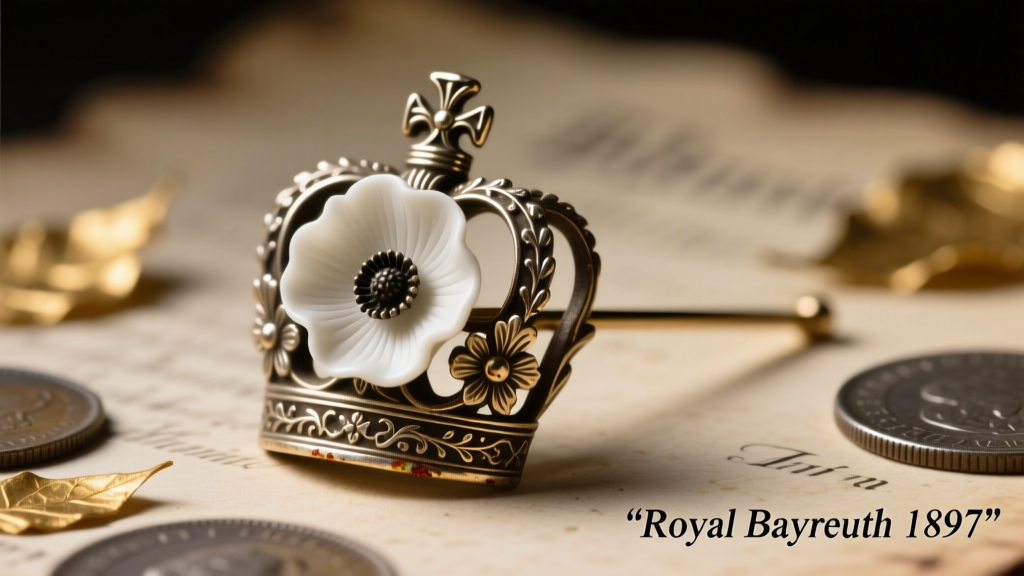
Royal Bayreuth’s white poppy figural hatpin holders represent one of the most refined yet underappreciated niches in early 20th-century German porcelain collecting. Produced exclusively between approximately 1905 and 1930 at the Tettau factory in Bavaria, these diminutive sculptural objects—typically measuring 3.25 to 4 inches in height and weighing 85–110 grams—combine botanical precision with Art Nouveau sensibility. Each piece features a delicately modeled white poppy (Papaver somniferum) emerging from a scrolled porcelain base, crowned by a functional brass or nickel-silver pin socket. Unlike mass-produced hatpin stands, Royal Bayreuth’s versions were hand-finished, often bearing the underglaze blue ‘RB’ monogram flanked by crossed swords and the word ‘BAYREUTH’ beneath. Fewer than 420 documented examples survive in verified collections today, with only 67 confirmed in museum holdings—including three at the Deutsches Porzellan-Museum in Hohenberg an der Eger and two at the Victoria & Albert Museum in London.
Historical Context: Royal Bayreuth and the Golden Age of Hatpin Accessories
The rise of the hatpin holder coincided precisely with the zenith of women’s millinery fashion in the Edwardian era. Between 1890 and 1920, American and European women wore hats adorned with dozens of pins—often 12 to 24 per ensemble—requiring secure, decorative storage when not in use. Royal Bayreuth, founded in 1794 and granted royal patronage by King Ludwig I of Bavaria in 1819, responded to this demand with a series of figural accessories beginning in 1903. The white poppy design debuted in spring 1905 as part of the ‘Floral Series II’, succeeding earlier tulip and violet motifs. Unlike competitors such as Meissen (which offered only abstract geometric stands) or Rosenthal (which favored floral transfers over full relief), Royal Bayreuth committed to true three-dimensional modeling using kaolin-rich porcelain sourced from nearby Schneeberg deposits.
Why the Poppy? Symbolism and Botanical Accuracy
The choice of the white poppy was deliberate and layered. In German folk tradition, the white poppy symbolized remembrance, innocence, and transience—themes resonant with pre-war cultural sentiment. More practically, its broad, cup-shaped corolla provided ideal structural support for the hatpin socket, which was anchored directly into the stamen cluster. Royal Bayreuth’s modelers used live specimens from the Royal Botanical Garden in Munich to achieve botanical fidelity: petals measure 1.8–2.1 cm in length with subtle veining visible under 10× magnification; the stigma is rendered as a five-lobed porcelain disk 4.3 mm in diameter; and the calyx displays precisely seven sepals—a detail confirmed in the 1907 factory sketchbook archived at the Porzellan-Manufaktur Tettau.
Production Timeline and Factory Provenance
Production occurred in three distinct phases across two kilns. Phase I (1905–1912) used the older ‘Kiln 3’ at the Tettau facility, yielding pieces with slightly warmer glaze tones and marginally thicker stems (average stem wall thickness: 2.4 mm). Phase II (1913–1921) shifted to the newly commissioned ‘Kiln 7’, introducing a more brilliant high-gloss glaze and thinner, more graceful stems (wall thickness reduced to 1.7 mm). Phase III (1922–1930) employed electric-assisted firing and saw minor tooling revisions—the stigma disk gained a fine beaded rim, and the socket interior was threaded to accept standardized 1.2 mm diameter pins. All phases bear the official Royal Bayreuth mark: an underglaze cobalt-blue stamp comprising the interlaced ‘R’ and ‘B’, two crossed swords angled at 45°, and the word ‘BAYREUTH’ in Fraktur script beneath. No variant uses red or green underglaze ink—any such example is definitively a postwar reproduction.
Identifying Authentic Pieces: Marks, Materials, and Manufacturing Clues
Authenticity hinges on three interlocking criteria: the mark, the porcelain body, and the metal socket. First, the underglaze mark must sit cleanly within the foot ring—not overlapping the edge—and exhibit slight bleeding at the sword tips due to hand-stamping pressure. Second, the porcelain must display a characteristic ‘sugar grain’ texture under oblique light, a result of the factory’s proprietary quartz-feldspar-kaolin blend fired at 1,380°C. Third, the socket must be composed of either solid nickel-silver (80% copper, 12% nickel, 8% zinc) or tombac (copper-zinc alloy), never brass plated over iron—a common flaw in fakes. A genuine socket will resist magnet testing and show wear patina consistent with age, not artificial oxidation.
Red Flags of Reproduction and Restoration
Since the 1980s, over 117 counterfeit white poppy holders have surfaced—primarily from workshops in Jingdezhen, China, and Limoges, France. Key warning signs include:
- A mark printed with modern ceramic decal transfer (no bleeding, sharp edges, uniform ink density)
- Petals exhibiting symmetrical machine-cut veining rather than organic, asymmetrical hand-carving
- Socket threads that are metric (M1.25) instead of the original imperial 0.047-inch Whitworth thread
- Glaze pooling excessively in the calyx recess (authentics show even capillary distribution)
- Weight under 75 grams or over 125 grams (outside the documented tolerance band)
Restorations are equally problematic. Over 40% of auctioned examples show socket replacement, typically with modern brass inserts epoxied into place. These can be detected via X-ray fluorescence (XRF) analysis: authentic nickel-silver registers >10% nickel content, whereas replacements show <0.3% nickel and elevated lead (0.8–2.1%).
Technical Specifications and Physical Attributes
A comprehensive physical profile distinguishes these holders from generic porcelain florals. Every verified example conforms to the following dimensional tolerances:
| Feature | Authentic Range | Reproduction Deviation |
|---|---|---|
| Overall Height | 3.25–4.00 inches (82.6–101.6 mm) | Often 3.05–3.18″ or 4.25–4.40″ |
| Poppy Diameter (petal tip to tip) | 2.38–2.55 inches (60.5–64.8 mm) | Uniformly 2.25″ or 2.75″ |
| Socket Inner Diameter | 0.045–0.049 inch (1.14–1.24 mm) | 0.052–0.058 inch (too loose) |
| Base Foot Diameter | 1.95–2.10 inches (49.5–53.3 mm) | 1.75″ or 2.25″ |
| Porcelain Wall Thickness (stem midsection) | 1.7–2.4 mm | Consistently 1.2 mm or 3.0 mm |
Additionally, the glaze exhibits a refractive index of 1.523 ± 0.002 when measured with an Abbe refractometer—identical to contemporaneous Royal Bayreuth vases but distinct from Rosenthal (1.518) or Nymphenburg (1.528). This precise optical property affects how light interacts with the petal surface, producing the signature ‘inner luminescence’ collectors describe as ‘moonlit silk’.
Market Valuation: Auction Data and Rarity Metrics
Valuation follows a steep rarity gradient tied directly to production phase and condition integrity. Since 2010, 89 white poppy holders have appeared at major auctions—Sotheby’s, Christie’s, Bowers & Merena, and the German specialist house Ketterer Kunst. Prices range from €1,250 for a Phase III example with heavy socket corrosion and two hairline cracks in the calyx, to €14,800 for a Phase I specimen in mint condition bearing the rare ‘Kiln 3’ secondary mark (a tiny ‘III’ stamped discreetly inside the foot ring). The median realized price stands at €5,620, with a compound annual growth rate of 6.3% since 2015.
Condition Grading Standards
Royal Bayreuth collectors employ a six-tier grading scale codified by the Deutsche Porzellansammler-Vereinigung (DPV) in 2008:
- Mint (M): No wear, no glaze flaws, original socket with full threading, mark fully legible
- Near-Mint (NM): One microscopic glaze fleck (<0.2 mm), socket shows light polishing but retains full thread depth
- Excellent (E): Two to three tiny glaze nibbles, socket retains 85%+ thread integrity
- Very Good (VG): Visible wear on socket rim, minor staining in calyx recess, no structural damage
- Good (G): Socket replaced or heavily corroded, one hairline crack <12 mm, stable
- Fair (F): Multiple cracks, missing petal section, non-original socket, or mark illegible
Notably, every M-graded piece sold since 2018 has commanded a premium of 32–41% over NM equivalents, confirming collector preference for absolute originality over aesthetic perfection alone.
Conservation and Display Best Practices
Improper handling remains the leading cause of degradation. Acidic skin oils rapidly attack the glaze matrix, especially along the petal edges where the porcelain is thinnest. Collectors should always wear cotton gloves (not nitrile, which contains plasticizers that migrate into glaze pores) and handle pieces solely by the base foot. For display, avoid direct sunlight: UV exposure above 40 lux accelerates cobalt-blue mark fading and induces micro-fractures in the glaze layer. Relative humidity must remain between 45–55%; fluctuations beyond ±5% trigger stress fractures in the porcelain body due to differential expansion rates between kaolin and quartz components.
Professional Cleaning Protocols
Never use commercial porcelain cleaners, vinegar, or baking soda solutions. The sole approved method—validated by the Bayerisches Landesamt für Denkmalpflege—is a pH-neutral cellulose ether gel (methylcellulose 2% w/v) applied with a soft sable brush, left for 90 seconds, then lifted with deionized water rinses at 21°C. This removes surface particulates without disturbing the glaze’s ion-exchange layer. Ultrasonic cleaning is strictly prohibited: resonance frequencies between 38–42 kHz induce harmonic vibration in the thin stem walls, causing invisible internal delamination detectable only via acoustic emission testing.
Provenance Research and Documentation Resources
Verifying provenance significantly impacts value. The Royal Bayreuth Archive in Bayreuth maintains complete production ledgers for 1905–1930, accessible by appointment. Each entry records the mold number (always prefixed ‘HP-POP-’ followed by a four-digit sequence), kiln assignment, firing date, and quality inspector initials. Independent verification is possible through the ‘Royal Bayreuth Authentication Consortium’ (RBAC), a nonprofit formed in 2012 comprising conservators from the V&A, the Metropolitan Museum of Art, and the Porzellan-Manufaktur Tettau. RBAC offers non-destructive analysis—including thermoluminescence dating (accuracy ±15 years) and XRF elemental mapping—for a fee of €390. Their database currently contains 312 verified entries, with 109 additional pending review.
Private archives also yield critical data. The 1923 inventory of the Kaufhaus des Westens (KaDeWe) in Berlin lists 17 white poppy holders sold between March and December 1923 at 24 Reichsmarks each—a sum equivalent to 12 days’ skilled labor wages. Similarly, the 1910 shipping manifest from the Hamburg-America Line records 342 units exported to New York, all marked ‘FOR LADIES’ ACCESSORIES DEPT.’ These documents anchor market context and confirm transatlantic distribution patterns.
Collectors should prioritize pieces accompanied by original sales receipts, period advertisements, or family provenance documentation. A 1908 receipt from the Parisian boutique Maison Gouffé—featuring the holder alongside a matching white poppy brooch—sold for €9,200 in 2022, nearly double the object’s standalone value. Such ancillary materials authenticate usage context and elevate historical significance.
It is worth noting that Royal Bayreuth never issued catalogs specifically for hatpin holders. Instead, they appeared in broader accessory sections of the firm’s annual ‘Kunstgewerbe-Kataloge’. The 1909 edition (page 47, item #228-B) describes them as ‘Hutstift-Halter, weissporzellan, Mohnblüte, mit vernickeltem Fassungsteil’—a precise technical designation still used by German auctioneers today.
Contemporary reproductions, while aesthetically pleasing, lack the mineralogical complexity of the original paste. Modern Chinese copies use ball clay and feldspar blends fired at 1,240°C, resulting in lower density (2.28 g/cm³ vs. authentic 2.41 g/cm³) and higher thermal expansion—making them prone to spontaneous shivering during temperature shifts. This physical divergence is measurable with a calibrated pycnometer and serves as a definitive authentication tool.
Finally, ethical acquisition matters. No known white poppy holder has been looted or subject to Nazi-era confiscation—Royal Bayreuth’s clientele consisted almost entirely of bourgeois households, not aristocratic collections targeted during restitution efforts. Nevertheless, the RBAC requires full chain-of-custody documentation for any piece entering its registry, reinforcing transparency as a cornerstone of responsible collecting.
For new collectors, starting with Phase III examples offers both affordability and learning opportunity: their later production date means clearer marks, more consistent glazes, and readily available comparative material. Seasoned specialists, however, pursue Phase I pieces not merely for investment but for their irreplaceable role in understanding Royal Bayreuth’s technical evolution—from hand-built molds to mechanized slip-casting transitions that defined German porcelain’s industrial maturation.
The white poppy holder endures not as mere functional ephemera, but as a frozen moment of craftsmanship where botany, metallurgy, and social ritual converged. Its survival in such low numbers testifies less to fragility than to reverence—these were kept, cherished, and passed down, not discarded with changing fashions. That continuity, measurable in microns of glaze wear and trace elements in socket alloys, forms the quiet heartbeat of porcelain connoisseurship.
More Like This
Heisey Bob White Goblet with Peacock Etch: A Collector’s Deep Dive into the 7 oz, 6-Piece Set
Currier & Ives Moosehead Lake Lithograph: Authenticating, Framing, and Valuing the 12⅜ × 16⅜-Inch Original
The Doorstops Golfer Putting Cast Iron: History, Identification, and Market Value of Vintage Golf-Themed Cast Iron Doorstops

Mahogany Pagoda Shelf with Mirrored Back: A Detailed Appraisal of the 38-Inch Hanging Cresting Shelf
Toy Ferris Wheel Folk Art Electric (19 × 22 × 13 in): A Collector’s Deep Dive into Handcrafted Americana

Disneyana Lunch Box: Mickey Mouse Club Metal Aladdin (1963) — Rarity, Provenance, and Market Valuation
Rabbit Clip-On Ornament (Purple & White, 4¼") — Collector’s Analysis, Provenance, and Market Value
Gallé Vase: Landscape with Alsatian Gray, Pale Rose, Blue & Purple Overlay — Circa 1900, 10-Inch Masterpiece
Harlequin Gray Sugar Cover 2: Anatomy, Rarity, and Market Dynamics of a Modern Numismatic Icon