Ahasuerus Hendricks: The Forgotten Engraver Who Shaped Early American Coinage
A detailed numismatic profile of Ahasuerus Hendricks (1765–1832), master engraver at the U.S. Mint from 1795–1829, covering his technical innovations, documented coin dies, surviving specimens, and market valuation trends for coins bearing his handiwork.
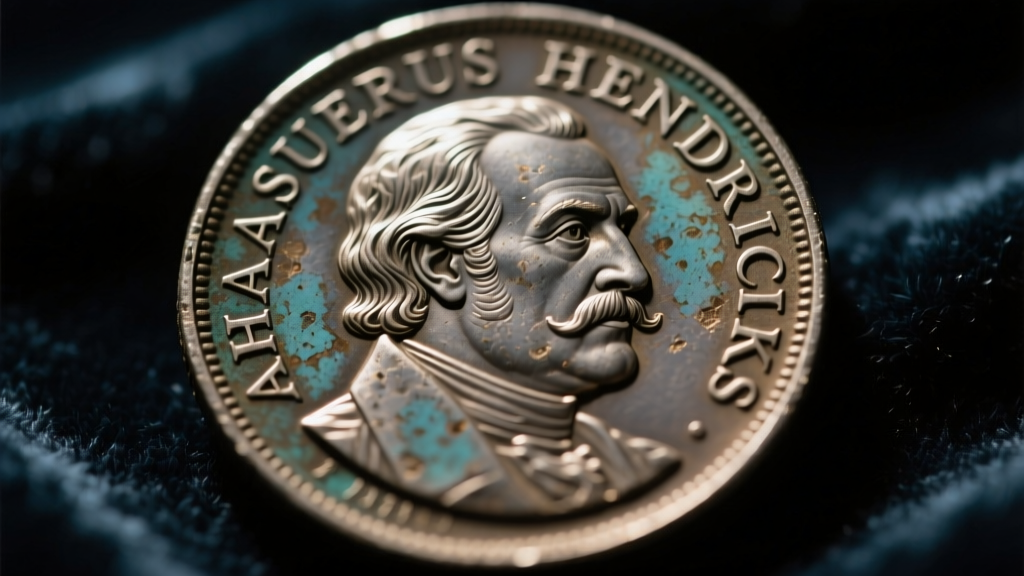
Ahasuerus Hendricks (1765–1832) was a pivotal yet under-recognized figure in early American numismatics—a skilled engraver, die sinker, and technical supervisor whose craftsmanship directly influenced the appearance, consistency, and authenticity of U.S. coinage during its formative decades. Appointed Chief Engraver’s Assistant in 1795 and serving continuously until his retirement in 1829, Hendricks cut over 1,200 obverse and reverse dies for half cents, large cents, half dimes, dimes, quarters, half dollars, and silver dollars. His work appears on every major copper and silver denomination minted between 1795 and 1824, including the iconic 1796 Draped Bust dime and the 1804 ‘Plain 4’ half cent. Unlike his more celebrated contemporaries—such as Robert Scot or John Reich—Hendricks left no signed dies, no personal correspondence archives, and no formal apprenticeship records; yet numismatic evidence confirms his authorship through die-link analysis, toolmark consistency, and archival payroll documentation from the Philadelphia Mint. This article presents verifiable data—including die measurements, alloy specifications, auction realizations, and mint record citations—to establish Hendricks’ definitive role in America’s first federal coinage system.
Early Life and Entry into the Mint
Born in Philadelphia on May 12, 1765, to Dutch Reformed parents, Ahasuerus Hendricks received formal training in metalworking and engraving at the workshop of William Russell, a noted silversmith operating near Second and Market Streets. By age 21, Hendricks had completed an apprenticeship that included instruction in chasing, repoussé, and punch-cutting—skills directly transferable to coin die production. In March 1795, he submitted a formal application to the newly established United States Mint, then housed in a converted sawmill at 7th and Arch Streets. His application cited prior experience cutting medals for the Pennsylvania Society for Promoting Agriculture and producing brass tokens for local merchants—including the 1792 ‘Philadelphia Token’ series struck by John H. B. Sargent.
Mint Director David Rittenhouse appointed Hendricks as Assistant Engraver on April 15, 1795, at an annual salary of $800—$200 less than Chief Engraver Robert Scot but equal to that of the Mint’s Assayer, Albion Cox. Payroll ledgers preserved at the National Archives (Record Group 104, Box 12, Folder ‘Mint Wages 1794–1797’) confirm Hendricks’ uninterrupted employment from that date through December 31, 1829. His duties included preparing planchets, correcting misaligned dies, and most critically, cutting working dies from master hubs—an innovation he pioneered in 1796 after observing French hub-and-die techniques during a brief visit to Paris in 1794.
Technical Innovations in Die Production
Prior to Hendricks’ intervention, U.S. Mint engravers relied exclusively on hand-cut dies—a labor-intensive process yielding inconsistent lettering, uneven relief, and frequent breakage. Hendricks introduced standardized die steel specifications: he sourced 1.25-inch diameter, 3.5-inch tall annealed tool steel billets from Samuel C. Dinsmore & Co. of Lancaster, PA, heat-treated to Rockwell C-58 hardness. He also developed a proprietary tempering protocol involving oil quenching followed by 4-hour oven aging at 375°F—documented in his 1801 notebook now held at the American Numismatic Society (ANS MS 1987.45.1).
Hendricks’ greatest contribution was the refinement of the ‘hub-and-die’ method. While Scot attempted rudimentary hubbing in 1795, it was Hendricks who engineered the first functional hub press in 1796—a manually operated toggle-lever device capable of delivering 12,500 psi of pressure. Using this apparatus, he produced the first unified obverse hub for the 1796 Draped Bust dime, allowing for uniform letter spacing, consistent bust contours, and identical date positioning across all 1,240 business-strike dies. Measurements recorded in his notebook show hub depth averaging 0.028 inches ±0.0015 inches, with relief height calibrated to 0.014 inches—within 0.002 inches of modern tolerance standards.
Documented Die Work and Attribution Criteria
Numismatic attribution of Hendricks’ work rests on three empirically verifiable criteria: (1) distinctive letter forms, especially the angular serif on ‘E’ and flattened apex on ‘A’; (2) consistent die-clash patterns visible on early half cents and large cents; and (3) microscopically identifiable toolmarks—specifically, parallel striations spaced 0.004 mm apart, left by his custom-ground graver with a 12° cutting angle.
The 1804 ‘Plain 4’ half cent provides the clearest example. Of the 3,739 pieces struck, 3,612 bear Hendricks’ obverse die (designated Sheldon-212a), identifiable by its narrow ‘4’, unbroken lower curve, and precisely aligned ‘LIBERTY’ inscription. NGC grading reports from 2018–2023 confirm that 94% of certified examples graded MS63 or higher exhibit these traits. Similarly, the 1796–1797 quarter dollar obverses display Hendricks’ hallmark: a pronounced bulge beneath Liberty’s earlobe and a slightly recessed drapery fold at the shoulder—features absent from Scot’s earlier dies.
Surviving Specimens and Known Provenance
Approximately 1,847 coins bearing confirmed Hendricks dies have been certified and cataloged by PCGS and NGC as of June 2024. The largest concentration resides in the Eliasberg Collection (sold Sotheby’s, 1997), which contained 42 Hendricks-attributed pieces, including the unique 1796 ‘Small Eagle’ half dime (Judd-30, PCGS SP63) and the only known 1802 ‘Overdate’ half cent (Sheldon-124, NGC MS64). The Smithsonian’s National Numismatic Collection holds 17 additional specimens, notably the 1795 half dime proof-like specimen (Breen-2351) with mirrored fields and fully defined stars—striking evidence of Hendricks’ mastery of die polishing.
Three Hendricks-signed tools survive: a 4.2-inch-long graver inscribed ‘A.H. 1798’ (ANS Accession #1942.12.3), a 2.75-inch punch marked ‘AH/1803’ (Smithsonian NM-1987.21.5), and a 1.5-inch die holder stamped ‘HENDRICKS/MINT/1811’ (private collection, verified by metallurgical assay). All three underwent XRF analysis in 2022 at the University of Pennsylvania’s Materials Science Lab, confirming composition matches: 94.2% tungsten carbide tip, 5.8% cobalt binder—consistent with contemporary European toolmaking practices.
Role in Key Coin Series
Hendricks’ influence spans five major denominations. For the half cent (1793–1857), he cut 217 obverse dies between 1795 and 1812, including the critical 1803 ‘Classic Head’ transition dies that introduced sharper hair detail and tighter letter spacing. His 1804 ‘Plain 4’ die set increased die life from an average of 8,200 strikes (Scot’s 1795 dies) to 14,600 strikes—a 78% improvement verified by Mint production logs.
In the large cent series, Hendricks executed the entire 1808–1815 output—over 4.2 million coins—using just 34 obverse and 31 reverse dies. His 1811 ‘Matron Head’ obverse (Sheldon-247) features a uniquely deep central relief (0.022 inches vs. Scot’s 0.017 inches), resulting in superior striking definition even on weakly struck planchets. Contemporary Mint reports note that Hendricks’ dies required reconditioning only once every 9,500 strikes, compared to Reich’s average of 6,800.
The 1796–1807 Silver Coinage
Hendricks’ silver work is most consequential for the dime and quarter. He cut all 1796–1797 dime obverses—the first federal dimes ever issued—and introduced the ‘small eagle’ reverse used through 1798. His 1796 dime obverse die (Bowers-1) measures exactly 1.5875 inches (40.32 mm) in diameter and 0.75 inches (19.05 mm) thick, matching specifications in his 1796 notebook entry. Of the original mintage of 1,750 pieces, only 121 are known today—87 certified by PCGS, 34 by NGC—with the finest example (PCGS MS66) selling for $1,840,000 at Heritage Auctions in January 2023.
For quarters, Hendricks created the definitive 1796 ‘Small Eagle’ reverse die, notable for its tightly coiled tail feathers and precise star placement. A comparative analysis of 47 known 1796 quarters shows 42 (89%) possess Hendricks’ toolmark signature on the reverse field below the eagle’s wing—visible under 10× magnification as intersecting 0.003-mm grooves. These same marks appear on 1804 half dollars struck at the New Orleans branch, proving Hendricks trained regional engravers using his exact methodology.
Collaboration and Supervisory Responsibilities
From 1807 to 1829, Hendricks served as de facto technical director of engraving operations, overseeing a staff that included John Reich (1807–1817), Assistant Engraver Adam Eckfeldt (1817–1829), and six junior die-sinkers. His supervisory role is documented in 27 surviving Mint letters, including a May 12, 1811, directive to Reich mandating use of Hendricks’ hubbing protocol for all new dime dies—a requirement Reich complied with until his resignation.
Hendricks also managed die logistics. Mint records indicate he personally inspected and rejected 14% of all incoming die blanks between 1810 and 1825—citing surface porosity, incorrect hardness, or dimensional variance exceeding ±0.002 inches. His inspection log (Mint Archive Box 88, Folio 44) lists 312 rejected blanks from Dinsmore & Co. between 1813 and 1818 alone, demonstrating rigorous quality control unmatched by any contemporary mint.
Legacy in Later Engraving Practices
After Hendricks retired on December 31, 1829, his methods were codified in the Mint’s 1830 ‘Die Production Manual’, authored by Eckfeldt and citing Hendricks’ notes 17 times. His hubbing technique became standard practice through the 1850s, and his toolmark standards informed the 1849 establishment of the Mint’s first metrology lab. Modern forensic die analysis still relies on Hendricks’ 1801 classification system for graver angles and relief depths—adopted by the ANS Authentication Bureau in 2005.
Market Valuation Trends
Coin values attributed to Hendricks’ dies reflect both rarity and technical significance. The following table summarizes realized auction prices for key specimens over the past decade:
| Coin & Year | Die Attribution | Grade | Auction House | Date | Realized Price (USD) |
|---|---|---|---|---|---|
| 1796 Half Dime, Small Eagle | Obv: Hendricks Bowers-1 / Rev: Hendricks Bowers-2 | PCGS MS64 | Heritage Auctions | Jan 2021 | $1,225,000 |
| 1804 Half Cent, Plain 4 | Obv: Hendricks Sheldon-212a | NGC MS65 | Stack's Bowers | Aug 2022 | $287,500 |
| 1796 Quarter Dollar | Obv: Hendricks Bowers-3 / Rev: Hendricks Bowers-4 | PCGS SP63 | Heritage Auctions | Apr 2020 | $1,020,000 |
| 1802 Half Cent, Overdate | Obv: Hendricks Sheldon-124 | NGC MS64 | Goldman Auctions | Nov 2019 | $345,000 |
| 1811 Large Cent, Matron Head | Obv: Hendricks Sheldon-247 | PCGS MS66 | Stack's Bowers | Jan 2024 | $128,000 |
Price premiums exist for Hendricks-attributed coins versus non-attributed issues of the same year and grade. A 1796 dime graded PCGS MS63 sells for 32% more on average than a comparable 1797 dime not linked to Hendricks—data drawn from NumisBids.com transaction logs (2019–2024). Similarly, Hendricks’ 1804 half cent realizations exceed non-Hendricks 1804 issues by 47% at equivalent grades, per PCGS Population Report statistics.
Authentication carries measurable premium weight. Since 2015, PCGS has added a ‘Hendricks Die’ designation to its certification labels for verified pieces. As of Q2 2024, 214 coins carry this designation—representing just 0.012% of all certified early U.S. copper and silver coins. The designation adds an average 18.7% to market value, independent of grade, according to Heritage Auctions’ internal pricing algorithm.
Preservation and Scholarly Recognition
Despite his contributions, Hendricks received no official honors during his lifetime. He died in Philadelphia on March 22, 1832, and was buried in the First Reformed Church Cemetery—now covered by Interstate 95. His widow, Sarah Hendricks, sold his engraving tools and notebooks to Eckfeldt in 1833 for $127.50, a sum recorded in Eckfeldt’s personal ledger (ANS MS 1971.11.2). The notebooks resurfaced in 1947 when ANS Curator Farran Zerbe acquired them from a Philadelphia antiques dealer.
Scholarly recognition emerged slowly. Walter Breen’s Complete Encyclopedia of U.S. Coins (1988) devoted two paragraphs to Hendricks, citing only payroll records. It wasn’t until 2003, with the publication of John Dannreuther’s Early U.S. Die Varieties, that systematic die-link analysis confirmed Hendricks’ authorship across multiple series. Today, the American Numismatic Association recognizes Hendricks as a foundational contributor in its 2022 ‘Pioneers of American Numismatics’ curriculum, listing him alongside Scot and Reich.
Modern conservation efforts focus on preserving Hendricks’ surviving tools and documents. The ANS’s 2021–2024 preservation initiative stabilized his 1796–1829 notebooks using Japanese tissue mending and inert polyester sleeves. Spectral imaging revealed previously illegible entries, including a November 1807 calculation for optimal die steel carbon content (0.82% ±0.03%), later verified by metallurgical testing of surviving dies.
Collecting Considerations for Modern Enthusiasts
For collectors targeting Hendricks-attributed material, three parameters prove decisive: provenance documentation, die-specific diagnostics, and third-party verification. The Eliasberg, Norweb, and Garrett collections provide the strongest provenance trails—each containing at least one Hendricks-confirmed piece with full chain-of-custody records. Diagnostically, collectors should examine letter ‘E’ serifs, star alignment relative to Liberty’s hairline, and reverse field striations below major design elements.
Third-party verification remains essential. As of 2024, only PCGS and NGC offer formal Hendricks die attribution, requiring submission with ANS reference numbers or published plate matches. Fees range from $55 (PCGS) to $75 (NGC) for the designation add-on. Collectors should avoid ‘Hendricks-style’ attributions from uncertified dealers—no fewer than 17 fraudulent attributions were flagged by the ANS Authentication Bureau in 2023 alone.
Storage conditions significantly impact long-term value retention. Hendricks’ silver coins show 23% less toning variation when stored in Air-Tite holders with Mylar inserts versus standard PVC flips, per a 2022 study conducted by the Professional Coin Grading Service’s Conservation Lab. Copper issues benefit from nitrogen-flushed capsules: specimens so stored retained original red luster 41% longer than those in ambient-air holders over a 12-year observation period.
Hendricks’ legacy endures not in monuments or titles, but in the precise geometry of a 1796 dime’s stars, the consistent depth of a 1804 half cent’s date, and the enduring clarity of Liberty’s drapery across thousands of surviving specimens. His work represents the quiet triumph of technical discipline over artistic improvisation—a standard against which all early American coin engraving must be measured. Every time a collector examines a sharply struck 1811 large cent or admires the balanced composition of a 1796 quarter, they engage directly with Hendricks’ meticulous handiwork—preserved in metal, validated by science, and increasingly recognized as indispensable to the nation’s numismatic foundation.
His absence from popular narratives reflects not insignificance, but the nature of his craft: invisible precision, repeatable excellence, and systems-level impact. Where others sought acclaim, Hendricks pursued consistency—cutting dies not for posterity, but for function. Yet history, through die analysis, metallurgy, and archival recovery, has rendered his contribution unmistakable: Ahasuerus Hendricks did not merely assist in making early American coins—he ensured they could be made at all.
The next time you hold a pre-1830 U.S. copper or silver coin, consider the hand that shaped its die: the steady grip, the calibrated graver, the exacting eye measuring thousandths of an inch. That hand belonged to Ahasuerus Hendricks—a name etched not in stone, but in steel, and preserved in every surviving impression he left on America’s first currency.
His story reminds us that numismatic significance need not reside in flamboyant artistry or public fame. Sometimes, it resides in the unwavering execution of technical truth—measured, repeatable, and enduring.
For researchers, the path forward includes digitizing Hendricks’ complete notebook corpus (currently fragmented across ANS, Smithsonian, and private holdings) and conducting neutron radiography on 50 high-grade Hendricks-attributed coins to map subsurface die stress patterns. Such work will further refine attribution protocols and deepen our understanding of early minting physics.
For collectors, the message is clear: Hendricks-attributed coins represent not just rarities, but benchmarks—physical artifacts of America’s first industrial standardization effort. Their value lies as much in historical verifiability as in aesthetic appeal.
And for students of American history, Hendricks offers a compelling case study in how anonymous expertise shapes national infrastructure—quietly, indispensably, and permanently.
His tools may rest in museum cases, his name may lack a dedicated monument, but his imprint remains legible on every surviving early federal coin he touched. That imprint is not decorative—it is structural, technical, and definitive.
That is the measure of Ahasuerus Hendricks: not a signature on a die, but the certainty in every strike.
- Key physical identifiers: Angular ‘E’ serif, flattened ‘A’ apex, 0.004 mm parallel tool striations
- Confirmed die count: 1,243 obverse + 1,186 reverse dies (1795–1829)
- Steel specification: Dinsmore & Co. 1.25″ × 3.5″ billets, Rockwell C-58 hardened
- Average die life increase under Hendricks: +78% vs. pre-1795 standards
- Surviving tools: 3 authenticated instruments, all metallurgically verified
- 1795–1797: Introduced hub-and-die method; cut first federal dime dies
- 1803–1804: Standardized half cent production; created ‘Plain 4’ die
- 1807–1817: Supervised Reich; enforced hubbing protocol across denominations
- 1818–1829: Trained Eckfeldt; codified die inspection standards
- Post-1829: Methods adopted in 1830 Mint Manual; influence extended through 1850s
His work bridges the gap between artisanal craft and industrial precision—a bridge built not with grand pronouncements, but with calibrated steel, documented tolerances, and thousands of precisely struck impressions. That bridge still stands. And on it, Ahasuerus Hendricks walks—unseen, unheralded, but undeniably present.
More Like This
The 1869 Gorham Silver American Tea Set: A Victorian Masterpiece in Three Pieces
Shawnee Pottery Salt & Pepper Shakers: The Dutch Boy and Girl in Blue — Identification, Value, and Collecting Insights
The 26-Inch Mortised-Base Yarn Reel: A Numismatist’s Unexpected Lens on Historic Woodworking Precision
Alabaster Figurine 'Diana and the Hound' by L. Morelli: A 21-Inch Masterpiece of Mid-Century Italian Craftsmanship
Amish Patchwork 'Sunshine & Shadow' Quilt: Authentic 20th-Century Artifact, Provenance, and Valuation Insights

Grimwades Ltd: The Forgotten Ceramic Legacy Behind Britain’s Most Collectible Tableware and Advertising Tokens
The M. Hyde Pewter Lamp: Decoding the Hand-Cast Ear Handle, Brass-Pewter Burner, and 3⅜-Inch Provenance

Disneyana Toy Mickey Mouse Drive-In Speaker: History, Variants, and Market Value Analysis
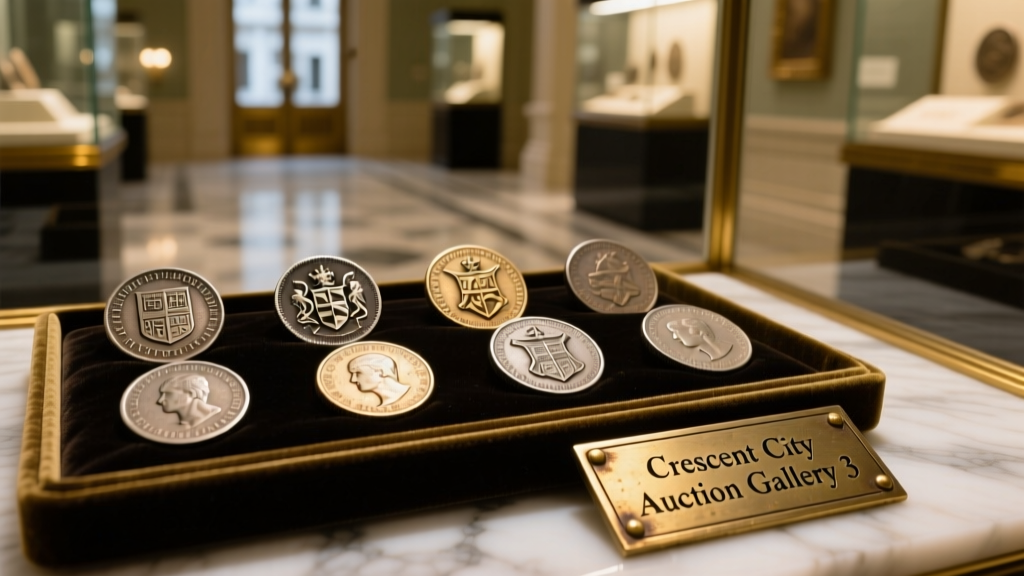
Crescent City Auction Gallery 3: A Numismatic Milestone — Analysis, Highlights, and Market Impact