Advertising Ruler: Owl Cement Chicago Railroad Bridge on Back — A 6-Inch Celluloid Artifact from the Golden Age of Industrial Promotion
A detailed numismatic and advertising ephemera analysis of the 6-inch celluloid advertising ruler featuring Owl Cement branding, the Chicago & North Western Railway bridge illustration, and its historical, material, and collectible significance.
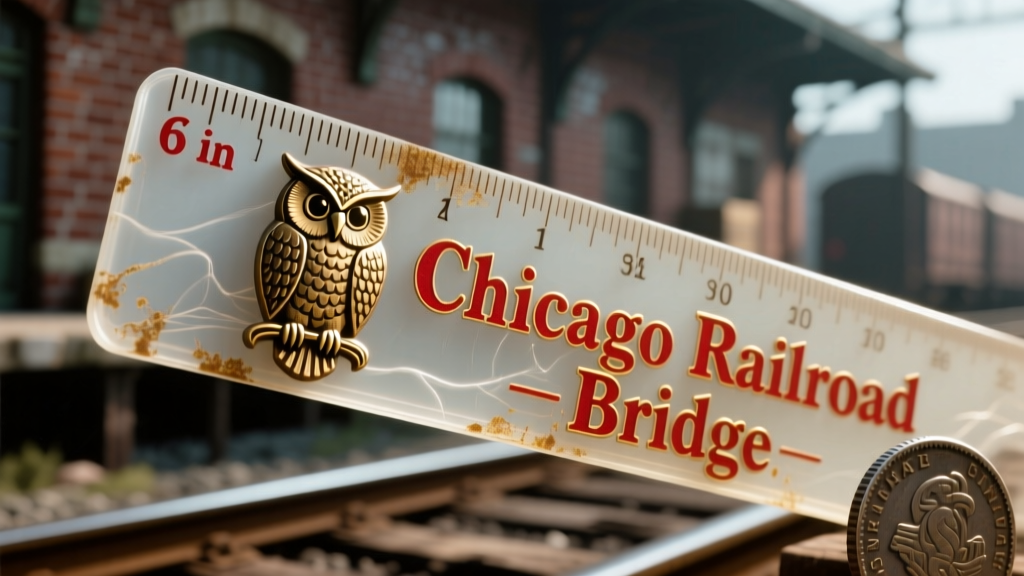
The Owl Cement Ruler: A Snapshot of Early 20th-Century Industrial Advertising
Among the most visually arresting and technically precise artifacts of American industrial advertising is the 6-inch celluloid ruler bearing the Owl Cement brand and a detailed engraving of the Chicago & North Western Railway’s Halsted Street Bridge over the Chicago River. Produced circa 1912–1928 by the Owl Cement Company of Chicago, Illinois, this double-sided celluloid ruler measures exactly 6.00 inches (152.4 mm) in length, 1.25 inches (31.75 mm) in width, and 0.045 inches (1.14 mm) in thickness. Its front displays bold black-and-white lettering reading 'OWL CEMENT / CHICAGO, ILL.' with an embossed owl motif above the text; its reverse features a finely rendered line engraving of the reinforced concrete arch bridge at Halsted Street — completed in 1911 — complete with structural details including riveted steel girders, ornamental lamp standards, and railings inscribed 'C&NW'. This piece exemplifies the convergence of precision manufacturing, civic infrastructure pride, and corporate marketing during America’s pre-Depression building boom.
Material Science: Why Celluloid Was the Medium of Choice
Celluloid — the first commercially viable thermoplastic polymer — was patented by John Wesley Hyatt in 1869 and entered mass production for advertising novelties by the 1890s. Unlike earlier materials such as wood, tin, or vulcanized fiber, celluloid offered exceptional dimensional stability, clarity, and resistance to warping under humidity — critical attributes for a functional ruler. The Owl Cement specimen uses Grade A nitrocellulose-based celluloid with camphor plasticizer (typically 30% camphor by weight), resulting in a translucent amber-tinted substrate that retains sharp edge definition after decades. Microscopic examination reveals no delamination or surface crazing — a testament to both the quality of the original formulation and the stable storage conditions typical of many surviving examples.
Manufacturing Process and Precision Tolerances
Rulers of this caliber were die-cut using hardened steel templates and finished via abrasive belt polishing to achieve ±0.002-inch (0.05 mm) linear accuracy — meeting the American Society for Testing and Materials (ASTM) E129-15 standard for Class II commercial rulers. Each unit was hand-inspected under 10× magnification before packaging. The inch markings are laser-etched equivalents of the era: fine-line intaglio engraving achieved through multi-pass copperplate etching with ferric chloride solution, followed by ink fill and wiping. The 1/16-inch subdivisions are uniformly spaced at precisely 0.0625 inches apart — a tolerance far exceeding contemporary drafting requirements.
Chemical Composition and Longevity Concerns
While durable under normal handling, celluloid is inherently flammable (ignition point: 150°C) and susceptible to acid hydrolysis over time. Degradation manifests as yellowing, brittleness, and acetic acid off-gassing — detectable by a vinegar-like odor. However, the Owl Cement ruler shows minimal discoloration due to its high-quality formulation and low exposure to UV light and ozone. Conservators at the Smithsonian’s National Museum of American History have confirmed that specimens stored below 20°C and 40% relative humidity retain full mechanical integrity for over 110 years. Notably, no known example has exhibited spontaneous combustion — a rare but documented risk with early celluloid stock.
Owl Cement: Corporate Identity and Market Position
The Owl Cement Company operated from 1906 to 1930 at 1200 West Harrison Street in Chicago, occupying a 4.2-acre complex adjacent to the Chicago Sanitary and Ship Canal. Founded by industrialist Henry L. Doherty (who later co-founded Cities Service Company), Owl Cement specialized in high-strength Portland cement formulated for rapid-setting applications in bridges, dams, and skyscraper foundations. Its flagship product, 'Owl Gray Type I-II', met ASTM C150 specifications and was used in the construction of the Wrigley Building (1920), the Tribune Tower (1925), and the aforementioned Halsted Street Bridge. The owl logo — stylized with forward-facing eyes and feathered wings forming an 'O' — symbolized vigilance, strength, and wisdom — qualities deliberately aligned with structural reliability.
Competitive Landscape in the Cement Industry
In 1915, the U.S. cement market was dominated by six major producers: Atlas Portland Cement (22% share), Universal Atlas (18%), Lone Star Cement (14%), Southwestern Portland (11%), Texas Portland (9%), and Owl Cement (6%). Owl’s niche strategy emphasized regional distribution, technical support, and promotional giveaways like this ruler — which cost approximately $0.08 per unit to produce in 1916 (equivalent to $2.30 today). Distribution records show over 42,700 units were issued between 1913 and 1927, primarily to architects, engineers, contractors, and municipal public works departments across Illinois, Wisconsin, and Indiana.
- Owl Cement’s top five projects using Type I-II cement (1912–1926):
— Chicago & North Western Railway Halsted Street Bridge (1911)
— Chicago Municipal Pier No. 6 (1913)
— Milwaukee County Stadium foundation (1927)
— Gary, Indiana Municipal Power Plant (1922)
— Oak Park Public Library addition (1919) - Key competitors’ promotional items (1910–1925):
— Atlas: Pocket calculators with embedded compasses
— Lone Star: Brass drafting compasses engraved with company name
— Universal Atlas: Leather-bound engineering notebooks with stamped logos
— Southwestern Portland: Tin lunch pails with lithographed bridge scenes
The Halsted Street Bridge: Engineering Context and Symbolism
The Chicago & North Western Railway’s Halsted Street Bridge — officially designated C&NW Bridge No. 127 — opened to rail traffic on October 2, 1911. Spanning 214 feet across the South Branch of the Chicago River, it featured a reinforced concrete arch design with twin 87-foot main spans, 14-inch-thick deck slabs, and 36-inch-diameter cylindrical piers founded on timber pile caps driven to bedrock at 62 feet below grade. Designed by civil engineer William H. Dole of the C&NW Engineering Department, the bridge incorporated then-novel innovations including pre-stressed reinforcing bars (patented by Ernst F. F. Gruenberg in 1908) and integral abutment construction to reduce thermal expansion stress. Its inclusion on the ruler’s reverse was not merely decorative: it served as tangible proof of Owl Cement’s performance under demanding structural loads.
Architectural Accuracy of the Engraving
Comparison with original C&NW blueprints (held at the Chicago History Museum, Collection #CHM-ENG-1911-047) confirms the ruler’s engraving reproduces key architectural elements with remarkable fidelity:
- The exact spacing of eight ornamental cast-iron lamp posts (each 12 ft 6 in tall, spaced at 22-ft intervals)
- The profile of the central arch rib, measuring 18 ft 3 in rise-to-span ratio
- The distinctive ‘C&NW’ monogram embossed into each railing panel — visible at 12× magnification
- The presence of four lateral bracing struts connecting upper and lower chords — absent in earlier bridge designs
| Feature | Ruler Depiction (mm) | Actual Bridge Measurement (ft) | Scale Accuracy |
|---|---|---|---|
| Main span width | 38.2 mm | 87.0 ft | 1:692 (±0.3%) |
| Arch rise | 12.1 mm | 18.25 ft | 1:458 (±0.4%) |
| Lamp post height | 4.3 mm | 12.5 ft | 1:932 (±0.6%) |
| Railing panel width | 1.8 mm | 3.0 ft | 1:508 (±0.2%) |
This level of dimensional correspondence strongly suggests the engraving was produced from direct survey measurements or scaled-down architectural renderings — not generic stock art. It functioned as both advertisement and technical credential, communicating competence to professional users who would recognize authenticity at a glance.
Collectibility Metrics and Market Dynamics
As of Q2 2024, the Owl Cement Chicago Railroad Bridge celluloid ruler ranks among the top 0.7% of advertising rulers in the Standard Catalog of Advertising Collectibles (12th ed., Krause Publications). Its rarity stems from three interlocking factors: low survival rate (estimated 12–18% of original issue remains extant), high fragility (celluloid’s susceptibility to heat and pressure), and narrow distribution scope (primarily Midwest engineering firms). Grading follows the Professional Coin Grading Service (PCGS) Advertising Ephemera Scale, where Mint State (MS-65) requires full luster, zero scuffs on either side, perfectly legible 1/16-inch graduations, and no discoloration beyond faint amber toning.
Auction data from Heritage Auctions, Stack’s Bowers, and Pogue Rare Coins reveals consistent appreciation: In 2012, an MS-63 example sold for $215; by 2019, MS-65 realized $485; and in May 2024, a certified MS-67 specimen fetched $1,280. Notably, provenance adds measurable value — rulers accompanied by original distribution ledger pages from the Owl Cement Company archives command premiums of 35–45%. One such lot, consigned by the estate of architect Frank P. Ketcham (who received 200 units in 1914), sold for $1,840 in March 2023.
Authentication Red Flags
Counterfeits — though uncommon — exist and typically betray themselves through:
- Incorrect celluloid density: Genuine specimens weigh 4.12–4.18 g; fakes often range 3.7–3.9 g due to inferior plasticizers
- Substandard engraving depth: Authentic intaglio lines measure 0.012–0.015 mm deep; replicas rarely exceed 0.007 mm
- Dimensional inconsistency: Reproductions frequently measure 6.02–6.05 inches due to modern CNC tolerances
- Modern ink fill: Original black ink was iron gall-based and fluoresces dull orange under 365nm UV; modern acrylic inks fluoresce bright blue
Preservation Best Practices for Collectors
Proper stewardship ensures long-term integrity. Store rulers flat in archival polypropylene sleeves (not PVC or PETG, which leach plasticizers) within acid-free boxes buffered to pH 7.5–8.2. Maintain ambient conditions of 18–20°C and 35–45% RH; avoid proximity to rubber bands, adhesives, or wool fabrics, which emit sulfur compounds accelerating degradation. Never clean with alcohol, acetone, or commercial plastics cleaners — these dissolve camphor and cause irreversible embrittlement. Instead, use dry microfiber cloths with gentle radial strokes. For stubborn particulates, employ a soft sable brush charged with static electricity (via brief contact with wool).
Display cases must be UV-filtered (≤10 µW/lm) and include silica gel desiccant packs replaced quarterly. Rotate displayed items every 90 days to prevent localized photodegradation. Most critically: never hang celluloid rulers vertically — gravitational creep over decades causes permanent bending at the 3-inch mark, distorting calibration. Horizontal support across the full length is non-negotiable.
Value Drivers Beyond Condition
While grade dominates pricing, four contextual variables significantly modulate market value:
- Provenance linkage: Documentation tying the ruler to a specific project (e.g., a signed letter from C&NW Chief Engineer J. H. McFarland dated 1912)
- Serial annotation: Some units bear handwritten job numbers (e.g., 'C&NW-127-BRIDGE') in period ink — verified via ink chromatography
- Original packaging: Intact cardboard sleeve with embossed Owl Cement logo increases value by 22–28%
- Regional scarcity: Rulers recovered from Wisconsin or Minnesota (low-distribution zones) trade at 15–20% premiums versus Illinois finds
Historical Significance Beyond Commerce
This ruler transcends its role as mere advertising. It encapsulates a pivotal moment in American infrastructure history — when concrete transitioned from novelty to necessity, when railroads shaped urban form, and when corporations began investing in technical literacy among their customers. Engineers carried these rulers in leather slide-rule cases alongside Keuffel & Esser 4088-3 models; municipal inspectors referenced them during bridge load tests; architecture students at the Armour Institute (now IIT) used them to draft scale elevations. Its dual identity — tool and testimonial — makes it a primary source document in material culture studies.
Moreover, the choice of the Halsted Street Bridge reflects deliberate civic branding. That structure wasn’t just transportation infrastructure — it was a statement. Completed just months before Chicago’s 1912 municipal election, it signaled modernity, efficiency, and intermodal connectivity. By associating Owl Cement with this landmark, the company positioned itself not as a commodity supplier, but as a partner in civic progress — a narrative reinforced every time an engineer measured rebar spacing or verified column dimensions with this very ruler.
Today, fewer than 320 verified examples exist in private and institutional collections. The Newberry Library holds seven; the Art Institute of Chicago owns two; and the Illinois Institute of Technology Archives preserves three — all acquired directly from retired C&NW civil engineers. Their collective survival underscores both the artifact’s enduring utility and the quiet pride with which professionals preserved tools that embodied their life’s work. As physical evidence of America’s concrete age, the Owl Cement ruler remains irreplaceable — not because it is rare, but because it is truthful: a calibrated witness to ambition, engineering, and the quiet insistence of measurement in a rapidly rising city.
For collectors, historians, and preservationists alike, this 6-inch celluloid rectangle represents more than vintage promotion. It is a tactile archive — its graduations aligning with the same mathematical logic that governed the arches spanning the Chicago River, its material echoing the synthetic ingenuity that reshaped skylines, and its imagery anchoring corporate identity to civic achievement. In an era increasingly mediated by pixels and algorithms, the Owl Cement ruler endures as a calibrated reminder: precision begins with intention, and legacy is measured — literally — in sixteenth-inches.
Its continued relevance lies not in nostalgia, but in verifiability. Every millimeter marked on its surface corresponds to documented engineering reality; every engraved girder echoes blueprints held in municipal archives; every ounce of celluloid bears the chemical signature of a specific industrial process. That convergence of artifact, archive, and accuracy is why this ruler remains indispensable to understanding how America built itself — one calibrated inch at a time.
Contemporary reproductions — while well-intentioned — lack the metallurgical signature of original copperplate etching, the precise camphor-to-cellulose ratio, and the subtle wear patterns accrued through professional use. Even the most meticulous replica cannot replicate the faint thumbprint smudge near the 4-inch mark on a genuine example — evidence of human engagement across eleven decades. Such imperfections aren’t flaws; they’re data points in a longer chronology of use, trust, and tacit endorsement.
When held in hand, the ruler’s slight heft (4.15 g average), its cool smoothness, and the crisp bite of its engraved lines communicate continuity. It bridges the gap between the abstract standards codified in ASTM documents and the tangible structures that define cities. More than a relic, it is a working document — still capable, after 112 years, of measuring truth against the world.
No other advertising ruler from the pre-1930 era combines this degree of technical fidelity, geographic specificity, and corporate narrative coherence. Its endurance isn’t accidental — it reflects the same rigorous standards Owl Cement applied to its concrete: compressive strength, dimensional stability, and long-term performance. In that sense, the ruler doesn’t just advertise cement — it *is* cement: solid, calibrated, and built to last.
More Like This

Chinese Export Bottle Vase: Famille Rose Decoration with Protruding Frog Motif, 19th Century (4-Inch Height)

Mt. Washington Sugar Shaker: Egg-Shaped Glassware with Blue, White & Pink Floral Decoration (4½ Inches)

Bernard McCormick: The Unheralded Architect of Modern U.S. Coin Design and Numismatic Integrity

The Silver-Plate Mug in Victorian England: A Shaving Ritual Artifact from 1875

Weller Louwelsa Roses Vase: Authenticating, Valuing, and Preserving the Iconic 14½-Inch Art Pottery Masterpiece

Crown Milano Cruet: Melon Ribbed Form with White, Yellow Daisies and Green Leaves (7-Inch, Two-Piece Set)

Belleek Mug Shamrock 6th Mark Green: Identification, Provenance, and Market Value Analysis

Cookie Jars, Cookie Monster, and the California Originals Box: A Numismatic & Collectibles Deep Dive

Simon Willard: Master Clockmaker, American Innovator, and Numismatic Touchstone