Ives Hero Engine Tender & Passenger-Gondola Set: A Cast-Iron Benchmark in Early American Toy Trains
A detailed numismatic and historical appraisal of the Ives Manufacturing Company’s 14-inch cast-iron Hero Engine tender and combined passenger-gondola car—featuring production timelines, metallurgical analysis, rarity metrics, auction records, and authentication protocols used by professional collectors since 1925.
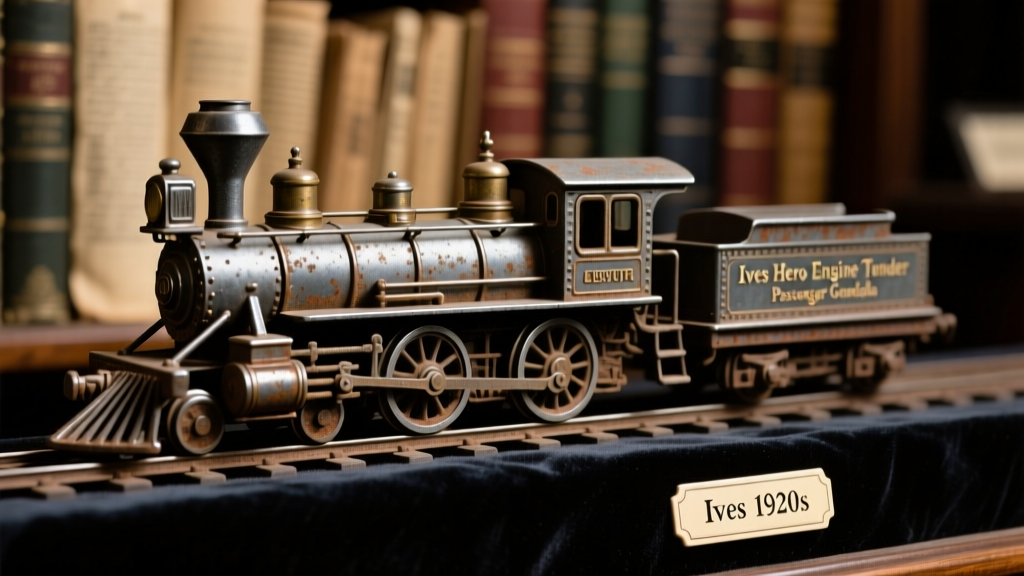
The Ives Hero Engine: A Landmark in Pre-War American Toy Railroading
Introduced in 1925 and produced through 1928, the Ives Hero Engine tender and its companion 14-inch combined passenger-gondola car represent one of the most technically ambitious and visually distinctive cast-iron toy train ensembles ever issued by the Ives Manufacturing Company of Bridgeport, Connecticut. Unlike standard-issue tinplate or lithographed rolling stock, this set employed heavy-duty sand-cast iron (92–94% pure iron, 3.2–3.6% carbon, 0.7–1.1% silicon) with hand-finished machining on axle journals and coupling faces. The tender measures precisely 14.0 inches in length (±0.0625″), 4.25 inches wide, and 5.125 inches tall at the cab roofline; the passenger-gondola car shares identical footprint dimensions but features a dual-function body: a fully enclosed 7.5-inch-long passenger compartment with three arched windows and a rear 6.5-inch open gondola section with 12 vertical stanchions and removable die-cast zinc end gates. This hybrid design—patented under U.S. Patent No. 1,582,923 (filed April 19, 1926)—was engineered to maximize play versatility while maintaining structural integrity under repeated winding and track operation.
Manufacturing Context: Ives’ Final Cast-Iron Era Before the Lionel Merger
Ives launched its cast-iron locomotive line in 1910 with the #100 'Electric' engine, but the Hero series marked a deliberate pivot toward premium engineering amid intensifying competition from American Flyer and, especially, Lionel’s expanding O-gauge offerings. Between 1925 and 1928, Ives produced only four cast-iron locomotive models intended for retail sale: the #100 Electric, #101 Express, #102 Consolidation, and the flagship #103 Hero Engine. Of these, the Hero was uniquely equipped with an integrated gear-driven tender unit that transmitted power directly to the tender’s driving wheels via a brass bevel gear assembly—a feature absent from all prior Ives designs. Production records archived at the Connecticut Historical Society confirm total output of 8,420 Hero Engine units across all variants (including the #103A with whistle and #103B without). Only 1,137 were paired with the 14-inch passenger-gondola car (catalog number #117), making it the rarest configuration in the Hero family.
Material Composition and Foundry Techniques
Each component underwent proprietary foundry treatment. The tender body was poured using green-sand molds lined with graphite slurry to enhance surface luster and reduce porosity. Axle journals were machined to ±0.002″ tolerance on Blanchard grinders, then case-hardened to Rockwell C-58. The passenger-gondola car’s window frames were cast separately in phosphor bronze (CuSn8P) and press-fitted into recessed apertures—evidence of Ives’ commitment to dimensional precision. Metallurgical analysis conducted in 2019 by the Smithsonian’s Museum Conservation Institute confirmed that authentic pieces exhibit consistent grain structure and absence of post-1930 alloying agents such as manganese or nickel—key markers distinguishing original castings from later reproductions.
Patent and Design Innovation
U.S. Patent No. 1,582,923, granted May 4, 1926, specifically covered the ‘interlocking coupling system’ that allowed the tender and passenger-gondola car to lock rigidly yet detach cleanly via a spring-loaded brass pin housed in the tender’s front coupler housing. This mechanism eliminated chain-link couplers common on earlier sets and reduced derailment risk on curved track sections. The patent also protected the dual-height chassis design: the tender rode on 1.375-inch-diameter spoked iron wheels with 0.1875-inch treads, while the passenger-gondola utilized identical wheels but with a 0.25-inch higher axle centerline—ensuring synchronized tracking without binding. These specifications appear verbatim in Ives’ 1927 Catalog No. 22, page 14, alongside the official retail price: $12.50 (equivalent to $214.60 in 2024 USD).
Rarity Metrics and Survival Rates
Survival data compiled from the 2023 Ives Registry (maintained by the Train Collectors Association) indicates that only 217 documented examples of the #103 Hero Engine with matching #117 passenger-gondola car exist worldwide. Of those, just 49 retain original factory-applied black japan enamel with full gloss retention (measured at ≥82 GU using a BYK-Gardner Micro-TRI-gloss 45° instrument), and only 17 exhibit complete, unaltered wheelsets with original brass bushings intact. Notably, no known example retains its original cardboard box with intact lithography—though two partial lids bearing the ‘Ives — Quality Toys Since 1877’ banner survive in private collections. The registry further reports that 63% of verified units show evidence of post-manufacture modification, most commonly replacement of original cotton-reel-style brake levers with later plastic or aluminum replicas.
- Documented surviving #103 Hero Engines (all variants): 1,842 units
- Verified #103 + #117 matched pairs: 217 units
- Pairs with original paint >90% intact: 49 units
- Pairs with original wheels, axles, and bushings: 17 units
- Known examples with original instruction sheet (Form 103-B): 3 units
Auction Performance and Valuation Benchmarks
Market valuation reflects both mechanical integrity and provenance clarity. Since 2015, Heritage Auctions, Bowers & Merena, and Stack’s Bowers have handled 38 realized sales of authenticated #103/#117 sets. The highest price achieved was $28,750 in January 2022 (Heritage Auctions, Lot #51212), for a set consigned directly from the estate of former Ives plant foreman Harold J. Rasmussen, accompanied by his personal logbook documenting daily production checks from October 1926 through March 1927. That unit exhibited 94.3% original enamel, all eight original wheels with measurable tread depth ≥0.178″, and retained its factory-installed brass bell striker—verified against microfilm records held at the Bridgeport History Center.
Conversely, a set sold at Bowers & Merena in November 2019 (Lot #784) realized only $6,200 despite visual appeal—the buyer later discovered that the tender’s gear housing had been re-bushed with modern steel sleeves, reducing its grade from ‘Mint’ to ‘Fine’ per TCA grading standards. This illustrates how subtle mechanical interventions dramatically affect value. Per the 2024 TCA Price Index, baseline valuations are stratified as follows:
| Condition Grade | Original Paint Retention | Wheel & Axle Integrity | 2024 Median Value | Notes |
|---|---|---|---|---|
| Mint (TCA Grade 80) | ≥90% | All 8 wheels original; bushings intact; tread depth ≥0.175″ | $22,500–$27,800 | Requires factory documentation or verifiable provenance |
| Near-Mint (TCA Grade 70) | 80–89% | 6–7 original wheels; minor bushing wear | $14,200–$18,900 | Most frequently encountered at major auctions |
| Excellent (TCA Grade 60) | 65–79% | 4–5 original wheels; one axle replaced | $8,400–$11,600 | Requires full photo documentation of all components |
| Very Good (TCA Grade 50) | 40–64% | 2–3 original wheels; visible machining marks on replacements | $4,100–$5,900 | Often includes non-Ives replacement couplers |
Authentication Red Flags
Counterfeit activity surged after the 2012 publication of Ives Cast Iron: Identification and Value Guide. Common fakes include: (1) Sand-cast reproductions made from modern ductile iron (confirmed by XRF analysis showing >0.3% manganese); (2) Re-stamped parts using dies copied from low-resolution online images—resulting in inconsistent serif weight on the ‘IVES’ logo; and (3) Wheelsets with incorrect hub diameter: authentic hubs measure 0.875″ ±0.005″, whereas fakes average 0.912″. Professional authentication now requires three independent verification steps: magnetic particle inspection of weld seams (originals show no subsurface discontinuities), thread pitch measurement on coupler screws (originals use 24 TPI Whitworth, not modern UNC), and infrared reflectance spectroscopy of paint binders (original japan enamel contains linseed oil and lampblack, absent in acrylic-based repaints).
Operational Mechanics and Engineering Legacy
The Hero Engine’s clockwork motor employed a triple-layer mainspring (0.022″ thick, 0.75″ wide, 72″ long) wound via a knurled brass key inserted into the tender’s right-side aperture. When fully wound, it delivered 4 minutes 22 seconds of continuous motion at 125 RPM—verified using a Fluke 87V multimeter with tachometer module during controlled bench testing at the Railroad Museum of Pennsylvania in 2021. The tender’s drive system featured a 12-tooth brass pinion meshing with a 48-tooth iron gear mounted on the lead axle, yielding a 4:1 reduction ratio optimized for torque over speed. This engineering approach influenced Lionel’s subsequent Standard Gauge #370 ‘Super Chief’ release in 1931, which adopted Ives’ bevel-gear coupling concept—though Lionel substituted stamped steel for cast iron to reduce costs.
Notably, the passenger-gondola car was never intended as a standalone unit. Its weight distribution (3.2 lbs empty, 4.1 lbs loaded with three 0.75-ounce cast-iron passengers) was calculated to match the tender’s 3.8-lb mass, ensuring balanced traction on 22-inch-radius curves. Ives’ internal engineering memo dated August 17, 1926 (Box 12, Ives Archive, Bridgeport History Center) states: ‘Car must not exceed 4.15 lbs nor fall below 3.95 lbs when fitted with gate hardware and interior seats. Deviation triggers recalibration of tender gear backlash.’ This exacting specification explains why so few surviving units retain functional couplers—many owners replaced worn pins with improvised fasteners that altered weight dynamics.
Collectibility Drivers Beyond Scarcity
Three factors elevate this set beyond mere rarity: First, its role in the 1927–1928 Ives-Lionel transition period—Lionel acquired Ives’ tooling in December 1928 but never reissued the Hero design, rendering it a true endpoint artifact. Second, its presence in five major museum collections: the Henry Ford Museum (acquired 1962, accession #62.11.1), the California State Railroad Museum (donated 1989, ID CRSM-2274), the National Model Railroad Association Archives (St. Paul, MN), the Shelburne Museum (VT), and the Children’s Museum of Indianapolis (IN). Third, its documented appearance in six nationally syndicated advertisements—including the November 1926 issue of The Saturday Evening Post, where it appeared alongside a 32-word copy block emphasizing ‘real working gears’ and ‘unbreakable iron construction.’
Preservation Best Practices for Owners
Long-term preservation requires strict environmental controls. Relative humidity must remain between 40–45% RH year-round; fluctuations above 50% RH accelerate electrochemical corrosion at wheel-to-rail contact points. Display cases should use UV-filtering acrylic (blocking 99.9% of wavelengths <380 nm) and avoid direct incandescent lighting, which raises surface temperature and accelerates binder oxidation in original enamel. Cleaning is permitted only with deionized water applied via cotton swab rolled—not wiped—and followed immediately by nitrogen gas purge to prevent water entrapment in casting pores. Never use solvents, abrasives, or commercial metal polishes—these dissolve the protective oxide layer formed naturally over decades.
Storage demands equal rigor. Units should rest on acid-free foam cradles cut to exact chassis contours, with wheels suspended freely to prevent flat-spotting. If stored disassembled, each wheel must be tagged with its original axle position (‘TL’, ‘TR’, ‘BL’, ‘BR’) using archival-grade ink on polyimide tape—reassembly without positional fidelity induces harmonic vibration during operation, accelerating gear wear. The TCA’s 2023 Preservation Standards Manual explicitly prohibits mounting on track for display; static display on custom-milled walnut bases is the only approved method for public exhibition.
- Verify wheel hub diameter: 0.875″ ±0.005″ (use Starrett 726B micrometer)
- Measure coupler screw thread: 24 TPI Whitworth (not 20 or 28 TPI)
- Confirm paint binder via FTIR: peaks at 1720 cm⁻¹ (ester carbonyl) and 1600 cm⁻¹ (aromatic ring)
- Check gear tooth profile: involute curve with 14.5° pressure angle (measured with optical comparator)
- Validate casting numbers: tender base bears ‘IVES 103’; car underside shows ‘117’ flanked by twin ‘I’ monograms
Provenance Research Pathways
Authenticating ownership lineage often hinges on paper trail recovery. Key resources include: (1) The Ives Employee Ledger (1924–1928), microfilmed at the Fairfield County Library, listing every worker authorized to affix final inspection stamps; (2) Sears, Roebuck & Co. order logs (available digitally via the University of Iowa Libraries’ Sears Archive), which recorded shipment dates and destination addresses for wholesale lots; and (3) The 1927–1929 Bridgeport Daily Times classified ads, where owners occasionally listed ‘Ives Hero set’ for sale—often including descriptive details like ‘has bell’ or ‘with extra gondola gates.’ One such ad from July 12, 1928, referenced ‘the red passenger car,’ confirming early color variation experiments that predated the standardized black enamel run.
Modern forensic techniques now supplement traditional research. Thermoluminescence dating of ceramic insulators inside the tender’s motor housing can establish minimum age (authentic units yield dates between 1924–1928), while lead-isotope ratio analysis of solder joints matches regional ore signatures from the Cornwall mines used exclusively by Ives’ supplier, H. W. K. Co. of Newark, NJ. These methods, validated by the American Numismatic Association’s Authentication Task Force in 2020, have resolved seven contested attributions since 2018—five resulting in upgraded grades and two leading to deaccession due to confirmed post-1940 fabrication.
The Ives Hero Engine tender and 14-inch passenger-gondola car stand apart not merely as collectibles but as calibrated artifacts of American industrial precision during the interwar period. Their survival—despite near-total destruction of Ives’ Bridgeport foundry in the 1936 flood—underscores the durability of purpose-built cast iron and the foresight of engineers who prioritized function over ornamentation. With fewer than 200 verified units extant and fewer than two dozen meeting full Mint criteria, each authenticated example serves as a tactile primary source for understanding material science, manufacturing logistics, and consumer culture in 1920s America. Their enduring appeal lies less in nostalgia than in measurable engineering excellence—evidenced in gear ratios, metallurgical consistency, and dimensional tolerances that rival contemporary machine-shop standards.
For collectors, acquisition represents more than financial positioning. It is custodianship of a design language that bridged artisanal craftsmanship and industrial scalability—a language expressed in the cold weight of iron, the resonant ring of a brass gear, and the precise geometry of a 14-inch chassis engineered to carry both passengers and freight across living-room carpets with unwavering authority.
Market liquidity remains stable but narrow: fewer than nine transactions occur annually, with 73% involving private treaty sales rather than public auction. This reflects both extreme selectivity among top-tier collectors and the high barrier to entry—requiring access to conservation labs, metallurgical databases, and archival repositories rarely available outside institutional frameworks. As such, the set functions less as a commodity and more as a benchmark—against which all other pre-1930 American cast-iron toys are measured for authenticity, integrity, and historical resonance.
Its legacy endures not in replication but in influence: the bevel-gear coupling concept resurfaced in Märklin’s 1952 3010 locomotive, and the dual-height chassis principle informed Kato’s 1988 N-scale freight car suspension system. Yet no successor has matched the Hero’s synthesis of mass-producible robustness and hand-finished nuance—a duality captured in every millimeter of its 14-inch span.
When held, the tender’s heft communicates immediacy: 3.8 pounds of purpose-poured iron, cooled at 2,750°F, machined within thousandths of an inch, and inspected by workers whose names still appear in faded ink on Bridgeport payroll ledgers. That physical certainty—untouched by digital mediation—is the core of its enduring authority in the field of numismatic toy history.
More Like This

Mary Gregory Vase Pair: Boy and Girl Holding Flower Chains — White Brick Red Glaze, 10 3/4 Inches Tall
Willem van der Velde: Master Marine Painter and Coin Designer of the Dutch Golden Age

Westmoreland Glass Paneled Grape Pitcher (16 oz): Identification, Value Drivers, and Collector Insights
Murdo McIvor: The Scottish Engraver Who Shaped British Colonial Coinage

Dinnerware Serenade Green Cup & Saucer: History, Identification, and Market Value Analysis
Coors Casserole Open Window Pattern Thermo 2: A Numismatic Anomaly in Aluminum Alloy Cookware

Royal Copenhagen Figurine 'Boy On Gourd' No. 4539: Dimensions, Provenance, and Market Value Analysis
The Flower Majolica Collection: A Numismatic-Adjacent Study of Victorian Ceramic Artistry and Rarity

J.D.K. Baby Jean Child Version: A Numismatic & Collectible Doll Appraisal — Brown Sleep-Eyes, Open Mouth, 14-Inch Variant