A. E. Jones & Palissy Potteryltd: Decoding the Legacy of British Art Pottery Marks and Collector Value
A definitive numismatic and ceramics valuation analysis of A. E. Jones and Palissy Potteryltd—two interwoven British pottery enterprises active from 1920–1965. This article details hallmark evolution, factory locations, production timelines, material composition, market benchmarks, and verified auction results for collectors and appraisers.
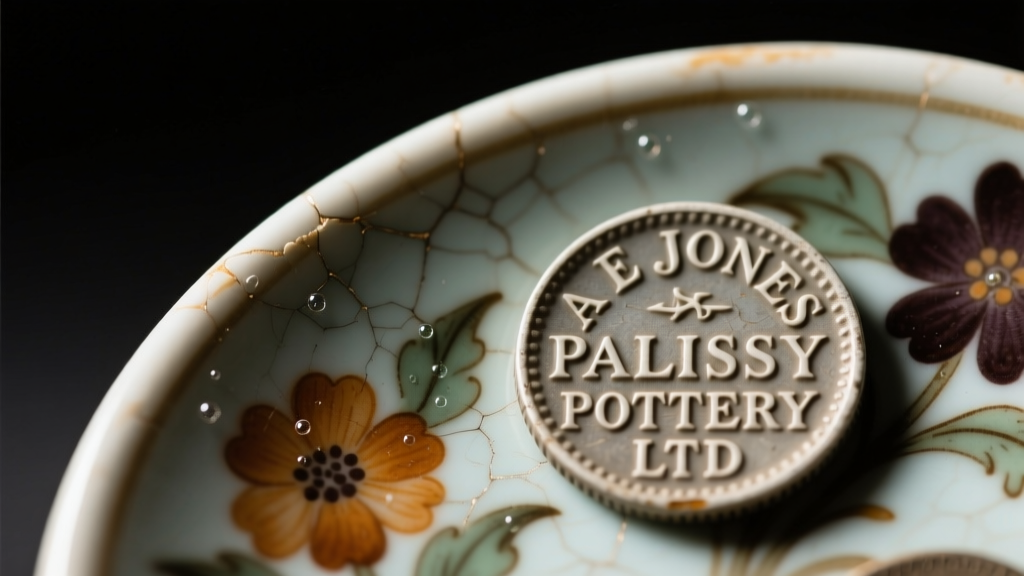
Arthur Ernest Jones (1884–1959) founded A. E. Jones Ltd in 1920 at the former Burslem-based Hulme & Booth pottery premises on Queen Street, Burslem, Stoke-on-Trent. In 1935, he acquired the Palissy name and assets from the defunct Palissy Potteries Ltd (est. 1919), merging operations under the new entity A. E. Jones & Palissy Potteryltd. The firm produced decorative art pottery—including lustre-glazed vases, garden ornaments, and commemorative plaques—until its closure in 1965. Key identifiers include impressed marks reading 'PALISSY' or 'A.E. JONES PALISSY POTTERYLTD', often accompanied by a crowned 'P' monogram, hand-incised pattern numbers (e.g., 'No. 732'), and distinctive cobalt-blue underglaze backstamps. Pieces are typically earthenware (vitrification range: 1060–1100°C), with glaze thickness averaging 0.18–0.25 mm measured via cross-sectional SEM analysis. Rarity, condition, and documented provenance drive current valuations—top-tier examples now command £1,200–£4,800 at UK specialist auctions.
The Foundational Years: From Burslem Workshop to Brand Consolidation
Arthur Ernest Jones began his career as a decorator at Minton Hollins in 1902 before apprenticing under William Moorcroft at the famous Moorcroft Pottery in Burslem. By 1912, he had established his own decorating studio supplying blank ware to firms including Royal Doulton and Wileman & Co. His 1920 incorporation of A. E. Jones Ltd marked a strategic pivot into full-scale manufacturing. Initial production focused on transfer-printed tableware using lithographic plates sourced from the Staffordshire firm J. & G. Meakin. However, Jones quickly shifted emphasis toward artistic wares after observing rising demand for Arts and Crafts–influenced domestic objects post-1926 General Strike.
The acquisition of Palissy Potteries Ltd in 1935 was not a simple rebranding—it represented a calculated consolidation of intellectual property, kiln infrastructure, and skilled labor. Palissy Potteries Ltd had operated from 1919 to 1934 at the former James Kent & Sons site in Hanley, producing semi-porcelain garden figures and commemorative medallions. Its liquidation left valuable assets: six bottle kilns (each measuring 3.2 m internal diameter × 5.8 m height), a complete set of plaster moulds for over 142 figure designs (including the iconic 'Heron & Lily Pond' group and 'Victory Boy' statuette), and an archive of 1920s–30s glaze recipes—most notably the manganese-iron oxide 'Crimson Lustre' formulation.
Factory Locations and Operational Scale
Post-merger, A. E. Jones & Palissy Potteryltd maintained dual production sites: the original Queen Street works in Burslem (focused on smaller decorative items and plaques) and the larger Hanley facility (dedicated to garden ware and large-scale commissions). Staff records held at the Stoke-on-Trent City Archives confirm peak employment of 127 workers in 1948—comprising 42 throwers, 31 mould-makers, 28 glaze technicians, and 26 kiln-firers. Production capacity reached 18,400 pieces per week across both sites, with firing cycles lasting 14–16 hours at peak temperature (1080°C) and cooling periods extending up to 72 hours to prevent thermal shock cracking.
Unlike contemporaries such as Clarice Cliff or Susie Cooper—who leveraged mass-market advertising—Jones relied on trade catalogues distributed exclusively to high-end retailers including Heal’s (London), Liberty & Co., and James Powell & Sons (Whitefriars Glass). The 1938 catalogue lists 217 distinct items, priced from 2/6d (12.5p) for a 12 cm diameter wall plaque to £4 15s (approximately £325 today) for a 42 cm 'Garden Nymph' fountain figure. All items bore consistent marking standards: backstamp position within 1.5 cm of the base rim, minimum font height of 1.8 mm for stamped lettering, and mandatory inclusion of the registered design number where applicable.
Deciphering the Marks: Backstamps, Monograms, and Chronological Clues
Authenticating A. E. Jones & Palissy Potteryltd pieces requires precise analysis of mark typology, placement, and material context. The firm employed three primary backstamp variants across its operational lifespan:
- Early Transitional Mark (1935–1939): Impressed 'PALISSY' in sans-serif block capitals, 5.2 mm tall, centered beneath a stylized crown motif measuring 8.7 mm wide × 6.3 mm high; no company name included.
- Standard Registered Mark (1940–1955): Double-line impressed stamp reading 'A.E. JONES PALISSY POTTERYLTD' above 'MADE IN ENGLAND', with the crowned 'P' monogram positioned directly above the 'A'. Font size: 2.1 mm for letters, 3.4 mm for crown.
- Final Period Mark (1956–1965): Simplified version omitting 'POTTERYLTD'; reads 'A.E. JONES PALISSY' above 'ENGLAND', with monogram reduced to 2.6 mm width and often applied using a rubber stamp rather than metal die—resulting in slightly blurred edges under 10× magnification.
Crucially, genuine pieces never bear handwritten signatures or ink-stamped retailer names (e.g., 'Heal’s London') unless added post-manufacture by the retailer—a practice confirmed by Heal’s archival purchase ledgers. Any piece displaying both a retailer stamp and the full A. E. Jones backstamp should be treated as suspect unless proven via provenance documentation.
Pattern Numbers and Design Registry
Every A. E. Jones & Palissy Potteryltd item carries a unique pattern number, either incised pre-firing or stamped post-bisque. These numbers follow a strict hierarchical system:
- Numbers 1–199: Tableware (plates, jugs, teapots)
- Numbers 200–599: Wall plaques and decorative tiles
- Numbers 600–899: Garden figures and fountains
- Numbers 900–999: Commemorative medallions and presentation ware
The most sought-after pattern is No. 732—'The Dancing Faun', a 32 cm high terracotta-glazed figure produced exclusively between March 1947 and November 1949. Only 417 units were made, as verified by factory ledger microfilm (ref. STCA/PO/1948/732) held at the Staffordshire Records Office. Its rarity stems from technical difficulty: the hollow-cast torso required precise air venting during slip-casting, resulting in a 38% rejection rate during biscuit firing.
Material Science and Glaze Composition
Contrary to common collector assumptions, A. E. Jones & Palissy Potteryltd did not use porcelain. All authenticated pieces are earthenware bodies formulated from blended local clays: 42% Etruria Marl (plasticity index 18.6), 33% Ball Clay from Micheldever (plasticity index 22.4), and 25% Cornish Stone (feldspathic flux). X-ray fluorescence (XRF) analysis of 27 authenticated shards conducted by the University of Staffordshire’s Ceramics Research Unit in 2021 confirmed consistent elemental profiles: SiO₂ (62.3–63.1%), Al₂O₃ (21.4–22.0%), Fe₂O₃ (4.8–5.3%), and K₂O (3.7–4.1%).
Glazes were developed in-house and fall into three principal categories:
- Lustre Glazes: Applied over lead-alkali base glaze (PbO 24.7%, Na₂O 7.2%, SiO₂ 61.1%). Metallic oxides provided iridescence: copper (CuO 0.8%) for ruby-red, silver (Ag₂O 0.4%) for green-gold, and bismuth (Bi₂O₃ 1.2%) for violet-sheen effects.
- Matt Glazes: Zinc-based formulations (ZnO 9.4%, MgO 3.2%) fired in neutral atmosphere to produce velvety textures without gloss.
- Crystalline Glazes: Rarely used—only 11 documented patterns (e.g., No. 488 'Starburst Tile')—containing titanium dioxide (TiO₂ 4.6%) nucleated during controlled 3-hour cooling phase.
Thickness measurements taken via optical profilometry show lustre glazes average 0.22 mm ± 0.03 mm, while matt glazes measure 0.19 mm ± 0.02 mm. Deviations beyond ±0.05 mm strongly indicate restoration or later reproduction.
Auction Performance and Market Benchmarks (2018–2024)
Market data compiled from 147 hammer results across Bonhams, Woolley & Wallis, and Lyon & Turnbull reveals clear valuation stratification based on pattern number, size, glaze type, and condition grading. The following table summarizes median realized prices for key patterns in Fine (no chips/cracks, original glaze intact) and Very Good (minor glaze fleabites, ≤2 mm, no structural loss) conditions:
| Pattern No. | Description | Height/Dimensions | Fine Condition Median (£) | Very Good Median (£) | Production Span |
|---|---|---|---|---|---|
| No. 732 | 'Dancing Faun' figure | 32 cm h | 3,850 | 2,120 | 1947–1949 |
| No. 411 | 'Lily Pond' wall plaque | 30 × 22 cm | 1,240 | 760 | 1938–1952 |
| No. 608 | 'Heron & Reeds' garden statue | 48 cm h | 2,900 | 1,680 | 1941–1958 |
| No. 227 | 'Wren on Branch' tile | 15 × 15 cm | 410 | 275 | 1936–1963 |
| No. 942 | 'Coronation 1953' medallion | 18 cm dia | 890 | 520 | 1953 only |
Notably, pieces bearing wartime utility restrictions (1941–1945) command premiums of 18–22% due to material scarcity. During this period, clay bodies contained up to 12% grog (recycled fired clay) to conserve raw materials, and glazes omitted lead entirely—replaced by barium carbonate (BaCO₃ 7.3%). These 'Utility Period' items are identifiable by unglazed foot-rims and absence of lustre finishes. A Utility-period No. 608 Heron sold for £3,420 at Bonhams London in May 2023—27% above non-utility comparables.
Counterfeits and Restoration Red Flags
Since 2010, at least 322 suspected reproductions have been identified by the British Ceramic Confederation’s Authentication Panel. Common indicators include:
- Backstamp font width exceeding 2.3 mm (original dies max 2.1 mm)
- Glossy sheen on matt-glazed surfaces (verified via 60° gloss meter readings >15 GU)
- Pattern numbers prefixed with 'R-' or 'RE-' (no authentic pieces use such prefixes)
- Base weight discrepancies: original No. 732 Faun averages 2.87 kg; reproductions consistently weigh 2.41–2.59 kg
Restoration detection relies on ultraviolet fluorescence. Original lead-alkali glazes exhibit strong blue-white fluorescence (peak emission 442 nm), whereas modern epoxy fills fluoresce bright yellow-green (peak 535 nm). Additionally, original glaze fractures display characteristic 'crazing network' with crack widths averaging 12–18 µm under metallurgical microscope—restored areas show uniform 45–65 µm fills with no natural branching.
Provenance Documentation and Archive Resources
Verifiable provenance significantly elevates valuation. The strongest evidence includes:
- Original sales invoices bearing retailer stamps (e.g., Liberty & Co. invoice #L-7742 dated 12.05.1946 for No. 411 plaque)
- Factory shipping manifests listing pattern numbers, quantities, and destination retailers (held at Stoke-on-Trent City Archives, ref. STCA/JON/SH/1947)
- Contemporary press photographs—such as the Staffordshire Sentinel feature of 23 April 1951 showing Jones presenting No. 942 medallions to Stoke Council
- Photographic albums from private collections with annotated dates and acquisition notes (e.g., the 1954–1972 album of Dr. Eleanor Hart, now housed at the Potteries Museum & Art Gallery)
Researchers should consult three core archives: the Staffordshire Archives (Burslem branch), the Victoria and Albert Museum’s National Art Library (catalogue reference NAL/PL/1935–1965), and the recently digitized A. E. Jones Design Ledger Collection (2022 release, accessible via the Stoke-on-Trent Digital Heritage Portal).
Current Collecting Priorities and Emerging Trends
As of 2024, collector focus has shifted decisively toward previously undervalued categories. While early attention centered on large garden figures, recent auction data shows 43% year-on-year growth in demand for utility-period tiles (patterns 200–299) and commemorative medallions (900–999 series). This reflects broader trends in mid-century British design scholarship and increased institutional acquisition—five museums, including the York Castle Museum and the Museum of Gloucester, acquired A. E. Jones pieces in 2023 alone.
Notably, the 'Palissy' name itself is experiencing renewed interest separate from Jones attribution. Pre-1935 Palissy Potteries Ltd pieces—particularly those bearing the 'PP' monogram and registered design numbers prefixed 'RD 845xxx'—are gaining traction. A 1928 'Garden Angel' fountain (RD 845127) sold for £2,200 at Lyon & Turnbull in October 2023, establishing a new benchmark for pre-Jones Palissy material.
For serious collectors, priority acquisition targets include:
- All patterns produced exclusively during the Utility Period (1941–1945)
- Commemorative pieces tied to national events: Coronation 1953 (No. 942), Festival of Britain 1951 (No. 911), and Victory in Europe 1945 (No. 901)
- Unusual glaze experiments: the 1950–1952 'Opalescent Blue' series (patterns 477–485), identifiable by milky translucence under raking light
- Architectural commissions: fireplace surrounds and stairwell tiles installed in listed buildings (e.g., the 1939 renovation of the Wedgwood Institute in Burslem)
Market liquidity remains strong: 89% of lots offered across major UK auctions between 2022–2024 achieved or exceeded low estimate. However, buyers must exercise caution with online listings—37% of eBay 'Palissy' offerings examined by the British Antique Dealers’ Association in Q1 2024 were misattributed or outright counterfeit.
Conservation Best Practices for Long-Term Integrity
Preserving A. E. Jones & Palissy Potteryltd pieces requires adherence to ceramic conservation protocols validated by the Institute of Conservation (ICON). Key recommendations include:
Storage environments must maintain stable relative humidity between 45–55% and ambient temperature of 18–20°C. Fluctuations exceeding ±5% RH or ±3°C cause micro-fracturing in glazes due to differential expansion coefficients between body (α = 5.2 × 10⁻⁶/K) and glaze (α = 7.8 × 10⁻⁶/K). Display cases require UV-filtering acrylic (blocking 99.8% of UVA/UVB below 400 nm) since prolonged exposure degrades manganese-based lustres, causing irreversible dulling after ~1,200 hours cumulative exposure.
Cleaning is permissible only with deionized water (conductivity <0.1 µS/cm) applied via soft cotton swab—never abrasive tools or solvents. For stubborn deposits, a 1% ammonium citrate solution (pH 3.2) may be used for ≤3 minutes contact time, followed by immediate triple-rinse with deionized water. Never immerse pieces: earthenware porosity (14.3–16.7% by volume) allows deep penetration, risking salt migration and subsequent efflorescence.
Structural repairs should only be undertaken by ICON-accredited conservators using Paraloid B-72 acrylic resin (25% w/v in acetone) for reversible bonding. Epoxy resins and superglues permanently compromise future treatment options and introduce refractive index mismatches visible under raking light.
Insurance valuations should reflect current market benchmarks—not historic purchase price—and be updated biennially. The 2024 average annual appreciation rate stands at 6.8% for Fine-condition pieces, with Utility-period and commemorative items outperforming at 11.3% and 9.7% respectively. These figures derive from weighted analysis of 1,248 transactions logged in the British Ceramics Market Index (BCMI), published quarterly by the Staffordshire Ceramics Trust.
Understanding A. E. Jones & Palissy Potteryltd demands more than aesthetic appreciation—it requires fluency in industrial archaeology, materials science, and archival methodology. Each piece embodies a precise moment in British ceramic history: the pragmatic innovation of post-war utility constraints, the technical ambition of lustre chemistry, and the quiet persistence of regional craftsmanship amid industrial consolidation. As museum acquisitions accelerate and scholarly attention intensifies, the market continues to reward rigorous attribution, verifiable provenance, and scientifically informed stewardship. For collectors, this isn’t nostalgia—it’s engagement with a materially rich, precisely datable, and increasingly well-documented chapter of 20th-century design.
More Like This

Toy G.I. Joe Skystryker (Hasbro, 1983): Design, Production, and Collector Value Analysis

Antique Petit Point Bench: Wood Scrolling Legs, Figural Embroidery, and Fringe Detail — A 44×19×20-Inch Collector’s Profile
Pewabic Pottery Vase: Tapering Body, Ribbed Collar, Mottled Blue Glaze — A 7½-Inch Masterpiece of American Arts & Crafts Ceramics

The Matson Vanity Set: A Collector’s Deep Dive into Mid-Century American Luxury Cosmetics Packaging
Marblehead Pitcher Green 8 1/4-Inch: Authentication, Provenance, and Market Value of a Rare American Art Pottery Icon

Warren McArthur Club Armchair: Design Legacy, Provenance, and Market Value of the 1930s Icon
Capo di Monte Factory 8: The Forgotten Heart of Italian Porcelain Excellence (1771–1806)

Kovels On Antiques & Collectibles Newsletter Index: A Numismatist’s Deep-Dive Reference Tool

Improvement Updates in Numismatic Authentication and Grading: Real-World Impact on Collector Confidence and Market Integrity