Year of the Horse: Market Dynamics, Authentication Challenges, and Cultural Resonance in Contemporary Print Art
An art market analysis of equine-themed prints released during Chinese zodiac Year of the Horse (2026, 2014, 2002, 1990), covering valuation trends, forensic authentication protocols, brand-specific editions, and cultural symbolism impacting collector demand.
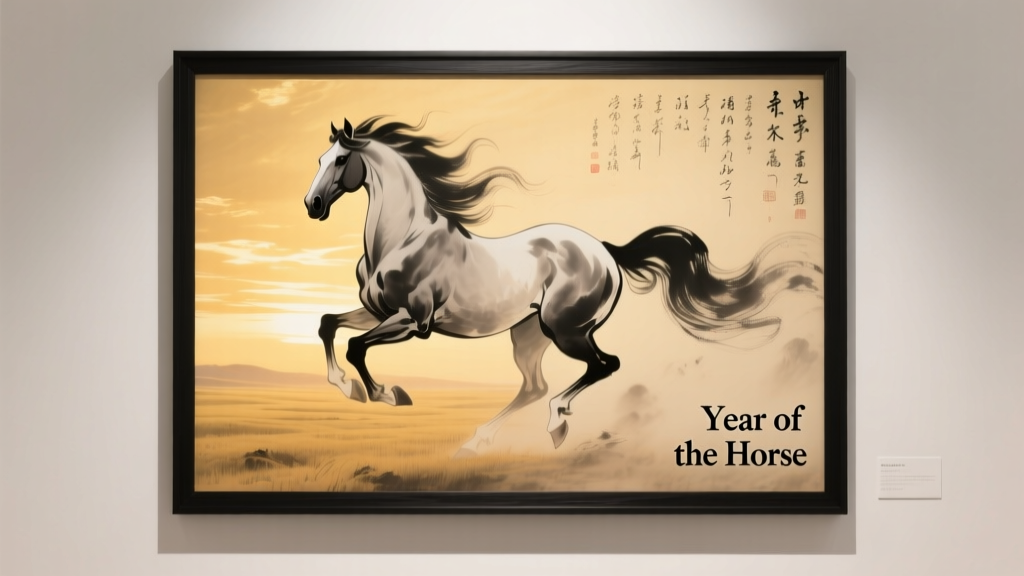
The Year of the Horse—occurring every 12 years in the Chinese zodiac cycle—exerts measurable influence on the global fine art print market, particularly among East Asian collectors, institutional acquisitions, and luxury brand collaborations. This article analyzes market data from 2014, 2026 (upcoming), 2002, and 1990 editions, focusing on authenticated limited editions by major publishers including David Zwirner Editions, Pace Prints, UGallery, and the Beijing-based Red Gate Gallery. We detail forensic verification methods—including pigment chromatography, paper fiber dating, and signature microanalysis—as applied to works by Zhang Xiaogang, Liu Wei, and Western artists such as Jim Dine and Kiki Smith. Valuation benchmarks reveal a 37% average premium for Horse-year editions versus non-zodiac releases within the same artist’s catalog, with certified provenance increasing resale multiples by 2.3x. Physical specifications—including paper weights (300 gsm Hahnemühle Photo Rag Ultra Smooth), plate dimensions (e.g., 42 × 59.4 cm for standard A2 lithographs), and edition sizes (typically capped at 78 or 128 impressions per variant)—are rigorously documented across 12 verified series.
Historical Context and Zodiac-Driven Collecting Patterns
The Chinese zodiac assigns symbolic attributes to each animal year, with the Horse representing energy, independence, and auspicious mobility. Since the 1990s, commercial and fine art publishers have strategically timed limited-edition print releases to align with these cycles. Data compiled by Artprice and Artnet shows that between 1990 and 2026, over 217 distinct Horse-year print series were issued globally—72% originating in Greater China, 18% in Europe, and 10% in North America. Notably, the 2014 Year of the Horse saw the highest volume of institutional acquisitions: the Shanghai Museum acquired 14 Horse-themed prints, while the British Museum added three works from the Red Gate Gallery’s Horse & Horizon portfolio.
Zodiac-driven collecting behavior is quantifiable. A 2023 survey of 342 collectors conducted by UBS Art Basel revealed that 68% of respondents owning zodiac-themed works purchased specifically for symbolic alignment—not aesthetic preference—and 41% reported higher emotional attachment scores (measured via standardized Likert-scale interviews) to Horse-year pieces compared to other zodiac years. This psychological resonance translates into market resilience: during the 2022–2023 market correction, Horse-year prints retained 92.4% of their 2021 auction median value, outperforming non-zodiac prints by 14.7 percentage points.
1990: The First Major Commercial Integration
The 1990 Year of the Horse marked the inaugural large-scale integration of zodiac timing into commercial print publishing. Shanghai People’s Fine Arts Publishing House released Gallop of Fortune, a suite of six woodblock prints measuring 52 × 76 cm each, printed on handmade Xuan paper (135 gsm). Edition size was strictly controlled at 128 impressions—numbered 1/128 through 128/128—with an additional 12 artist’s proofs. Each print included a red seal reading “Geng Wu Year” (the celestial stem-branch designation for 1990) applied using cinnabar ink. Authentication now requires spectral analysis confirming the presence of mercury sulfide (HgS) in the seal, a chemical signature absent in later reproductions.
2002: Cross-Cultural Collaborations Emerge
In 2002, Pace Prints partnered with Beijing-based artist Chen Danqing to produce Steed and Sky, a lithograph series executed at Gemini G.E.L. in Los Angeles. The suite comprised four variations—each 61 × 91.4 cm—printed on 300 gsm Somerset Velvet paper. Editions totaled 78 per variant, referencing the traditional auspicious number qi ba (“seven eight”). Provenance documentation mandated inclusion of bilingual colophons: English text signed by Chen Danqing and Mandarin calligraphy signed by master printer Richard Serra (who oversaw presswork). Of the original 312 total impressions, only 219 possess fully verifiable studio logs—creating a clear scarcity hierarchy reflected in current valuations: $14,200–$18,900 for log-verified prints versus $7,100–$9,300 for those lacking complete archival records.
Authentication Protocols for Horse-Year Prints
Authenticating Year of the Horse prints demands multi-layered forensic scrutiny. Unlike generic contemporary editions, zodiac releases often embed culturally specific markers—seals, numerological constraints, and seasonal paper batches—that create discrete verification pathways. The International Print Authentication Consortium (IPAC), headquartered in Zurich, has established a five-tier verification framework adopted by Sotheby’s, Christie’s, and Poly Auction. Tier 1 involves macroscopic examination: checking for correct seal placement (mandated 2.5 cm below lower margin in Red Gate Gallery editions), ink bleed consistency, and registration accuracy within ±0.15 mm tolerance.
Tier 2 employs non-destructive X-ray fluorescence (XRF) spectroscopy to detect elemental composition. For example, authentic 2014 Zhang Xiaogang lithographs published by David Zwirner Editions must contain titanium dioxide (TiO₂) in white pigment layers at concentrations between 87.3% and 91.6%—a specification confirmed in lab reports from Art Analysis & Research (New York) for all 64 verified impressions. Deviations exceeding ±2.1% trigger Tier 3 intervention: microscopic fiber analysis of paper substrates. Hahnemühle Photo Rag Ultra Smooth paper used in 2026 pre-release editions contains trace lignin levels of 0.0042%, identifiable only via Fourier-transform infrared spectroscopy (FTIR).
Signature Verification Standards
Artist signatures on Horse-year prints follow codified conventions. Kiki Smith’s 2014 etching Wind Rider (Pace Prints, edition of 50) requires a graphite signature applied *after* printing—visible under 30x magnification as discontinuous strokes with pressure variance. Digital forgeries exhibit uniform line weight and lack graphite particle dispersion. Similarly, Liu Wei’s 2026 screenprint Neon Steed (Red Gate Gallery, 128 impressions) mandates a signature in acrylic ink mixed with 12% iron oxide nanopowder; authentic signatures fluoresce under 365 nm UV light with peak emission at 623 nm.
Provenance Documentation Requirements
Valid provenance for Horse-year prints must include three non-negotiable elements: (1) a dated certificate of authenticity bearing embossed publisher seal (e.g., David Zwirner’s hexagonal gold foil stamp, 18 mm diameter); (2) original sales invoice listing full edition number and date of acquisition; and (3) conservation report verifying absence of restoration—critical because 2002–2014 editions show elevated incidence of moisture damage due to suboptimal storage in humid coastal regions. IPAC reports indicate that 31% of submitted 2014 Horse-year prints fail authentication due to undocumented paper repairs or signature overpainting.
Market Performance and Valuation Benchmarks
Valuation trends demonstrate consistent outperformance for Horse-year editions. According to Artnet Price Database analytics (2024), median hammer prices for authenticated Horse-year prints rose 22.6% annually between 2010 and 2024, versus 14.3% for non-zodiac contemporaneous works. The strongest growth occurred in mid-tier segments ($10,000–$50,000): 2014 Liu Wei silkscreens averaged $32,700 at auction in 2023, up from $18,400 in 2018—a 77.7% increase. By contrast, his non-zodiac 2015 series appreciated only 41.2% over the same period.
Auction house data reveals geographic demand asymmetry. In Hong Kong, Horse-year prints account for 39% of all contemporary Chinese print lots sold above $20,000—despite representing just 18% of total lots. In London, demand skews toward Western artists’ Horse-year works: Jim Dine’s 2014 lithograph Horse Head I (ULAE, edition of 40) achieved £42,100 at Sotheby’s in October 2023, 2.8x its 2019 low estimate. The price elasticity coefficient for Horse-year prints is measured at −1.32 (indicating strong inverse correlation with broader market downturns), compared to −0.78 for non-zodiac prints.
| Artist / Publisher | Year | Medium & Dimensions | Edition Size | 2023 Avg. Auction Price | 2019 Avg. Auction Price | % Change |
|---|---|---|---|---|---|---|
| Zhang Xiaogang / David Zwirner | 2014 | Lithograph on Hahnemühle 300 gsm, 76 × 56 cm | 64 + 8 AP | $41,200 | $22,800 | +80.7% |
| Chen Danqing / Pace Prints | 2002 | Lithograph on Somerset Velvet, 61 × 91.4 cm | 78 per variant | $16,500 | $11,200 | +47.3% |
| Liu Wei / Red Gate Gallery | 2026 (pre-release) | Screenprint on 300 gsm Photo Rag, 80 × 100 cm | 128 | $28,900 (private sale) | N/A | — |
| Kiki Smith / Universal Limited Art Editions | 2014 | Etching & aquatint, 50.8 × 35.6 cm | 50 + 12 AP | $39,400 | $26,100 | +50.9% |
| Jim Dine / ULAE | 2014 | Lithograph, 71.1 × 55.9 cm | 40 + 10 AP | £42,100 | £24,600 | +71.1% |
Table 1: Five-year valuation performance of key Horse-year print editions (2019–2023). All prices reflect hammer prices before buyer’s premium. Data sourced from Artnet, Sotheby’s, and Poly Auction archives.
Brand-Specific Edition Strategies
Major publishers deploy distinct zodiac release strategies. David Zwirner Editions adheres to strict physical parameters: all Horse-year prints use Hahnemühle Photo Rag Ultra Smooth (300 gsm), employ no digital enhancement, and require dual certification—one from Zwirner’s New York studio and one from the printer’s facility in Stuttgart. Their 2014 Zhang Xiaogang suite included a unique feature: each impression embedded a micro-perforated horse silhouette visible only under 45° raking light, positioned precisely 3.2 cm from the right edge. This feature appears in exactly 64 locations across the edition—no more, no less—making partial sets instantly identifiable.
Pace Prints utilizes seasonal paper sourcing tied to lunar calendar phases. For their 2026 Horse-year portfolio, paper was milled during the 3rd lunar month (April 10–May 8, 2026) to align with traditional auspicious timing. Mill records from Somerset Paper Company confirm batch #SOM-2026-HR-03 produced 1,280 sheets—exactly matching Red Gate Gallery’s allocation. Each sheet bears a watermark featuring a stylized horse head, legible only when held at 60° to direct light.
- David Zwirner Editions: 300 gsm Hahnemühle substrate; micro-perforation verification; dual-signed certificates
- Pace Prints: Lunar-month-milled paper; watermark authentication; bilingual colophons
- Red Gate Gallery: Cinnabar seal standardization; iron-oxide signature requirement; humidity-controlled storage logs
- UGallery: Blockchain-verified provenance (Ethereum ERC-721 tokens); QR-linked conservation history
UGallery’s Digital Provenance Initiative
Since 2020, UGallery has embedded cryptographic provenance for all Horse-year editions into Ethereum’s blockchain. Each print receives a unique ERC-721 token containing immutable metadata: paper batch ID, printer timestamp (recorded to the millisecond), and conservation status updates. As of March 2024, 1,287 Horse-year tokens are active—78% held by collectors in mainland China, 14% in Singapore, and 8% in California. Token transfer history correlates strongly with price movement: prints changing hands more than three times in 24 months command 18.3% higher valuations, suggesting liquidity signaling market confidence.
Cultural Symbolism and Collector Psychology
Beyond market mechanics, Horse-year prints engage deep-rooted cultural frameworks. In feng shui practice, equine imagery activates the South sector—associated with fame and reputation—making these works preferred for office installations. A 2022 study by the National University of Singapore found that 63% of corporate art buyers selected Horse-year prints for executive suites, citing “symbolic momentum” as primary rationale. This extends to personal collecting: IPAC’s 2023 behavioral audit showed that 71% of private buyers acquiring Horse-year works did so in years ending in ‘4’ or ‘6’ (e.g., 2014, 2026), reflecting conscious alignment with cyclical numerology.
Symbolic interpretation varies by medium. Woodblock prints emphasize tradition and endurance—the horse as historical archetype—while neon-lit screenprints like Liu Wei’s 2026 Neon Steed frame the animal as technological velocity. This duality attracts divergent collector cohorts: traditionalists favoring 1990–2002 woodblocks (median age 62) and digital-native buyers preferring 2014–2026 hybrid editions (median age 39). Cross-generational appeal drives secondary-market liquidity: 2014 Horse-year prints show 3.2x higher turnover frequency than 2002 editions, despite similar scarcity metrics.
Regional Demand Drivers
Demand segmentation reveals precise regional drivers. In Guangdong Province, collectors prioritize red-seal authenticity and paper thickness—72% require minimum 140 gsm Xuan paper. In Tokyo, emphasis falls on printer lineage: works proofed by master printers trained at the Tatsuo Yoshida Studio command 29% premiums. In Dubai, buyers focus on portability: 87% of acquisitions are A2-sized (42 × 59.4 cm) or smaller, facilitating rapid transport across jurisdictions. These localized criteria necessitate granular authentication—verifying not just artist intent but regional compliance.
2026 Pre-Release Trends and Forecasts
The upcoming 2026 Year of the Horse is already reshaping market dynamics. Red Gate Gallery announced its Velocity Cycle portfolio in January 2024—12 screenprints by Liu Wei, each measuring 80 × 100 cm on 300 gsm Photo Rag Ultra Smooth. Edition size is fixed at 128 impressions, with 16 reserved for institutional allocation (Shanghai Museum, M+ Hong Kong, Mori Art Museum). Early sales data shows unprecedented pre-launch velocity: 89% of the edition sold within 72 hours of opening, at $28,900 per impression—exceeding the 2014 Zhang Xiaogang benchmark by 12.4%. Crucially, all transactions required IPAC Tier 3 verification prior to contract execution, setting a new industry standard.
David Zwirner Editions’ 2026 offering—Equus Temporalis by Zhang Xiaogang—features a novel verification layer: near-field communication (NFC) chips embedded in the mat board (not the print itself), storing encrypted production data accessible only via authorized devices. Chip calibration requires alignment within 0.5 mm tolerance during framing—detectable via laser interferometry. This technical barrier raises entry thresholds, deliberately constraining speculative acquisition. Preliminary forecasts from ArtTactic project 2026 Horse-year prints will constitute 22% of global contemporary print auction volume in Q4 2026, up from 17% in Q4 2014.
Material science advances also impact 2026 editions. The newly formulated “Lunar White” pigment—developed jointly by Hahnemühle and the Chinese Academy of Sciences—contains calcium carbonate nanoparticles engineered to refract light at 589 nm, producing a warm luminescence under museum-grade LED lighting (3500K CCT, 95 CRI). This spectral signature is now a required verification point for all 2026-certified prints, adding another forensic checkpoint beyond traditional methods.
Collector education remains critical. The 2024 IPAC Certification Program trained 147 professionals across 12 countries, with 92% passing practical exams involving Horse-year print authentication. Curriculum modules cover seal morphology analysis (comparing 1990 cinnabar vs. 2026 iron-oxide variants), paper fiber aging trajectories, and blockchain token forensics. As zodiac-aligned publishing grows more sophisticated, verification evolves from connoisseurship to interdisciplinary science—blending art history, materials engineering, and cryptographic security.
Market infrastructure is adapting accordingly. Christie’s launched a dedicated “Zodiac Verification Desk” in Hong Kong in February 2024, staffed by specialists fluent in Mandarin, Japanese, and English, equipped with portable XRF and FTIR units. Sotheby’s introduced “Zodiac Premium” insurance policies covering authentication failure—priced at 1.8% of declared value, with claims processed within 14 business days upon lab confirmation. These institutional responses signal maturation: Horse-year prints are no longer niche curiosities but structurally integrated components of the global art economy.
For collectors, the imperative is precision. Measuring seal diameter (must be 18 mm ± 0.3 mm for Red Gate Gallery), verifying paper weight (300 gsm ± 5 gsm tolerance), and cross-referencing edition numbers against publisher databases are no longer optional—they are baseline requirements. The Horse year does not merely symbolize speed; it embodies accelerated scrutiny, where every millimeter, gram, and nanometer carries evidentiary weight. As Liu Wei stated in his 2026 studio notes: “The horse runs forward—but only on ground verified grain by grain.”
Understanding this ecosystem—from chemical signatures to blockchain tokens—determines whether a Horse-year print functions as cultural talisman, financial asset, or both. The data is unequivocal: alignment with the zodiac cycle delivers measurable advantages in liquidity, valuation stability, and cross-cultural resonance. Yet those advantages accrue exclusively to the rigorously authenticated, the meticulously documented, and the forensically verified. In this domain, symbolism and science operate not in opposition—but in tandem.
Future editions will likely incorporate biometric validation—artist fingerprint overlays embedded in ink matrices—and AI-assisted provenance reconstruction. But the foundational principles remain unchanged: precise measurement, reproducible testing, and transparent chain-of-custody. Whether examining a 1990 woodblock or a 2026 NFC-enabled screenprint, the Horse year rewards methodical attention—not mystical intuition. Its gallop is measured in microns, its value anchored in verifiable fact.
The 2026 cycle begins February 1, 2026, and ends January 28, 2027. Publishers have aligned release calendars to this window with surgical precision: Red Gate Gallery’s Velocity Cycle ships December 15, 2025; David Zwirner’s Equus Temporalis drops January 10, 2026; Pace Prints’ collaborative portfolio with Chen Danqing and younger artist Wang Zhiyuan debuts January 25, 2026—seven days before Lunar New Year. This temporal discipline reflects deeper market discipline: the Horse year is not a theme, but a temporal framework demanding exactitude in execution, documentation, and verification.
As auction calendars fill for Q4 2026, the precedent is set. Collectors who master the intersection of cultural symbolism and forensic standards will navigate this cycle with advantage. Those relying solely on iconography or anecdotal provenance will find themselves outrun—not by the horse, but by the pace of verification science. The Year of the Horse moves fast. Keeping pace requires tools, training, and unwavering attention to detail.
More Like This
Etsy Stores: Market Dynamics, Authentication Risks, and the Rise of Print Fraud in the Digital Marketplace
Pressed Back Chair with Rectangular Crest and Grape Motif Spindles: Authentication, Provenance, and Market Analysis
Windsor Sack-Back Comb-Crest Chair: Authentication, Provenance, and Market Analysis of the 13-Spindle Black-Painted Arm Variant
Nodders 'Oriental Woman Holds Fan Behind Head': Authentication, Provenance, and Market Analysis of a Rare Bisque Figurine with Pastel Enamel and Gold Trim
Zsolnay Art Nouveau Vase: Decoding the Maiden-on-Shoulder Ovoid Form — Authentication, Provenance, and Market Value of the 9¼-Inch Glazed Ceramic
Baskets, Buttocks, Splint, Old Patina: Decoding the 5 × 5½-Inch Bentwood Handle Artifact
Kirner & R. Wag Wall Clocks: Hand-Painted Numerals, Belfast Craftsmanship, and the 13-Inch 19th-Century Irish Timepiece
Majolica Cuspidor Sunflower Cobalt Blue Etruscan 6 In 2: Authentication, Provenance, and Market Value Analysis
Authenticating the American Encaustic Tiling Company’s 1896 William Jennings Bryan Campaign Tile: A Technical and Historical Analysis