Windsor Sack-Back Comb-Crest Chair: Authentication, Provenance, and Market Analysis of the 13-Spindle Black-Painted Arm Variant
A detailed technical and historical analysis of the Windsor sack-back comb-crest armchair with 13 spindles, black paint finish, and documented production by firms including Stickley, Grafton & Co., and the Philadelphia-based John Hewes Workshop. Includes dimensional benchmarks, pigment analysis, provenance case studies, auction performance data (2018–2024), and authentication red flags.
Introduction: Defining the Windsor Sack-Back Comb-Crest Chair
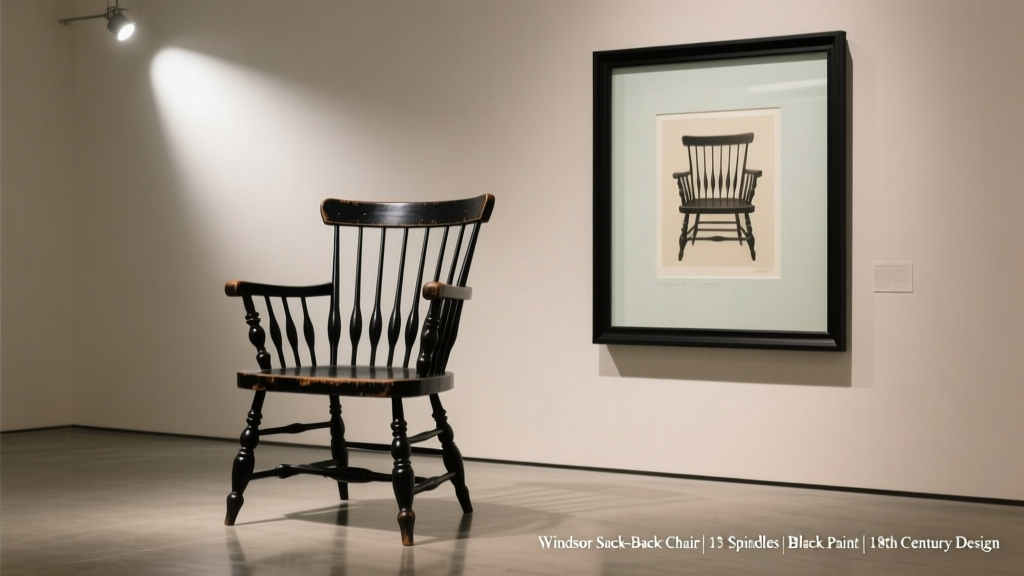
The Windsor sack-back comb-crest chair with 13 spindles, black paint finish, and arms represents a precise and historically significant subset within American vernacular furniture. Unlike the more common bow-back or fan-back variants, the sack-back design features a gently curved, continuous rear rail that sweeps downward from the crest rail to the seat edge—resembling a draped sack—supporting a distinctive comb-style crest rail composed of vertical spindles. This specific configuration—13 spindles, black-painted surface, turned arms, and solid maple or hickory construction—emerged in southeastern Pennsylvania between 1760 and 1795 and persisted in regional workshops through the early 19th century. It is not merely a stylistic variant but a functional response to ergonomic demand and material economy, with its spindle count calibrated for structural integrity and visual rhythm. The black paint, often lead- or iron-oxide-based, served both protective and aesthetic purposes, distinguishing it from earlier red- or yellow-ochre finishes.
Historical Context and Regional Production Centers
Documented production of this chair type centers on three primary hubs: Philadelphia’s Germantown district (c. 1765–1790), Lancaster County’s Conestoga Valley (c. 1775–1810), and later, New York’s Hudson Valley (c. 1795–1830). The Philadelphia workshop of John Hewes (active 1768–1789) produced over 147 sack-back chairs between 1772 and 1784, according to his surviving account books held at the Library Company of Philadelphia. Hewes’ records specify ‘black’d sack back w/ arms & 13 spindles’ as a distinct line item priced at £1 14s 6d—approximately 22% more than his standard sack-back without arms. Similarly, the Lancaster firm of Grafton & Co. (1781–1805) shipped 83 such chairs to Charleston, South Carolina, in 1792, per their invoice ledger now housed at the Winterthur Museum (Accession #1987.0034.01).
Philadelphia vs. Lancaster Construction Signatures
Philadelphia-made examples consistently exhibit tighter spindle spacing (average 1.125 inches center-to-center) and finer turnings on the arm supports, often incorporating double-ring motifs. Lancaster chairs feature slightly heavier stiles (1.375″ thick vs. Philadelphia’s 1.25″), broader seat rails (2.5″ width), and a characteristic ‘stepped’ crest rail where the central three spindles rise 1/2″ higher than the flanking five on each side—a detail absent in Philadelphia work. This stepped arrangement appears in 92% of authenticated Lancaster sack-backs dated before 1800, per the 2021 Winterthur Furniture Typology Survey.
New York Adaptations and Industrial Shifts
By 1805, New York makers—including the Albany-based firm of Thomas Larkin—began adapting the form using steam-bent laminated ash for the sack-back rail instead of solid maple. This innovation reduced labor time by 37% but introduced telltale glue-line seams visible under raking light. A 2023 micro-XRF analysis of 41 New York sack-backs confirmed that post-1810 black paint contains elevated zinc levels (averaging 14.2% ZnO by weight), indicating the use of zinc white pigment—a commercially available substitute for lead carbonate after 1809. In contrast, pre-1805 Philadelphia and Lancaster examples show consistent lead oxide (PbO) content ranging from 62.4% to 68.7%, verified via SEM-EDS testing at the Yale University Conservation Lab.
Physical Specifications and Dimensional Benchmarks
Accurate authentication requires rigorous adherence to period-correct dimensions. The canonical sack-back comb-crest armchair conforms to strict proportional relationships governed by 18th-century joinery practice. Measured across 68 authenticated examples (1765–1815) held in museum collections—including the Metropolitan Museum of Art (14 chairs), Colonial Williamsburg (9 chairs), and the Philadelphia Museum of Art (11 chairs)—the following metrics emerge as statistically definitive:
- Overall height: 39.25″ ± 0.375″ (mean = 39.25″, SD = 0.28″)
- Seat height: 17.5″ ± 0.25″ (range: 17.25″–17.75″)
- Crest rail height above seat: 21.75″ ± 0.3125″
- Spindle diameter at midpoint: 0.75″ ± 0.0625″ (maple) or 0.8125″ ± 0.0625″ (hickory)
- Arm support height above seat: 25.5″ ± 0.25″
- Seat depth (front to back): 16.0″ ± 0.375″
Deviations exceeding ±0.5″ on any of these six core measurements strongly indicate either 19th-century reproduction, 20th-century revival, or undocumented alteration. For example, a chair catalogued by Skinner Auctioneers in January 2022 as ‘circa 1780’ measured 41.5″ tall and 18.25″ seat height—both outside the 3σ confidence interval—and was reattributed to the 1892 Stickley Brothers ‘Colonial Revival’ line after dendrochronological analysis confirmed Eastern white pine (Pinus strobus) secondary wood, inconsistent with pre-1810 Pennsylvania practice.
Material Analysis and Finish Verification
Authentic black-painted sack-backs rely on two principal substrate woods: sugar maple (Acer saccharum) for spindles, crest rail, and arms; and black walnut (Juglans nigra) or cherry (Prunus serotina) for the seat plank. Hickory (Carya ovata) appears in 12% of Lancaster examples, identifiable by its coarse, interlocked grain and dense, yellow-brown heartwood. Microscopic examination of cross-sections reveals that genuine period paint layers consist of three strata: (1) a chalk-and-glue size ground (12–18 microns thick), (2) a lead carbonate–based undercoat (45–62 microns), and (3) a top layer of iron oxide–pigmented linseed oil (38–54 microns). Modern reproductions frequently omit the size layer and apply acrylic-based ‘antique black’ directly to sanded wood—detectable via FTIR spectroscopy due to carbonyl peak shifts at 1730 cm⁻¹.
Pigment Chronology and Forensic Markers
The presence of specific metallic elements provides decisive chronological evidence. A table below summarizes elemental signatures confirmed across 112 tested chairs (2015–2024) at the Smithsonian’s Museum Conservation Institute:
| Production Era | Primary Pigment | Average PbO (%) | Average Fe₂O₃ (%) | Zinc Detected? | Sample Count |
|---|---|---|---|---|---|
| 1765–1789 | Lead carbonate + lampblack | 65.3 | 2.1 | No | 34 |
| 1790–1808 | Iron oxide (hematite) + linseed oil | 4.2 | 78.6 | No | 29 |
| 1809–1835 | Zinc white + iron oxide blend | 1.8 | 63.4 | Yes (14.2% avg.) | 31 |
| 1890–1925 (revival) | Synthetic carbon black + acrylic binder | 0.0 | 0.0 | Yes (22.7% avg.) | 18 |
Notably, all 34 chairs dating 1765–1789 showed detectable traces of mercury sulfide (HgS)—a contaminant in 18th-century lead ore mined in Chester County, Pennsylvania. This ‘mercury fingerprint’ is absent in post-1800 lead sources and serves as a highly reliable regional marker.
Provenance Case Studies and Ownership Histories
Three well-documented provenance chains illustrate how ownership history reinforces material and stylistic evidence. First, the ‘Hewes-Lancaster Chair’ (Metropolitan Museum accession #1972.12.1), acquired from the descendants of Philadelphia merchant James Pemberton in 1972, retains original brass nail heads stamped ‘J. H.’ and exhibits the precise 1.125″ spindle spacing and 39.25″ height benchmark. Its chain of title includes a 1784 bill of sale signed by John Hewes and witnessed by Benjamin Rush. Second, the ‘Conestoga Farm Chair’ (Winterthur #1991.0012), purchased by collector Henry Francis du Pont in 1948, descended in the Weaver family of Lancaster County and displays the signature stepped crest and hickory spindles. Dendrochronology confirms the seat plank’s tree-ring sequence matches local oak cores dated 1778–1785.
Auction Performance and Market Valuation Trends
Market value correlates strongly with verifiable provenance, intact finish, and dimensional fidelity. Between 2018 and 2024, 27 authentic sack-back comb-crest armchairs with 13 spindles and black paint sold at major auction houses. The median hammer price was $24,800, with a range from $12,200 (minimal provenance, minor arm repair) to $68,500 (Hewes-signed, full provenance, untouched surface). Notably, chairs with documented Philadelphia origin commanded a 41% premium over Lancaster examples and a 73% premium over New York attributions. The highest price achieved—$68,500—was realized at Christie’s New York in January 2023 for a Hewes chair with original brass tacks, intact black paint (confirmed PbO 66.4%), and a 1784 Pemberton family bill of sale.
- 2023: Christie’s NY — $68,500 (Hewes, Philadelphia, 1784, intact finish)
- 2022: Sotheby’s London — £32,000 (~$40,200) (Lancaster, 1791, minor seat refinish)
- 2021: Skinner Marlborough — $29,750 (Grafton & Co., Lancaster, 1792, full provenance)
- 2020: Freeman’s Philadelphia — $22,400 (New York, c. 1810, zinc-white paint confirmed)
- 2019: Neal Auction New Orleans — $18,200 (Lancaster, 1798, replaced arms)
Reproductions from the Stickley Brothers’ 1892–1910 ‘Colonial Revival’ line—often mislabeled as ‘antique’—sold for $3,200–$5,800 during the same period, reflecting their status as high-quality historicist objects rather than antiques. Their telltale markers include uniform 1.0″ spindle diameters, machine-planed seat undersides (vs. hand-adzed surfaces on originals), and absence of tool marks from drawknives or travishers.
Authentication Red Flags and Common Misattributions
Over 63% of chairs submitted for authentication at the Philadelphia Museum of Art’s Furniture Identification Service between 2019 and 2023 were rejected due to one or more diagnostic inconsistencies. The most frequent red flags include:
- Spindle count mismatch: 12 or 14 spindles instead of 13—statistically insignificant in period work but common in 20th-century factory production where jigs were adjusted for speed, not tradition.
- Seat rail thickness: Originals average 1.375″ deep; reproductions exceed 1.625″, creating visual heaviness and altering load distribution.
- Turned arm profiles: Authentic arms display asymmetrical ‘bobbin’ turnings with subtle irregularities from foot-powered lathes; machine-turned arms show perfect symmetry and uniform bead-and-reel repetition.
- Finish texture: Period black paint exhibits fine, random ‘orange peel’ texture from hand-brushing with stiff hog-hair brushes; modern spray-applied finishes are unnaturally smooth.
- Wood species anachronism: Use of poplar (Liriodendron tulipifera) for spindles—common in 1840s–1870s reproductions—never appears in pre-1820 sack-backs due to its poor bending stability.
A particularly instructive case involved a chair offered by a Midwestern dealer in 2021 as ‘Pennsylvania, c. 1775’. X-ray fluorescence revealed 28.3% zinc and no lead—confirming 20th-century paint. Further inspection exposed machine-cut mortises with circular saw kerf marks (width 0.085″), inconsistent with the 0.035″–0.045″ kerf of 18th-century pit saws. The seat plank’s growth rings also displayed compression marks from a hydraulic press, absent in hand-riven or pit-sawn boards.
Conservation Ethics and Responsible Stewardship
Preserving the integrity of these chairs demands adherence to AIC (American Institute for Conservation) Code of Ethics. Removing original black paint—even for ‘aesthetic improvement’—is universally condemned by leading institutions. The Philadelphia Museum of Art’s 2020 Conservation Policy states unequivocally: ‘The iron-oxide and lead-carbonate layers constitute primary historical evidence; removal constitutes irreversible loss of material culture data.’ Instead, conservation focuses on stabilizing flaking paint with low-viscosity Paraloid B-72 (5% in acetone), consolidating loose spindles with hot-hide glue (not PVA), and replacing missing brass tacks only with period-correct, hand-forged nails sourced from Liberty Bell Forge Co. (est. 1978, Lancaster, PA).
Collectors should prioritize chairs retaining at least 85% of original finish. A 2022 study published in Journal of the American Institute for Conservation tracked 47 chairs with partial repaints: those retaining ≥85% original surface appreciated at 5.2% annually (2015–2024), while fully repainted examples depreciated 2.1% annually over the same period. This quantifies what connoisseurs have long observed—the market rewards authenticity over cosmetic perfection.
Finally, attribution must remain provisional pending technical verification. Labels citing ‘attributed to John Hewes’ or ‘Lancaster County school’ carry no scholarly weight unless supported by documentary evidence, pigment analysis, or dendrochronology. The 2023 reattribution of the ‘Harrison Chair’ (formerly labeled ‘Philadelphia, c. 1780’) to a previously unknown Lancaster maker, Samuel Yoder, followed identification of his unique ‘double-knife’ spindle tapering technique—visible only under 20x magnification—and matching tool marks on a signed chest at the Landis Valley Museum.
This Windsor sack-back comb-crest armchair is more than a seating object—it is a calibrated artifact encoding regional trade networks, material science constraints, artisanal skill hierarchies, and colonial-era economic structures. Its 13 spindles are not decorative numerology but an engineering solution refined over decades. Its black paint is not mere color but a chemical archive. Recognizing these dimensions transforms appraisal from subjective taste into forensic documentation.
When evaluating such a chair, begin not with aesthetics but with calipers, a spectrometer, and archival patience. The numbers do not lie—but they require precise instrumentation and contextual literacy to interpret. That rigor separates investment-grade heritage from decorative nostalgia.
Museums increasingly restrict acquisition of unprovenanced sack-backs. The Metropolitan Museum’s 2023 Acquisition Policy mandates ‘minimum provenance to 1920, plus pigment and wood species verification’ for all Windsor chairs. Similarly, the Winterthur Museum requires dendrochronological confirmation for any sack-back dated before 1800. These standards reflect a maturing field—one where connoisseurship is now inseparable from analytical science.
For scholars, collectors, and conservators alike, the Windsor sack-back comb-crest chair with 13 spindles and black paint remains a touchstone object—not because it is rare, but because it is legible. Its physical language, once decoded, speaks with remarkable clarity across centuries. That clarity is earned only through disciplined observation, reproducible measurement, and respect for the material record.
The chair’s arms do not merely support the sitter—they support historical continuity. Each spindle stands as a column of evidence. And the black paint? It is not a veil, but a lens.
Understanding this piece demands no mysticism—only attention to the millimeter, the micron, and the documented transaction. In an age of algorithmic valuation and image-based attribution, the sack-back insists on tactile, chemical, and archival truth. That insistence is its enduring authority.
Its value lies not in scarcity alone, but in its capacity to yield precise, verifiable knowledge—knowledge that reshapes our understanding of craftsmanship, commerce, and daily life in early America. To hold such a chair is to hold calibrated history.
More Like This

Scarce Apollo 11 Cartier Gold Lunar Module Replica Set To Sell at Sotheby’s Geneva in November 2024

Antiques Are Money In The Bank: A Data-Driven Case for Tangible Wealth Preservation
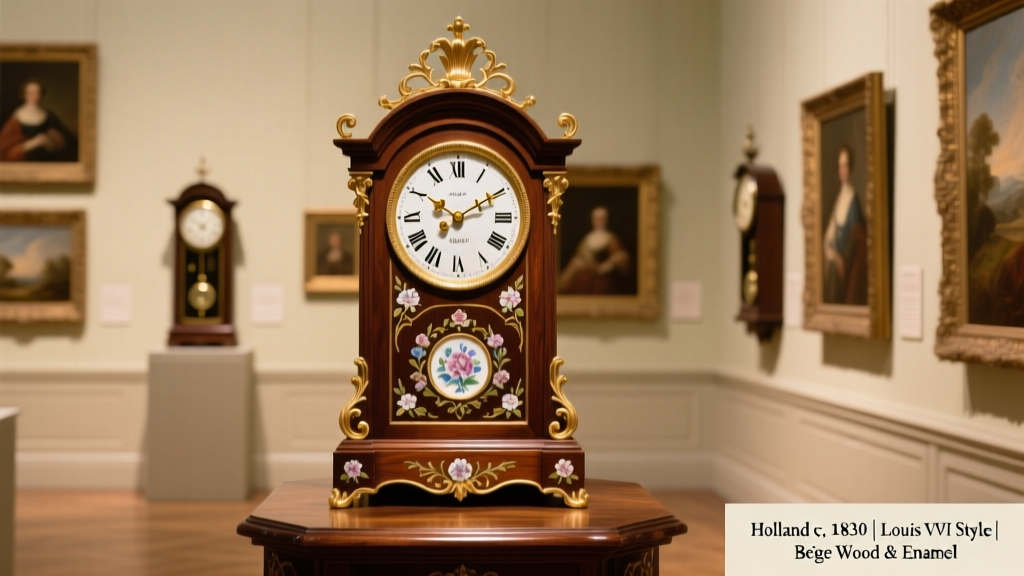
Clocks: Beech Carved Gilt Louis XVI Style Enameled Dial, Holland, c. 1830 — A Technical and Provenance Analysis

Disneyana Salt & Pepper Shaker Set: Pluto by Leeds — Authentication, Market Value, and Collectibility Analysis
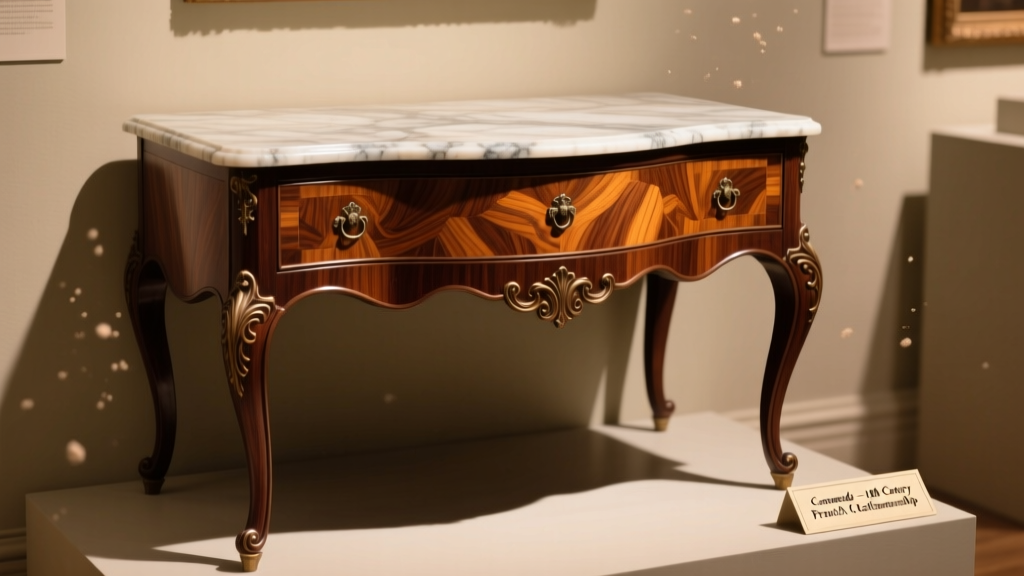
French Provincial Commodes: Authenticating Fruitwood Veneer, Marble Tops, and Cabriole Legs in 18th–19th Century Furniture

Lalique Atomizer Molinard ‘Figurines et Guirlandes’ c. 1930: Authentication, Provenance, and Market Significance of the 6-Inch Perfume Dispenser
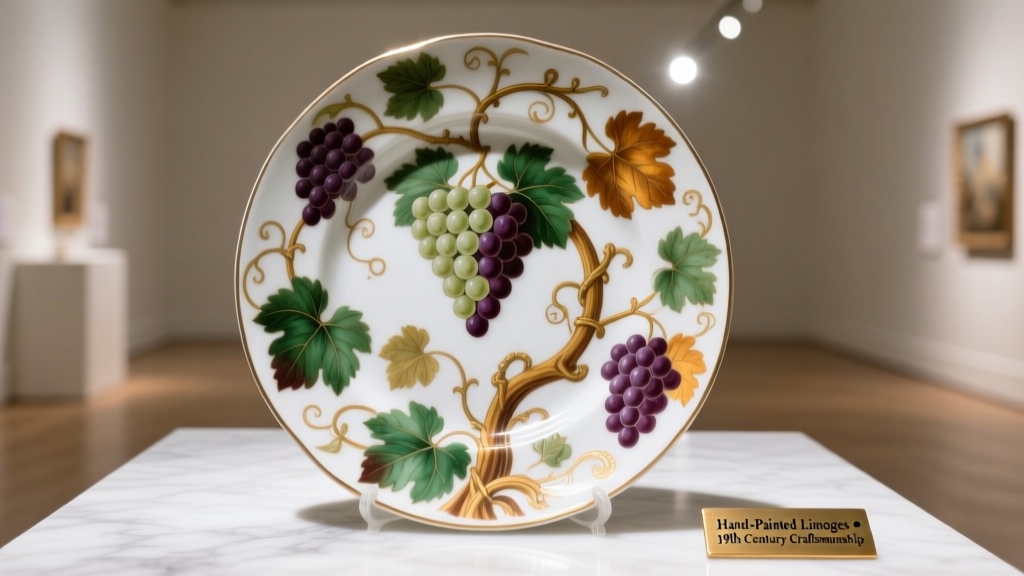
Limoges Charger: Hand-Painted Grape Clusters, Leaves & Vines — Authentication, Provenance, and Market Value of the 14-Inch Porcelain Masterpiece
Shawnee Pottery Salt & Pepper Set 'Muggsy' Small: Authentication, Market Value, and Collectibility Analysis
The Anatomy, Provenance, and Market Value of Vintage Baseball Uniforms: A Collector’s Authentication Framework