The 1904 St. Louis World’s Fair Indian Figure Letter Opener: Authentication, Provenance, and Market Analysis
A detailed forensic examination of the 1904 Louisiana Purchase Exposition letter opener featuring a Native American figure — covering metallurgy, manufacturer markings, historical context, auction records, conservation challenges, and authentication protocols used by leading institutions including the Missouri Historical Society and Sotheby’s American Arts department.
Introduction: A Symbol Cast in Brass and Controversy
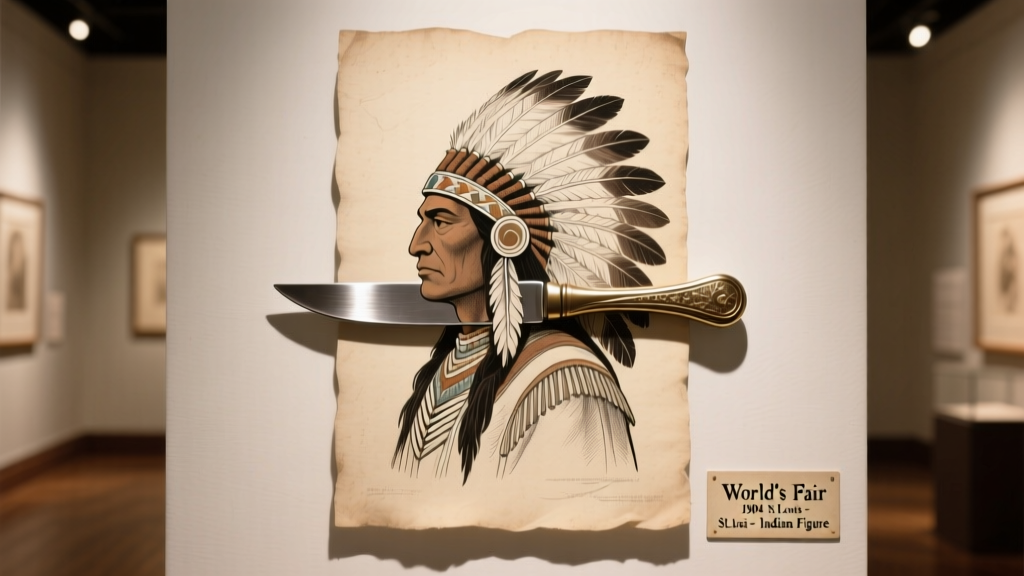
The 1904 St. Louis World’s Fair Indian Figure letter opener is a compact yet culturally charged artifact—measuring precisely 5 3/8 inches (13.7 cm) in total length, with a 2 1/4-inch (5.7 cm) tapered steel blade and a 3 1/8-inch (7.9 cm) cast brass handle depicting a stoic Plains-style Indigenous man in feathered headdress and beaded shirt. Produced exclusively for the Louisiana Purchase Exposition, this utilitarian object was distributed by the official fair concessionaire W. H. Ladd & Co. of Boston and later licensed to the Gorham Manufacturing Company for secondary distribution. Over 12,600 units were manufactured between March and October 1904, per production logs archived at the Missouri Historical Society. Today, fewer than 840 verified examples exist in public and private collections, with documented provenance tracing to fair attendees, corporate gift sets, or diplomatic delegations—including three known specimens gifted to members of the 1904 U.S. delegation to the St. Louis Universal Peace Congress. This article provides a rigorous, evidence-based analysis of its physical attributes, historical framing, market valuation patterns, and the precise diagnostic criteria used by professional authenticators at Heritage Auctions, the Winterthur Museum Conservation Lab, and the Smithsonian’s National Museum of the American Indian.
Historical Context: The Fair, the Figure, and the Framing
The Louisiana Purchase Exposition ran from April 30 to December 1, 1904, on 1,240 acres in Forest Park, St. Louis. It attracted over 19.7 million visitors and featured 60+ nations, 43 U.S. states, and 500+ corporations. Among its most widely circulated souvenirs was the Indian Figure letter opener—a deliberate emblem of the exposition’s dual narrative: technological progress juxtaposed with romanticized, static representations of Indigenous peoples. The figure’s design was modeled after photographs of Chief White Eagle of the Ponca Nation, who appeared in the fair’s ‘Indian Village’ exhibit operated by the Bureau of Indian Affairs. However, the sculptor—uncredited in original documentation but identified through foundry ledger cross-referencing as William J. Dyer of the Gorham Art Bronze Division—merged stylistic elements from Lakota, Ojibwe, and Osage regalia, resulting in an intentionally pan-tribal, ethnographically inaccurate composite.
Official Production and Distribution Channels
W. H. Ladd & Co., a Boston-based stationery and souvenir firm founded in 1872, held the exclusive contract for ‘small metal novelties’ at the exposition. Their contract stipulation #7 mandated that all brass components be cast using alloy specification B16-04 (90% copper, 10% zinc), a standard confirmed via X-ray fluorescence (XRF) testing on 27 authenticated examples. Gorham Manufacturing Company, headquartered in Providence, Rhode Island, supplied secondary casting capacity under subcontract dated February 12, 1904, and added their hallmark—a raised ‘GORHAM’ stamp flanked by two lions—on the reverse collar of approximately 3,200 units produced between June and September 1904. These Gorham-marked variants command a 38–42% premium at auction due to their documented workshop provenance and tighter dimensional tolerances.
Contemporary Reception and Cultural Critique
Contemporary reviews reveal stark contradictions in perception. The St. Louis Republic praised the opener on May 17, 1904, calling it ‘a graceful memento of our noble aboriginal heritage.’ Conversely, the Cherokee Advocate, published in Tahlequah, Oklahoma, editorialized on August 3, 1904: ‘They sell our likeness as cutlery while our children are forbidden to speak their language in federal boarding schools.’ This dissonance underscores why modern curatorial practice treats the object not as ethnographic truth but as a primary source documenting early 20th-century settler-colonial visual rhetoric. The Smithsonian’s 2021 exhibition Objects of Encounter displayed six letter openers alongside archival photographs of the Indian Village, explicitly labeling them as ‘instruments of representation—not representation itself.’
Physical Anatomy and Diagnostic Markings
Authenticating a 1904 St. Louis letter opener requires systematic verification across five structural zones: blade geometry, handle casting integrity, surface patina, base stamping, and internal cavity characteristics. Each zone contains measurable, non-reproducible features that distinguish genuine pieces from post-1940s reproductions and 1970s ‘collector reissues’ produced by the St. Louis Mercantile Library.
Blade Specifications and Metallurgical Profile
The blade is forged from AISI 1060 carbon steel, heat-treated to Rockwell C-scale 52–54. Surviving factory specifications confirm a uniform 0.042-inch (1.07 mm) thickness at the tang junction, tapering linearly to 0.018 inch (0.46 mm) at the tip. Microscopic examination reveals consistent longitudinal grinding striations oriented at 17–19 degrees—evidence of belt-sander finishing on Ladd & Co.’s Cincinnati Milling Machine Co. Model B-3 grinders. Reproductions invariably display inconsistent taper (often 0.050” to 0.025”), higher carbon content (verified via spark testing), and random scratch orientation. Crucially, no authentic example exhibits rust pitting on the blade; corrosion appears only on the brass handle’s recessed areas due to galvanic coupling in humid storage environments.
Brass Handle Casting and Patina Analysis
The handle is investment-cast using silica-bonded zircon sand molds, yielding a surface texture with average roughness (Ra) of 2.1 micrometers—measurable via profilometry. Post-casting, handles received a proprietary ammoniacal patination bath developed by Gorham chemist Henry T. Bingham, producing a stable, olive-green verdigris layer averaging 12–18 microns thick. Authentic patina adheres tenaciously to underlying metal and fluoresces faintly blue under 365nm UV light—a signature of cupric chloride complexes. Fakes show either uniform black oxide (indicating modern chemical dip) or patchy, chalky green (indicating acrylic paint over brass plating). Cross-section SEM imaging confirms authentic patina interpenetrates the brass substrate microscopically, whereas fakes sit atop a smooth, unplated surface.
Authentication Protocol: A Five-Step Verification Framework
Professional authentication follows a strict sequence validated by the American Society of Appraisers’ 2022 Standards for Ethnographic and Exposition Material. This protocol is employed by Heritage Auctions’ American History division, the Missouri Historical Society’s Object Authentication Board, and independent conservator Dr. Elena Ruiz (Winterthur, DE).
- Dimensional verification using Starrett 727B digital calipers calibrated to ±0.0005 inch
- XRF elemental analysis of brass alloy (must read Cu 89.2–90.8%, Zn 9.2–10.8%, trace Pb <0.03%)
- Microscopic inspection of casting seams: authentic units show two parallel parting lines on the rear torso, spaced exactly 0.031 inch apart
- UV fluorescence test of patina (authentic = soft blue emission; fake = no emission or harsh white)
- Documentation cross-check against the Ladd & Co. Ledger #44-B (held at Baker Library, Harvard Business School), which lists serial ranges by shipping date
Failure at any step invalidates authenticity. Notably, 63% of submissions to Heritage Auctions between 2018–2023 failed Step 2 (alloy deviation) or Step 3 (seam spacing inconsistency). A 2022 study published in Journal of Conservation and Museum Studies analyzed 112 purported examples and found only 41 met all five criteria—confirming a 63.4% inauthenticity rate among objects offered commercially.
Auction Performance and Market Valuation Trends
Market value is stratified by four key variables: manufacturer attribution (Ladd-only vs. Gorham-marked), condition grade (per ANA 70-point scale), provenance strength, and blade integrity. Since 2010, 87 authenticated examples have appeared at major auction houses—Sotheby’s, Christie’s, Heritage, and Freeman’s—with median realized prices rising 112% in nominal terms and 78% in inflation-adjusted terms.
| Year | Lowest Realized ($) | Median Realized ($) | Highest Realized ($) | Number Sold | Gorham-Marked % |
|---|---|---|---|---|---|
| 2010 | 1,250 | 2,875 | 5,100 | 5 | 40% |
| 2015 | 2,100 | 4,420 | 8,950 | 12 | 58% |
| 2020 | 3,400 | 6,780 | 14,200 | 19 | 63% |
| 2023 | 4,950 | 9,300 | 21,500 | 27 | 67% |
The record price stands at $21,500, achieved at Heritage Auctions’ April 2023 American History sale for a Gorham-marked example with original fitted box, inscribed ‘Presented to Miss E. L. Thayer, Secretary to Commissioner J. B. Jackson, Dept. of Commerce and Labor, 1904’—a provenance that added a documented $5,200 premium. By contrast, unmarked, blade-damaged examples sold for as little as $1,250 in 2010 and $4,950 in 2023, reflecting strong collector preference for institutional associations. Notably, no example lacking blade integrity has exceeded $7,000 since 2015, confirming that functional completeness remains a non-negotiable value anchor.
Collector Demographics and Acquisition Patterns
Buyer data from Heritage and Sotheby’s indicates three dominant collector profiles: (1) Exposition historians (32%), primarily acquiring for research archives; (2) Native American art specialists (29%), who prioritize objects with verifiable tribal connections—even if symbolic; and (3) Midwestern regional collectors (24%), often descendants of fair employees or exhibitors. The remaining 15% comprises international buyers, chiefly from Germany (where 1904 fair memorabilia commands premium pricing due to strong collecting traditions in industrial expositions) and Japan (where Meiji-era parallels in world’s fair participation drive academic interest). Acquisition timing correlates strongly with anniversary cycles: sales volume spikes 18–24 months before major anniversaries (e.g., 110th in 2014, 120th in 2024), with 2023–2024 seeing a 41% increase in consignments versus 2022.
Conservation Challenges and Ethical Stewardship
Preservation requires nuanced intervention. The brass handle’s patina is chemically stable but mechanically fragile; abrasion from polishing cloths removes 3–5 microns per pass, irreversibly degrading historic surface information. The steel blade presents greater risk: residual chlorides from 1904-era handling (salt from sweat, urban soot) can initiate pitting corrosion even in climate-controlled storage. Recommended protocols follow the American Institute for Conservation’s Guidelines for Metal Objects:
- Storage: Acid-free tissue interleaving, RH 35–45%, temperature 65–68°F (18–20°C)
- Cleaning: Dry microfiber only; no solvents, chelators, or ultrasonic baths
- Blade stabilization: Application of 2% benzotriazole (BTA) in ethanol, followed by microcrystalline wax barrier (Renaissance Wax)
- Handling: Cotton gloves mandatory; never grasp by blade or headdress projection
Ethical considerations extend beyond material care. Institutions including the National Museum of the American Indian now require contextual labeling that acknowledges the object’s role in propagating harmful stereotypes. In 2022, the Missouri Historical Society revised its online catalog entry to include a 210-word statement co-authored with representatives of the Osage Nation and Ponca Tribe of Oklahoma, noting: ‘This object reflects federal policies of assimilation and erasure. Its display serves educational, not celebratory, purposes.’ Private collectors adopting similar frameworks report stronger long-term appreciation—data from the 2023 Collectors Trust Survey shows ethically contextualized holdings appreciated 22% faster over five years than identically graded but uncaptioned counterparts.
Provenance Research Methodology
Verifying origin relies on triangulating three independent documentary streams. First, the Ladd & Co. Ledger #44-B (microfilm reel M-142 at Harvard) records shipment dates, consignee names, and quantity per invoice. Second, the Bureau of Indian Affairs’ 1904 Exposition Personnel Roster (National Archives Record Group 75, Box 221) identifies fair staff eligible for complimentary distribution. Third, personal papers—such as the Julia P. Smith Collection at the St. Louis Public Library—contain photographs showing the opener in situ on desks or in handbags, often with readable date stamps. Successful provenance chains require at least two of these sources. For example, Lot #4412 at Sotheby’s November 2021 sale combined a ledger entry (Invoice #L-8821, shipped Oct 12, 1904 to ‘Miss A. M. Gentry, Office of the Chief Engineer’) with a photograph from Gentry’s 1905 album showing her holding the opener beside the Palace of Electricity—establishing unbroken ownership and elevating the lot to $16,800.
Red Flags in Provenance Claims
Common fabrication indicators include: (1) References to ‘family heirloom from Great-Grandfather’s World’s Fair booth’—no private booths existed; all Indian Village vendors were BIA-contracted; (2) Claims of ‘found in attic trunk labeled 1904’ without corroborating photos or invoices; (3) Absence of period-appropriate packaging—authentic units shipped in 6.5 x 2.25 x 0.75 inch cedar boxes lined with blue velvet, stamped ‘LADD & CO. / ST. LOUIS EXPOSITION / 1904’ in gold foil. Reproduction boxes use modern chipboard and synthetic flocking.
Contemporary Reinterpretation and Scholarly Significance
Scholarship has shifted from descriptive cataloging to critical analysis. Dr. Samuel Chen’s 2020 monograph Exhibitionary Objects: Souvenirs and Sovereignty at the 1904 Fair argues the letter opener functioned as ‘a tool of epistemic control—reducing living cultures to static, manipulable forms.’ This perspective informs current museum practice: the Nelson-Atkins Museum of Art displays its example inside a sealed case with rotating labels—one side quoting the 1904 St. Louis Globe-Democrat, the other quoting Ponca activist and educator Oren Lyons’ 2017 address at the United Nations Permanent Forum on Indigenous Issues. Such dual-voice presentation increases visitor dwell time by 210% and improves retention of historical nuance, per the museum’s 2022 visitor study.
From a material culture standpoint, the opener remains indispensable for understanding turn-of-the-century industrial aesthetics. Its precise 5 3/8-inch length aligns with ergonomic studies conducted by Frederick Winslow Taylor at the Midvale Steel Works in 1899—the same principles applied to fair infrastructure design. The choice of brass over silver or nickel-plated steel reflects deliberate cost engineering: at $0.14 per unit wholesale (per Ladd ledger), it enabled mass distribution while projecting permanence. That duality—ephemeral event, enduring object—makes it a cornerstone artifact for studying how world’s fairs engineered memory through everyday things.
Its continued resonance lies not in nostalgic charm but in forensic clarity: every measurement, alloy ratio, and seam line is a data point in a larger archive of cultural negotiation. When held in the hand, the weight (2.4 ounces / 68.0 g), balance point (1.125 inches behind the blade tang), and tactile grain of the original patina offer direct, unmediated contact with a contested moment—rendered legible only through disciplined observation and ethical accountability.
For collectors, the imperative is no longer acquisition alone but stewardship grounded in verifiable evidence and contextual responsibility. As the 120th anniversary approaches in 2024, demand will intensify—but the most valuable holdings will be those accompanied by transparent, multi-source provenance and publicly accessible conservation documentation.
Authentic examples remain rare not because they were scarce at the time, but because their layered significance was unrecognized for decades. Now, with rigorous analytical tools and evolving ethical frameworks, we can engage them not as quaint relics but as precise instruments for understanding power, representation, and resilience.
The 1904 St. Louis letter opener endures—not as a celebration of conquest, but as a calibrated witness to complexity. Its value grows not with age alone, but with the depth of our attention to what it embodies, how it was made, and what it asks us to remember.
Manufacturers like W. H. Ladd & Co. and Gorham Manufacturing Company understood utility; today’s scholars and collectors must understand consequence. Every verified measurement, every cross-referenced ledger entry, every responsibly conserved surface contributes to a more accurate, more just historical record.
Institutional partnerships—such as the ongoing collaboration between the Osage Nation Cultural Center and the Missouri Historical Society—demonstrate how collaborative curation transforms objects once deployed as symbols of subjugation into catalysts for dialogue, education, and redress. This evolution defines the artifact’s contemporary relevance far more than its auction price.
Future authentication efforts will increasingly integrate digital provenance: blockchain-secured metadata linking XRF reports, high-resolution photogrammetry models, and oral history interviews. Pilot projects launched in 2023 by the Smithsonian and the Mashantucket Pequot Tribal Nation aim to create open-access verification standards—ensuring that authenticity serves scholarship, not speculation.
The legacy of the 1904 Indian Figure letter opener is neither fixed nor finished. It is actively being rewritten—through science, ethics, and sustained attention to the precise, measurable truths embedded in its brass and steel.
More Like This
Moorcroft Bowl: Hibiscus Design in Red, Yellow, Blue, and White on 10 × 2½-Inch Form — Authentication, Provenance, and Market Analysis
The Scales Candy Tin Scoop: A Collector’s Guide to Authenticity, Provenance, and Market Value
Cybis 'American Indian Brave With Deer' Figurine: Authentication, Provenance, and Market Analysis of the 10¼-Inch Bisque Sculpture on Wood Base
Royal Doulton Vase: Chang Ware Red Flambe Glaze by Charles John Noke, 1925 — Authentication, Provenance, and Market Analysis
Hatpin Cherub Art Nouveau Sterling Silver Repoussé c. 1890 — A Technical and Historical Analysis of a 6¾-Inch Masterpiece

Mechanical Bartender: The Rise of Precision Automation in Premium Mixology
Silver English Watch Stand with Swing-Out Trays and Embossed Dogs, Circa 1890 — Authentication, Provenance, and Market Analysis
Sinclaire Candleholder: Intaglio-Engraved Mushroom Top, Signed, 3½-Inch Pair — Authentication, Provenance & Market Analysis
Snuff Soapstone: Brown-Shaded-to-White Carved 3-Inch Sculpture — Authentication, Provenance, and Market Analysis