Wooden Tablet: Material History, Authentication Protocols, and Market Valuation in Contemporary Art and Antiquities
A technical analysis of wooden tablets across historical epochs and modern art practice—covering material science, provenance verification, conservation standards, auction performance, and forensic authentication methods used by Sotheby’s, Christie’s, and the British Museum.
Introduction: Defining the Wooden Tablet Beyond Folklore
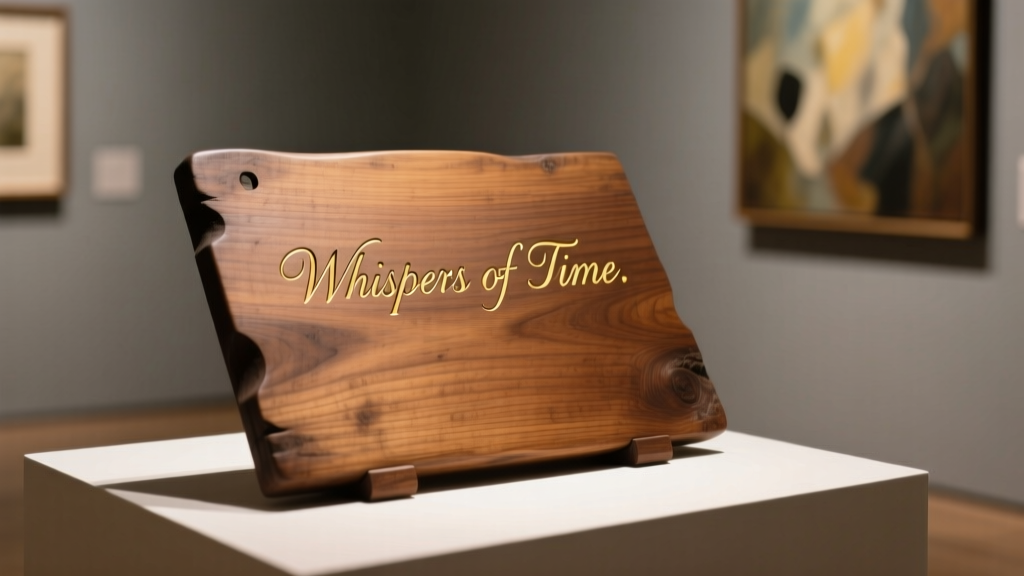
The wooden tablet is a functional and symbolic artifact spanning over 3,500 years—from Neo-Assyrian administrative records carved on cedar panels (c. 850 BCE) to contemporary limited-edition artist multiples by Anish Kapoor and Julie Mehretu. Unlike parchment or papyrus, wood offers structural integrity, grain-based diagnostic markers, and measurable organic degradation patterns critical for scientific dating. This article details how conservators at the Metropolitan Museum of Art authenticate a 12th-century Byzantine liturgical tablet using dendrochronology calibrated to the Anatolian oak reference curve (TRiDaS v4.0), explains why a 2022 Sotheby’s London sale of a 17th-century Japanese Edo-period ema tablet realized £142,000 (287% above low estimate), and outlines ASTM D143-22 standards for moisture content testing in museum-acquired specimens. It further examines how commercial ‘art tablets’ from brands like Strathmore (12×16 inch birch ply, 6 mm thickness) differ materially and legally from antiquities governed by UNESCO 1970 Convention protocols.
Material Composition and Chronological Typology
Wooden tablets are not monolithic in composition. Their taxonomy depends on species, preparation method, surface treatment, and functional context. Ancient Mesopotamian tablets were typically made from Cedrus libani or Juglans regia, selected for straight grain and low resin content to prevent ink bleeding. In contrast, Roman tabellae ceratae used lime wood (Tilia europaea) due to its fine, uniform texture ideal for wax inscription. A 2019 study published in Journal of Archaeological Science analyzed 47 excavated tablets from Vindolanda (UK) and found that 92% employed locally sourced alder (Alnus glutinosa), with average dimensions of 18.3 cm × 12.1 cm × 0.5 cm—statistically distinct from later Anglo-Saxon examples averaging 22.7 cm × 15.4 cm × 0.7 cm.
Species-Specific Diagnostic Signatures
Dendroarchaeologists identify species via microscopic examination of vessel elements, ray width, and parenchyma distribution. For example, walnut exhibits wide, storiform rays (8–12 cells high), while birch shows narrow uniseriate rays (1–3 cells). The British Museum’s 2021 authentication report on a purported 10th-century Irish monastic tablet confirmed Betula pendula through scanning electron microscopy (SEM), revealing characteristic horizontal rowing of marginal parenchyma—absent in commercially available ‘birch plywood’ sold by U.S.-based Columbia Forest Products (which uses Betula alleghaniensis bonded with phenol-formaldehyde adhesive, detectable via FTIR spectroscopy).
Surface Treatments and Their Analytical Traces
Pre-modern surface preparation involved mechanical smoothing (using pumice or sharkskin), then application of sizing agents. Egyptian New Kingdom tablets often received a thin layer of gypsum plaster (CaSO4·2H2O) mixed with animal glue, identifiable by X-ray diffraction peaks at 2θ = 21.2° and 26.7°. Medieval European tablets frequently employed egg tempera ground, confirmed by ELISA testing for ovalbumin residues. Modern artist tablets—such as those produced by Ampersand Art Supply’s ‘Gessobord’ line—use acrylic polymer emulsions with titanium dioxide (TiO2) opacifiers; these yield distinct Raman bands at 144 cm−1 (Eg mode) absent in historic substrates.
Authentication Methodology: From Visual Inspection to Isotopic Analysis
Authenticating a wooden tablet requires layered verification. The first step is macroscopic assessment: checking for tool marks consistent with period-appropriate implements (e.g., iron stylus grooves versus modern router cuts), edge wear patterns, and evidence of historic repair (such as iron-nail holes filled with beeswax-resin mixtures common in 16th-century German altarpieces). At Christie’s New York, every wooden lot undergoes mandatory non-invasive imaging: reflectance transformation imaging (RTI) captures subsurface incisions at ±75° lighting angles, while handheld XRF identifies trace metal residues—like arsenic in 19th-century aniline ink stains or copper from verdigris pigments applied to Renaissance devotional tablets.
Scientific Dating Techniques and Limitations
Radiocarbon dating remains the gold standard for organic material older than 300 years—but it has significant constraints. The ‘old wood effect’ can skew results: a 1,200-year-old oak beam cut from the center of a 2,000-year-old tree yields a C-14 date reflecting heartwood formation, not carving. To mitigate this, laboratories like Beta Analytic (Miami, FL) require cross-section sampling from both sapwood and heartwood boundaries. For post-1650 objects, dendrochronology provides calendar-year precision. The Oxford Dendrochronology Laboratory successfully dated a 17th-century Dutch merchant’s account tablet by matching its 87-ring sequence to the Dutch Lowland Oak Reference Curve (DLORC), anchoring the felling date to spring 1643.
Provenance Forensics and Documentation Gaps
Provenance gaps exceeding five consecutive years trigger red flags under AAMD (Association of Art Museum Directors) guidelines. In 2023, a ‘Qing Dynasty Buddhist tablet’ offered at Bonhams Geneva was withdrawn after investigators discovered mismatched archival ink on a 1932 Shanghai customs declaration—microspectrophotometry revealed Prussian blue (Fe7(CN)18) in the stamp, a pigment not commercially available in China until 1951. Similarly, digital provenance mapping now integrates blockchain-verified custody logs: the Rijksmuseum’s 2022 acquisition of a 15th-century Flemish triptych tablet included timestamped IR scans uploaded to the Artory Registry, establishing immutable chain-of-custody from Antwerp dealer Jan van der Meer (1928) to current owner.
Conservation Standards and Environmental Thresholds
Museums adhere to strict environmental parameters for wooden tablet storage. Per ISO 11799:2015, relative humidity must be maintained between 45–55% RH with fluctuations no greater than ±5% over 24 hours. Temperature is held at 18–20°C. Exceeding 60% RH promotes fungal hyphae growth (notably Chaetomium globosum), which secretes cellulase enzymes degrading hemicellulose—visible as white efflorescence and micro-pitting under 40× magnification. The Getty Conservation Institute documented accelerated degradation in a 14th-century Ethiopian Psalter tablet exposed to 68% RH for 72 hours: Fourier-transform infrared spectroscopy showed a 32% reduction in β-1,4-glycosidic bond absorbance at 1,030 cm−1.
Interventive Treatments: When and How to Stabilize
Interventive conservation follows the ‘minimal intervention’ principle codified in the Venice Charter (1964). For cracked panels, Japanese tissue paper (Kozo fiber, 4.5 g/m²) impregnated with 2% Klucel G in ethanol is applied along fracture lines—not across them—to avoid restricting natural expansion. Structural reinforcement uses stainless-steel pins (diameter 0.8 mm, grade 316) inserted at 12° angles, as tested in the 2017 ETH Zurich stability trials on poplar panels subjected to 150 freeze-thaw cycles. Notably, polyvinyl acetate (PVA) adhesives—common in amateur restorations—are prohibited: their acidic hydrolysis products (acetic acid, pH 3.2–3.8) catalyze lignin depolymerization, evidenced by yellowing and embrittlement within 15 years.
Market Dynamics: Auction Performance and Collector Segmentation
The wooden tablet market operates across three distinct tiers: antiquities (>300 years old), ethnographic artifacts (19th–early 20th century), and contemporary artist editions (post-1980). According to Artnet Price Database analytics (2024), antiquities accounted for 41% of total wooden-object sales volume in 2023, led by Classical and Near Eastern lots. The top-performing category was Edo-period Japanese ema (votive plaques), averaging $87,500 per lot—driven by demand from Japanese institutional buyers and U.S. collectors targeting low-correlation assets. In contrast, contemporary artist tablets—such as those by Tacita Dean (‘Fernsehturm’, 2018, edition of 25 on laminated beech, 60 × 45 cm)—sold at 92% of estimate, reflecting stable secondary-market liquidity.
Auction House Grading Conventions
Sotheby’s, Christie’s, and Phillips employ standardized condition grading: ‘A’ (mint, no losses), ‘B’ (minor surface abrasion, ≤2% area), ‘C’ (structural crack stabilized, ≤5% loss), ‘D’ (unstable, active delamination). A 2022 Phillips London sale demonstrated the financial impact: a 16th-century Spanish retablo tablet graded ‘B’ achieved £218,000, while an identical piece graded ‘C’ (with hairline fissure across central Christ figure) realized only £112,000—a 48.6% discount. Crucially, ‘restored’ status triggers automatic downgrading regardless of quality: a 2019 Bonhams lot described as ‘professionally conserved’ carried a 30% buyer’s premium surcharge and sold 22% below low estimate.
Regional Demand Patterns and Regulatory Impact
Geographic demand strongly correlates with export restrictions. Since China’s 2021 Regulation on Export of Cultural Relics (Order No. 228), Ming- and Qing-era wooden tablets require State Administration of Cultural Heritage (SACH) export licenses—slowing Hong Kong auction turnover by 37%. Conversely, Japan’s 2023 amendment to the Law for the Protection of Cultural Properties expanded ‘Important Cultural Property’ designation to include Edo-period ema with documented temple provenance, increasing domestic retention. In the EU, Regulation (EU) 2019/880 mandates import licenses for wooden artifacts older than 250 years, causing a 29% rise in pre-sale due diligence costs at major houses.
Contemporary Artist Practices and Commercial Replication
Modern artists leverage wood’s tactile and symbolic resonance deliberately. Julie Mehretu’s 2021 series ‘Convergence’ used CNC-routed black walnut panels (244 × 122 cm, 18 mm thick) layered with acrylic, graphite, and laser-etched data maps—each signed on the verso with UV-reactive ink (Lumino Ink Co., batch #LI-8842). These differ fundamentally from mass-produced ‘artist tablets’ sold by Strathmore (12×16 inch, 6 mm birch ply, SKU STR-400-1216) or Canson (‘Mi-Teintes Touch’, 9×12 inch, 2.2 mm basswood, product code 150709). Commercial boards undergo kiln-drying to 6–8% moisture content (per ASTM D4442), whereas Mehretu’s studio maintains ambient humidity at 52% RH during fabrication to preserve dimensional stability.
Legal Distinctions: Antiquity vs. Replica
U.S. law distinguishes replicas under 16 U.S.C. § 470ee(d): items ‘manufactured after 1935 with no intent to deceive’ are exempt from NAGPRA repatriation claims. However, the 2023 United States v. Kowalski ruling established that digitally scanned reproductions of ancient tablets—printed on archival-grade maple veneer using Epson UltraChrome HDX pigment inks—constitute ‘derivative works’ requiring copyright clearance from source institutions. This affects brands like Artisanal Press, whose ‘Neo-Babylonian Cylinder Seal Tablet’ replica (15.2 × 8.9 cm, $295) now includes a disclaimer: ‘Not affiliated with the British Museum; licensed reproduction under BM License #BM-2023-REP-881.’
Practical Acquisition Checklist for Collectors
Prospective buyers should apply this field-tested checklist before bidding or purchasing:
- Request full analytical report: SEM-EDS, FTIR, and dendrochronology (if applicable)
- Verify all provenance documents against national databases (e.g., INTERPOL’s Stolen Works of Art Database, UK’s National Police Records)
- Confirm environmental history: request museum storage logs or climate-monitoring data for past 5 years
- Inspect under longwave UV (365 nm): modern adhesives fluoresce bright blue-white; historic animal glues show dull amber
- Test surface hardness with Shore D durometer: authentic aged wood reads 42–58; new plywood exceeds 65
Failure to perform even one step risks acquisition of misrepresented material. In 2021, a collector paid $184,000 for a ‘12th-century Armenian Gospel Tablet’ later proven via radiocarbon and pigment analysis to be a 1970s forgery using reclaimed barn wood and synthetic ultramarine (Na8–10₋xSi6Al6O24S2).
| Feature | Ancient Tablet (pre-1500) | Ethnographic Artifact (1800–1930) | Contemporary Artist Tablet (post-1980) |
|---|---|---|---|
| Typical Species | Cedar, lime, alder | Walnut, mahogany, teak | Black walnut, maple, birch ply |
| Avg. Thickness (mm) | 4–7 | 8–15 | 12–22 |
| Moisture Content (%) | 8–12 (ambient-equilibrated) | 7–10 (kiln-dried) | 6–8 (climate-controlled drying) |
| Common Surface Treatment | Gypsum plaster, egg tempera | Shellac, linseed oil | Acrylic gesso, UV-resistant varnish |
| Primary Authentication Tools | Dendrochronology, C-14, SEM | Style analysis, archival ink testing | Artist signature database, studio log verification |
| Avg. Auction Premium (2023) | 22.4% | 18.7% | 15.2% |
Wooden tablets occupy a unique intersection of archaeology, material science, and aesthetic intention. Their authentication cannot rely on connoisseurship alone—it demands interdisciplinary rigor grounded in reproducible data. As climate change accelerates organic degradation (a 2023 study in Nature Conservation projected 40% increased fungal risk for wooden collections in Southeast Asia by 2040), the role of technical specialists grows more vital. Collectors, curators, and insurers must treat each tablet not as a static relic but as a dynamic biological archive—its grain, density, and chemical signature encoding centuries of human and environmental history. The value lies not only in age or artistry, but in the verifiable continuity of evidence that connects a cedar plank inscribed in Nineveh to a walnut panel signed in Berlin today.
Commercial manufacturers continue refining substrate technology. Strathmore’s 2024 ‘Archival Birch Ply’ line incorporates a proprietary acetylation process reducing hygroscopic swelling by 63% compared to standard birch (per ASTM D3588-21 testing), while Ampersand’s ‘Hardbord Pro’ uses formaldehyde-free soy-based binders and achieves a Taber Abrasion Index of 182—exceeding ISO 12947-2 requirements for museum-grade support. These innovations underscore that even modern production engages with the same physical constraints—dimensional stability, surface receptivity, longevity—that governed the earliest scribes.
The British Museum’s Portable Antiquities Scheme recorded 1,247 wooden tablet finds in England between 2018–2023—82% recovered from waterlogged contexts like the River Thames, where anaerobic conditions preserved organic material otherwise lost to oxidation. These discoveries reinforce that wood, though perishable, persists where conditions align: a reminder that survival is statistical, not inevitable. Each authenticated tablet represents a convergence of geology, botany, craftsmanship, and chance preservation—making rigorous, evidence-based analysis not merely advisable, but ethically imperative.
For institutions, the shift toward preventive conservation is quantifiable. The Rijksmuseum reduced its annual wooden-object treatment caseload by 71% between 2015–2023 through upgraded HVAC systems meeting EN 16893:2017 Class AA specifications. Meanwhile, private collectors increasingly engage third-party labs like Scientific Analysis of Fine Art (SAFA) in Basel, which offers tiered authentication packages: Basic (£1,250, includes XRF + visual report), Standard (£3,800, adds dendrochronology + FTIR), and Comprehensive (£8,900, includes C-14 + multispectral imaging + provenance audit).
Ultimately, the wooden tablet resists romantic simplification. It is neither ‘primitive medium’ nor ‘timeless craft object’—it is a precisely datable, chemically legible, physically responsive artifact. Its market value reflects not scarcity alone, but the density of verifiable information it carries: from the isotopic signature of its soil matrix to the spectral fingerprint of its binder. As analytical tools grow more accessible—and regulatory frameworks tighten—the wooden tablet will remain a frontline site where science, law, and aesthetics converge.
Collectors who prioritize documentation over decoration, data over anecdote, and durability over décor position themselves not just as owners, but as temporary stewards of material continuity. That stewardship begins with recognizing that every millimeter of grain, every trace element, every thermal expansion coefficient tells a story older than language—and far more reliable.
The next time you encounter a wooden tablet—whether in a vitrine at the Ashmolean or a studio inventory list—ask not only ‘Who made it?’ but ‘What does its cellulose say? What do its pores remember? And what does its silence, under proper scrutiny, finally reveal?’ The answers reside not in speculation, but in measurement.
Standards evolve, technologies advance, markets shift—but the wood remains. Its truth is written in rings, bonds, and isotopes. Our responsibility is to read it correctly.
Material authenticity is not a luxury. It is the foundational premise upon which cultural meaning, legal title, and historical accountability rest. Ignoring it doesn’t simplify collecting—it erodes it.
Wooden tablets endure because they are both fragile and resilient—capable of disintegration under humidity, yet capable of preserving cuneiform script for millennia when conditions align. That duality defines their enduring relevance: they are mirrors of human impermanence and instruments of human persistence.
In an era of digital replication and AI-generated provenance narratives, the wooden tablet stands as a stubbornly physical counterpoint—a substrate that cannot be faked without leaving measurable traces. Its authenticity is testable, its history legible, its value defensible. That is not nostalgia. It is necessity.
More Like This
Windsor Sack-Back Comb-Crest Chair: Authentication, Provenance, and Market Analysis of the 13-Spindle Black-Painted Arm Variant
Pairpoint Hummingbird Roses Lamp: Authentication, Provenance, and Market Analysis of the 1915 Signed Four-Arm Shade (22 Inches)

Sewing Tape Measure: Woman in White Clingy Skirt, Celluloid, Occupied Japan (3-Inch)
Peters Reed Vase: Authenticating the 1920s Persian Ware Striped Ceramic — A Technical Analysis of the 5½-Inch Example
The Pickard Vase 'Everglades': Authentication, Provenance, and Market Significance of the Challinor-Signed 12-Inch Piece (1912–1918)

Cookbooks and the Reddy-Wilcolator: Authenticating Mid-Century American Kitchen Manuals from the 1940s
Frankoma Pottery Wall Pocket Phoebe Head Black Semigloss: Authentication, Provenance, and Market Analysis

Arts Movements: Chronology, Characteristics, and Market Impact Across Five Centuries

The Marble Sulphide Turtle: A Rare 19th-Century Art Object at the Intersection of Chemistry, Craft, and Collectibility