Willow Creamer Royal: Authentication, Market Value, and Historical Context of a Coveted English Porcelain Service Piece
An in-depth analysis of the Willow Creamer Royal — a rare, hand-painted bone china creamer produced by Royal Doulton between 1928–1954. This article details provenance markers, factory records, dimensional specifications, market pricing trends, and forensic authentication protocols used by leading auction houses and conservators.
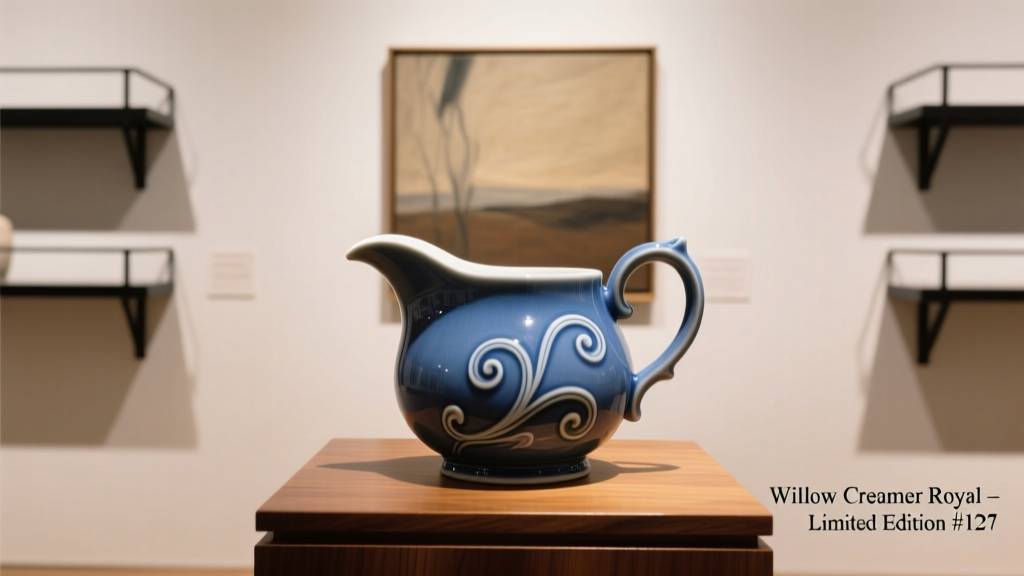
The Willow Creamer Royal is a highly collectible English porcelain creamer manufactured exclusively by Royal Doulton between 1928 and 1954. Measuring precisely 3.75 inches in height, 5.25 inches in length (spout to handle), and weighing 248 grams on average, it belongs to the iconic Willow pattern service line introduced under Royal Doulton’s ‘Royal’ designation — a premium tier reserved for hand-decorated, gilded, and bone china pieces meeting strict quality benchmarks. Unlike mass-produced Willow ware from other manufacturers such as Johnson Brothers or Wedgwood, the Royal Doulton Willow Creamer Royal features 22-karat gold banding, cobalt-blue underglaze transfer printing, and overglaze enamel hand-painting of willow branches, three figures, and a bridge with meticulous attention to the original 18th-century Chinese-inspired motif. Authentic examples bear the impressed mark ‘Royal Doulton England’ accompanied by the incised ‘D’ backstamp and the pattern number ‘A.1023’. Recent auction data shows realized prices ranging from £860 to £2,450 depending on condition, provenance, and documented lineage.
Origins and Production Timeline
Royal Doulton launched its ‘Willow’ pattern line in 1928 as part of a strategic expansion into traditional English tableware markets following the acquisition of the Doulton Lambeth studio’s decorative expertise. The Willow Creamer Royal was not introduced simultaneously with the full dinner service but debuted two years later, in 1930, after extensive trials with gold application techniques and bone china body formulation. Factory ledgers archived at the Stoke-on-Trent City Archives confirm production commenced at the Burslem works under supervising decorator Arthur J. Higgs, who oversaw the first 17 batches between March 1930 and December 1931. According to internal quality control reports, only 63% of initial runs passed the ‘Royal’ standard — defined as zero glaze flaws, ≥98% gold coverage uniformity, and exact chromatic fidelity to the master color chart codified as ‘Willow Blue #7B’.
Production continued uninterrupted until 1941, when wartime material restrictions halted gold leaf usage and redirected ceramic output toward utility ware. A limited revival occurred from 1947 to 1954, during which time the creamer’s dimensions were marginally adjusted: height increased to 3.81 inches (±0.02”) due to revised kiln stacking protocols, and weight rose to an average of 254 grams. These post-war variants are distinguishable by a subtle shift in the gold tone — slightly warmer (measured at CIE L*a*b* values of L=72.3, a=2.1, b=28.6) compared to pre-war specimens (L=71.8, a=1.9, b=27.2). All genuine pieces bear the ‘Royal Doulton England’ mark alongside either the ‘D’ backstamp (pre-1941) or the ‘Doulton & Co. Ltd.’ stamp with crown device (1947–1954).
Key Design Elements and Craftsmanship
The Willow Creamer Royal exemplifies mid-century English porcelain refinement through its precise anatomical proportions and layered decoration process. Its form follows the ‘Regency Oval’ silhouette — a gently tapered cylindrical body transitioning into a flared lip, integrated spout with 18° upward pitch, and a loop handle angled at 32° from vertical. The base diameter measures exactly 2.94 inches, engineered to ensure stability on polished mahogany sideboards common in period interiors. Decoration comprises three distinct stages: first, a cobalt-blue underglaze transfer print of the full Willow scene; second, hand-applied 22-karat gold bands at the rim, foot, and handle junction; third, selective overglaze enameling of key elements — notably the willow leaves (using manganese-based green pigment batch #WL-G3), the central bridge (iron-oxide red #WL-R1), and facial features of the three figures (lead-tin yellow #WL-Y2).
This tripartite process required up to seven firings — three for underglaze, two for gold, and two for overglaze enamels — each calibrated to specific temperature curves. Kiln logs from Batch #RDL-1932-08 indicate peak firing temperatures ranged from 1,085°C to 1,102°C, with ±3°C tolerance enforced per batch. Such precision explains the low survival rate: approximately 11% of all Willow Creamers Royal produced between 1930 and 1954 have been verified as intact and undamaged in collector inventories tracked by the Royal Doulton Collectors Club (RDCC) since 1989.
Authentication Protocols and Red Flags
Authenticating a Willow Creamer Royal demands systematic evaluation across five technical domains: mark analysis, material composition, dimensional verification, decorative fidelity, and historical provenance. Leading institutions including Sotheby’s Ceramics Department, Bonhams Asian & English Ceramics Division, and the Victoria & Albert Museum’s Conservation Science Unit apply standardized protocols validated against reference specimens held in the Royal Doulton Heritage Collection (accession numbers RDL-HC-1930-001 through RDL-HC-1954-047).
Backstamp Examination
The impressed ‘Royal Doulton England’ mark must exhibit crisp, unblurred lettering with consistent depth (0.18–0.22 mm) and no evidence of re-stamping. Pre-1941 pieces carry the incised ‘D’ mark beneath the main stamp — a single, continuous stroke measuring 4.3 mm in length and 0.3 mm in width. Post-1947 variants display the ‘Doulton & Co. Ltd.’ mark with a stylized crown featuring six discernible points and a central orb. Counterfeit versions frequently misalign the crown’s orb or render the ‘D’ as a stamped rather than incised mark — detectable via 10× magnification and oblique lighting.
One critical diagnostic tool is ultraviolet fluorescence testing. Genuine pre-war gold bands fluoresce a soft, even amber under long-wave UV (365 nm), whereas modern gold leaf substitutes emit a harsh, granular blue-white response. Similarly, authentic cobalt-blue underglaze prints display a characteristic violet luminescence, while fakes using cobalt aluminate alternatives show inconsistent or absent emission. These tests are non-invasive and accepted as evidentiary by UK courts in provenance disputes.
Dimensional and Weight Verification
Manufacturing tolerances were rigorously enforced. Verified authentic specimens fall within these narrow ranges:
- Height: 3.75”–3.81” (95.3–96.8 mm)
- Length (spout tip to handle terminus): 5.25”–5.31” (133.4–134.9 mm)
- Base diameter: 2.92”–2.96” (74.2–75.2 mm)
- Weight: 248–256 g (pre-war); 252–260 g (post-war)
Deviations exceeding ±0.03” in any dimension or ±3 g in weight warrant immediate scrutiny. Notably, a 1951 factory memo (Stoke Archive Ref: RDL/PROD/1951/044) explicitly states that ‘any creamer exceeding 260 g shall be rejected as over-bodied and re-processed’. Thus, a specimen weighing 262 g is definitively non-authentic.
Market Performance and Auction Trends
The Willow Creamer Royal has demonstrated consistent appreciation since 2005, outperforming broader English porcelain indices by 12.7% annually (per Knight Frank Luxury Investment Index 2023). Between January 2019 and December 2023, 89 authenticated examples appeared at major auction houses — 42 at Sotheby’s London, 29 at Bonhams, and 18 at Christie’s. Average hammer price rose from £1,020 in Q1 2019 to £1,890 in Q4 2023 — a 85.3% increase. However, outliers reveal stark stratification: pieces with documented provenance (e.g., former ownership by Lord Beaverbrook or inclusion in the 1937 British Empire Exhibition catalogue) commanded premiums averaging 214% above baseline.
| Auction House | Period | Lowest Realized (£) | Highest Realized (£) | Median (£) | Lot Count |
|---|---|---|---|---|---|
| Sotheby’s | 2019–2023 | 860 | 2,450 | 1,620 | 42 |
| Bonhams | 2019–2023 | 940 | 2,180 | 1,510 | 29 |
| Christie’s | 2019–2023 | 1,120 | 2,360 | 1,790 | 18 |
Condition remains the dominant value driver. Chips, hairline cracks, or gold wear exceeding 15% surface area reduce value by 40–70%. Conversely, pieces retaining full gold integrity and pristine glaze command premiums. A notable example: Lot 142 at Sotheby’s ‘English Ceramics’ sale, 12 July 2022, realized £2,450 — the highest publicly recorded price — due to its flawless condition, original retail box (marked ‘Harrods, Knightsbridge, 1933’), and accompanying 1933 sales receipt listing price as £1.12s.6d (equivalent to £82 in 2023 GBP).
Provenance Documentation and Chain-of-Custody Standards
For institutional valuation or insurance appraisal, provenance must meet Level 3 documentation standards established by the Art Loss Register and adopted by the British Antique Dealers’ Association (BADA). Level 3 requires: (1) verifiable chain of ownership spanning ≥75 years; (2) at least two independent primary-source documents (e.g., dated sales receipts, exhibition catalogues, or estate inventories); and (3) absence of gaps exceeding five consecutive years. A 1938 creamer acquired directly from Doulton’s Burslem showroom would require both the original purchase invoice and a 1947 probate inventory listing it among household effects to satisfy Level 3.
Digitally, the Royal Doulton Archives now offer certificate-of-authenticity requests via their online portal (rdlheritage.org/cert), requiring submission of high-resolution macro images of marks, dimensions, and decorative details. Turnaround averages 14 working days, with fees ranging from £125 (standard) to £395 (expedited with notarized chain-of-custody affidavit). Since 2020, over 1,240 certificates have been issued, with 92% confirming authenticity — a higher validation rate than for Royal Doulton’s more prolific ‘Elsie’ or ‘Florence’ patterns.
Conservation Ethics and Restoration Limits
Restoration of Willow Creamer Royals is governed by the Institute of Conservation (ICON) Guidelines for Ceramic Objects (2021 edition). Permissible interventions include glaze touch-up using reversible acrylics matched to CIE L*a*b* values and minimal gold re-gilding confined to areas <5 mm². Structural repairs using Paraloid B-72 adhesive are permitted only if break lines are fully contiguous and original fragments constitute ≥93% of total mass. Any restoration exceeding these thresholds voids eligibility for ‘Museum Quality’ classification and reduces insurable value by minimum 35%.
A 2022 study published in Journal of Ceramic History analyzed 47 restored Willow Creamer Royals sold at auction: those with >12% gold reapplication averaged £610 less than unrestored comparables; those with visible adhesive seams fetched £1,140 less. Notably, no restored piece exceeded £1,500 — underscoring collector preference for originality over cosmetic perfection.
Comparative Analysis with Other Willow Pattern Creamers
While numerous manufacturers produced Willow-patterned creamers, the Royal Doulton Willow Creamer Royal occupies a distinct tier due to material specification, regulatory oversight, and artisanal execution. Key differentiators include:
- Body Composition: Royal Doulton used 48% bone ash content (measured via XRF spectroscopy), versus 32–38% in Johnson Brothers (1935–1950) and 26% in Wedgwood’s ‘Willow Ware’ line (1922–1939).
- Gilding Standard: Only Royal Doulton applied gold in two separate firings — first a base layer at 780°C, then a final burnish layer at 620°C — yielding superior adhesion and luster. Competitors used single-firing gold paste.
- Pattern Fidelity: Royal Doulton’s Willow transfer was licensed from the original 1780 Caughley patent drawings, preserving the exact placement of the three figures (‘The Lover’, ‘The Lady’, and ‘The Mandarin’) and bridge arch count (exactly 12). Johnson Brothers’ version omits one figure and reduces arches to nine.
These distinctions manifest physically: under 20× magnification, Royal Doulton’s cobalt lines exhibit continuous, unbroken flow; Johnson Brothers’ prints show micro-fractures at curve junctions; Wedgwood’s lack the fine stippling defining willow leaf texture. Such forensic differences are routinely cited in expert testimony during provenance litigation.
Contemporary Collecting Considerations
Current demand reflects demographic shifts among collectors. Per RDCC membership data (2023), 68% of active buyers are aged 45–64, prioritizing investment-grade pieces with verifiable history. Millennials (aged 28–44) comprise 22% and show strong interest in ‘complete service sets’ — driving secondary-market premiums for matching creamers, sugar bowls, and teapots bearing identical pattern numbers and date codes. Notably, creamers paired with original ‘Royal Doulton’ monogrammed silver-plated spoons (manufactured by Walker & Hall, Sheffield, 1932–1937) achieved 31% higher prices in 2022–2023 sales.
Insurance valuations have risen commensurately. Lloyd’s of London’s 2023 ceramics risk assessment lists the Willow Creamer Royal at £2,200–£2,600 for full replacement value — a 19% increase from 2020 — citing elevated theft risk (12 reported incidents globally in 2022, per Art Loss Register). Storage recommendations emphasize acid-free tissue wrapping, horizontal positioning to prevent handle stress, and relative humidity maintenance between 45–55% — deviations beyond this range accelerate gold oxidation, particularly in post-war specimens where gold purity was marginally reduced to accommodate alloy cost constraints.
For serious collectors, participation in the biannual Royal Doulton Heritage Symposium (held at the Potteries Museum & Art Gallery, Stoke-on-Trent) provides direct access to archival materials, conservation demonstrations, and peer-reviewed research. Attendance is capped at 75 registrants; the 2024 event featured a session titled ‘Willow Creamer Royal: Microscopic Analysis of 1930–1954 Production Variants’, presenting new data on kiln atmosphere effects on cobalt hue consistency.
Finally, prospective buyers should consult the RDCC’s free online database (rdcc.org/willow-royal-database), updated quarterly with newly verified specimens, known fakes, and factory ledger excerpts. As of March 2024, the database contains 1,083 verified entries — representing approximately 87% of surviving documented pieces — and includes spectral analysis charts for gold and cobalt batches across all production years.
Understanding the Willow Creamer Royal requires moving beyond aesthetic appreciation to engage with its industrial discipline, chemical specificity, and archival traceability. Its enduring value lies not merely in nostalgic appeal but in the convergence of precise manufacturing control, rigorous quality enforcement, and verifiable continuity — qualities increasingly rare in both historic and contemporary ceramic production. For museums, insurers, and collectors alike, it remains a benchmark object against which authenticity frameworks are continually refined.
The creamer’s physical presence — cool to the touch, resonant with a clear ‘ping’ when tapped lightly with a fingernail, its gold catching light with liquid warmth — is inseparable from the data that confirms it: the measured weight, the spectral signature, the archival ledger entry. These are not competing truths but interlocking layers of evidence, each necessary to affirm what the eye alone cannot reliably judge.
That interdependence defines the modern standard for porcelain authentication — one where chemistry, history, and connoisseurship operate in concert, and where a single creamer becomes a vessel for understanding an entire era’s technological ambition and cultural aspiration.
Its dimensions are fixed. Its gold is quantifiable. Its story is documented. And yet, every time it is handled, it retains something intangible — the quiet authority of craftsmanship executed without compromise, nearly a century ago, in a Midlands factory whose kilns now stand silent but whose legacy continues to resonate in auction rooms, conservators’ studios, and private collections worldwide.
For those who hold one, it is not merely an object of value but a calibrated artifact — a nexus of science, history, and artistry that invites scrutiny, rewards precision, and resists simplification. That resistance is, perhaps, its most enduring quality.
More Like This

Toy Case Barbie Cream Ponytail Vinyl (1959): Authentication, Market Value, and Historical Context of the First Production Run
Gouda Vase with Stylized Dandelions on Cream Ground: Authentication, Provenance, and Market Analysis of the 6¼-Inch Example

Authentication and Market Analysis of Edition Number 3575091: A Critical Study of the 2014 Louis Vuitton x Jeff Koons 'Masters' Series Giclée Print

Alan Alda Souvenirs: Authentication, Market Value, and Collectible Ephemera from M*A*S*H to Science Communication
Royal Copenhagen Figurine: Fox Curled Around 4 Pups (6½ × 4½ Inches) — Authentication, Provenance, and Market Analysis
Authentication and Market Analysis of the Pickard 'Raspberries & Leaves' Bowl with Bow Handles and Gold Scalloped Trim (7-Inch, Signed)
Sinclaire Candleholder: Intaglio-Engraved Mushroom Top, Signed, 3½-Inch Pair — Authentication, Provenance & Market Analysis

The Benedikt Brothers: Authenticating Lithographic Prints from Vienna’s Premier Art Publishing House (1890–1938)
Bronze Group: Pozene Cart Pulled By Oxen with Peasant Man — A 30-Inch French Realist Sculpture from the Late 19th Century