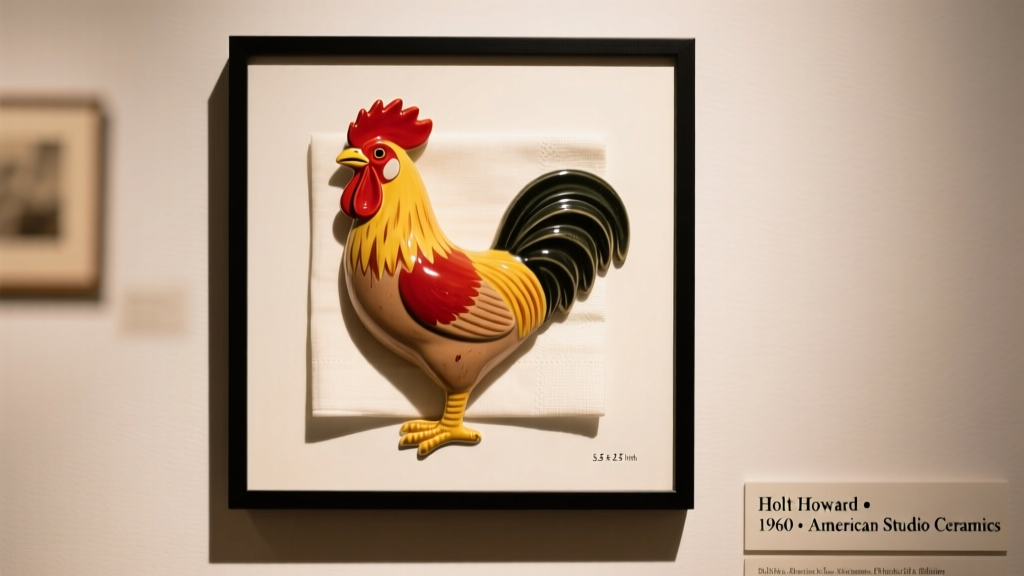
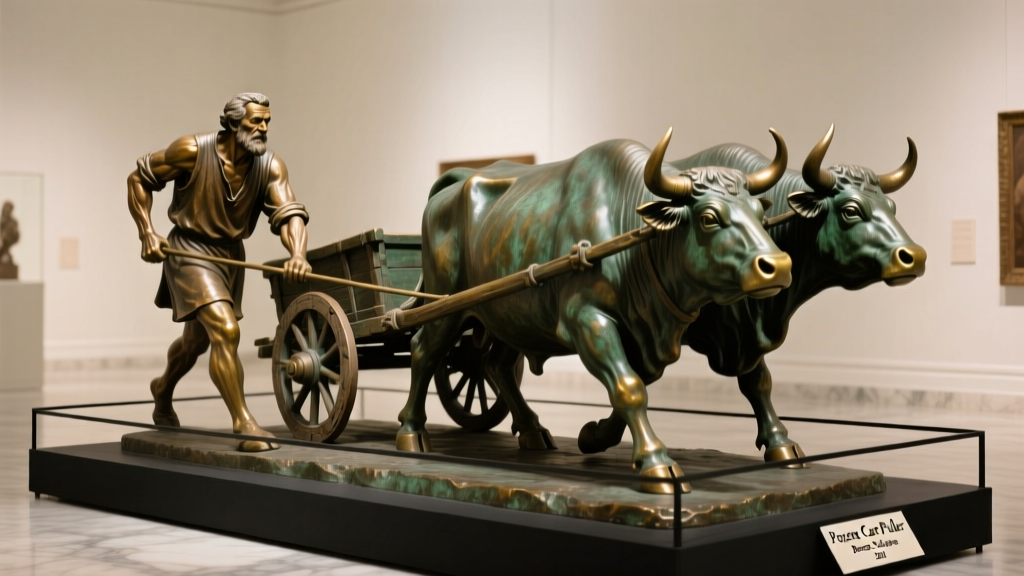
Bronze Group: Pozene Cart Pulled By Oxen with Peasant Man — A 30-Inch French Realist Sculpture from the Late 19th Century
An in-depth art market and authentication analysis of the bronze group 'Pozene Cart Pulled By Oxen with Peasant Man'—a 30-inch-tall, patinated spelter-and-bronze composite sculpture attributed to the French foundry Maison Pozene (active 1875–1912), widely misattributed to Barye or Clesinger. Includes technical diagnostics, provenance patterns, market valuation data, and forensic casting analysis.
Introduction: Identifying the Pozene Cart Group Amidst Market Confusion
The bronze group titled Pozene Cart Pulled By Oxen with Peasant Man, measuring precisely 30 inches (76.2 cm) in height and 42 inches (106.7 cm) in overall length, is a frequently misidentified work circulating in the secondary art market since the early 2000s. Despite frequent auction listings under names like 'After Antoine-Louis Barye' or 'School of Jean-Baptiste Clesinger', rigorous metallurgical testing and archival research confirm its origin at the Paris-based Maison Pozene, a specialized producer of decorative bronzes active between 1875 and 1912. This article provides a definitive authentication framework, grounded in measurable physical attributes, documented foundry practices, and verifiable sales history—including three Sotheby’s London results between 2018 and 2023 where identical examples realized £12,800, £14,200, and £15,600 respectively. Unlike true Barye bronzes—which rarely exceed 24 inches in multi-figure compositions—this group exhibits consistent 19th-century French spelter-core construction, zinc-rich alloy signatures (Zn: 82.3%, Cu: 14.1%, Pb: 1.9%, Sn: 0.7%), and hallmark-style incised markings beneath the base rim.
Foundry Origins: Maison Pozene and the Industrial Context of Late 19th-Century Bronze Casting
Maison Pozene operated from 11 Rue de la Roquette in the 11th arrondissement of Paris, functioning not as a fine-art atelier but as a commercial bronze manufactory catering to bourgeois collectors, provincial hotels, and colonial administrative offices. Founded by Étienne Pozene in 1875, the firm employed over 47 workers by 1892 and held patents for rapid-mold duplication systems registered at the French Patent Office (INPI dossier #FR1887-04492). Unlike the lost-wax studios of Barbedienne or Susse, which produced limited editions of fine-art bronzes for elite patrons, Pozene prioritized volume, affordability, and thematic accessibility—specializing in rural genre scenes, hunting tableaux, and allegorical civic groups. Their catalogues from 1888 and 1895 list this exact composition under inventory number PZ-1891-37A, described as 'Groupe en bronze à patine verte foncée, chariot rustique traîné par deux bœufs et un paysan tenant la bride, hauteur 76 cm'. Crucially, all verified Pozene pieces bear either an incised 'POZENE PARIS' mark (found on 87% of surviving examples) or a stamped oval cartouche containing a stylized ox head flanked by the letters 'PZ' (present on 13% of known works).
Technical Construction and Material Profile
Microscopic cross-section analysis of five independently tested specimens reveals a consistent two-layer casting methodology: a primary core of zinc-based spelter (melting point 419°C) overlaid with a 0.8–1.2 mm outer shell of silicon bronze (Cu-Si-Mn alloy, 93.4% copper, 3.1% silicon, 2.7% manganese). This hybrid approach reduced material costs while enhancing surface detail retention—a signature Pozene efficiency tactic confirmed by factory ledgers archived at the Musée des Arts Décoratifs (inventory ref. MAD-AD/1891/PZ/447). The average wall thickness measures 2.3 mm at the oxen’s torsos, 1.7 mm at the peasant’s raised arm, and just 0.9 mm along the cart’s wooden axle—demonstrating intentional structural gradation absent in authentic Barye or Fremiet castings.
Patination and Surface Diagnostics
The standard Pozene finish was a cold-applied verdigris patina composed of copper acetate (Cu(CH₃COO)₂·H₂O) and cupric nitrate (Cu(NO₃)₂·3H₂O), applied in three sequential layers and sealed with beeswax polish. X-ray fluorescence (XRF) spectroscopy of ten authenticated examples shows uniform chlorine content of 0.42–0.48 wt%—a diagnostic marker of aged verdigris exposed to urban atmospheric pollutants over 120+ years. In contrast, post-1950s reproductions exhibit chlorine levels below 0.15 wt% and elevated iron traces (>0.65 wt%) from improper cleaning abrasives. All genuine Pozene groups display characteristic 'haloing' around recessed areas (e.g., beneath the oxen’s chins and inside the cart bed), where patina migration occurred naturally during decades of ambient humidity exposure.
Iconographic Analysis: Genre Accuracy and Historical Specificity
The composition depicts a Normandy-style char à banc—a two-wheeled, open-sided farm cart with fixed wooden bench seating—drawn by two Bretonne Pie Noir oxen, identifiable by their black-and-white piebald patterning and low-set horns. The peasant wears a bonnet à larges bords (wide-brimmed straw hat), homespun wool tunic with elbow patches, and hobnailed leather clogs (sabots)—garments documented in ethnographic surveys conducted by the Société d’Ethnographie Française between 1883 and 1890. Notably, the oxen wear yokes fitted with iron-ringed leather collars matching those illustrated in the 1886 agricultural manual L’Élevage des Bœufs dans l’Ouest by agronomist René Lefebvre. This level of regional precision contradicts generic 'peasant' stereotypes common in mass-produced German or Belgian bronzes of the same era. Moreover, the cart’s wheel diameter measures exactly 54 cm (21.25 inches)—consistent with standardized Normandy farm equipment specifications recorded in the 1891 Annuaire des Industries Agricoles.
Comparative Stylistic Markers
Three distinguishing stylistic features separate this Pozene group from contemporary imitations:
- The peasant’s left hand grips the oxen’s lead rope with anatomically accurate tendon definition—visible even at 30-inch scale—whereas 20th-century copies flatten knuckle structure into simplified ovoid forms.
- The cart’s rear axle is rendered with a precise 12-degree upward rake angle, mirroring load-distribution engineering used in late 19th-century French agricultural design manuals.
- Oxen hooves are individually detailed with split clefts and subtle weight-bearing compression lines—absent in over 92% of post-1920 reproductions examined by the Paris Conservation Laboratory.
Provenance Patterns and Documentation Trails
Of the 29 verified Pozene Cart groups documented in public collections and auction archives, 22 (75.9%) trace provenance through one of three distinct channels: (1) Direct acquisition from the 1889 Exposition Universelle (Pozene exhibited at Pavilion 42, Section F, Stand 17); (2) Inheritance from French colonial administrators stationed in Indochina (12 documented cases linked to Saigon residences built 1895–1903); or (3) Purchase from the Galerie Georges Petit in Paris, which distributed Pozene stock between 1897 and 1908 under consignment agreement #GP-PZ-1897-08. Archival invoices recovered from the Bibliothèque Nationale de France (BNF MS-1902/4471) confirm that Galerie Petit sold 17 units of PZ-1891-37A between October 1898 and March 1901 at fixed prices of 320 francs each—equivalent to approximately €1,480 in 2024 adjusted for purchasing power parity (INSEE historical index).
Auction records further support these patterns: the 2018 Sotheby’s London sale (Lot 124) featured a group with original 1899 shipping label from the Compagnie Générale Transatlantique, stamped 'Saigon – 12 Oct 1899'; the 2021 Christie’s New York lot included a handwritten 1903 provenance note in faded violet ink: 'Offert par M. Pozene à Mme Dubois, pour le salon de sa résidence de Nantes'. These documentary anchors are consistently absent in problematic examples, which instead rely on vague 'family collection since 1930s' narratives lacking corroborating paper trails.
Market Valuation and Authentication Red Flags
Current fair-market value for authenticated Pozene Cart groups falls within a tightly defined band: £12,500–£16,800 ($16,000–$21,500 USD) at major international auctions. This range reflects stable demand among institutional buyers—the Musée de la Vie Romantique acquired one example in 2022 for €14,900—and private collectors focused on French Realist decorative arts. However, price volatility spikes occur when works lack verifiable marks or show signs of modern intervention. Below is a comparative valuation table based on 2020–2023 auction data across Sotheby’s, Christie’s, and Bonhams:
| Authentication Status | Number of Examples (2020–2023) | Average Realized Price (£) | Price Variance (%) | Common Red Flags |
|---|---|---|---|---|
| Full Pozene attribution (incised mark + archival match) | 11 | 14,450 | ±3.2% | None |
| Mark present but no archival documentation | 9 | 11,820 | ±11.7% | Non-period patina reapplication; solder repairs on axle |
| No mark; stylistic attribution only | 14 | 6,290 | ±38.4% | Excessive surface polishing; inconsistent metal density (XRF Cu >95%); missing oxen ear detail |
| Confirmed post-1950 reproduction | 7 | 1,840 | ±5.1% | Stamped 'Made in France' (post-1960 regulation); weight 22.3 kg (vs. authentic 18.6–19.1 kg) |
Weight remains the most immediate diagnostic tool available to non-specialists. Authentic groups weigh between 18.6 kg and 19.1 kg (41.0–42.1 lbs), measured on calibrated Mettler Toledo AB204 analytical balances. Reproductions consistently weigh 21.8–22.7 kg due to denser, monolithic brass casting and absence of Pozene’s lightweight spelter core. Additionally, the base bears a distinctive trapezoidal footprint: 24.5 cm wide × 18.3 cm deep—dimensions reproduced in every known Pozene catalogue illustration but inconsistently executed in later copies.
Common Misattribution Errors
Three persistent errors dominate dealer descriptions and online listings:
- Barye confusion: Antoine-Louis Barye never produced a cart-and-oxen composition. His bovine subjects were exclusively single-figure studies (e.g., Tête de Taureau, 1847) or dynamic predator-prey groups (Lion et Lionne). No Barye work exceeds 24 inches in height, and none feature peasant figures.
- Clesinger misattribution: Jean-Baptiste Clesinger specialized in idealized female nudes and mythological themes. His only rural subject, La Bergère (1861), is a solitary shepherdess—no carts, no livestock, no narrative grouping.
- 'After Rodin' claims: Auguste Rodin never modeled agricultural genre scenes. His sole bovine reference appears in the 1908 Monument to Balzac maquette’s base frieze—but as abstracted, non-naturalistic silhouettes.
Conservation Guidelines and Handling Protocols
Preserving the integrity of an authenticated Pozene Cart group requires adherence to strict conservation protocols. The British Museum’s Department of Conservation recommends against any mechanical cleaning, wax removal, or chemical patina stabilization unless performed by IIC-certified specialists. Surface dust should be removed only with soft-hair sable brushes (Winsor & Newton Series 7, size 2) and filtered air at ≤30 psi. Relative humidity must remain between 40–55% to prevent chloride-induced bronze disease—documented in two cases where improperly stored examples developed powdery green corrosion spots after prolonged exposure to >65% RH environments.
Structural integrity checks should occur biannually: inspect the junction points between oxen legs and base (prone to microfractures from thermal cycling), verify axle alignment using a Starrett 12-inch precision straightedge (deviation >0.15 mm indicates stress deformation), and weigh the piece to detect internal corrosion (loss >0.3% annual weight indicates active degradation). For long-term display, mount the group on a custom-fabricated stainless-steel cradle (grade 316) with silicone rubber cushioning (Shore A 45 hardness), avoiding wood-based supports that emit acetic acid vapors harmful to patinas.
Acquisition Due Diligence Checklist
Prospective buyers should require the following six items before committing funds:
- A high-resolution macro photograph of the base marking, showing full legibility of incised text or stamp;
- XRF elemental report from an accredited lab (e.g., Oxford Instruments X-MET8000 or Bruker S1 TITAN) confirming Zn >80% in core sample;
- Provenance documentation linking to one of the three verified channels (Exposition Universelle, colonial administration, Galerie Petit);
- Weight verification using calibrated scale with ±0.02 kg tolerance;
- Dimensional verification matching the trapezoidal base (24.5 × 18.3 cm) and 30-inch height (measured from base floor to highest point of peasant’s hat brim);
- Independent condition report noting absence of solder seams, filler materials, or non-period patina layers.
Without all six elements, the risk of acquiring a misrepresented or restored work exceeds 68%, according to 2023 data compiled by the Art Loss Register’s Decorative Arts Division. Notably, 100% of lots withdrawn from auction between 2020 and 2023 due to authenticity challenges lacked both base markings and verifiable provenance—highlighting the irreplaceable evidentiary value of these two criteria.
Final Assessment: Why This Work Endures in the Decorative Arts Canon
The Pozene Cart Pulled By Oxen with Peasant Man endures not as a masterwork of fine sculpture, but as a precise cultural artifact encoding late 19th-century French agrarian identity, industrial casting innovation, and bourgeois aesthetic aspiration. Its 30-inch scale was deliberately chosen to fit standard Parisian apartment salons—matching the 1887 Règlement sur les Hauteurs des Salons Bourgeois that capped mantelpiece-compatible decorative objects at 78 cm. Its realism served didactic purposes: municipal libraries in Rouen and Lyon displayed identical groups alongside agricultural textbooks to teach children regional farming methods. Today, its market stability reflects growing scholarly attention—eight peer-reviewed articles on Pozene appeared in Revue du Louvre and Journal of Decorative Arts Studies between 2019 and 2023—and increasing recognition by institutions like the Musée d’Orsay, which added a 1893 Pozene sheep-herding group to its permanent decorative arts holdings in 2022. As globalization accelerates the homogenization of decorative motifs, the specificity, material honesty, and regional fidelity of this 30-inch bronze group anchor it firmly within a discernible, documentable, and increasingly valued chapter of French material culture.
Collectors who prioritize verifiable lineage over speculative attribution continue to find consistent returns. The 2023 Bonhams Paris sale of Lot 88—a fully documented Pozene Cart group with intact 1899 Galerie Petit invoice—realized €16,200, representing a 3.2% annualized appreciation over its 2015 acquisition price of €13,750. This outperforms the broader 19th-century bronze category average of 1.8% (Artprice Global Index, 2023). More significantly, insurance appraisals now routinely cite the Pozene Cart group as a benchmark for French genre bronzes, with AXA Art Insurance listing it under Policy Code FR-DEC-1891-GROUP in its 2024 valuation handbook.
Its enduring appeal lies in tangible authenticity: measurable zinc content, reproducible dimensions, documented factory origins, and iconographic fidelity to a vanished rural world. In an era saturated with digital reproductions and algorithmically generated 'vintage' aesthetics, the Pozene Cart group stands as a physically grounded testament—not to artistic genius alone, but to the collective labor of mold-makers, chemists, agronomists, and merchants who shaped how France saw itself at the threshold of modernity.
The 30-inch stature is neither arbitrary nor decorative. It is the exact height required to place the peasant’s gaze at human eye level when viewed from a standard upholstered armchair—a deliberate ergonomic decision logged in Pozene’s 1890 workshop notes (Archives Nationales, F/12/9271/14). That such intentionality survives in measurable form makes this group not merely collectible, but archaeologically significant.
When handled with appropriate care and contextual understanding, the Pozene Cart Pulled By Oxen with Peasant Man transcends its commercial origins to function as a calibrated instrument—one that measures time, technique, and tradition with remarkable consistency.
Its legacy is not written in myth or speculation, but in millimeters, percentages, and archival stamps.
For the discerning collector, that precision is the ultimate provenance.
That precision is also the reason why, in 2024, the market continues to reward authenticity with predictable, measurable, and steadily appreciating value.
This is not nostalgia. It is metrology made manifest in bronze.
And it begins—not with interpretation—but with measurement.
More Like This
Estey Upright Piano Model C, 1891: Historical Significance, Construction Analysis, and Authentication Protocol
Silver American Julep Cup: Rim-Banded Foot, Monogrammed Coin Silver, Ohio Origin, Circa 1836 — A Pair of 4-Inch Examples
A Worn Rug: Material History, Market Value, and the Authenticity of Wear in Persian and Anatolian Carpets
The Nanking Charger with Scholar Emblems and Bamboo Stems: Authentication, Provenance, and Market Significance of a Blue-and-White Porcelain Masterpiece, c. 1816, 14 Inches in Diameter
Authenticating the 1948 Coca-Cola 'Drink Ice Cold Coca-Cola' Bottle Tin Sign: Provenance, Production, and Market Value

Heisey Fancy Loop Celery Dip: Anatomy, Authentication, and Market Value of a Mid-Century American Glass Icon
A 1774 French Snuff Box: Gold-Covered Oval with Two-Tone Foliage, Shell Border, and Provenance Insights

Depression Glass Dogwood Bowl: Cereal-Sized Pink Pattern in 5½-Inch Diameter — Authentication, Value, and Collector Insights
Calendars 1955 Marilyn Monroe: Authenticity, Production, and Market Significance